Mushrooms and Gut Health
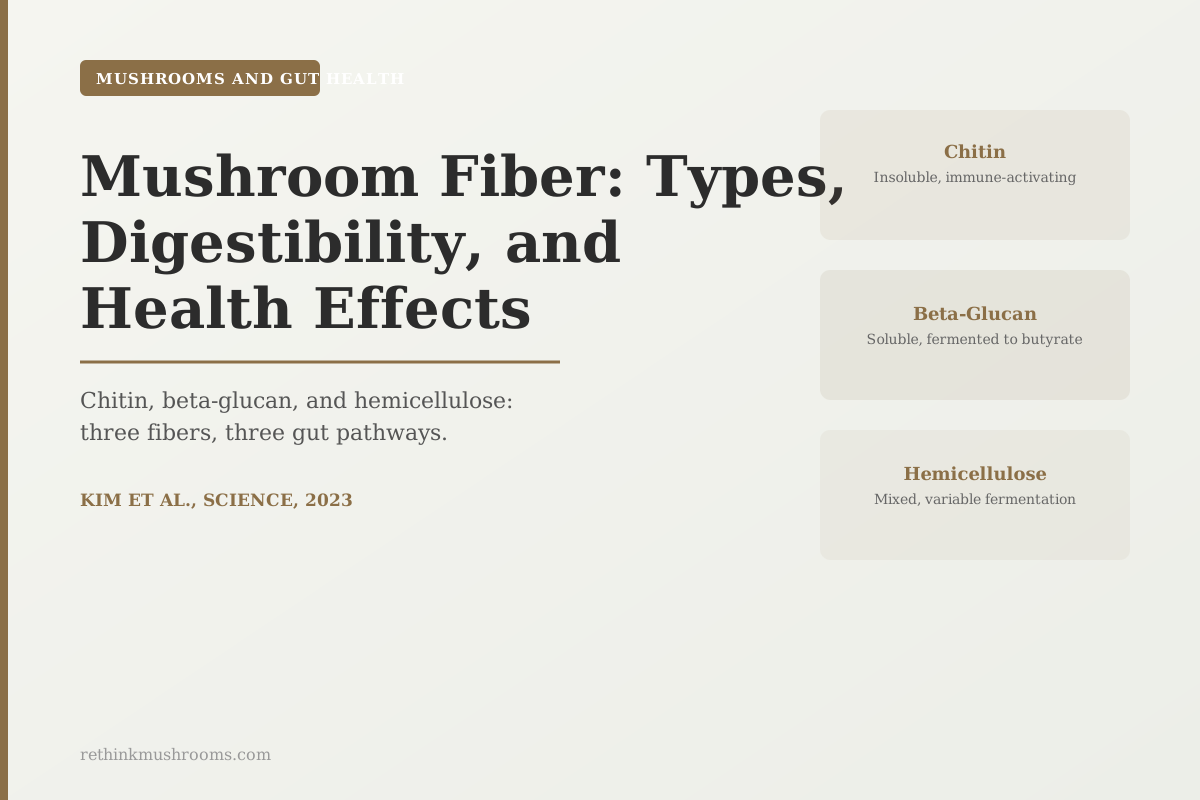
3 types of dietary fiber in mushrooms, each acting differently in the gut
Most mushroom content only mentions beta-glucan. But mushrooms contain three distinct fiber types (chitin, beta-glucan, and hemicellulose) that act on different gut segments and different microbial populations. A 2023 Science paper found chitin actively improves digestion rather than simply passing through.
Kim et al., Science, 2023
Science 2023
Kim et al. found chitin activates a type 2 immune circuit in the stomach, improving gastric digestion and insulin sensitivity in animal models
Butyrate + propionate
SCFAs produced when beta-glucan is fermented by Bifidobacterium in the colon; these are the primary downstream gut health effects
8% → 2.7%
chitin concentration in portabella mushrooms: raw vs. cooked; why cooking matters for nutrient release
Kim et al., Science, 2023
 View as image ↗
The conversation about mushroom nutrition tends to start and end with beta-glucan. Beta-glucan gets the research attention, the supplement marketing, and most of the consumer content. But mushrooms contain multiple distinct fiber types, and each one interacts with the digestive system and gut microbiome in a different way. The question of how mushroom fiber affects health is not a single question with a single answer. It depends on which fiber type, which part of the gut, which bacteria, and which endpoint you're measuring. The most striking recent development is that chitin, long described as simply "indigestible," was shown in a 2023 paper published in Science to activate a specific immune circuit in the stomach that improves overall gastric digestion and metabolic health.[1] That finding changes the standard description of mushroom fiber in ways that have not yet reached consumer content. This article is part of a broader look at mushrooms as prebiotics and what the gut health evidence actually shows.
Key Takeaways
- Mushrooms contain three distinct dietary fiber types: chitin (structural cell wall fiber), beta-glucan (soluble prebiotic fiber), and hemicellulose (mixed-linkage carbohydrate); each acts on different gut segments
- A 2023 paper in Science found that chitin ingestion triggers a type 2 immune circuit in the stomach, upregulating an enzyme called AMCase that partially breaks down chitin and improves overall gastric digestion (Kim et al., 2023)
- A 2024 review confirmed that the enzyme AMCase in the human stomach can partially hydrolyze chitin, and that cooking/processing improves this further (Zhang et al., 2024)
- Chitin concentration varies substantially by species: portabella mushrooms drop from approximately 8% chitin raw to 2.7% when cooked, releasing trapped beta-glucans, proteins, and other compounds (Yen MT et al., 2011)
- Soluble beta-glucan reaches the colon intact, where Bifidobacterium ferments it into butyrate and propionate; these are the short-chain fatty acids with the strongest gut health evidence (Cheung, 2020; Valverde et al., 2017)
- Different mushroom species produce different SCFA profiles: oyster mushrooms preferentially increase acetic and propionic acid, while enoki mushrooms increase total SCFAs including butyric acid (Zhang M et al., 2020)
The Three Fiber Types in Mushrooms (and Why the Distinction Matters)
Mushrooms are fungi, not plants, and their cell wall composition reflects that. Plant cell walls are primarily made of cellulose. Mushroom cell walls are primarily made of chitin, an entirely different structural molecule. Beta-glucan is woven through the cell wall alongside chitin. A third category, hemicellulose, includes mixed-linkage polysaccharides that are less well studied but contribute to fermentation activity.
The three fiber types differ in two properties that determine what they do in the gut: solubility (whether they dissolve in water) and fermentability (whether gut bacteria can break them down).
Chitin is insoluble and partially fermentable. It passes through the stomach and small intestine largely intact, arrives in the large intestine, and some species of gut bacteria can partially ferment it. But as the Kim 2023 Science paper showed, "partially intact" does not mean biologically inert. Chitin interacts with the stomach's immune system in a way that was not understood until recently.
Beta-glucan is largely soluble and highly fermentable. It dissolves in water in the gut, travels to the colon intact, and is actively fermented by specific beneficial bacteria, producing short-chain fatty acids (acetate, propionate, and butyrate) as the primary metabolic byproduct.
Hemicellulose represents a mixed group of structural carbohydrates with variable fermentability depending on specific molecular configuration. The review literature treats mushroom hemicellulose as contributing to total fiber and fermentation activity, but with less species-specific data than chitin or beta-glucan.
A 2020 review specifically documented how soluble beta-glucan and insoluble chitin reach different gut segments and activate different fermentation pathways, making them complementary rather than redundant in their gut health contributions.[5]
| Fiber type | Solubility | Primary gut segment | Primary bacteria | Main output | Evidence strength |
|---|---|---|---|---|---|
| Chitin | Insoluble | Stomach + colon | Partial fermentation by colonic bacteria | Immune activation, partial SCFA | Emerging (Kim 2023) |
| Beta-glucan | Soluble | Colon | Bifidobacterium, Lactobacillus | Butyrate, propionate | Strong (multiple RCTs) |
| Hemicellulose | Mixed | Colon | Diverse fermenters | Acetate, mixed SCFAs | Limited |
Chitin: The Fiber That Was Misunderstood
The standard description of chitin in consumer health content is that it is "indigestible" and passes through the human gut without being absorbed. That description is partially correct and increasingly incomplete.
A 2023 paper published in Science by Kim and colleagues tested what actually happens when mammals eat chitin.[1] They found that chitin ingestion causes physical distension of the stomach, which activates a type 2 innate immune circuit. That immune circuit signals gastric chief cells (the cells that line the stomach and secrete digestive enzymes) to increase production of an enzyme called acidic mammalian chitinase, or AMCase. AMCase breaks down chitin. The result: animals that eat chitin develop a stronger ability to digest it, and they also show improved digestion of other foods and better insulin sensitivity compared to animals fed other types of dietary fiber.
What makes this finding significant is that it reframes chitin from a passive fiber that "just passes through" to an active biological signal that upregulates the gut's own digestive machinery. The immune activation doesn't stop at chitin digestion. It improves the overall gastric environment.
A 2024 comprehensive review of chitin bioavailability confirmed that AMCase is present in the human stomach and can partially hydrolyze chitin from dietary sources including mushrooms.[2] Cooking and processing further improve this by partially breaking chitin bonds before the food even reaches the stomach.
How much chitin is actually in mushrooms? Yen and colleagues developed and validated a quantification method for chitin across edible mushroom species and found that chitin content varies substantially between species and changes with the mushroom's maturation stage.[3] Portabella mushrooms contain approximately 8% chitin by dry weight when raw, dropping to around 2.7% when cooked. That reduction reflects the partial breakdown of chitin structure by heat, which simultaneously releases beta-glucans, proteins, ergothioneine, and other compounds that were physically enclosed inside the cell walls.
For readers interested in the practical cooking side of this biology, why cooking mushrooms matters for breaking down chitin covers the cooking method comparison specifically. For a deeper look at what chitin's prebiotic role means in context, chitin in mushrooms: indigestible fiber or underrated prebiotic examines the full evidence.
Beta-Glucan: The Soluble Fiber That Feeds Bifidobacterium
Beta-glucan is the mushroom fiber with the deepest prebiotic evidence base. It is soluble in water, resistant to digestion in the stomach and small intestine, and arrives in the colon largely intact where specific bacterial species ferment it.
A 2017 review by Valverde and colleagues documented how mushroom dietary fiber, particularly the beta-glucan component, selectively enriches Bifidobacterium while modulating the balance between different bacterial groups.[4] Bifidobacterium ferments beta-glucan into short-chain fatty acids, primarily butyrate and propionate. Butyrate is the primary energy source for colonocytes, the cells lining the colon. It also reduces inflammation and reinforces the tight junctions that prevent intestinal permeability. Propionate travels to the liver via the portal vein and plays a role in glucose regulation and satiety signaling.
Beta-glucan also binds to a receptor on immune cells called Dectin-1. This binding is separate from the fiber's prebiotic activity and represents a direct immune effect: Dectin-1 activation triggers innate immune responses that are relevant to anti-inflammatory and anti-infective function. This means beta-glucan has two distinct biological mechanisms: a fiber-mediated prebiotic pathway and a receptor-mediated immune pathway.
A 2020 review specifically noted that soluble beta-glucan reaches the colon intact while insoluble chitin acts earlier and at different sites, establishing that the two fiber types in mushrooms are complementary rather than redundant.[5]
For readers interested in how mushroom beta-glucan specifically connects to gut inflammation and IBD research, mushroom beta-glucans and gut inflammation covers that connection.
How Different Mushroom Species Produce Different SCFA Profiles
Not all mushrooms produce the same short-chain fatty acids when their fiber is fermented, and the species you eat determines which SCFAs your microbiome will produce.
Zhang and colleagues examined the SCFA production from dietary fibers of different mushroom species in a 2020 review.[6] Pleurotus eryngii (king oyster mushroom) dietary fibers specifically increased acetic acid and propionic acid production. Flammulina velutipes (enoki mushroom) dietary fibers increased total SCFA production and specifically elevated butyric acid more than other species tested.
A 2023 review of mushroom dietary fiber effects on gut microbiota further documented that the prebiotic activity of mushrooms is attributed to both the beta-glucan and chitin fractions acting on different microbial populations, and that species-specific differences in the beta-glucan and chitin composition drive these SCFA differences.[7]
The practical implication: if a specific SCFA is the goal (for example, butyrate for colon cell health), the species choice is not arbitrary. Enoki and shiitake appear to produce more butyrate-generating fermentation than oyster mushrooms, which favor propionate. For someone eating mushrooms specifically for gut health, rotating species would provide a broader SCFA profile than relying on a single variety.
For a deeper look at how mushrooms affect the gut microbiome specifically in terms of which bacterial populations shift, how mushrooms change your gut microbiome covers the microbiota research directly.
Clinical Evidence: What Happened When Humans Ate Mushroom Fiber
The human clinical evidence for mushroom fiber's effects is limited but informative.
Ranaivo and colleagues conducted a double-blind crossover RCT in 15 adults at cardiometabolic risk, giving participants either 4.5 grams per day of chitin-glucan (a combined fiber from mushroom cell walls) or placebo for three weeks.[8] The chitin-glucan group showed improved postprandial glycemic response, meaning their blood sugar rose less steeply after eating, and altered gut microbiota composition compared to placebo. However, the dose was not sufficient to significantly increase SCFA levels. That dose-outcome gap is an honest and important detail: 4.5 grams per day of isolated chitin-glucan changed gut microbiota and glycemia without producing measurable SCFA increases.
The evidence from whole mushroom consumption points in a similar direction. Human trials using Agaricus bisporus (white button mushrooms) as a whole food changed gut health biomarkers, including markers of SCFA production and microbiota composition, in healthy adults over the intervention period.
Together, the clinical evidence suggests that mushroom fiber produces measurable gut effects in humans, but that the dose and form matter. Isolated chitin-glucan at 4.5g/day produced microbiota changes but not SCFA changes. Whole mushroom consumption produced both. This may reflect that whole mushrooms provide both fiber types together, alongside other compounds (ergothioneine, polyphenols, beta-glucan at higher absolute amounts) that interact with the fiber's effects.
For the SCFA-specific question in detail, including the 80-person clinical study showing significant butyrate and propionate increases, mushroom dietary fiber and short-chain fatty acid production covers the SCFA evidence in full. And for the practical question of whether the chitin benefits carry through after cooking, why cooking mushrooms matters for breaking down chitin addresses the heat-treatment question specifically.
The Bottom Line
Mushroom fiber comprises three distinct types: chitin (insoluble, partially digestible via stomach AMCase enzyme, triggers beneficial immune signaling as shown in a 2023 Science paper), beta-glucan (soluble, fermented by Bifidobacterium into butyrate and propionate, also binds Dectin-1 immune receptors), and hemicellulose (variable fermentability, less studied). Different mushroom species produce different SCFA profiles during fermentation. Clinical evidence confirms that mushroom fiber alters gut microbiota and improves glycemic response in humans, though the dose and form appear to determine whether measurable SCFA increases follow.
Frequently Asked Questions
Sources & References
- 1RTHM-01719·Kim, Do-Hyun et al. (2023). “A type 2 immune circuit in the stomach controls mammalian adaptation to dietary chitin..” Science (New York.Study breakdown →PubMed →↩
- 2. Source details for this reference are not yet available.
- 3. Source details for this reference are not yet available.
- 4. Source details for this reference are not yet available.
- 5. Source details for this reference are not yet available.
- 6. Source details for this reference are not yet available.
- 7. Source details for this reference are not yet available.
- 8RTHM-01604·Ranaivo, Harimalala et al. (2022). “Chitin-glucan supplementation improved postprandial metabolism and altered gut microbiota in subjects at cardiometabolic risk in a randomized trial..” Scientific reports.Study breakdown →PubMed →↩