Mushroom Fiber and Chitin
β-(1→4) GlcNAc polymer
Chitin is a straight-chain polymer of N-acetylglucosamine that humans cannot fully digest with upper-GI enzymes, but that colonic microbes can partially ferment into short-chain fatty acids.
Wijesekara et al., J Agric Food Chem, 2024
3-8% dry weight
typical mushroom chitin content
Chitinase + chitobiase
human enzymes that partially degrade it
SCFA-producing
confirmed for chitin-glucan in human colon
Wijesekara et al., J Agric Food Chem, 2024
 View as image ↗
The standard dietary advice about mushrooms calls their fiber "indigestible" and stops there. That is technically correct for the small intestine and deeply misleading for the colon. Mushroom chitin, the structural polymer that makes up the fungal cell wall, resists full hydrolysis by human upper-GI enzymes, but it does not pass through the body inert. A growing body of work shows that chitin and its chitin-glucan composite undergo microbial fermentation in the colon, produce short-chain fatty acids, and shift gut microbiota composition in ways that overlap with the definition of a prebiotic.[1] The question for anyone eating mushrooms for their fiber content is not whether chitin is digestible in the narrow sense but what happens downstream of the small intestine.
This article reviews the evidence on chitin structure, its digestibility in humans, its fermentation profile in the colon, and the specific microbiota shifts documented after consumption of whole mushrooms and purified chitin-glucan. The conclusion is not that chitin is a confirmed prebiotic by the strict International Scientific Association for Probiotics and Prebiotics (ISAPP) definition. It is that treating mushroom chitin as purely inert roughage understates what the fermentation and microbiota data actually show. For a broader view of mushroom fiber classes, see mushroom fiber: types, digestibility, and health effects. For the cooking question, see why cooking mushrooms matters: breaking down chitin.
Key Takeaways
- Chitin is a β-(1→4)-linked linear polymer of N-acetylglucosamine (GlcNAc) and is the second most abundant biopolymer on Earth after cellulose, forming 3-8% of mushroom dry weight depending on species (Wijesekara et al., 2024)
- Humans express two enzymes capable of partially degrading chitin (chitotriosidase/CHIT1 and acidic mammalian chitinase/AMCase), but their activity is limited, so most ingested chitin reaches the colon intact (Wijesekara et al., 2024)
- In human colonic fermentation, chitin-glucan supplementation increases exhaled hydrogen and raises short-chain fatty acid production, consistent with active microbial utilization of the polymer (Nguepi Tsopmejio et al., 2020)
- Pleurotus ostreatus extracts modulated gut microbiota composition in vitro, increasing Bifidobacterium and Lactobacillus and decreasing potential pathogens like Escherichia coli and Clostridium perfringens (Toros et al., 2023)
- In a high-fat-diet mouse model, Pleurotus eryngii polysaccharides reduced body weight gain and reversed obesity-induced shifts in gut microbiota composition (Nakahara et al., 2020); whole king oyster mushroom had similar effects (Du et al., 2024)
- Polish wild mushrooms analyzed by Mirończuk-Chodakowska et al. (2020) contained substantial beta-glucan content alongside chitin, meaning most mushroom fiber intake delivers both polymers together rather than chitin in isolation
What Chitin Is: Structure and Location in the Mushroom
Chitin is a linear polysaccharide made of β-(1→4)-linked N-acetylglucosamine (GlcNAc) residues. Structurally it is the nitrogen-containing analog of cellulose: cellulose is β-(1→4)-linked glucose, chitin is β-(1→4)-linked GlcNAc. Like cellulose, it forms rigid, crystalline microfibrils that serve a structural role. In fungi, chitin microfibrils are cross-linked with β-(1→3)- and β-(1→6)-glucans to build the cell wall that gives the fruiting body its shape and mechanical resistance.[1]
Wijesekara et al. (2024) review the sources and bioavailability of chitin and chitosan (the partially deacetylated derivative). Total chitin content varies by species and tissue: edible mushrooms typically contain 3-8% chitin on a dry weight basis, with higher concentrations in the stipe than the cap and higher concentrations in older fruiting bodies than young ones.[1] A 100 g fresh mushroom serving (roughly 10 g dry weight) therefore delivers approximately 0.3-0.8 g of chitin, embedded in roughly three times as much beta-glucan.
The chitin in fungi is not always pure. It is often cross-linked with glucan to form chitin-glucan complexes, and in some species is partially deacetylated to chitosan. Both the cross-linking and the degree of acetylation affect how easily the polymer is fermented in the colon. This is why clinical trials often use "chitin-glucan" as the test substance rather than pure chitin; it reflects how fungal fiber actually reaches the gut.
The Digestibility Question: What Happens in the Stomach and Small Intestine
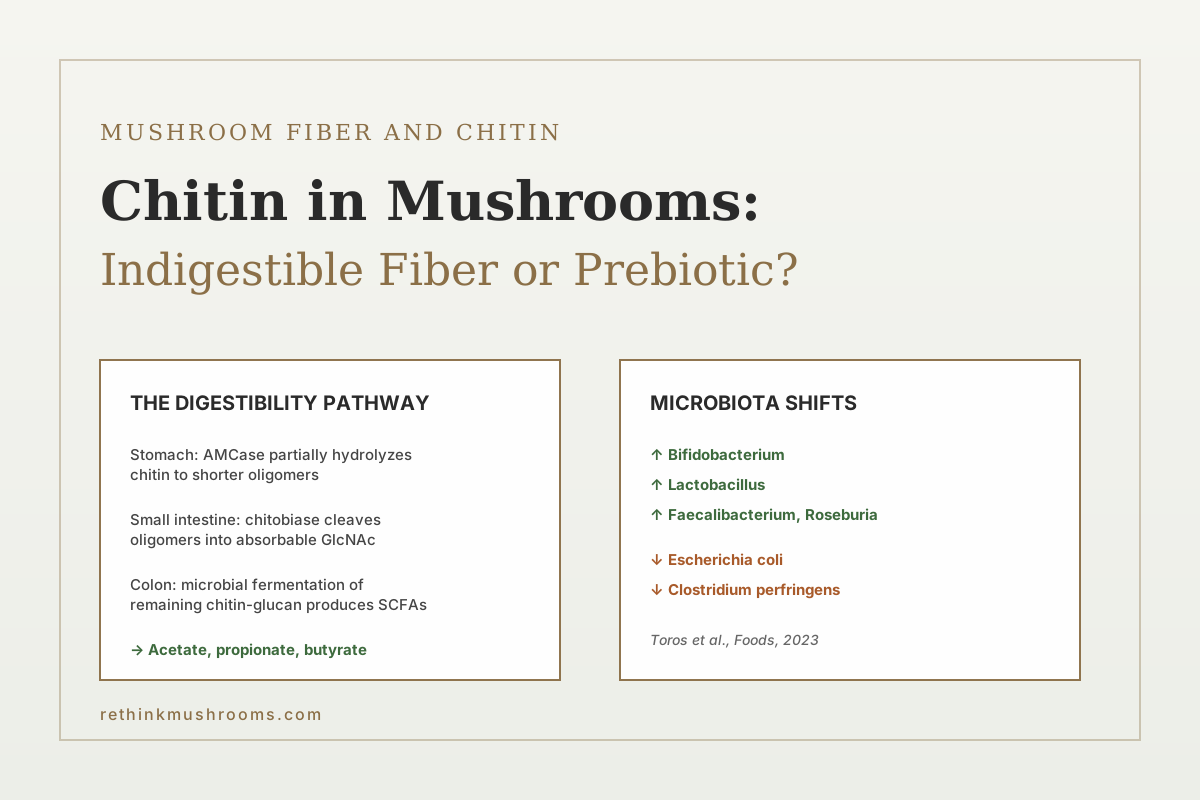
The claim that chitin is "indigestible" originates from the older nutrition literature, which treated humans as lacking chitinase activity entirely. That turns out to be wrong. Humans express two genes encoding active chitinases: CHIT1 (chitotriosidase, secreted by macrophages and neutrophils) and CHIA (acidic mammalian chitinase, AMCase, expressed in the stomach, lung, and salivary glands). Both enzymes hydrolyze the β-(1→4)-glycosidic bonds in chitin. Humans also express chitobiase activity that breaks down chitin oligomers into GlcNAc monomers.[1]
What this means in practice: chitin digestion in humans is partial, not complete. AMCase in the stomach can degrade a fraction of ingested chitin to shorter oligomers. Chitobiase in the intestine can further hydrolyze those oligomers to GlcNAc, which is absorbable. But the rate of this process is slow compared to the transit time of food through the upper GI tract, and a large fraction of ingested chitin (especially in its crystalline, cell-wall-embedded form) reaches the colon intact. The original "indigestible" characterization therefore holds for most of the chitin most people eat, even though the biochemistry is more nuanced than a blanket impossibility.
Wijesekara et al. (2024) note that the bioavailability of chitin and chitosan depends strongly on processing: cooked, mechanically disrupted, or deacetylated forms reach the colon in a different physical state than raw chitin and are fermented at different rates.[1] For whole mushrooms, cooking ruptures the cell wall and releases intracellular nutrients, but does not destroy the chitin polymer itself; the chitin continues on to the colon, just in a more accessible form for microbial enzymes.
Colonic Fermentation: Where the Prebiotic Question Is Decided
The definition of a prebiotic, as agreed by ISAPP in 2017, is "a substrate that is selectively utilized by host microorganisms conferring a health benefit." Two parts of that definition matter: selective utilization (not every fiber that gets fermented counts) and a demonstrated health benefit. Chitin and chitin-glucan meet the utilization criterion clearly, and meet the health benefit criterion in several specific contexts, though the strength of evidence is still shy of the standard set for established prebiotics like fructo-oligosaccharides and galacto-oligosaccharides.
Nguepi Tsopmejio et al. (2020) reviewed mushroom bioactives as prebiotics, with particular attention to gut-liver axis effects. They note that mushroom-derived polysaccharides, including chitin-glucan complexes and beta-glucans, undergo fermentation by colonic microbes with production of short-chain fatty acids (acetate, propionate, butyrate). The SCFAs affect host metabolism through multiple routes: butyrate is the primary energy substrate for colonocytes, propionate is taken up by the liver and modulates gluconeogenesis, and acetate enters systemic circulation and can cross the blood-brain barrier.[3]
The selectivity question is whether chitin specifically feeds beneficial microbes rather than acting as a generic fermentable substrate. Toros et al. (2023) tested Pleurotus ostreatus extracts (which contain both chitin-glucan and free beta-glucan) in an in vitro fermentation model with human fecal inocula. The extract increased the relative abundance of Bifidobacterium and Lactobacillus species and decreased the abundance of potential pathogens including Escherichia coli and Clostridium perfringens.[2] That selectivity pattern matches the classical prebiotic profile.
Mouse Models: What Happens When Mushroom Fiber Becomes the Intervention
Rodent feeding studies with whole mushrooms or mushroom polysaccharides provide the in vivo evidence for microbiota modulation. Two Pleurotus eryngii (king oyster) studies are directly relevant.
Nakahara et al. (2020) fed high-fat-diet mice a Pleurotus eryngii polysaccharide preparation for 8 weeks. The supplemented mice gained less weight than controls, had improved glucose tolerance, and showed partial reversal of high-fat-diet-induced shifts in gut microbiota composition. Specifically, the polysaccharide increased the relative abundance of Bacteroidetes and decreased Firmicutes, partially reversing the Firmicutes:Bacteroidetes shift associated with obesity.[6]
Du et al. (2024) extended this to whole-mushroom feeding (not just extracted polysaccharide) in a similar high-fat-diet model. The whole king oyster mushroom attenuated obesity, improved lipid profiles, and shifted gut microbiota composition. The whole-mushroom intervention produced effects comparable to or larger than the polysaccharide extract alone, suggesting that the chitin-glucan matrix plus the other mushroom components is at least as effective as the purified fraction.[7]
The obvious caveat is that mouse microbiota is not human microbiota and mouse physiology is not human physiology. Still, these studies provide a plausible mechanism and a target effect size for human trials.
Human Evidence: Smaller, Fewer, Still Suggestive
Human clinical trials on mushroom chitin specifically are limited. Cerletti et al. (2021) reviewed the human evidence on edible mushrooms and beta-glucans, focusing on immunomodulation, metabolic parameters, and cardiovascular markers. The review identified studies showing improvements in lipid profiles, glycemic control, and immune function after mushroom consumption, with effect sizes that are modest but consistent across small trials.[4] The review is careful to note that most of these studies cannot isolate chitin-specific effects from beta-glucan effects or from other mushroom bioactives.
The cleanest human data on the chitin fraction specifically come from chitin-glucan extract trials. Chitin-glucan fiber at 4.5 g/day has been shown to increase exhaled hydrogen (a marker of colonic fermentation) and shift postprandial metabolic markers including glycemia and triglyceridemia in subjects at cardiometabolic risk. The fermentation signature and the microbiota changes are consistent with a prebiotic mechanism, though the trials have been small and heterogeneous.
Mirończuk-Chodakowska et al. (2020) quantified beta-glucan content across Polish wild mushrooms, documenting substantial variability across species and seasons. Their data reinforce an important point for the chitin question: in real-world mushroom consumption, chitin is never delivered alone. The fiber fraction is always a chitin-glucan mixture with varying ratios. Human trials that isolate chitin from glucan are testing a purified material that does not correspond to what mushroom eaters actually ingest.[5]
For how this fiber fraction relates to SCFA production downstream, see mushroom dietary fiber and short-chain fatty acid production. For the barrier-vs-benefit framing of chitin as a nutritional factor, see chitin in mushrooms: is it a benefit or a barrier?.
The Prebiotic Verdict: What the Evidence Supports and What It Does Not
Calling mushroom chitin a "prebiotic" in the strict ISAPP sense requires three things: selective utilization by beneficial microbes, documented health benefit, and evidence that the specific substrate (not a co-ingested one) is responsible. The evidence grades:
Selective utilization: supported. Chitin and chitin-glucan are fermented by specific taxa including Bifidobacterium, Lactobacillus, Faecalibacterium, and Roseburia, with relative suppression of less desirable taxa.[2]
Health benefit: suggestive, not conclusive. Short human trials with chitin-glucan extract show changes in metabolic markers. Rodent studies show effects on body weight, lipid profiles, and glucose tolerance. Large, long-term randomized trials with chitin as the isolated intervention do not exist.
Specificity: incomplete. In whole-mushroom studies, chitin and beta-glucan co-vary, and bioactive small molecules (triterpenoids, ergothioneine, vitamin D) are also present. Attribution of specific effects to chitin alone is not possible from these trials.
A fair summary is that mushroom chitin behaves like a prebiotic substrate in all the biochemical ways a prebiotic should, that whole mushrooms produce health-relevant metabolic effects in humans and animals, and that the chitin fraction is probably contributing to those effects. It is not currently possible to say how much of the effect is chitin versus chitin-glucan versus beta-glucan versus other mushroom components. The "indigestible fiber" framing is accurate for the small intestine but understates what happens in the colon. The "prebiotic" framing is suggestive but not yet supported by the kind of isolated-substrate clinical evidence that established prebiotics have.
The Bottom Line
Mushroom chitin is a β-(1→4) polymer of N-acetylglucosamine that escapes complete digestion in the upper GI tract despite humans expressing two active chitinases, then undergoes microbial fermentation in the colon to produce short-chain fatty acids and shift microbiota composition toward Bifidobacterium, Lactobacillus, and SCFA-producing taxa. Clinical and rodent data support a prebiotic-like mechanism, but whole mushrooms deliver chitin as part of a chitin-glucan complex alongside beta-glucans and other bioactives, making it difficult to attribute effects to chitin in isolation. The accurate description is neither "inert roughage" nor "confirmed prebiotic" but a partially fermentable fiber with measurable downstream metabolic and microbiota effects.
Frequently Asked Questions
Sources & References
- 1RTHM-00915·Wijesekara, Tharuka et al. (2024). “New Insights into Sources, Bioavailability, Health-Promoting Effects, and Applications of Chitin and Chitosan..” Journal of agricultural and food chemistry.Study breakdown →PubMed →↩
- 2RTHM-00855·Törős, Gréta et al. (2023). “Modulation of the Gut Microbiota with Prebiotics and Antimicrobial Agents from Pleurotus ostreatus Mushroom..” Foods (Basel.Study breakdown →PubMed →↩
- 3RTHM-00644·Nguepi, Tsopmejio Ivan Steve et al. (2020). “Mushrooms Bioactive as Prebiotics to Modulate Gut Microbiota in Relationships with Causes and Prevention of Liver Diseases (Review)..” International journal of medicinal mushrooms.Study breakdown →PubMed →↩
- 4RTHM-00676·Cerletti, Chiara et al. (2021). “Edible Mushrooms and Beta-Glucans: Impact on Human Health..” Nutrients.Study breakdown →PubMed →↩
- 5RTHM-00637·Mirończuk-Chodakowska, Iwona et al. (2020). “Evaluation of Polish wild Mushrooms as Beta-Glucan Sources..” International journal of environmental research and public health.Study breakdown →PubMed →↩
- 6RTHM-00643·Nakahara, Daiki et al. (2020). “Effect of mushroom polysaccharides from Pleurotus eryngii on obesity and gut microbiota in mice fed a high-fat diet..” European journal of nutrition.Study breakdown →PubMed →↩
- 7RTHM-00876·Du, Hengjun et al. (2024). “Dietary intake of whole king oyster mushroom (Pleurotus eryngii) attenuated obesity via ameliorating lipid metabolism and alleviating gut microbiota dysbiosis..” Food research international (Ottawa.Study breakdown →PubMed →↩