Mushroom Fiber
Both barrier and benefit
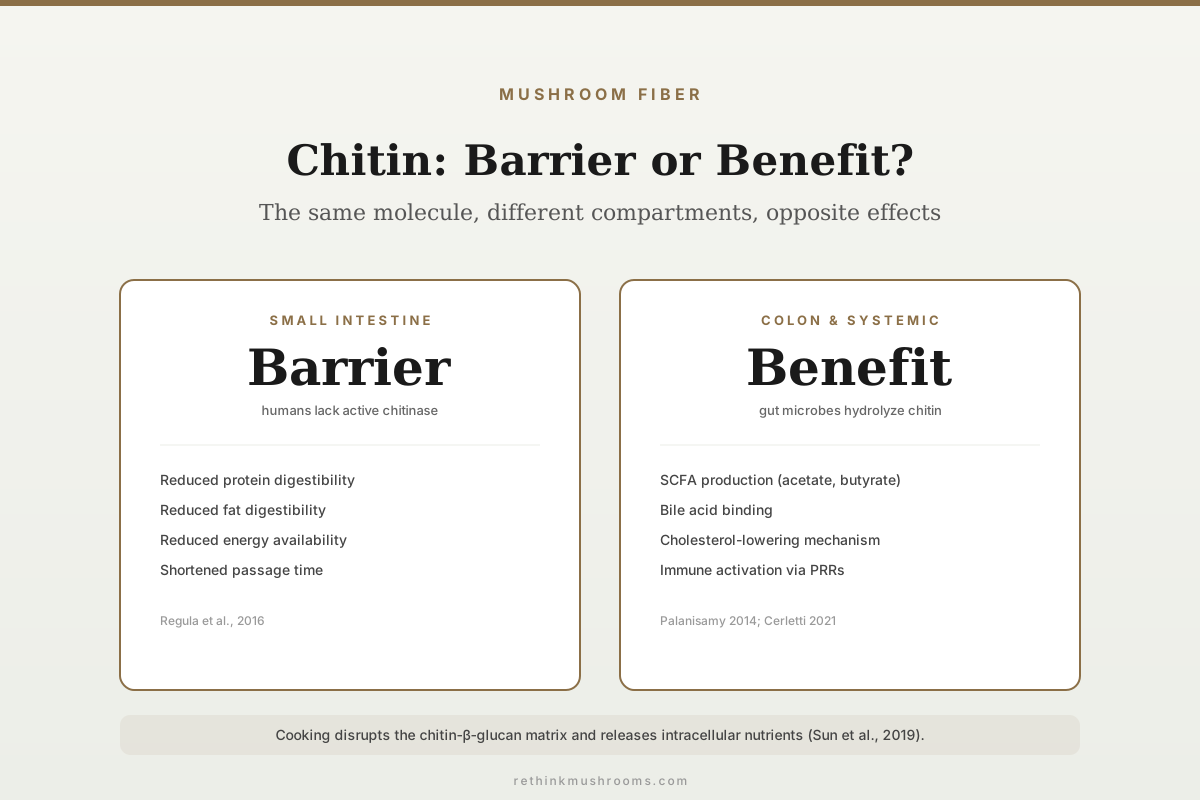
Chitin is the nitrogen-containing structural polysaccharide of fungal cell walls, indigestible by human enzymes, responsible for reduced nutrient availability from raw mushrooms, and also the source of prebiotic chitooligosaccharides produced by gut microbial hydrolysis and processing.
Palanisamy et al., Biotechnology Progress, 2014; Regula et al., Int J Med Mushrooms, 2016
Indigestible by Humans
we lack active chitinase enzymes
Fermented in Colon
yields short-chain fatty acids and chitooligosaccharides
Cooking Changes It
heat and pressure alter chitin structure and release bound nutrients
Palanisamy et al., Biotechnology Progress, 2014; Regula et al., Int J Med Mushrooms, 2016
 View as image ↗
Chitin in mushrooms is the second most abundant biopolymer on earth and the main structural component of fungal cell walls. It is also the single most common reason people find mushrooms hard to digest, the reason raw mushrooms deliver fewer nutrients than cooked ones, and the reason several fungal bioactives are less bioavailable than their chemistry suggests. At the same time, chitin and its breakdown products feed the gut microbiome, yield short-chain fatty acids under colonic fermentation, and contribute to the immune activation profile of mushroom-derived polysaccharide extracts. The answer to whether chitin is a benefit or a barrier is: both, simultaneously, depending on what is being measured and how the mushroom is prepared.
For related coverage, see the sibling articles chitin in mushrooms: indigestible fiber or underrated prebiotic?, mushroom fiber: types, digestibility, and health effects, why cooking mushrooms matters: breaking down chitin, and mushroom dietary fiber and short-chain fatty acid production.
Key Takeaways
- Palanisamy et al. (2014) demonstrated that pressurized water extraction of edible mushrooms (Agaricus bisporus, Lentinula edodes, Pleurotus ostreatus) hydrolyzes chitin into chitooligosaccharides that co-elute with β-glucans and contribute to bile acid-binding activity (Biotechnology Progress)
- Regula et al. (2016) measured apparent digestibility in rats fed diets with 4% and 8% dried Pleurotus ostreatus powder and found mushroom addition reduced overall diet digestibility and protein/fat availability and shortened alimentary tract passage time (Int J Med Mushrooms)
- Cerletti et al. (2021) reviewed the human health evidence for mushroom β-glucans in Nutrients and identified immunomodulation, anti-inflammation, and cardiovascular protection as the best-supported activity categories, with clinical data still limited
- Sima et al. (2018) reviewed β-glucan cholesterol-lowering mechanisms and concluded that insoluble and soluble β-glucan fractions reduce cholesterol via bile acid and lipid binding in the gut (International Journal of Molecular Medicine)
- Gil-Ramirez et al. (2018) documented that fungal sterols and β-glucan/chitin fractions modulate cholesterol homeostasis through transcriptional effects on Srebf2 and Nr1h4 (FXR), extending the mechanism beyond simple bile acid binding (Food & Function)
- Sun et al. (2019) measured the effect of autoclaving, microwaving, sous vide, and stewing on mushroom soup composition and found each method increased polysaccharide, polyphenol, and amino acid availability compared to uncooked mushroom, with autoclaving producing the highest polysaccharide release (Food Science & Nutrition)
What Chitin Actually Is
Chitin is a linear polymer of N-acetylglucosamine units linked by β-1,4 glycosidic bonds. Structurally it resembles cellulose but with an acetamide group in place of a hydroxyl group at the second carbon. It forms the rigid fibrillar network of fungal cell walls, usually cross-linked with β-glucans and embedded in a matrix of glucans, proteins, and polysaccharides. In mushroom fruiting bodies, chitin content typically ranges from 1 to 8 percent of dry weight depending on species and maturity, with higher concentrations in older specimens and in the stem compared to the cap.
Humans produce no active chitinase enzyme capable of hydrolyzing chitin in meaningful amounts. Acidic mammalian chitinase (AMCase) is expressed in stomach tissue but has negligible activity against dietary chitin at normal gastric conditions. This functional absence is the reason chitin is classified as dietary fiber rather than a digestible carbohydrate.
The consequence is that chitin reaches the colon largely intact, where it encounters gut microbes with chitinolytic capacity. Specific bacteria in the Bacteroidetes and Firmicutes phyla carry chitinases and can hydrolyze chitin into shorter chitooligosaccharides, which are then fermented into short-chain fatty acids (acetate, propionate, butyrate) along with the surrounding β-glucan matrix.
The Barrier Side: Why Raw Mushrooms Are Less Nutritious
Regula et al. (2016), publishing in the International Journal of Medicinal Mushrooms, measured nutrient digestibility in rats fed semisynthetic diets supplemented with 4% and 8% dried Pleurotus ostreatus (oyster mushroom) powder.[1] The measured effects were direct:
- Reduced digestibility of the overall diet
- Reduced apparent protein digestibility
- Reduced apparent fat digestibility
- Reduced apparent energy availability
- Shortened passage time through the alimentary tract
- No negative effect on body weight gain or feeding efficiency
All of these effects were dose-dependent on mushroom inclusion. The mechanism is the chitin-β-glucan matrix in the fungal cell wall, which encapsulates intracellular nutrients and resists the full range of mammalian digestive enzymes. When nutrients are locked inside intact cell walls, they pass through the small intestine without absorption and either become substrate for colonic fermentation or leave the body unused.
This is the barrier side of chitin. Eating raw or minimally cooked mushrooms means eating a food where a meaningful fraction of the measured nutritional content is not biologically accessible. Protein, B vitamins, minerals, and some polysaccharide-bound compounds all deliver less than their total content would suggest. Shortened alimentary passage time compounds the effect by reducing the window for enzymatic attack on exposed nutrients.
For mushroom consumers, the practical implication is that the nutrition label on raw mushrooms overstates the bioavailable nutrition. The digestibility reduction is typically in the range of 10 to 30 percent depending on cell wall composition, cooking method, and dietary matrix.
The Benefit Side: Chitin as Functional Fiber
The same chitin-β-glucan matrix that blocks small-intestinal digestion is the substrate for colonic fermentation and the basis of several well-documented beneficial activities.
Palanisamy et al. (2014), publishing in Biotechnology Progress, developed a pressurized water extraction method applied to Agaricus bisporus, Lentinula edodes, and Pleurotus ostreatus.[2] At 200°C and 10.3 MPa, extraction produced β-glucan-enriched fractions that contained chitooligosaccharides derived from chitin hydrolysis, along with α-glucans and proteo-glucans. The measured bile acid-binding capacity of some of these extracts was comparable to a β-glucan enriched fraction obtained from cereals. The chitin-derived fraction was not an inert barrier in this system; it contributed directly to the lipid-binding activity that underpins cholesterol-lowering mechanisms.
Sima et al. (2018), in a review published in International Journal of Molecular Medicine, analyzed the cholesterol-lowering mechanism of β-glucans and concluded that the insoluble and soluble β-glucan fractions (which in mushrooms are tightly associated with chitin) interact with lipids and biliary salts in the bowel and consequently reduce cholesterol absorption.[3] This is a gut-lumen mechanism that does not require absorption of the fiber itself. The chitin content of the mushroom cell wall is part of what produces the binding activity.
Gil-Ramirez et al. (2018), publishing in Food & Function, extended the cholesterol mechanism beyond bile acid binding.[4] Fungal sterols, β-glucan fractions, and water-soluble compounds from edible mushrooms were shown to modulate cholesterol homeostasis through transcriptional effects on Srebf2 and Nr1h4 (FXR) genes in the liver, producing profiles similar to simvastatin and ezetimibe. This places mushroom fiber in a functional category different from pure cereal β-glucans: chitin-associated mushroom fractions affect cholesterol through both direct gut-lumen binding and indirect transcriptional modulation.
Cerletti et al. (2021), in a comprehensive review published in Nutrients, placed the chitin-β-glucan complex in the broader context of human health evidence.[5] Mushroom β-glucans carry both β-1,3 and β-1,6 linkages with branching structures, unlike cereal β-glucans which have no 1,6 linkages or branching. This structural difference, together with the tight chitin association, gives mushroom β-glucans distinctive immunomodulatory activity through dectin-1 and related pattern recognition receptors. The chitin component itself is recognized by immune cells independently through chitin-binding receptors and is part of the reason whole-mushroom extracts produce stronger immune activation than purified β-glucan fractions.
How Cooking Changes the Chitin Equation
Sun et al. (2019), publishing in Food Science & Nutrition, investigated the effect of four cooking methods (autoclaving, microwaving, sous vide, and stewing) on Hypsizygus marmoreus mushroom soup composition.[6] All four methods increased polysaccharide, polyphenol, and amino acid levels compared to uncooked mushroom soup. Specific findings:
- Autoclaving produced the highest polysaccharide release
- Sous vide produced the highest polyphenol and flavor compound retention
- Stewing increased protein content release
- All methods reduced nucleotide content except sous vide
The mechanism is physical and chemical disruption of the chitin-glucan matrix. Heat weakens the hydrogen bonding network that holds chitin fibrils together. Pressure (autoclaving) accelerates hydrolysis of both chitin and β-glucan linkages. Extended cooking time extracts intracellular nutrients into the liquid phase where they become bioavailable. This is the reason traditional mushroom preparations in cuisines from Chinese to European to Japanese involve extended simmering, broths, soups, and slow-cooked dishes rather than raw or lightly heated preparations.
The practical implication is that cooking method materially affects how much of a mushroom's nutritional and bioactive content is actually delivered to the eater. Autoclaving or pressure cooking produces the highest polysaccharide release. Long aqueous cooking (soups, broths, stews) produces the best balance of nutrient release and flavor retention. Raw consumption delivers the most chitin-bound, least bioavailable version of the food.
The Cross-Cutting Point: Structure Determines Function
The barrier-versus-benefit framing oversimplifies the underlying biology. Chitin is the same molecule in both roles; what changes is whether the mushroom is consumed raw or cooked, whole or extracted, and whether the target nutrients are intracellular (blocked by chitin) or cell-wall-associated (potentiated by chitin).
In the small intestine, chitin is a barrier because it blocks enzymatic access to intracellular nutrients. In the colon, chitin is a substrate because microbial chitinases hydrolyze it into fermentable chitooligosaccharides. In the gut lumen, chitin-associated β-glucan is a functional fiber because it binds bile acids and alters cholesterol absorption. In systemic immunity, chitin fragments are recognized by pattern recognition receptors and drive part of the characteristic immune activation attributed to mushroom consumption. These are different mechanisms operating simultaneously in different anatomical compartments.
The implication for reading nutrition claims: statements that chitin "reduces nutrient absorption" and statements that chitin "acts as a prebiotic fiber" are both correct, apply in different compartments, and do not cancel each other out. A cooked mushroom delivers nutrients that a raw mushroom does not, and also delivers a chitin fraction to the colon that produces the fiber effects. There is no version of mushroom consumption where chitin is purely beneficial or purely harmful.
For the structural fiber angle, see the sibling article on mushroom fiber: types, digestibility, and health effects. For the SCFA production mechanism specifically, see mushroom dietary fiber and short-chain fatty acid production. For the cooking implications, see why cooking mushrooms matters: breaking down chitin.
What the Evidence Does Not Yet Show
The chitin literature in mushrooms has specific gaps that limit clinical inference.
No human pharmacokinetic data for chitooligosaccharides from dietary mushroom intake. The concentrations achieved in plasma or tissue after normal mushroom consumption are not published.
No controlled human trial comparing mushroom β-glucan/chitin intake to cereal β-glucan for cholesterol outcomes. Animal and in-vitro data support a similar or possibly distinct mechanism, but head-to-head human comparison has not been done.
No standardized measurement of chitin content across mushroom species and cooking methods in a way that allows consumers to predict fiber delivery from labeled intake.
Limited data on inter-individual variation in gut microbial chitinase activity, which likely drives most of the variation in who responds to mushroom fiber and who does not.
Cerletti et al. (2021) identified human clinical validation of the immunomodulatory and cardiovascular effects as the key research direction, with particular emphasis on distinguishing whole-mushroom effects from purified β-glucan effects.[5]
For a cross-cluster view of how this fiber chemistry relates to antioxidant activity in specific species, see chaga vs. other superfoods for antioxidant power: a comparison.
The Bottom Line
Chitin in mushrooms is both a barrier (reducing small-intestinal digestibility of raw mushrooms) and a benefit (prebiotic substrate, cholesterol-modulating fiber, immune-activating polysaccharide after cooking or colonic fermentation). Regula (2016) documented the barrier effect; Palanisamy (2014), Sima (2018), Gil-Ramirez (2018), and Cerletti (2021) documented the functional benefits. Cooking changes the balance. The honest answer is both, depending on what is measured.
Frequently Asked Questions
Sources & References
- 1RTHM-00443·Regula, Julita et al. (2016). “Bioavailability and Digestibility of Nutrients from the Dried Oyster Culinary-Medicinal Mushroom, Pleurotus ostreatus (Agaricomycetes): In Vivo Experiments..” International journal of medicinal mushrooms.Study breakdown →PubMed →↩
- 2RTHM-00342·Palanisamy, Marimuthu et al. (2014). “Pressurized water extraction of β-glucan enriched fractions with bile acids-binding capacities obtained from edible mushrooms..” Biotechnology progress.Study breakdown →PubMed →↩
- 3RTHM-00531·Sima, Petr et al. (2018). “β-glucans and cholesterol (Review)..” International journal of molecular medicine.Study breakdown →PubMed →↩
- 4RTHM-00510·Gil-Ramírez, Alicia et al. (2018). “Molecular actions of hypocholesterolaemic compounds from edible mushrooms..” Food & function.Study breakdown →PubMed →↩
- 5RTHM-00676·Cerletti, Chiara et al. (2021). “Edible Mushrooms and Beta-Glucans: Impact on Human Health..” Nutrients.Study breakdown →PubMed →↩
- 6RTHM-00589·Sun, Yujing et al. (2019). “Domestic cooking methods affect nutrient, phytochemicals, and flavor content in mushroom soup..” Food science & nutrition.Study breakdown →PubMed →↩