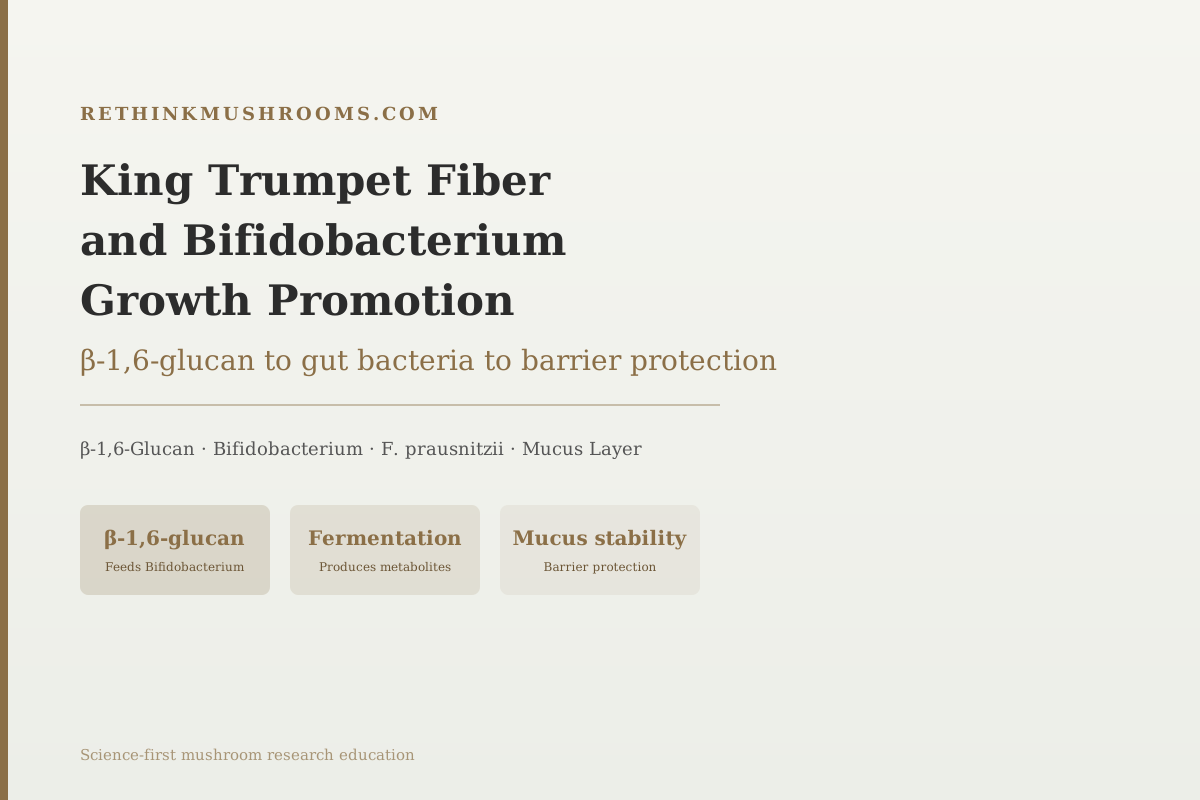
King Trumpet & Bifidobacterium
β-1,6-glucan drives growth
The specific β-1,6-glucan fraction from Pleurotus eryngii modulates gut microbiota and immunity (including Bifidobacterium enrichment), establishing that different glucan structures from the same mushroom have different biological targets in the gut.
Wang et al., Frontiers in Immunology, 2022
Complete chain
the mechanistic pathway from P. eryngii fiber: feeds Bifidobacterium and F. prausnitzii, which ferment the polysaccharide and produce metabolites that interact with and stabilize gut mucus, protecting the intestinal barrier (Ma et al., 2024)
Immune + microbiome
the dual effect of β-1,6-glucan from P. eryngii: both gut microbiota composition and immune parameters changed in vivo after the polysaccharide fraction was administered, confirming systemic effect beyond local gut changes (Wang et al., 2022)
Age-related decline
what happens to Bifidobacterium levels in the human gut across the lifespan: Bifidobacterium abundance declines significantly with age, making dietary prebiotic support especially relevant for adults over 50
Wang et al., Frontiers in Immunology, 2022
 View as image ↗
Bifidobacterium is the gut bacterium most people recognize by name. It's the genus marketed in probiotic supplements, added to yogurt, and associated with healthy infants. What's less commonly known is that Bifidobacterium declines substantially with age, that most commercially available probiotic supplements provide strains that don't colonize the gut long-term, and that dietary fiber from specific foods feeds and sustains resident Bifidobacterium more effectively than transient supplementation.
King trumpet mushroom (Pleurotus eryngii) contains a specific beta-glucan structural fraction that promotes Bifidobacterium and butyrate-producing bacteria through prebiotic fermentation. The fermentation products of this process then interact with gut mucus to provide intestinal barrier protection. This three-step chain (fiber to bacteria to barrier protection) is the complete Bifidobacterium story for P. eryngii.
For the overview of king trumpet's gut health research, see king trumpet and gut health: prebiotic effects. For the pillar article, see what is king trumpet mushroom: the meaty mushroom with health benefits.
Key Takeaways
- The β-1,6-glucan fraction specifically from P. eryngii modulates gut microbiota composition and immune parameters, distinct from the β-1,3-glucan fraction that primarily drives immune activation (Wang et al., Frontiers in Immunology, 2022)
- In vivo fermentation of P. eryngii polysaccharide altered fecal microbiota composition and stimulated immune responses, confirming that the polysaccharide undergoes active colonic fermentation rather than passive transit (Ma et al., Food Function, 2017)
- The fermentation products of P. eryngii polysaccharide by gut bacteria interact with and stabilize gut mucus, the protective layer coating the intestinal epithelium, through a mechanism distinct from tight junction protein restoration (Ma et al., Food Function, 2024)
- Bifidobacterium declines with age and in high-fat diet conditions; P. eryngii prebiotic activity specifically enriches both Bifidobacterium and butyrate-producing Faecalibacterium prausnitzii
- The complete mechanistic chain runs from fiber to bacterial fermentation to mucus-layer stabilization to intestinal barrier protection
- Whole king oyster mushroom provides a broader Bifidobacterium-promoting effect than isolated polysaccharide extracts, with the Kerezoudi 2025 fermentation study confirming all PE forms increase Bifidobacterium and Bacteroides versus controls
Why Bifidobacterium Matters and Why It Declines
Bifidobacterium is an obligate anaerobic genus that inhabits the large intestine. It produces acetate and lactate (from carbohydrate fermentation), synthesizes B vitamins, inhibits pathogenic bacteria through competitive exclusion and pH reduction, and supports the mucosal immune system. Bifidobacterium species are among the first colonizers of the infant gut, where they dominate the microbiome during breast-feeding.
The decline story is less well-publicized. Bifidobacterium abundance in the gut drops significantly across the adult lifespan, with elderly adults typically having 10-100 times fewer Bifidobacterium than infants. High-fat diets further suppress Bifidobacterium, as does antibiotic use. In gut dysbiosis associated with metabolic syndrome and obesity, Bifidobacterium depletion is a consistent finding.
Probiotic supplements add transient Bifidobacterium strains that typically don't colonize the gut long-term because they're not the resident strains adapted to that individual's microbiome ecology. Dietary prebiotics that feed resident Bifidobacterium populations are increasingly recognized as a more sustainable strategy for Bifidobacterium support than transient supplementation.
This is the context in which king trumpet's β-glucan fiber becomes relevant: it feeds the Bifidobacterium already present in the gut, supporting and potentially expanding populations that are adapted to the individual's intestinal environment.
The β-1,6-Glucan Connection: Structural Specificity Matters
Not all beta-glucan is the same. King trumpet contains two distinct glucan structures: β-1,3-glucan (linked at the 1 and 3 carbon positions) and β-1,6-glucan (linked at the 1 and 6 positions). These are different molecular architectures recognized differently by gut bacteria and immune receptors.
Wang and colleagues investigated the β-1,6-glucan fraction from P. eryngii specifically, publishing the results in Frontiers in Immunology in 2022.[2] The study found that β-1,6-glucan modulated both gut microbiota composition and immune parameters in vivo; both the microbial community and the systemic immune response changed after the glucan fraction was administered.
This dual effect on microbiota and immunity is consistent with the biological relationship between gut bacteria and immune education: gut microbiota composition shapes immune tone, and changing microbiota composition produces downstream immune changes. The fact that both effects were documented in the same study for the β-1,6-glucan fraction establishes this as the gut-modulating structural driver in P. eryngii.
The β-1,3-glucan fraction, by contrast, has its primary immunological action through Dectin-1 receptor activation in immune cells rather than through gut bacterial fermentation. Understanding which fraction does what helps explain why whole king trumpet mushroom, which retains all fractions in native ratios, may produce different gut outcomes than β-glucan extracts standardized for only one fraction.
The In Vivo Fermentation Evidence
Ma and colleagues demonstrated in 2017 that P. eryngii polysaccharide undergoes active colonic fermentation in vivo, producing measurable changes in fecal microbiota composition alongside stimulation of immune responses.[1]
The fermentation confirmation is important for the prebiotic classification. Fiber that passes through the colon without being fermented provides bulk and may support motility, but it doesn't feed specific bacteria. A substrate that gets fermented, changes microbiota composition, and produces metabolites that have biological effects satisfies the technical criteria for prebiotic activity.
The immune stimulation alongside microbiota changes in the Ma 2017 study reflects the gut-immune axis: as bacteria ferment P. eryngii polysaccharide, the fermentation products (short-chain fatty acids, bacterial metabolites) signal to the gut-associated immune system. This systemic immune effect from dietary fiber fermentation is the mechanism by which the Bifidobacterium enrichment translates to broader health relevance.
What Bifidobacterium Does With P. eryngii Polysaccharide
Ma and colleagues' 2024 follow-up study investigated the interactions between the fermentation products of P. eryngii polysaccharide and gut mucus.[3] This is the final step in the mechanistic chain.
When gut bacteria (including Bifidobacterium) ferment P. eryngii polysaccharide, they produce metabolites. These metabolites were found to interact with and stabilize gut mucus, the protective layer of gel-forming mucin proteins that coats the intestinal epithelium. The mucus layer is a critical component of intestinal barrier function: it traps bacteria at a safe distance from the epithelial cells, provides a habitat for commensal bacteria, and protects against pathogen invasion.
The mucus interaction is mechanistically distinct from the tight junction protein restoration documented in the Kerezoudi 2025 study. That study showed fermentation supernatants restored ZO-1, occludin, and claudin-1 proteins at the cellular level. The Ma 2024 study shows that the fermentation metabolites also stabilize the extracellular mucus layer. Together, these findings describe two separate intestinal barrier protection mechanisms downstream of P. eryngii fiber fermentation by gut bacteria.
The complete chain: P. eryngii fiber (specifically β-1,6-glucan) feeds Bifidobacterium and other beneficial gut bacteria. These bacteria ferment the polysaccharide and produce metabolites. The metabolites stabilize gut mucus. The mucus layer protects the intestinal epithelium. The epithelium maintains tight junction integrity. The result is a more intact intestinal barrier.
How King Trumpet Compares to Other Bifidobacterium-Promoting Fibers
Inulin is the reference standard for Bifidobacterium-promoting prebiotic fiber. It is highly effective at enriching Bifidobacterium in human trials and is the most well-studied prebiotic. Comparisons between inulin and mushroom beta-glucans for Bifidobacterium promotion are limited in published literature.
What is established is that P. eryngii beta-glucan fiber promotes Bifidobacterium through a fermentation mechanism similar to inulin but via a different structural substrate. The β-1,6-glucan from P. eryngii has distinct linkage chemistry that gut bacteria may metabolize through different enzymatic pathways than inulin. This structural difference could produce complementary rather than redundant effects if consumed alongside inulin-containing foods.
For how king trumpet compares to other mushroom species as a prebiotic, see which mushrooms are the best prebiotics: a species comparison. For the short-chain fatty acid production story including the butyrate-producing bacteria angle, see king trumpet and short-chain fatty acid production. For a parallel edible mushroom species, see enoki for gut health: prebiotic fiber and microbiome effects.
The Bottom Line
King trumpet mushroom's β-1,6-glucan fraction specifically promotes Bifidobacterium and gut microbiota more broadly, distinct from the β-1,3-glucan that drives immune activation (Wang et al., 2022). P. eryngii polysaccharide undergoes active colonic fermentation with measurable microbiota and immune effects in vivo (Ma et al., 2017). The fermentation metabolites produced by gut bacteria (including Bifidobacterium) fermenting P. eryngii polysaccharide interact with and stabilize gut mucus, providing a second intestinal barrier protection mechanism alongside tight junction protein restoration (Ma et al., 2024). The complete chain runs from β-1,6-glucan fiber to Bifidobacterium enrichment to mucus-layer stabilization.
Frequently Asked Questions
Sources & References
- 1RTHM-00894·Ma, Gaoxing et al. (2017). “In vivo fermentation of a Pleurotus eryngii polysaccharide and its effects on fecal microbiota composition and immune response..” Food & function.Study breakdown →PubMed →↩
- 2RTHM-00801·Wang, Xue et al. (2022). “β-1,6-Glucan From Pleurotus eryngii Modulates the Immunity and Gut Microbiota..” Frontiers in immunology.Study breakdown →PubMed →↩
- 3RTHM-01943·Ma, Gaoxing et al. (2024). “Interactions between intestinal microbial fermentation products of Pleurotus eryngii polysaccharide with gut mucus..” Food & function.Study breakdown →PubMed →↩