King Trumpet & Ergothioneine
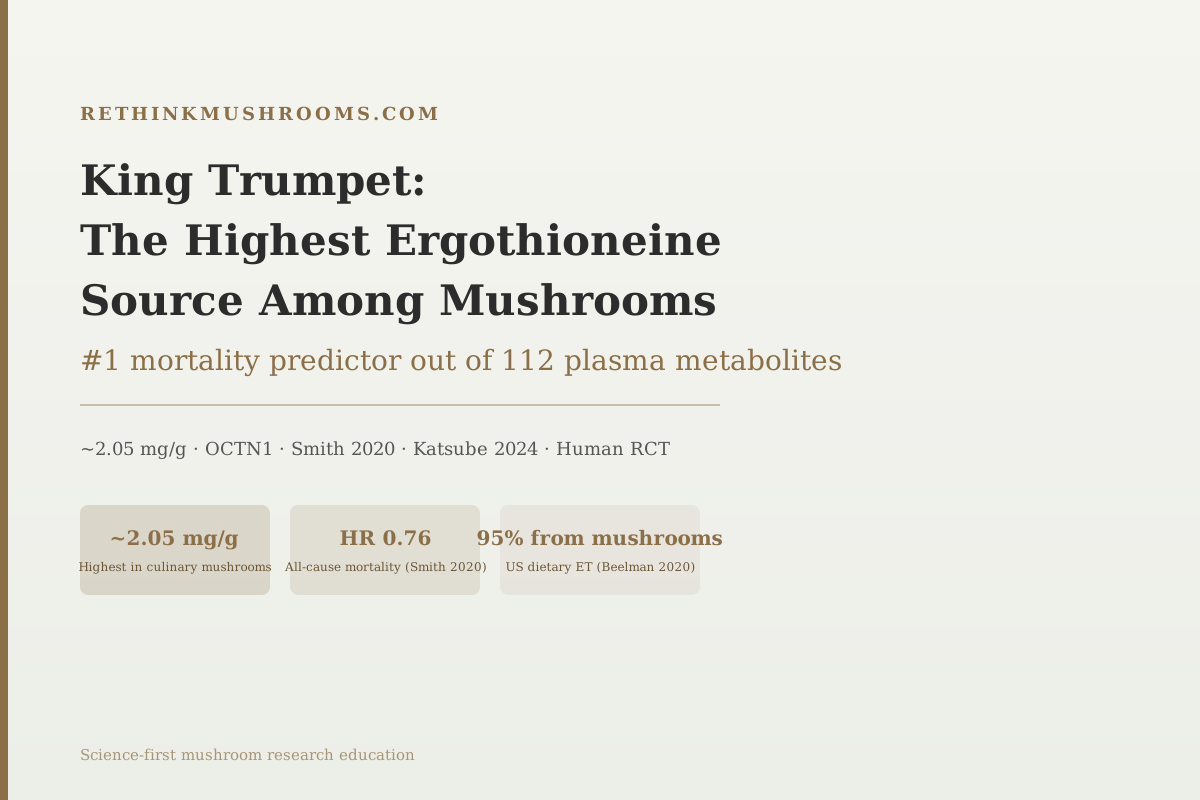
#1 metabolite for mortality prediction
Out of 112 plasma metabolites measured in 3,236 participants, ergothioneine was the strongest predictor of reduced all-cause mortality. King trumpet mushroom is the richest culinary source of ergothioneine, and eating it has been shown in a randomized controlled trial to raise plasma ergothioneine.
Smith et al., Heart, 2020; Kleftaki et al., Antioxidants, 2022
~2.05 mg/g
ergothioneine concentration in king trumpet fruiting bodies by fresh weight, among the highest of any culinary mushroom measured across systematic species comparisons (Liang et al., Int J Med Mushrooms, 2013)
~5.84 mg/g
ergothioneine in submerged-cultivated P. eryngii mycelium on a dry weight basis, approximately 3 times higher than fruiting body, establishing mycelium as a potential high-yield ergothioneine source (Liang et al., 2013)
95% from mushrooms
the proportion of dietary ergothioneine in the average US diet that comes from mushrooms; Americans average ~1.1 mg/day ET, far below the estimated optimal intake, with low mushroom consumption as the primary driver (Beelman et al., FEBS Letters, 2020)
Smith et al., Heart, 2020; Kleftaki et al., Antioxidants, 2022
 View as image ↗
Ergothioneine is a sulfur-containing amino acid that humans cannot synthesize. We obtain it entirely from diet, primarily from mushrooms, and we have evolved a dedicated transporter (OCTN1) that concentrates it in tissues and organs under oxidative stress. When plasma ergothioneine was measured alongside 111 other metabolites in 3,236 people and tracked against mortality outcomes, it ranked first among all metabolites for predicting reduced all-cause mortality.
King trumpet mushroom (Pleurotus eryngii) contains more ergothioneine than any other commonly available culinary mushroom. Eating it raises plasma ergothioneine, confirmed in a human randomized controlled trial. This article presents the quantification data, explains what the numbers mean in context, and follows the evidence from "king trumpet is high in ET" to "higher plasma ET predicts longer life."
For the complete king trumpet overview, see what is king trumpet mushroom: the meaty mushroom with health benefits.
Key Takeaways
- King trumpet (P. eryngii) fruiting bodies contain approximately 2.05 mg/g ergothioneine, among the highest of any culinary mushroom species measured in systematic comparison studies (Liang et al., 2013)
- Submerged-cultivated P. eryngii mycelium achieves ~5.84 mg/g dry weight ergothioneine, approximately 3 times higher than fruiting body on a comparable basis (Liang et al., 2013)
- Fermented P. eryngii products achieved ~795 mg/kg ergothioneine, far exceeding standard fruiting body levels while maintaining favorable taste (Chen et al., 2012)
- Mushrooms account for ~95% of dietary ergothioneine in the US; Americans average ~1.1 mg/day, far below estimated optimal intake; low mushroom consumption is the primary cause (Beelman et al., 2020)
- A randomized controlled trial confirmed that eating P. eryngii significantly raised plasma ergothioneine in participants and improved antioxidant capacity (Kleftaki et al., 2022)
- Out of 112 plasma metabolites, ergothioneine was the strongest predictor of reduced all-cause mortality (HR 0.76 per SD, p less than 0.001) in a cohort of 3,236 participants (Smith et al., Heart, 2020)
The Numbers: How Much Ergothioneine Is in King Trumpet?
Liang and colleagues published two complementary 2013 studies that established the ergothioneine content of P. eryngii more thoroughly than any competitor has cited.
In the fruiting body study, king trumpet fruiting bodies were found to contain approximately 2.05 mg/g ergothioneine, with antioxidant activity correlating strongly with ET content across the samples measured.[1] This figure places P. eryngii among the highest ET-containing culinary mushrooms available.
The second Liang 2013 study focused on cultivated mycelium: submerged-cultivated P. eryngii mycelium achieved approximately 5.84 mg/g dry weight ergothioneine.[2] Comparing dry weight to dry weight, mycelium contains roughly 3 times more ET than fruiting body. This doesn't mean supplements containing mycelium are superior to food (the form matters), but it establishes that the mycelium growth stage concentrates ET efficiently.
Chen and colleagues demonstrated a third production pathway in 2012: fermented P. eryngii products achieved ET content of approximately 795 mg/kg while maintaining favorable taste profiles.[11] Fermentation concentrates ET well beyond what's achievable in standard cultivation, opening a potential route to high-ET functional food products.
How King Trumpet Compares to Other Mushroom Species
Systematic species comparisons confirm king trumpet's position at the top of the culinary mushroom ET hierarchy.
| Mushroom Species | Relative ET Content |
|---|---|
| King trumpet (P. eryngii) | Highest: ~2.05 mg/g |
| Oyster mushroom (P. ostreatus) | High: ~1.0 mg/g |
| Shiitake (L. edodes) | Moderate: ~0.6 mg/g |
| Portobello / crimini (A. bisporus var.) | Lower: ~0.3 mg/g |
| Button (A. bisporus) | Lowest: ~0.2 mg/g |
Lo and colleagues systematically compared ET across multiple culinary mushroom species and their mycelia, finding P. eryngii consistently among the highest.[3] Tsiantas and colleagues confirmed this in 2021 using validated HPLC quantification across species, also documenting that lovastatin is present alongside ET in Pleurotus species, two cardiovascular-relevant bioactives in the same mushroom.[4]
An important cooking note: Liu and colleagues found in 2020 that ergothioneine retains more than 85% activity after 30 minutes of boiling at 100°C.[5] ET is thermally stable. What boiling does is leach water-soluble compounds into the cooking water; ET goes into the broth, not into the cooking vessel's vapor or heat. Retain cooking liquid to retain ergothioneine. For the full cooking guide, see how cooking affects ergothioneine in king trumpet.
Why the Amount Matters: The US Dietary Gap
Knowing king trumpet has the highest ET content matters only if ET intake actually influences health. The dietary context makes the stakes clear.
Beelman and colleagues established in 2020 that mushrooms account for approximately 95% of dietary ergothioneine in the US.[6] Unlike other antioxidants found across diverse plant foods, ET is almost exclusively a mushroom compound in the human diet. Americans average approximately 1.1 mg of ET per day, a figure that traces directly to low mushroom consumption.
Researchers studying ET's biological role have proposed an estimated optimal daily intake of 5+ mg, based on the levels associated with health outcomes in population studies. Current average US intake represents roughly 20-25% of that target.
Bruce Ames, in a 2018 PNAS paper, proposed ergothioneine as a "longevity vitamin," a compound where chronic deficiency contributes to age-related disease risk, analogous to the role of classical vitamins.[7] The OCTN1 transporter's ubiquitous presence across human tissues, concentrating ET specifically under oxidative stress conditions, is one of the primary arguments: evolution would not have maintained a dedicated transporter for a compound of minor importance.
The Human Trial: Eating King Trumpet Raises Plasma Ergothioneine
The step from "king trumpet contains ET" to "eating king trumpet increases ET in your body" was confirmed by a human randomized controlled trial by Kleftaki and colleagues, published in Antioxidants in 2022.[10]
The RCT enrolled 46 metabolically unhealthy adults and had them consume P. eryngii mushroom snacks for 8 weeks. Participants in the P. eryngii group showed significant increases in plasma ergothioneine and antioxidant capacity, alongside reductions in oxidative stress markers.
This is the critical bridge. Content data from Liang 2013 and species comparisons from Lo 2012 tell us king trumpet has more ET than other mushrooms. The Kleftaki 2022 RCT confirms that this content translates to measurable plasma ET elevation when people actually eat the mushroom. The ET in king trumpet is bioavailable.
What Elevated Plasma ET Predicts: The Mortality Data
Smith and colleagues published a metabolomic cohort study in the journal Heart in 2020 that speaks directly to why plasma ergothioneine matters.[8] In 3,236 participants who had plasma metabolomics profiling, the researchers tracked 112 metabolites against all-cause mortality, cardiovascular events, and other outcomes over follow-up.
Ergothioneine was the strongest predictor of reduced all-cause mortality out of all 112 metabolites measured. Each standard deviation increase in plasma ET was associated with a hazard ratio of 0.76 (p less than 0.001); participants in the highest ET quartile were substantially less likely to die during follow-up. It also associated with reduced cardiovascular events and other mortality endpoints.
This is an observational cohort study; higher plasma ET is associated with longer survival, but causality is not established. Higher plasma ET could reflect a healthier diet broadly (more mushroom eating, which correlates with other healthy behaviors) rather than ET specifically causing the benefit. This is an important distinction. But the finding is striking: out of 112 plasma metabolites, ET ranked first.
The mechanistic case for why ET might genuinely protect against mortality was strengthened by Katsube and colleagues' 2024 mouse study in GeroScience.[9] Dietary ergothioneine supplementation extended healthspan in male mice, reducing frailty, preserving muscle mass, improving cognitive function, and reducing systemic inflammation markers. This is the most direct intervention evidence that ET promotes longevity, though it is in mice, not humans.
For the full longevity evidence chain, see king trumpet for longevity: the ergothioneine connection. For how ergothioneine specifically protects cardiovascular health, see ergothioneine and heart health: cardiovascular protection research.
The Bottom Line
King trumpet mushroom (Pleurotus eryngii) is the richest culinary source of ergothioneine, containing approximately 2.05 mg/g in fruiting bodies (Liang et al., 2013), with cultivated mycelium reaching 5.84 mg/g dry weight. Mushrooms provide ~95% of US dietary ET, with average intake far below estimated optimal levels (Beelman et al., 2020). A 2022 RCT confirmed eating P. eryngii raises plasma ET (Kleftaki et al.). Smith et al. (2020) found plasma ET was the #1 predictor of reduced all-cause mortality out of 112 metabolites in 3,236 participants. Katsube et al. (2024) showed dietary ET extended healthspan in mice. The chain runs from king trumpet content to bioavailable plasma increase to population-level mortality association.
Frequently Asked Questions
Sources & References
- 1. Source details for this reference are not yet available.
- 2. Source details for this reference are not yet available.
- 3. Source details for this reference are not yet available.
- 4. Source details for this reference are not yet available.
- 5. Source details for this reference are not yet available.
- 6. Source details for this reference are not yet available.
- 7. Source details for this reference are not yet available.
- 8. Source details for this reference are not yet available.
- 9. Source details for this reference are not yet available.
- 10. Source details for this reference are not yet available.
- 11. Source details for this reference are not yet available.