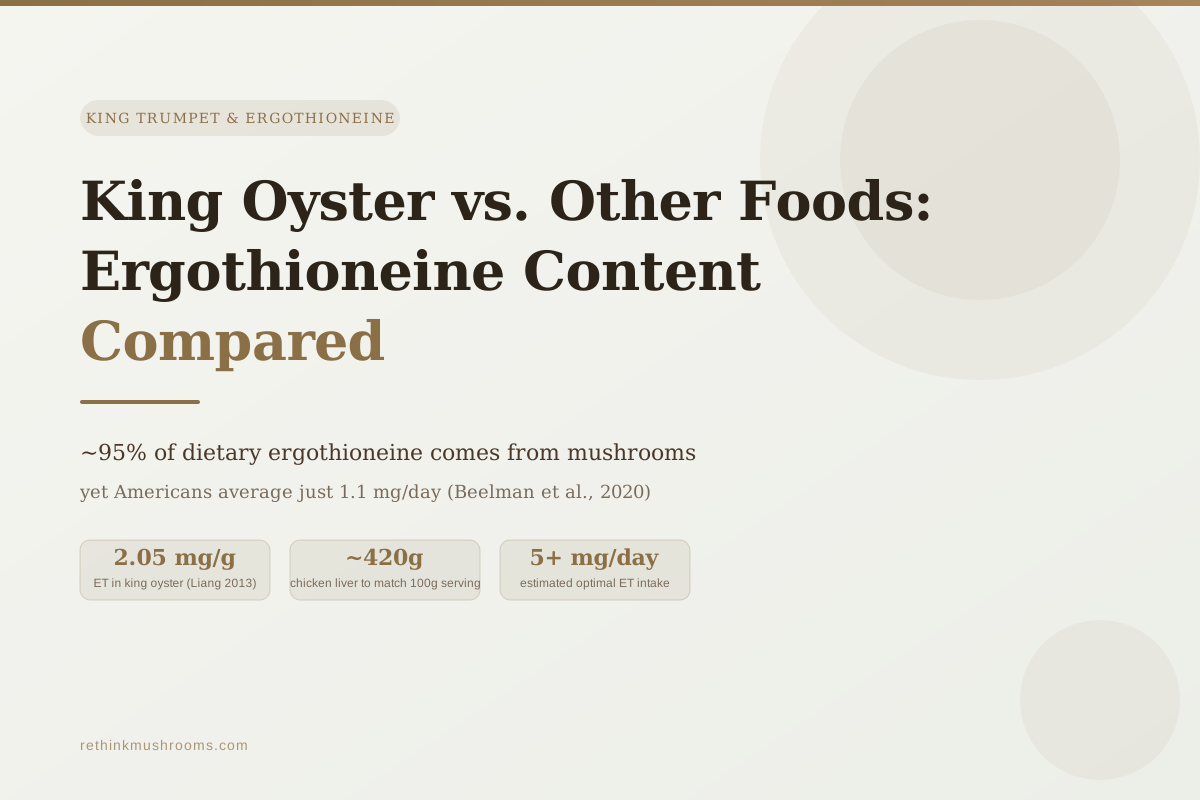
King Trumpet & Ergothioneine
~95% of dietary ET from mushrooms
Mushrooms supply roughly 95% of dietary ergothioneine in the American diet, yet the average American takes in just 1.1 mg per day, far below what researchers consider optimal.
Beelman et al., FEBS Lett, 2020
2.05 mg/g
ET in king oyster fresh weight (Liang 2013)
~1.1 mg/day
average US ergothioneine intake
3,236
participants in Smith 2020's plasma ET mortality study
Beelman et al., FEBS Lett, 2020
 View as image ↗
In 2020, researchers from Uppsala University analyzed plasma samples from 3,236 middle-aged adults and measured 112 blood metabolites: vitamins, lipids, amino acids, and signaling molecules. They asked which one best predicted who would still be alive years later.[9] The compound that rose to the top was ergothioneine, a sulfur-containing molecule most people have never heard of.
That finding from Smith and colleagues made a practical question suddenly urgent: where does dietary ergothioneine in food sources come from? The answer, confirmed by multiple nutritional surveys, is almost entirely from mushrooms. And within mushrooms, king oyster (Pleurotus eryngii) sits at the top of every species comparison in the published research.
This article walks through the ergothioneine content of foods across the full spectrum, from exotic mushrooms to organ meats to plant foods, using measurements from primary research. It covers where king oyster stands in the comparison, how much meat actually contributes, and what the gap between average American intake and what researchers consider optimal actually looks like in practical terms.
For a broader overview of king oyster's health properties, the complete king oyster mushroom guide covers the full research picture.
Key Takeaways
- King oyster mushroom (P. eryngii) fruiting bodies contain approximately 2.05 mg/g ET in fresh weight, among the highest measured for any culinary mushroom (Liang et al., 2013)
- Mushrooms account for approximately 95% of dietary ergothioneine intake in the US (Beelman et al., 2020)
- Americans average roughly 1.1 mg/day of dietary ET; researchers estimate 5 mg/day or more may be beneficial (Beelman et al., 2020)
- Chicken liver contains ET at approximately 140 mg/kg; you would need around 420g to match what a 100g serving of king oyster provides
- Plant foods (beans, oats, spinach) contain trace amounts, generally below 4 mg/kg
- Plasma ET declines significantly with age, and low levels track with cognitive impairment in population data (Cheah et al., 2016)
The Blood Compound That Outranked 111 Others for Predicting Who Lives Longer
Smith and colleagues were not looking for ergothioneine specifically. They ran an untargeted screen, measuring everything detectable in plasma, and let the statistics decide which compound had the strongest association with survival.[9]
Ergothioneine came out first. Higher plasma ET was associated with a hazard ratio of 0.76 for all-cause mortality. People with more of it in their blood were 24% less likely to die during follow-up. The effect held after adjusting for conventional cardiovascular risk factors.
This finding matters for the food source question because the body cannot synthesize ergothioneine on its own. Every milligram in your plasma came from what you ate. The protein responsible for moving ET from blood into cells, a transporter called OCTN1, is found in nearly every tissue in the body. Bruce Ames cited this ubiquity in 2018 when he proposed that ergothioneine qualifies as a "longevity vitamin": a compound the body treats as worth holding onto across evolution, pointing to biological necessity.[7]
A 2023 systematic review by Tian and colleagues in the British Journal of Nutrition went further, arguing that ET meets the formal criteria for an essential dietary micronutrient: humans cannot produce it, have an active dedicated transporter for it, and show health consequences from chronically low levels.[10]
That framing makes the ergothioneine in food sources comparison more than an academic exercise. It is, potentially, a question about a nutrient gap most people don't know they have.
Ergothioneine Content Across Food Sources: What Primary Research Actually Shows
Most articles that cover this topic either give a vague list ("mushrooms and some organ meats") or cite a single number without context. The data from Beelman and colleagues, combined with species-level measurements from Lo et al. and Tsiantas et al., gives a more complete picture.
Ergothioneine Content Across Common Foods
| Food | ET Content (approx. mg/kg wet weight) |
|---|---|
| King oyster mushroom (P. eryngii) | ~589–2,050 |
| Oyster mushroom (P. ostreatus) | ~100–900 |
| Shiitake (L. edodes) | ~300–600 |
| Cremini / Portobello (A. bisporus) | ~100–300 |
| White button mushroom | ~100–200 |
| Chicken liver | ~140 |
| Beef kidney | ~40–60 |
| Lean beef | ~10–30 |
| Black beans | <4 |
| Oats | <2 |
| Spinach | <1 |
Sources: Beelman et al. 2020,[6] Lo et al. 2012,[4] Tsiantas et al. 2021[5]
A few things stand out.
First, the range for king oyster is wide. Liang and colleagues measured P. eryngii fruiting bodies at approximately 2.05 mg/g fresh weight (equivalent to 2,050 mg/kg), which is the highest specific P. eryngii measurement in the published research.[1] Broader reviews using averaged data across exotic mushroom varieties report lower figures, closer to 589 mg/kg. Natural variation by strain, growing conditions, and harvest timing likely accounts for the spread. The lower end of that range is still far above any food outside the mushroom category.
Second, organ meats overlap with common button mushrooms. Chicken liver at 140 mg/kg sits within the white button mushroom range. This is higher than most people assume for animal products, but it's still well below shiitake, oyster, or king oyster mushrooms.
Third, plant foods do not meaningfully contribute. Spinach at less than 1 mg/kg and beans at less than 4 mg/kg make an effectively negligible dietary contribution when mushrooms are available as an alternative.
Lo and colleagues ran one of the more controlled species comparisons, measuring ET alongside other bioactive compounds across multiple culinary species in matched conditions.[4] P. eryngii consistently ranked highest. Tsiantas and colleagues confirmed this species ranking in 2021 using HPLC quantification across a commercial mushroom panel.[5] The pattern is consistent enough across methods that the ranking is not in dispute: king oyster at the top, followed by shiitake and oyster mushrooms, with common Agaricus species lower.
Why Meat Falls Short: The Chicken Liver Calculation
Meat contains ergothioneine because animals absorb it from their feed. Cattle and chickens consume ET-producing organisms through their diet, and it accumulates in tissues, particularly metabolically active organs like liver and kidney.
Chicken liver, at around 140 mg/kg, is a real ET source. It outperforms white button mushrooms on this metric. But it does not compete with exotic mushrooms.
At an average ET content of approximately 589 mg/kg for exotic mushrooms like king oyster, a 100g serving provides roughly 59 mg of ergothioneine. Getting the same amount from chicken liver requires around 420g, close to half a kilogram of organ meat in one sitting.[6]
For people who rarely eat mushrooms and rely on meat for dietary ET, that comparison is stark. Lean beef and chicken breast contain roughly 10 to 30 mg/kg. A daily 200g chicken breast provides at most 6 mg; that's already at the high end of the range for lean meat. Most estimates for meat-eating Americans suggest they're getting closer to 0.5 to 1 mg/day from meat alone.
Beelman and colleagues documented this in their 2020 review: mushrooms account for approximately 95% of dietary ET in the US, meaning the non-mushroom contribution from all other food sources combined is roughly 5%.[6] For someone who eats no mushrooms, their entire dietary ET supply comes from that small fraction.
The American ET Intake Gap: 1.1 mg/Day When Researchers Suggest 5+
Beelman and colleagues estimated that Americans average approximately 1.1 mg/day of dietary ergothioneine, based on dietary survey data combined with food content measurements.[6] The researchers proposed that 5 mg/day or more may be a more beneficial intake level, based on plasma ET levels associated with favorable health outcomes in population studies.
That is roughly a 4.5-fold gap between what the average American currently eats and what the data suggests might be worth aiming for.
One 100g serving of king oyster closes that gap in a single meal. At approximately 589 mg/kg (the Beelman review figure for exotic mushrooms), 100g provides roughly 59 mg, far above the proposed 5 mg/day threshold. Based on the specific Liang 2013 measurement of 2.05 mg/g for P. eryngii, the same serving could provide substantially more.
No official recommended daily intake for ergothioneine exists yet; it has not been formally classified as an essential nutrient in regulatory frameworks, despite Tian 2023 and others arguing it meets the scientific criteria. The 5 mg/day figure is a research estimate, not a dietary guideline.[10]
The gap between 1.1 mg/day and 5+ mg/day is real, and the reason for it is clear: most Americans eat few mushrooms. Beelman and colleagues estimated that Americans eat fewer than 10g of mushrooms per day on average, which provides only a modest ET contribution even from common varieties like white button.
For a deeper look at how king oyster's specific ET content positions it against other mushroom species, the king trumpet ergothioneine article breaks down the species comparison in full.
Within Mushrooms: King Oyster Consistently Outranks Every Other Common Species
The table shows the broad ranking, but a few nuances are worth noting.
Oyster mushroom (P. ostreatus) overlaps with king oyster in some measurements. The two species are in the same genus, and Lo and colleagues found P. eryngii consistently higher, though the gap was not always large.[4] Shiitake occupies a reliable middle position: a substantially better ET source than white button or portobello, and widely available.
Cremini and portobello are the same species as white button (Agaricus bisporus), which is why their ranges overlap. The higher ET levels sometimes reported for cremini and portobello likely reflect older, more mature fruiting bodies rather than a true species difference.
Tsiantas and colleagues' 2021 HPLC analysis of commercial mushrooms confirmed the ranking in controlled conditions: king oyster and related Pleurotus species at the top, shiitake in the middle, white button and portobello lower.[5] The measurement method matters. HPLC gives more precise species-level data than colorimetric assays, but the relative ranking holds across approaches.
Practical implication: if king oyster is not available, oyster mushroom or shiitake are the next-best options in most grocery stores. White button and portobello, despite being the most commonly consumed mushrooms in the US, provide substantially less ET per gram.
Ergothioneine Levels Decline With Age, Making Food Sources More Critical Over Time
A population study of 492 elderly Singaporeans by Cheah and colleagues found that plasma ergothioneine levels declined significantly with advancing age. Individuals with mild cognitive impairment also had significantly lower plasma ET than age-matched adults without cognitive decline.[8]
This is observational data. The direction of causality cannot be established from that study alone. Lower plasma ET could be a downstream consequence of poor health rather than a contributing factor to decline.
The pattern appears in independent datasets, and Tian and colleagues reviewed the same body of evidence in their 2023 systematic review, concluding that age-related ET depletion is a real phenomenon and one that may make dietary intake increasingly important precisely when the body is accumulating the wear that ergothioneine appears to protect against.[10]
If plasma ET declines with age independently of diet, older adults may need higher dietary ET intake to maintain the same plasma levels as younger people. That makes king oyster, the highest-ET food source available at a grocery store, especially relevant for people in middle age and beyond.
For the broader mechanisms linking ergothioneine to longevity and cardiovascular protection, the ergothioneine longevity hypothesis and ergothioneine and cardiovascular disease articles cover the downstream research.
Beyond the Grocery Store: Mycelium and Fermented P. eryngii at Much Higher Concentrations
The comparison above focuses on king oyster fruiting bodies, the part you buy at the store. Two other forms of P. eryngii show substantially higher ET concentrations.
Liang and colleagues measured submerged-cultivated P. eryngii mycelium at approximately 5.84 mg/g dry weight, roughly 3 times the concentration found in fruiting bodies on a dry-weight basis.[2] This is not a food product you'd cook for dinner; it represents the concentration achievable when growing the fungal mycelium alone under controlled conditions, more relevant to supplement production than the kitchen.
Chen and colleagues achieved even higher concentrations in fermented P. eryngii products at approximately 795 mg/kg, through controlled fermentation that drove the fungus to produce substantially more ET than it does in standard cultivation.[3] The study noted that fermented products maintained acceptable taste profiles, suggesting food applications were feasible. Neither mycelium-based nor fermented P. eryngii products are mainstream options right now, but these forms represent the upper ceiling of what P. eryngii can produce, and suggest that supplement-grade king oyster extracts could eventually provide concentrated ET intake far beyond what fruiting bodies offer.
For the practical question of how cooking affects ET content in the fruiting bodies most people eat, the how cooking affects ergothioneine in king trumpet article covers the evidence in detail. The short answer: ET is thermally stable, and cooking does not destroy it as much as is often assumed.
The Bottom Line
Ergothioneine comes almost entirely from mushrooms, accounting for approximately 95% of dietary intake in the US, and king oyster (Pleurotus eryngii) ranks at the top of every published species comparison. The gap between mushrooms and every other food category is large: chicken liver, the best non-mushroom source, provides roughly 4 times less ET per gram than exotic mushrooms on average, and far more would be required to approximate even a single 100g serving of king oyster. Americans average around 1.1 mg/day while researchers estimate 5 mg/day or more may be beneficial. Plasma ET declines with age and tracks with cognitive health in population data, making dietary sources an increasingly relevant consideration for older adults.
Frequently Asked Questions
Sources & References
- 1. Source details for this reference are not yet available.
- 2. Source details for this reference are not yet available.
- 3. Source details for this reference are not yet available.
- 4. Source details for this reference are not yet available.
- 5. Source details for this reference are not yet available.
- 6. Source details for this reference are not yet available.
- 7. Source details for this reference are not yet available.
- 8. Source details for this reference are not yet available.
- 9. Source details for this reference are not yet available.
- 10. Source details for this reference are not yet available.