King Trumpet / King Oyster
62.5% LDL reduction at 5% dietary king oyster in hypercholesterolemic rats
Alam and colleagues fed hypercholesterolemic rats a diet containing 5% Pleurotus eryngii fruiting body powder. LDL dropped 62.5%, triglycerides fell 46.33%, and the LDL/HDL ratio improved 57.14%. Faecal lipid and cholesterol excretion rose, and liver histology stayed normal in the mushroom-fed group.
Alam et al., Saudi Journal of Biological Sciences, 2011
apoE mouse aorta
3% dietary P. eryngii significantly reduced atherosclerotic lesion area in the aortic root of apoE-deficient mice over 10 weeks — a direct plaque measurement, not a lipid panel (Mori et al., Nutrition Research, 2008)
Beat aspirin in vitro
in a screen of eight edible species, P. eryngii extract inhibited ADP-induced platelet aggregation more strongly than 140 µmol/L acetylsalicylic acid — while leaving clotting times completely unchanged (Poniedzialek et al., Nutrients, 2019)
0 human trials
no clinical trial has tested P. eryngii for cardiovascular endpoints in people; the nearest human evidence is 8 trials of the related Pleurotus ostreatus, rated low quality for risk of bias (Dicks et al., Nutrients, 2020)
Alam et al., Saudi Journal of Biological Sciences, 2011
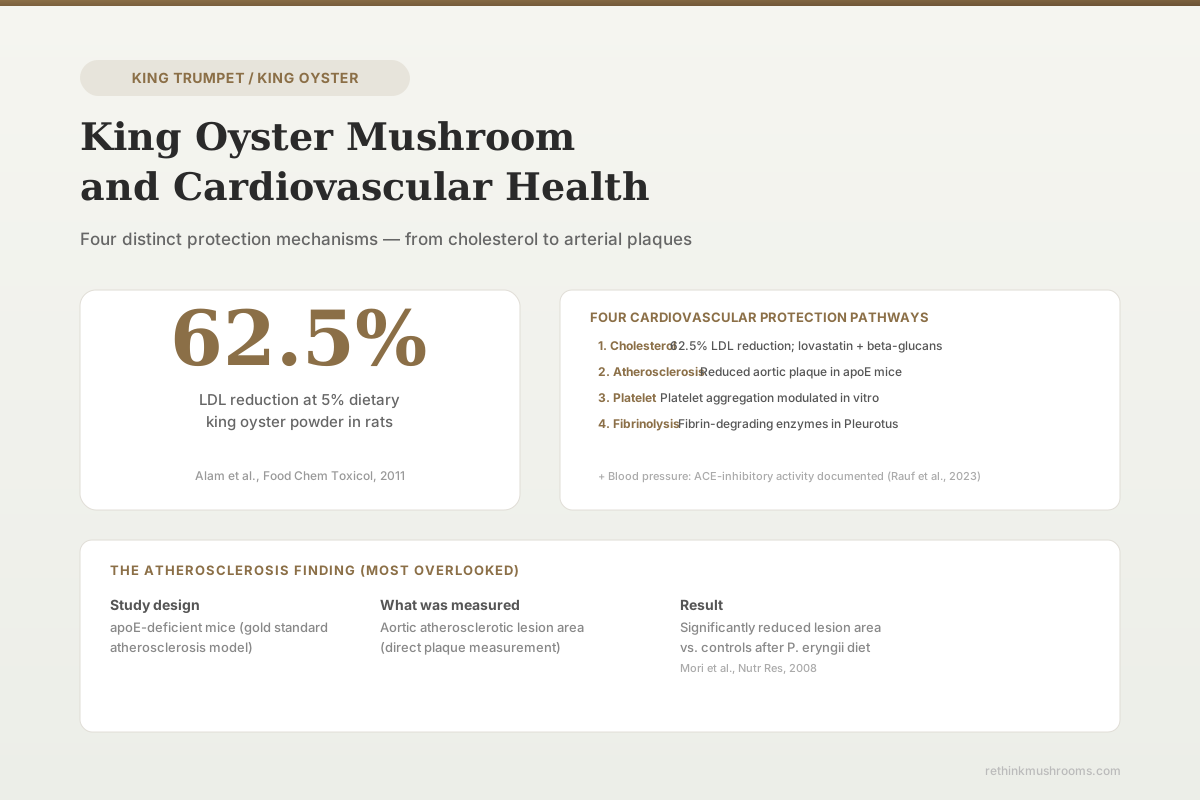 View as image ↗
King oyster mushroom (Pleurotus eryngii, also called king trumpet) has accumulated preclinical cardiovascular research from several directions at once. Most coverage compresses it to a single angle: the mushroom contains lovastatin, and lovastatin lowers cholesterol. That summary is both incomplete and, on the specifics, weaker than it sounds.
The research picture is broader. P. eryngii has documented effects across four cardiovascular mechanisms — cholesterol lowering, arterial plaque prevention, platelet modulation, and fibrinolytic enzyme activity — plus a fifth line of work on blood pressure that is real but almost entirely about other species.
The mechanisms are not equally supported, and that is the part most articles skip. This one covers each mechanism with its primary source, states the dose and model behind every number, and is explicit about where each finding stops. The honest summary up front: this is a preclinical literature. Not one human trial has tested king oyster mushroom for a cardiovascular endpoint.
For the pillar overview of king oyster's general properties, see what is king trumpet mushroom: the meaty mushroom with health benefits.
Key Takeaways
- A diet containing 5% Pleurotus eryngii fruiting body powder reduced LDL by 62.50%, triglycerides by 46.33%, total cholesterol by 24.05%, and the LDL/HDL ratio by 57.14% in hypercholesterolemic rats, while increasing faecal lipid and cholesterol excretion (Alam et al., Saudi J Biol Sci, 2011)
- A second, independent rat study using a different P. eryngii variety and a different hyperlipidemia model found the same direction of effect: significantly lower triglycerides, LDL and VLDL, significantly higher HDL, and reduced hepatic lipid accumulation over three weeks (Choi et al., Int J Med Mushrooms, 2017)
- Mori and colleagues fed apoE-deficient mice 3% dried mushroom powder for 10 weeks and measured atherosclerotic lesion area in aortic root cross-sections. P. eryngii significantly reduced lesion area — a direct measure of plaque, not a surrogate — though Hypsizygus marmoreus produced the strongest effect of the three species tested (Mori et al., Nutr Res, 2008)
- In an in vitro screen of eight edible species, P. eryngii was one of the two most promising antiplatelet extracts, inhibiting ADP-induced aggregation more strongly than 140 µmol/L acetylsalicylic acid. Critically, none of the extracts altered prothrombin time, prothrombin ratio, or INR — the effect is antiplatelet, not anticoagulant (Poniedzialek et al., Nutrients, 2019)
- Of four cultivated species compared for fibrin-degrading activity, P. eryngii ranked second behind P. ostreatus. The enzymes were inhibited by serine and metalloprotease inhibitors and worked best at pH 6–7 and 30–40 °C — conditions that stomach acid does not resemble (Petraglia et al., Molecules, 2022)
- The mechanism work points in two directions that were previously conflated: P. eryngii polysaccharide raised faecal bile acid excretion and hepatic LDLR expression in mice (Nakahara et al., Eur J Nutr, 2020), and separately blocked oxidized-LDL-driven foam cell formation in macrophages (Wei et al., Polymers, 2018)
- No human trial has tested P. eryngii for cardiovascular endpoints. The nearest evidence is a systematic review of 8 clinical trials of the related Pleurotus ostreatus, which found beneficial effects on lipids and glucose but rated the evidence low because risk of bias was high or unclear in most trials (Dicks et al., Nutrients, 2020)
The Five Pathways, and How Far Each One Actually Goes
Each mechanism below sits at a different point on the evidence scale. Reading them as a single undifferentiated body of "cardiovascular evidence" is the mistake that produces overstated claims.
Five Pathways · Evidence Reach
Every Pathway Stops Before Human Data
King oyster’s cardiovascular mechanisms are usually listed as if they were equally established. They are not. Only one has been replicated across independent groups, two exist solely in a laboratory vessel, and one is not really about this species. Not one has reached a human trial.
| Pathway | Model tested | What was found | Evidence reach | Where it stops |
|---|---|---|---|---|
| Cholesterol lowering[1] [5] [8] [10] | Rats and mice, dietary powder and isolated polysaccharide | LDL −62.50%, triglycerides −46.33% at 5% dietary powder; same direction in an independent rat study; faecal bile acid excretion and hepatic LDLR expression both up | Animal, replicated | No human lipid trial in this species |
| Atherosclerosis / plaque[2] [9] | apoE-deficient mice, 3% dietary powder, 10 weeks | Aortic root lesion area significantly reduced — an actual plaque endpoint, not a surrogate; oxidized-LDL foam cell formation blocked in macrophages | Animal, single study | One study; bunashimeji outperformed it in the same experiment |
| Platelet modulation[3] | Isolated human platelets, hot water extract | Among the two most promising of eight species; inhibited ADP-induced aggregation more strongly than 140 µmol/L aspirin. Clotting times (PT, PR, INR) unchanged | In vitro only | Never tested in a living animal or person |
| Fibrinolysis[4] | Crude fruiting-body extract, fibrin plate and zymography | Ranked 2nd of 4 cultivated species behind P. ostreatus; serine and metalloprotease classes; optimum pH 6–7 and 30–40 °C | In vitro only | Enzyme survival through gastric acid never demonstrated |
| Blood pressure[6] [12] | Review of mushroom bioactives; ACE peptide work in enoki | Ergosterol, lovastatin and ergothioneine listed among hypotensive mushroom bioactives; best-characterised ACE-inhibitory peptides come from Flammulina velutipes | Not this species | No study has tested P. eryngii on blood pressure at all |
The pattern: breadth is not the same as depth. Five mechanisms sounds like a strong case, but four of the five rest on a single study each, two never left a dish, and the blood pressure row describes other mushrooms. The cholesterol pathway is the only one where two independent groups, using different varieties and different induction models, reached the same result.
Sources: Alam 2011 [ref 1]; Mori 2008 [ref 2]; Poniedzialek 2019 [ref 3]; Petraglia 2022 [ref 4]; Du 2024 [ref 5]; Rauf 2023 [ref 6]; Choi 2017 [ref 8]; Wei 2018 [ref 9]; Nakahara 2020 [ref 10]; Zhang 2025 [ref 12]. “Evidence reach” describes the strongest model in which each pathway has been demonstrated, not the size of the effect.
Two things stand out from that map. The cholesterol pathway is the only one supported by more than one independent animal study. And every single pathway stops before human data.
Cholesterol Lowering: The 62.5% Finding, and What Was Actually Measured
The headline number in P. eryngii cardiovascular research comes from Alam and colleagues in 2011.[1] Six-week-old female Sprague-Dawley rats were divided into three groups of ten. Hypercholesterolemic animals were fed a diet supplemented with 5% P. eryngii fruiting body powder.
The reductions reported:
- LDL cholesterol: 62.50%
- Triglycerides: 46.33%
- Total lipid: 24.63%
- Total cholesterol: 24.05%
- Phospholipids: 19.22%
- LDL/HDL ratio: 57.14% improvement
Two further observations from that paper matter more than the percentages. Faecal excretion of total lipid and cholesterol increased, which points at reduced absorption rather than purely metabolic effects. And lipoprotein fractions separated by agarose gel electrophoresis shifted in the favourable direction: beta and pre-beta lipoprotein down, alpha lipoprotein up.
The histology is worth stating precisely, because it is frequently reported inaccurately. Alam and colleagues examined hepatic cells using haematoxylin-eosin and oil red O staining, and found normal findings in mushroom-fed hypercholesterolemic rats. No arterial or aortic tissue was examined in that study. The arterial evidence comes from a different paper, discussed in the next section.
That result does not stand alone. Choi and colleagues tested a different variety — P. eryngii var. ferulae DDL01 — in a different model, feeding rats a high-fat/high-cholesterol diet with mushroom-containing pellets at 7.5 g/rat/day for three weeks.[8] Serum triglycerides, LDL cholesterol and VLDL cholesterol fell significantly; HDL cholesterol rose significantly; hepatic lipid accumulation decreased; and the liver enzymes AST and ALT both fell. Two independent groups, two varieties, two induction models, same direction. For a preclinical literature, that is a meaningful degree of convergence.
A 2024 study by Du and colleagues extended this to whole-mushroom consumption rather than extracted powder or isolated fractions.[5] Whole P. eryngii in the diet of high-fat-diet-fed mice attenuated body weight and adipose tissue gain, improved glucose tolerance, reduced the severity of high-fat-diet-induced fatty liver, and alleviated gut microbiota dysbiosis. This is an obesity and lipid-metabolism study rather than a cardiovascular one, but it establishes that the whole-food form retains metabolic activity.
For the detailed mechanistic breakdown, see Pleurotus eryngii and LDL reduction: mechanisms and king trumpet and cholesterol: lipid-lowering research.
The two cholesterol mechanisms, separated
The lovastatin story deserves more care than it usually gets. Lovastatin — a competitive inhibitor of HMG-CoA reductase, the same enzyme pharmaceutical statins target — was identified in Pleurotus fruiting bodies by Gunde-Cimerman and colleagues in 1995.[11] That study worked with Pleurotus ostreatus, and found the content varied substantially by developmental stage and by anatomical part, with less in the stipes than the pilei. Lovastatin also appears in Rauf and colleagues' 2023 review as one of the mushroom bioactives with documented hypotensive and lipid effects.[6] What does not exist is a study demonstrating that the lovastatin content of a serving of P. eryngii is sufficient to explain its cholesterol effects in the animal studies above. The compound is present in the genus; its causal contribution in king oyster specifically is assumed, not established.
The polysaccharide mechanism is better characterised, and it is the one with direct experimental support. Nakahara and colleagues fed high-fat-diet mice P. eryngii polysaccharide at 1% or 5% for 16 weeks.[10] In the 5% group, serum total cholesterol and LDL cholesterol fell, faecal lipid and total bile acid excretion increased, and hepatic LDL receptor gene expression rose. That combination is the classic signature of bile acid sequestration: bind bile acids in the gut, force the liver to synthesise replacements from cholesterol, and the liver upregulates LDL receptors to pull cholesterol out of circulation. It also mirrors the increased faecal cholesterol excretion Alam's group observed with whole powder.
Atherosclerosis Prevention: What the Aortic Root Study Found
Lowering cholesterol numbers is one step. A more direct question is whether arterial plaques form less readily. Mori and colleagues provided that measure in 2008.[2]
The design was cleaner than it is usually described. Male apoE-deficient mice, six weeks old, were fed either a normal diet or a normal diet containing 3% dried powder of one of three mushrooms — P. eryngii (eringi), Grifola frondosa (maitake), or Hypsizygus marmoreus (bunashimeji) — for 10 weeks. These were separate groups, not a combined supplement. At 16 weeks of age, atherosclerotic lesion area was measured in cross-sections of the aortic root.
All three mushroom groups showed significantly decreased atherosclerotic lesions compared with control. The full result is more nuanced than the summary usually given:
- Bunashimeji produced the strongest antiatherosclerotic effect of the three species. P. eryngii was effective, but not the best performer in the comparison.
- Serum total cholesterol in the eringi group was significantly lower than control at only one of five measured timepoints (12 weeks of age), whereas the bunashimeji group was significantly lower at five timepoints.
- Serum triglycerides showed no significant difference in any group across the study.
The authors' own conclusion was appropriately cautious: the antiatherosclerotic effect is partly via lowering serum total cholesterol, and further mechanisms should be investigated. They did not propose a specific additional mechanism.
That gap has since been partially filled from a different direction. Wei and colleagues showed that P. eryngii polysaccharide significantly inhibited foam cell formation in murine macrophages stimulated with oxidized LDL, and reduced lipids during the absorption phase in a zebrafish hyperlipidemia model.[9]
The distinction between plaque data and lipid data matters. Reducing LDL numbers does not guarantee reduced plaque formation; whether circulating lipids become embedded in arterial walls depends on oxidation, endothelial state, and inflammatory signalling. A study measuring actual lesion area in the aortic root is a more direct cardiovascular endpoint than a lipid panel.
For the atherosclerosis research in depth, see king trumpet and arterial health: atherosclerosis research.
Platelet Modulation: A Stronger Result Than Usually Reported, With a Sharp Limit
Most discussion of mushrooms and heart health stops at cholesterol. Platelet activity is a separate dimension of cardiovascular risk, and it is where the P. eryngii data is most surprising.
Platelets form clots when blood vessels are damaged. In healthy arteries this is protective. In arteries already narrowed by plaque, excessive platelet aggregation can produce the acute occlusion that causes a heart attack or stroke — which is why low-dose aspirin exists as a secondary prevention strategy.
Poniedzialek and colleagues screened hot water extracts of eight edible mushroom species for antiplatelet and anticoagulant activity in vitro in 2019, benchmarking them against acetylsalicylic acid.[3] The result for P. eryngii was not incidental — it was one of the two headline findings:
- P. eryngii and Auricularia auricula-judae showed the most promising antiplatelet effect of the eight species, with the highest rates of inhibition of both ADP-induced and arachidonic-acid-induced platelet aggregation.
- In the ADP test, the response to both extracts exceeded that produced by 140 µmol/L acetylsalicylic acid. In the arachidonic acid test it was comparable to ASA.
- Ganoderma lucidum showed a similar dual effect, but the authors flagged it as cytotoxic to platelets and leukocytes — a caveat they did not attach to P. eryngii.
- The antiplatelet effect correlated positively with antioxidant capacity, polysaccharide content and ergosterol content, and inversely with zinc content.
And then the limit, which is just as important and is the single most commonly misreported detail in coverage of this study:
In Vitro · Poniedzialek 2019
Antiplatelet, Not Anticoagulant — The Split That Gets Lost
In a screen of eight edible mushroom species, king oyster extract inhibited platelet aggregation more strongly than a low-dose aspirin benchmark. In the same experiment, it left every standard clotting measure completely unchanged. Both halves are the finding; coverage usually reports the first and inverts the second.
| Measure | What it tests | Result | Reading |
|---|---|---|---|
| ADP-induced platelet aggregation | Inhibition rate vs. 140 µmol/L acetylsalicylic acid | Exceeded ASA | P. eryngii exceeded the aspirin benchmark |
| Arachidonic-acid-induced aggregation | Inhibition rate vs. 140 µmol/L acetylsalicylic acid | Matched ASA | Comparable to the aspirin benchmark |
| Prothrombin time (PT) | Standard coagulation cascade measure | No effect | No change from any of the eight extracts |
| Prothrombin ratio | Standard coagulation cascade measure | No effect | No change from any of the eight extracts |
| International Normalized Ratio (INR) | Standard coagulation cascade measure | No effect | No change from any of the eight extracts |
Why the split matters: platelet aggregation and the coagulation cascade are two separate clotting systems. Aspirin acts on the first; warfarin acts on the second, which is what PT and INR are used to monitor. An extract that moves platelets but not INR is behaving like the former, not the latter.
The hard limit: this is isolated human platelets exposed directly to hot water extract in a dish. No dose in food is implied, nothing was digested first, and no living animal or person was tested. Potency in vitro is a reason to run the study, not a result.
Source: Poniedzialek et al. (2019), Nutrients 11(12) [ref 3]. Eight species screened; P. eryngii and Auricularia auricula-judae were the two most promising antiplatelet extracts. Effect correlated positively with antioxidant capacity, polysaccharide and ergosterol content, and inversely with zinc. Ganoderma lucidum showed a comparable dual effect but was flagged by the authors as cytotoxic to platelets and leukocytes — a caveat not attached to P. eryngii.
None of the eight extracts altered the monitored coagulation parameters — prothrombin time, prothrombin ratio, or International Normalized Ratio were all unchanged. The effect is specifically on platelet aggregation, not on the coagulation cascade. Describing king oyster as affecting "blood coagulation" misstates the finding in the direction of an interaction risk the data does not show.
This remains in vitro work on isolated platelets exposed directly to hot water extract. Whether eating king oyster mushroom affects platelet aggregation in a living person has never been tested. The finding establishes a mechanism and a striking potency benchmark; it does not establish a clinical effect.
Fibrinolytic Enzymes: Breaking Down Clots, and the Digestion Problem
A fourth mechanism works differently from the others. Rather than preventing cholesterol accumulation or reducing platelet activation, fibrinolytic enzymes act on clots after they form, degrading fibrin — the protein mesh that gives a clot structural integrity.
Petraglia and colleagues compared crude fruiting body extracts of four cultivated species — Lentinula edodes, P. ostreatus, P. eryngii and Agrocybe aegerita — using fibrin plate assays, spectrophotometry and zymography.[4] The specific results:
- Ranking by fibrin(ogen)olytic activity: P. ostreatus highest, followed by P. eryngii, then L. edodes, then A. aegerita. King oyster placed second of four.
- Activity was inhibited by both serine protease and metalloprotease inhibitors, indicating more than one enzyme class is involved.
- Maximum activity occurred at pH 6–7 and 30–40 °C.
- The authors proposed a Specific Fibrin(ogen)olytic Index to express what proportion of an extract's total proteolytic capacity is actually fibrin-directed.
- In the full report, the Pleurotus extracts acted directly on fibrin itself, while the other two species showed measurable fibrin breakdown only after extended incubation; all four preferentially degraded the fibrinogen A-alpha chain.
The pH and temperature optima are the reason for caution here, and they are rarely mentioned. Enzymes with maximum activity at pH 6–7 are operating near neutral. Gastric contents sit far more acidic than that, and dietary proteins — including enzymes — are substrates for digestion rather than passengers through it. For a fibrinolytic enzyme eaten in food to matter systemically, it would need to survive gastric conditions and cross the intestinal epithelium intact and in quantity. Neither has been demonstrated for these mushroom enzymes. The finding identifies a mechanism available to an extract in a laboratory vessel, not an effect available to a person eating a mushroom.
Blood Pressure: Where the Evidence Is Genuinely Thin for This Species
Cardiovascular risk involves blood pressure alongside lipids and arterial health, and it is the pathway where king oyster's case is weakest — a point worth making plainly, because it is often padded out.
Rauf and colleagues published a 2023 review in Phytotherapy Research examining edible mushrooms as functional foods for hypertension.[6] The review identifies a specific set of mushroom bioactives with hypotensive effects: ergosterol, lovastatin, cordycepin, tocopherols, chitosan, ergothioneine, gamma-aminobutyric acid, quercetin and eritadenine. It also covers mode of action, absorption kinetics and bioavailability, and flags allergen and chemical-toxin safety considerations. Several of those compounds — ergosterol, lovastatin, ergothioneine — are present in P. eryngii, which is the basis for including king oyster in this conversation at all.
What the review does not provide is a demonstration of blood-pressure-lowering activity by P. eryngii itself. And the most concrete recent ACE-inhibition work in edible fungi is in a different species entirely: Zhang and colleagues prepared ACE-inhibitory peptides by enzymatic hydrolysis of Flammulina velutipes (enoki), reaching 85.73% ACE inhibition in the crude peptide fraction and isolating four peptides with IC50 values between 14.79 and 91.55 µM.[12] That is genuinely promising work on ACE inhibition from a mushroom — it is simply not work on king oyster.
The accurate position: king oyster contains compounds that a hypertension review lists as hypotensive, and the edible-fungi kingdom contains well-characterised ACE inhibitors. Neither of those facts is evidence that eating king oyster lowers blood pressure. No study has tested it.
What the Human Evidence Actually Shows
Across every mechanism above, the P. eryngii evidence is preclinical: animal models and in vitro work. No human clinical trial has tested Pleurotus eryngii for a cardiovascular endpoint.
The nearest human evidence comes from the related species Pleurotus ostreatus. Dicks and colleagues published a systematic review of clinical trials of P. ostreatus for cardiometabolic parameters in 2020, following PRISMA and assessing risk of bias with the Cochrane tool.[7] Across eight trials:
- Beneficial effects were observed on glucose metabolism (fasting and/or two-hour postprandial glucose) and on lipids (total cholesterol, LDL cholesterol and/or triglycerides).
- Some trials found a reduction in blood pressure.
- Body weight did not change.
- Appetite sensations were not assessed in any trial.
- In most studies, risk of bias was high or unclear, due to methodological weaknesses, inadequate reporting, or both.
The review's own conclusion was that P. ostreatus intake may improve cardiometabolic health but the evidence for this is low, and adequately designed trials are warranted.
P. ostreatus and P. eryngii share a genus and many chemical characteristics, including lovastatin content and beta-glucan fractions. But the two species are not interchangeable: in the fibrinolytic comparison above, P. ostreatus outperformed P. eryngii, and in the lovastatin work the compound was characterised in ostreatus. Extrapolating low-quality ostreatus clinical evidence to eryngii compounds two separate uncertainties.
- Mechanistic & cell studiescompleted
Bile acid sequestration signature with hepatic LDLR upregulation (Nakahara 2020); oxidized-LDL foam cell inhibition in macrophages (Wei 2018); antiplatelet activity exceeding 140 µmol/L ASA with coagulation times unchanged (Poniedzialek 2019); fibrin degradation ranked 2nd of 4 species (Petraglia 2022)
- Animal modelscurrent
Two independent rat studies, different varieties and induction models, same direction on lipids (Alam 2011; Choi 2017); whole-mushroom form retains metabolic activity in mice (Du 2024); one study reaching a true plaque endpoint — aortic root lesion area in apoE-deficient mice at 3% dietary powder for 10 weeks, significant but not the strongest of three species tested (Mori 2008)
- Small human trialmissing
No clinical trial has tested P. eryngii for any cardiovascular endpoint. The nearest human evidence is 8 trials of the related P. ostreatus, with high or unclear risk of bias in most (Dicks 2020)
- Large / replicated RCTmissing
No dose-response data, no in vivo platelet function data, and no blood pressure trial in any population for this species
- Meta-analysismissing
No P. eryngii cardiovascular trials exist to pool
The mechanistic and animal lipid evidence for king oyster is unusually broad for a culinary mushroom, converges across independent groups, and reaches a genuine plaque endpoint in one study. It then stops completely. The gap between 'multiple convergent preclinical mechanisms' and 'lowers cardiovascular risk in people' is the entire clinical literature, and for this species it is empty.
Synthesis of references [1]–[12] cited in this article
Before You Act On This
ModerateThis is preclinical research, not a cardiovascular intervention
Concern
Two specific points are routinely overstated. First, king oyster's antiplatelet activity has only been shown on isolated platelets in a dish — but it was potent there, exceeding low-dose aspirin's benchmark in one assay, which is worth knowing if you already take antiplatelet or anticoagulant medication or have surgery scheduled. Second, Pleurotus species contain lovastatin, the same compound class as prescription statins; the amount present in a serving of P. eryngii has not been quantified against a pharmacological dose, so a statin interaction is theoretical rather than demonstrated — but it is not nothing.
What the research says
Nothing in this article is a recommendation to treat, prevent or manage cardiovascular disease. King oyster is a food with an interesting preclinical literature and zero human cardiovascular trials. Eating it as part of a normal diet is a culinary decision; using it as a cholesterol or clotting intervention is not supported by evidence in people.
Particularly relevant for: People taking statins, antiplatelet agents or anticoagulants, people with diagnosed cardiovascular disease, people scheduled for surgery, and anyone pregnant or breastfeeding
What to do
Talk to your physician or pharmacist before using concentrated king oyster extracts or supplements, particularly alongside lipid-lowering or blood-thinning medication. Do not substitute any mushroom for prescribed cardiovascular treatment.
Poniedzialek et al. (2019); Gunde-Cimerman et al. (1995); Rauf et al. (2023)
For the ergothioneine angle (a second cardiovascular-relevant bioactive in king trumpet that provides antioxidant protection for LDL), see king trumpet for longevity: the ergothioneine connection and king trumpet: the highest ergothioneine source among mushrooms.
For how king oyster's cardiovascular benefits fit within the broader metabolic syndrome picture, see mushrooms and metabolic syndrome: targeting all five criteria.
The Bottom Line
King oyster mushroom (Pleurotus eryngii) shows cardiovascular activity across four preclinical mechanisms, each stopping short of human data. Cholesterol lowering is the best supported: 5% dietary P. eryngii cut LDL 62.50% and triglycerides 46.33% in hypercholesterolemic rats with increased faecal cholesterol excretion (Alam et al., 2011), independently replicated in a different variety and model (Choi et al., 2017), retained in whole-mushroom form (Du et al., 2024), and mechanistically explained by increased faecal bile acid excretion plus hepatic LDLR upregulation (Nakahara et al., 2020). Atherosclerosis: 3% dietary P. eryngii significantly reduced aortic root lesion area in apoE-deficient mice over 10 weeks, though bunashimeji outperformed it (Mori et al., 2008); polysaccharide separately blocked oxidized-LDL foam cell formation (Wei et al., 2018). Platelets: P. eryngii was among the two most promising of eight species screened, exceeding 140 µmol/L aspirin in the ADP aggregation test — while leaving prothrombin time and INR unchanged (Poniedzialek et al., 2019). Fibrinolysis: ranked second of four species, with enzymes optimal at pH 6–7, which stomach acid does not resemble (Petraglia et al., 2022). Blood pressure evidence is genus-level at best; the strongest mushroom ACE-inhibition work is in Flammulina velutipes, not P. eryngii (Rauf et al., 2023; Zhang et al., 2025). No human trial has tested P. eryngii for cardiovascular endpoints; the nearest is 8 trials of P. ostreatus rated low quality for risk of bias (Dicks et al., 2020).
Frequently Asked Questions
Sources & References
- 1RTHM-00204·Alam, Nuhu et al. (2011). “Dietary effect of Pleurotus eryngii on biochemical function and histology in hypercholesterolemic rats..” Saudi journal of biological sciences.Study breakdown →PubMed →↩
- 2RTHM-00267·Mori, Koichiro et al. (2008). “Antiatherosclerotic effect of the edible mushrooms Pleurotus eryngii (Eringi), Grifola frondosa (Maitake), and Hypsizygus marmoreus (Bunashimeji) in apolipoprotein E-deficient mice..” Nutrition research (New York.Study breakdown →PubMed →↩
- 3RTHM-01114·Poniedziałek, Barbara et al. (2019). “The Effect of Mushroom Extracts on Human Platelet and Blood Coagulation: In vitro Screening of Eight Edible Species..” Nutrients.Study breakdown →PubMed →↩
- 4RTHM-01598·Petraglia, Tania et al. (2022). “Edible Mushrooms as Source of Fibrin(ogen)olytic Enzymes: Comparison between Four Cultivated Species..” Molecules (Basel.Study breakdown →PubMed →↩
- 5RTHM-00876·Du, Hengjun et al. (2024). “Dietary intake of whole king oyster mushroom (Pleurotus eryngii) attenuated obesity via ameliorating lipid metabolism and alleviating gut microbiota dysbiosis..” Food research international (Ottawa.Study breakdown →PubMed →↩
- 6RTHM-01774·Rauf, Abdur et al. (2023). “Edible mushrooms as potential functional foods in amelioration of hypertension..” Phytotherapy research : PTR.Study breakdown →PubMed →↩
- 7RTHM-00614·Dicks, Lisa et al. (2020). “Effect of the Intake of Oyster Mushrooms (Pleurotus ostreatus) on Cardiometabolic Parameters-A Systematic Review of Clinical Trials..” Nutrients.Study breakdown →PubMed →↩
- 8RTHM-00862·Choi, Jun-Hui et al. (2017). “In Vitro Antioxidant and In Vivo Hypolipidemic Effects of the King Oyster Culinary-Medicinal Mushroom, Pleurotus eryngii var. ferulae DDL01 (Agaricomycetes), in Rats with High-Fat Diet-Induced Fatty Liver and Hyperlipidemia..” International journal of medicinal mushrooms.Study breakdown →PubMed →↩
- 9RTHM-00534·Wei, Hua et al. (2018). “Lipid-Lowering Effect of the Pleurotus eryngii (King Oyster Mushroom) Polysaccharide from Solid-State Fermentation on Both Macrophage-Derived Foam Cells and Zebrafish Models..” Polymers.Study breakdown →PubMed →↩
- 10RTHM-00643·Nakahara, Daiki et al. (2020). “Effect of mushroom polysaccharides from Pleurotus eryngii on obesity and gut microbiota in mice fed a high-fat diet..” European journal of nutrition.Study breakdown →PubMed →↩
- 11RTHM-00016·Gunde-Cimerman, N et al. (1995). “Pleurotus fruiting bodies contain the inhibitor of 3-hydroxy-3-methylglutaryl-coenzyme A reductase-lovastatin..” Experimental mycology.Study breakdown →PubMed →↩
- 12RTHM-02218·Zhang, Yajie et al. (2025). “Activity Analysis and Inhibition Mechanism of Four Novel Angiotensin I-Converting Enzyme Inhibitory Peptides Prepared from Flammulina velutipes by Enzymatic Hydrolysis..” Foods (Basel.Study breakdown →PubMed →↩