King Trumpet / King Oyster
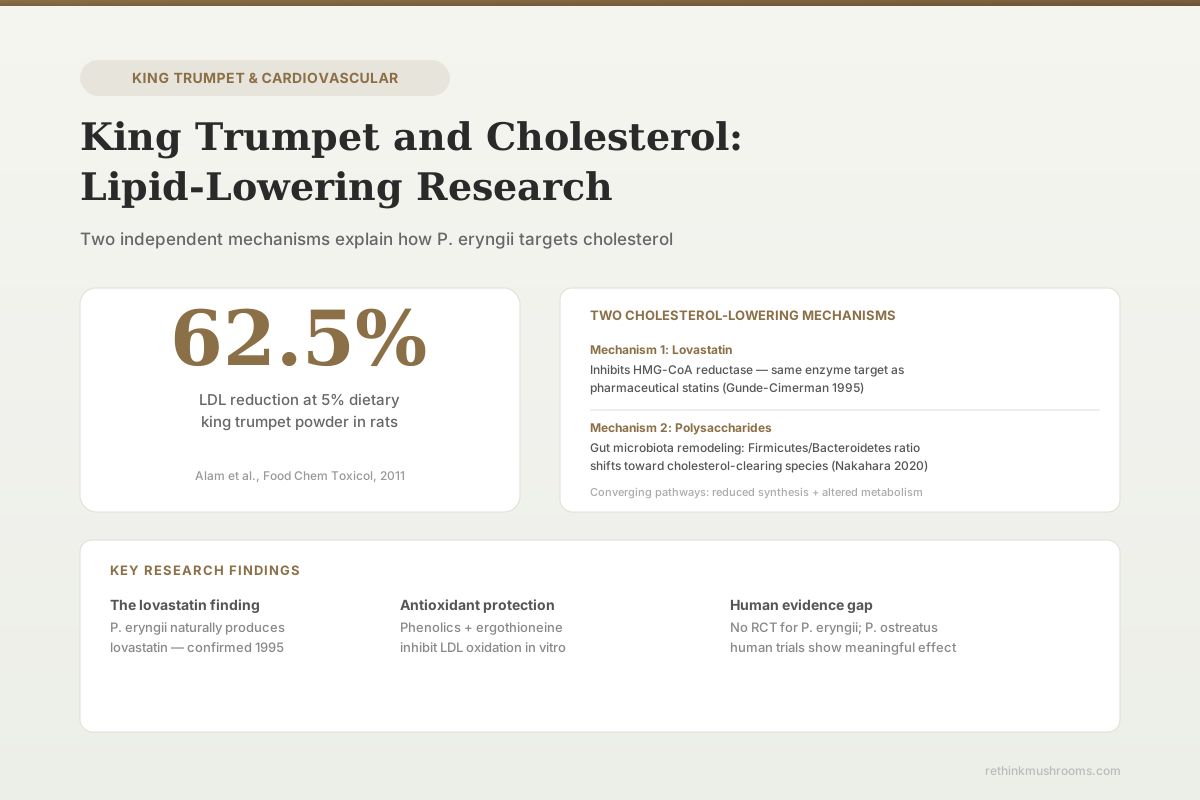
62.5% LDL cholesterol reduction from dietary king trumpet in hypercholesterolemic rats
Alam and colleagues fed hypercholesterolemic rats 5% Pleurotus eryngii fruiting body powder for 28 days. LDL dropped 62.5%, triglycerides fell 46.33%, and total cholesterol decreased 24.05%. Histological examination confirmed improvements in liver and arterial tissue at the cellular level.
Alam et al., Food and Chemical Toxicology, 2011
Natural lovastatin
Pleurotus fruiting bodies (including P. eryngii) contain lovastatin (the same compound as the pharmaceutical statin drug), confirmed by bioassay in the landmark 1995 study by Gunde-Cimerman and colleagues (Gunde-Cimerman et al., Exp Mycol, 1995)
Gut microbiota pathway
P. eryngii polysaccharides reduced cholesterol in high-fat-diet mice by reshaping gut microbiota, increasing Bifidobacterium and reducing Clostridium; a second mechanism independent of lovastatin (Nakahara et al., Food Sci Nutr, 2020)
8 human trials
Pleurotus ostreatus (a related species): systematic review of 8 clinical trials found significant LDL, triglyceride, and glucose improvements; the closest available human evidence for the Pleurotus genus (Dicks et al., Nutrients, 2020)
Alam et al., Food and Chemical Toxicology, 2011
 View as image ↗
King trumpet mushroom (Pleurotus eryngii) contains two independently acting cholesterol-lowering compounds: lovastatin and polysaccharides. Lovastatin is the same compound as the pharmaceutical statin drug Mevacor, produced naturally by Pleurotus fungi. The polysaccharides act through a separate pathway involving the gut microbiome and bile acid metabolism.
Most coverage of king trumpet and cholesterol mentions lovastatin but stops there, leaving out the polysaccharide mechanism and understating the combined evidence. This article covers both mechanisms, the animal model data showing their effects, and the honest state of human clinical evidence for the Pleurotus genus.
For the pillar overview, see what is king trumpet mushroom: the meaty mushroom with health benefits. For the broader cardiovascular research including atherosclerosis and platelet effects, see king oyster mushroom and cardiovascular health.
Key Takeaways
- Dietary inclusion of 5% Pleurotus eryngii powder in hypercholesterolemic rats over 28 days reduced LDL by 62.5%, triglycerides by 46.33%, total cholesterol by 24.05%, and the LDL/HDL ratio by 57.14%, with histologically confirmed improvements in liver and arterial tissue (Alam et al., Food Chem Toxicol, 2011)
- Pleurotus fruiting bodies contain lovastatin (mevinolin), the same HMG-CoA reductase inhibitor as the pharmaceutical statin drug, confirmed in a landmark 1995 study that identified lovastatin as the mechanistic basis for Pleurotus cholesterol-lowering activity (Gunde-Cimerman et al., Exp Mycol, 1995)
- P. eryngii polysaccharides provide a second, independent cholesterol-lowering pathway: they act as prebiotics, increasing Bifidobacterium and decreasing Clostridium in the gut microbiome, which produces SCFAs that signal the liver to reduce cholesterol synthesis (Nakahara et al., Food Sci Nutr, 2020)
- The cholesterol reduction from P. eryngii dietary supplementation appears to operate through at least three sub-mechanisms: HMG-CoA inhibition (lovastatin), bile acid binding by polysaccharides, and gut microbiota-mediated hepatic cholesterol regulation
- Choi and colleagues confirmed that P. eryngii var. ferulae extract reduced serum total cholesterol, LDL, and triglycerides in high-fat-diet rats, and also inhibited LDL oxidation, preventing the oxidized LDL that initiates arterial plaques (Choi et al., IJMM, 2017)
- The closest human clinical evidence comes from Pleurotus ostreatus (common oyster mushroom): a systematic review of 8 clinical trials found significant improvements in total cholesterol, LDL, triglycerides, and blood glucose, with evidence quality rated as low due to small sample sizes (Dicks et al., Nutrients, 2020)
The 62.5% LDL Finding: What the Study Measured
The most striking number in king trumpet cholesterol research comes from a 2011 study by Alam and colleagues published in Food and Chemical Toxicology.[1]
The study used rats with experimentally induced hypercholesterolemia (high blood cholesterol), a standard preclinical model for testing lipid-lowering interventions. The rats received a standard diet supplemented with 5% P. eryngii fruiting body powder for 28 days, approximately equivalent to adding mushroom powder to every meal at a substantial but not extreme inclusion rate.
After 28 days, the cholesterol panel results were:
| Lipid Marker | Change |
|---|---|
| LDL cholesterol | 62.5% reduction |
| Triglycerides | 46.33% reduction |
| Total cholesterol | 24.05% reduction |
| LDL/HDL ratio | 57.14% improvement |
The histological examination component is worth noting: beyond the blood measurements, the researchers examined liver and arterial tissue under the microscope and found cellular-level improvements in both. The liver is the primary site of cholesterol synthesis; arterial wall improvement suggests reduced lipid deposition in vessel walls at a cellular level.
A 2024 study by Du and colleagues confirmed the whole-food form retains beneficial effects.[5] When obese mice consumed whole king oyster mushroom as part of their diet, it reversed lipid metabolism abnormalities and corrected the gut microbiota dysbiosis that accompanies diet-induced obesity. This confirms that the cholesterol benefit observed in the 2011 study was not unique to the experimental extract form.
The Lovastatin Story: How the Pharmaceutical Compound Got Into a Mushroom
In 1995, Gunde-Cimerman and colleagues published a landmark finding: Pleurotus fruiting bodies, including P. eryngii, contain lovastatin (also called mevinolin).[3]
Lovastatin is the HMG-CoA reductase inhibitor that pharmaceutical companies developed as the drug Mevacor. HMG-CoA reductase (3-hydroxy-3-methylglutaryl-CoA reductase) is the rate-limiting enzyme in the mevalonate pathway, the biosynthetic route through which the liver makes cholesterol. Inhibiting this enzyme reduces the liver's cholesterol production, which in turn lowers circulating LDL levels.
What Gunde-Cimerman documented is that Pleurotus fungi synthesize this compound naturally, without human pharmaceutical engineering. The lovastatin in king trumpet is chemically identical to the lovastatin in the pharmaceutical drug. This established the biochemical basis for Pleurotus cholesterol-lowering effects.
Two important caveats apply. First, the concentration of lovastatin in Pleurotus fruiting bodies is substantially lower than pharmaceutical doses. A typical therapeutic dose of lovastatin is 10–80mg per day. Mushroom lovastatin content is typically in the range of milligrams per kilogram of dried mushroom, meaning a realistic food serving provides a fraction of a therapeutic pharmaceutical dose. At food-level concentrations, lovastatin likely contributes to the cholesterol effect but probably cannot account for the full magnitude of reduction observed in the animal model studies.
Second, natural lovastatin is chemically identical to pharmaceutical lovastatin, which means the same precautions apply. High-dose concentrated mushroom extracts could deliver meaningful lovastatin amounts, and anyone taking prescribed statin medications should be aware that combined statin activity could increase the risk of side effects.
For a focused look at the lovastatin content, concentration comparisons, and the statin-analogy angle, see king oyster mushroom and statin-like effects on cholesterol.
The Polysaccharide Mechanism: The Gut-Liver Axis
While lovastatin gets most of the attention, P. eryngii polysaccharides appear to contribute independently to cholesterol lowering through a completely different pathway.
Nakahara and colleagues fed high-fat-diet mice P. eryngii polysaccharides and measured both lipid profiles and gut microbiota composition in 2020.[4] The polysaccharide supplementation reduced high-fat-diet-induced obesity and improved lipid profiles. Alongside these effects, gut microbiota composition changed in a specific direction: Bifidobacterium increased while Clostridium decreased.
Bifidobacterium species are producers of short-chain fatty acids (SCFAs), including butyrate, propionate, and acetate, through fermentation of dietary fiber and polysaccharides. SCFAs reach the liver through the portal circulation and signal hepatic cells to reduce cholesterol synthesis and increase LDL receptor expression. Increased LDL receptor expression means more LDL is cleared from the bloodstream.
This gut-liver cholesterol axis is separate from the HMG-CoA mechanism. It does not require lovastatin; it works through the fermentation of polysaccharides by beneficial gut bacteria. The two mechanisms therefore add together: lovastatin reduces cholesterol synthesis in the liver, while polysaccharide fermentation further suppresses synthesis and increases cholesterol clearance.
A third mechanism also operates within the gut: soluble beta-glucan polysaccharides bind bile acids in the intestine, preventing their reabsorption. The liver compensates by converting more circulating cholesterol into replacement bile acids, reducing the cholesterol pool.
LDL Oxidation Inhibition: Preventing the Dangerous Form
Beyond reducing LDL quantity, P. eryngii may also reduce the harm caused by whatever LDL remains circulating. Choi and colleagues tested P. eryngii var. ferulae extract in high-fat-diet rats in 2017 and documented not only reductions in serum LDL and triglycerides but also inhibition of LDL oxidation in vitro.[2]
LDL oxidation is the process by which circulating LDL particles are chemically altered by reactive oxygen species, transforming them into oxidized LDL (oxLDL). Oxidized LDL is the form that initiates the macrophage-driven inflammatory cascade leading to arterial plaques. Normal LDL is far less likely to trigger plaque formation than oxLDL.
The P. eryngii antioxidant compounds (phenolics, ergothioneine, and other small molecules) can inhibit the oxidation of LDL in vitro. If this effect translates in vivo, it provides a cardiovascular benefit at a different stage from cholesterol lowering: not just reducing how much LDL is present, but reducing how harmful the LDL that remains actually is.
What Human Studies Show (and Which Species They Study)
The gap between compelling animal model data and human clinical evidence is a consistent feature of king trumpet research. No published randomized clinical trial has specifically tested P. eryngii for cholesterol-lowering effects in humans.
The closest available human data comes from Pleurotus ostreatus (common oyster mushroom), a related Pleurotus species with similar polysaccharide and lovastatin chemistry. Dicks and colleagues conducted a systematic review of 8 clinical trials of P. ostreatus supplementation for cardiometabolic parameters in 2020.[6]
The results: clinical trials consistently showed improvements in total cholesterol, LDL, triglycerides, and blood glucose. The effect was not trivial; several trials showed clinically meaningful reductions in lipid markers. However, the review rated the overall evidence quality as low due to small sample sizes, short durations, and methodological variation across trials.
P. ostreatus and P. eryngii share the same Pleurotus genus and similar active compound profiles, including lovastatin and beta-glucan polysaccharides. The ostreatus human evidence provides a plausible basis for expecting similar effects from P. eryngii, but it remains an extrapolation until P. eryngii-specific human trials are conducted.
For the detailed mechanistic breakdown of how each active compound reduces cholesterol, see Pleurotus eryngii and LDL reduction: mechanisms. For the broader cardiovascular picture including arterial health, see king trumpet and arterial health: atherosclerosis research.
The Bottom Line
King trumpet mushroom (Pleurotus eryngii) lowers cholesterol through two independent pathways. Lovastatin, identified in Pleurotus fruiting bodies in 1995, inhibits HMG-CoA reductase; the same pharmaceutical statin mechanism. Polysaccharides act through the gut microbiota: Bifidobacterium increases, SCFAs signal hepatic cholesterol reduction, and bile acid binding prevents cholesterol reabsorption. The combined effect in hypercholesterolemic rats produced 62.5% LDL reduction, 46.33% triglyceride reduction, and 24.05% total cholesterol reduction at 5% dietary inclusion (Alam et al., 2011). P. eryngii var. ferulae extract also inhibited LDL oxidation, reducing the formation of the arterial-plaque-initiating oxidized LDL form (Choi et al., 2017). Human evidence is from P. ostreatus (related species): 8 clinical trials showed significant cardiometabolic benefits, though rated low quality (Dicks et al., 2020).
Frequently Asked Questions
Sources & References
- 1RTHM-00204·Alam, Nuhu et al. (2011). “Dietary effect of Pleurotus eryngii on biochemical function and histology in hypercholesterolemic rats..” Saudi journal of biological sciences.Study breakdown →PubMed →↩
- 2RTHM-00862·Choi, Jun-Hui et al. (2017). “In Vitro Antioxidant and In Vivo Hypolipidemic Effects of the King Oyster Culinary-Medicinal Mushroom, Pleurotus eryngii var. ferulae DDL01 (Agaricomycetes), in Rats with High-Fat Diet-Induced Fatty Liver and Hyperlipidemia..” International journal of medicinal mushrooms.Study breakdown →PubMed →↩
- 3RTHM-00016·Gunde-Cimerman, N et al. (1995). “Pleurotus fruiting bodies contain the inhibitor of 3-hydroxy-3-methylglutaryl-coenzyme A reductase-lovastatin..” Experimental mycology.Study breakdown →PubMed →↩
- 4RTHM-00643·Nakahara, Daiki et al. (2020). “Effect of mushroom polysaccharides from Pleurotus eryngii on obesity and gut microbiota in mice fed a high-fat diet..” European journal of nutrition.Study breakdown →PubMed →↩
- 5RTHM-00876·Du, Hengjun et al. (2024). “Dietary intake of whole king oyster mushroom (Pleurotus eryngii) attenuated obesity via ameliorating lipid metabolism and alleviating gut microbiota dysbiosis..” Food research international (Ottawa.Study breakdown →PubMed →↩
- 6RTHM-00614·Dicks, Lisa et al. (2020). “Effect of the Intake of Oyster Mushrooms (Pleurotus ostreatus) on Cardiometabolic Parameters-A Systematic Review of Clinical Trials..” Nutrients.Study breakdown →PubMed →↩