Oyster Mushroom Lovastatin
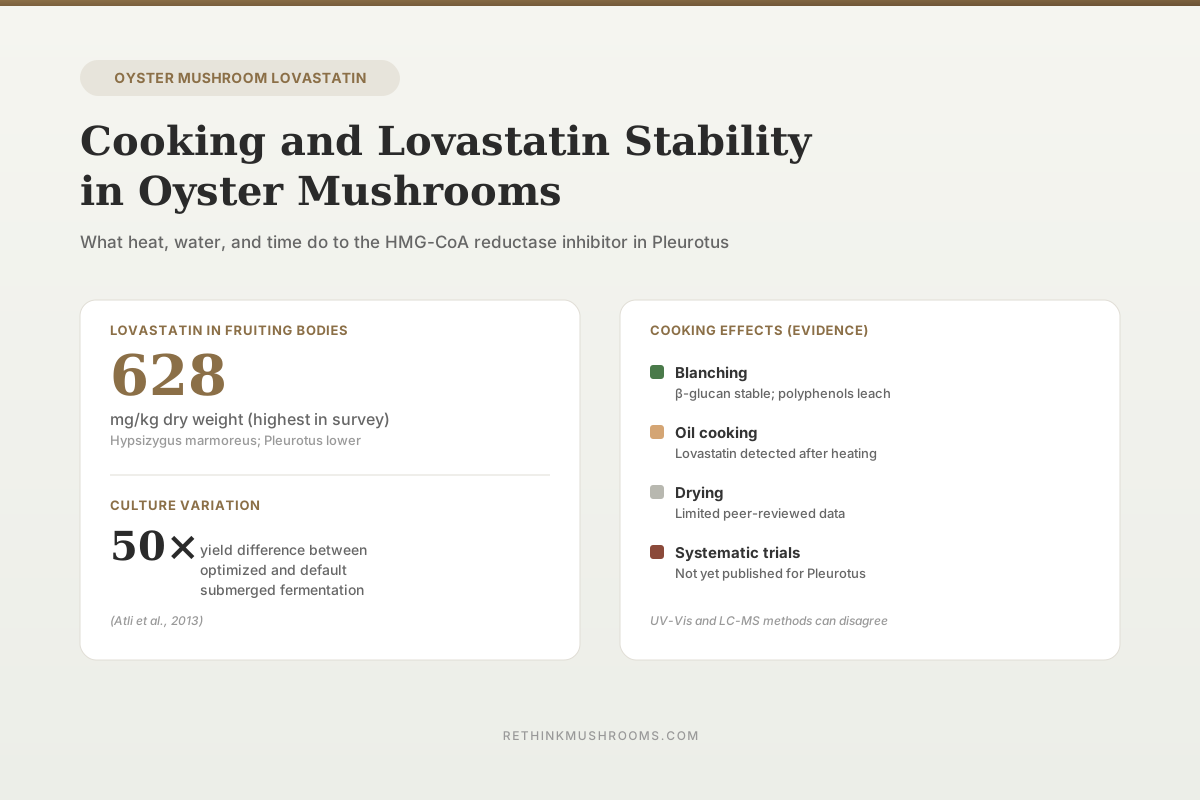
628 mg/kg
A 2012 survey of 19 mushroom species quantified lovastatin in fruiting bodies; Hypsizygus marmoreus (shimeji) led at 628 mg/kg dry weight, while Pleurotus species varied widely across samples.
Lo et al., Pharmaceutical Biology, 2012
1995
first identified in Pleurotus
50x
variation with culture conditions
UV vs. LC-MS
detection methods disagree
Lo et al., Pharmaceutical Biology, 2012
 View as image ↗
Pleurotus ostreatus fruiting bodies contain lovastatin, the same competitive HMG-CoA reductase inhibitor sold as a cholesterol-lowering drug. The question growers and eaters ask is practical: does cooking destroy it, or does a sautéed plate of oyster mushrooms deliver anything meaningful? The short answer is that direct cooking-stability trials are sparse, the natural content is highly variable, and the analytical methods used to measure lovastatin in mushrooms disagree with each other. This article collects the published evidence and names the gaps honestly. For the broader lovastatin context, see the sibling articles natural lovastatin in oyster mushrooms, lovastatin biosynthesis in Pleurotus ostreatus, can eating Pleurotus replace a statin, and oyster mushroom vs. statin drugs. For the broader cooking question, see best ways to cook oyster mushrooms.
Key Takeaways
- Lovastatin was first identified in Pleurotus ostreatus fruiting bodies in 1995, with content varying across the mycelium, primordia, stripes, pili, lamellae, and basidiospores (Gunde-Cimerman et al., 1995)
- In a survey of 19 mushroom species, Pleurotus contained lovastatin but the highest concentration recorded in any fruiting body was 628 mg/kg in Hypsizygus marmoreus, not an oyster species (Lo et al., 2012)
- Lovastatin was not detected in raw Pleurotus ostreatus in one controlled study, and blanching did not significantly change β-glucan content but reduced dry matter, polyphenols, and antioxidant activity (Lam et al., 2015)
- Optimized submerged fermentation reached 114.82 mg/L of lovastatin from P. ostreatus, approximately 50 times the yield under default conditions, showing how sensitive production is to culture environment (Atli et al., 2013)
- UV-Vis and LC-MS methods disagree on lovastatin quantification in mushroom matrices because substrate components interfere with UV absorbance (Tsiantas et al., 2021)
- The C:N ratio and the type of nitrogen source strongly influence lovastatin yield in Pleurotus cultures, with organic nitrogen maximizing output (Alarcón and Águila, 2006)
What Lovastatin Is and Why It Is in Pleurotus
Lovastatin is a naturally produced secondary metabolite. In fungi, it competitively inhibits HMG-CoA reductase, the rate-limiting enzyme in sterol biosynthesis. The pharmaceutical lovastatin sold as Mevacor was originally isolated from Aspergillus terreus. The same molecule is produced by Pleurotus ostreatus and related species, and it was first documented in the oyster mushroom by Gunde-Cimerman and colleagues in 1995. Their study followed lovastatin through the development of fruiting bodies and quantified it in vegetative mycelium, primordia, and different anatomical parts of sporocarps of different sizes, with less lovastatin in stripes than in pili or, in mature stages, in the lamellae and basidiospores.[1]
Two implications follow. First, lovastatin is not uniformly distributed across the fruiting body; the part of the mushroom you eat affects your exposure. Second, the compound is present in the mushroom matrix as a natural metabolite, surrounded by proteins, polysaccharides, and lipids that can protect or destabilize it during cooking.
Why Natural Content Is So Variable
Natural lovastatin in Pleurotus fluctuates across strains, substrates, and growing conditions. Alarcón and Águila (2006) showed that the C:N ratio and the type of nitrogen source directly change lovastatin yield in P. ostreatus cultures; the maximum yield in their experiments came from a medium containing organic nitrogen.[2] Alarcón et al. (2003) compared liquid culture to growth on wheat straw and measured different lovastatin yields between the two systems.[3]
The variability scales are large. Atli et al. (2013) used Plackett-Burman and Box-Behnken designs to optimize submerged fermentation for P. ostreatus OBCC 1031 and reached a maximum of 114.82 mg/L of lovastatin after 6 days under optimized conditions (30 g/L glucose, 10 g/L yeast extract, 200 rpm, 28°C, pH 6). This yield was approximately 50 times higher than the yield under unoptimized default conditions.[4] The same species, the same strain, under different culture environments, produces quantities that differ by more than an order of magnitude.
Lo et al. (2012) ran a comparative quantification of lovastatin, GABA, and ergothioneine across 15 fruiting bodies and 9 mycelia from 19 species. The highest lovastatin value in fruiting bodies was 628.05 mg/kg in Hypsizygus marmoreus; the highest mycelial value was 1,438.42 mg/kg in Morchella esculenta. Pleurotus species were present but did not top the rankings.[5]
Then comes the contradicting result. Lam and colleagues (2015) analyzed raw and processed P. ostreatus specifically for lovastatin, β-glucan, total polyphenols, and antioxidant activity. Dry matter was 8%; β-glucan was 23.9%; total polyphenols reached 487.12 mg gallic acid equivalent per 100 g dry matter. Lovastatin was not detected.[6] Either the specific P. ostreatus samples tested did not express lovastatin at detectable levels, or the analytical method failed to detect it. Both possibilities matter.
Before You Even Turn On the Stove
Natural Lovastatin Content Spans Orders of Magnitude
The same question — “how much lovastatin is in this mushroom?” — has answers ranging from none detectable to well over a thousand milligrams per kilogram, depending on species, strain, tissue, and how it was measured. Note the log scale: each gridline is 10× the last. Cooking effects sit on top of this baseline spread.
628 mg/kg
Hypsizygus (shimeji) fruiting body — not an oyster
Lo 2012 [5]
1,438 mg/kg
Morchella mycelium — not an oyster fruiting body
Lo 2012 [5]
mg/kg dry weight (log scale)
A different axis entirely: optimized submerged fermentation of P. ostreatus reached 114.82 mg/L of broth — roughly 50× the unoptimized yield (Atli 2013 [4]). That is a production number in mg per litre of liquid culture, not mg per kilogram of the fruiting body you would eat, so it cannot be placed on the axis above — but it shows how violently the same strain’s output swings with growing conditions.
Sources: Lo et al. 2012 [5] (628.05 mg/kg fruiting-body and 1,438.42 mg/kg mycelial ceilings across 19 species); Lam et al. 2015 [6] (lovastatin not detected in raw P. ostreatus); Atli et al. 2013 [4] (114.82 mg/L, ~50× swing under optimized fermentation). Marker positions are exact on the log axis; the survey ceilings belong to non-oyster species and are shown to bound the range, not as oyster values.
The Detection Problem
Tsiantas et al. (2021) compared UV-Vis spectrometry and liquid chromatography-mass spectrometry (LC-MS) methods for identifying and quantifying lovastatin and ergothioneine in various mushroom species.[7] They highlighted substrate-based interferences that hinder accurate determination of lovastatin in mushroom matrices, where pigments and co-extracted compounds absorb in the same UV range and inflate UV-Vis readings relative to LC-MS values. UV-Vis is cheaper and more widely used in older literature; LC-MS is specific but less accessible. This methodological split helps explain why published values for "lovastatin in P. ostreatus" range from undetectable to hundreds of mg/kg across studies.
For a reader trying to decide what a meal of oyster mushrooms actually delivers, this is the first honest caveat: many of the encouraging numbers published for Pleurotus lovastatin content derive from UV-Vis methods that may overstate true lovastatin, while the specific controlled studies using more rigorous detection sometimes find little or none.
What Is Published on Cooking and Heat
Direct cooking-stability trials on lovastatin in oyster mushrooms are limited in number and narrow in scope. The published evidence addresses blanching, steaming, and oil frying at commonly used kitchen temperatures.
Blanching. Lam et al. (2015) blanched P. ostreatus and measured the resulting mushrooms and the blanching water.[6] β-glucan content was not significantly affected by blanching. Dry matter, polyphenols, and three measures of antioxidant activity (DPPH, TEAC, FRAP) all decreased. Mushroom rolls made from the blanched mushrooms plus the blanching water recovered the β-glucan, polyphenol, and FRAP values relative to blanched mushrooms alone, indicating that the lost fraction leached into the water rather than degrading. Lovastatin was not measurable in this sample, so the effect of blanching on the compound itself could not be tracked directly.
The blanching-water finding is still instructive. If lovastatin behaves like polyphenols (water-soluble, heat-stable within the blanching range), discarding blanching water discards a fraction of the compound. If lovastatin behaves more like β-glucan (retained in the mushroom tissue), blanching would preserve it.
Lam & Okello (2015) · International Journal of Medicinal Mushrooms
- Population
- Raw and blanched Pleurotus ostreatus fruiting bodies, plus the blanching water and mushroom rolls made from both
- Intervention
- Blanching, with each fraction analyzed separately for β-glucan, polyphenols, antioxidant activity, and lovastatin
- Comparator
- Raw mushroom vs. blanched mushroom vs. blanched mushroom recombined with its blanching water
- Finding
- Raw P. ostreatus contained 23.9% β-glucan and 487.12 mg gallic-acid-equivalent polyphenols per 100 g dry matter, at 8% dry matter — but lovastatin was not detected. Blanching left β-glucan essentially unchanged while significantly lowering dry matter, polyphenols, and all three antioxidant measures (DPPH, TEAC, FRAP). Recombining the blanching water recovered the lost polyphenols and FRAP, pointing to leaching rather than thermal destruction.
narrow-scope Because lovastatin itself was undetectable in this sample, the study cannot tell us directly what blanching does to lovastatin. It is strong evidence about leaching of water-soluble compounds, and only indirect evidence for lovastatin retention.
Lam & Okello, International Journal of Medicinal Mushrooms, 2015
Oil cooking. Thermal stability research on P. ostreatus and P. eryngii cooked in oil at different temperatures reports that lovastatin remained present after cooking, while the mycotoxin citrinin (sometimes co-occurring in mushroom cultivation) decomposed. These results have been presented in conference format and in applied food-science literature but have not been replicated in high-profile peer-reviewed journals, so the confidence level is lower than the blanching data.
Drying. Published studies on drying effects are similarly sparse. Lovastatin was originally isolated from Aspergillus terreus, where it was first named mevinolin; it is the same molecule found in Pleurotus, and the purified compound is reasonably stable under dry, dark storage. Whether the Pleurotus matrix preserves or degrades lovastatin during hot-air or freeze drying — and how much drying temperature matters — is not directly answered in the available literature.
The honest summary. Across blanching, oil cooking, and drying, the available evidence points toward partial preservation of lovastatin under ordinary kitchen conditions, with water-based losses through leaching and potential thermal losses at extended cooking times or temperatures beyond typical sauté. No study yet has systematically measured cooking time, pan temperature, and lovastatin recovery across a range of conditions in a way that lets a grower or eater predict retention with confidence.
A note on molecular form. Lovastatin in mushroom tissue may exist as the closed lactone form, the open β-hydroxy acid form, or a mixture of both. The two forms are interconvertible by pH and temperature: alkaline conditions and heat favor ring opening to the acid form, while acidic conditions and cooling favor the closed lactone. The acid form is the pharmacologically active species in vivo. Published measurements of "lovastatin content" in mushrooms do not always specify which form was quantified or whether the extraction protocol preserved the native ratio. A cooking method that changes the lactone-to-acid ratio without destroying total mass would still change the apparent concentration reported by lactone-specific detection. This adds a second layer of methodological uncertainty on top of the UV-Vis vs. LC-MS distinction.
What Fruiting and Anatomy Contribute
The Gunde-Cimerman (1995) finding that lovastatin is not uniformly distributed matters for cooking.[1] If the lamellae and basidiospores carry more lovastatin than stripes, the part of the fruiting body trimmed and discarded (tough stem bases are commonly removed) could remove a proportionally smaller share than the tissue kept for cooking. Conversely, any preparation that breaks off spore-bearing surfaces (vigorous washing, long pre-cook soaking) could deplete a proportionally larger share.
Maturity also matters. Primordia and young fruiting bodies contain lovastatin; mature sporocarps with open gills contain it in different anatomical concentrations. The practical implication is that mushroom age at harvest, which growers control and home cooks often do not, contributes to the compound's initial concentration before any heat is applied.
Is This a Meaningful Dietary Source?
The pharmaceutical dose of lovastatin for cardiovascular indications is typically 10-80 mg per day. If a P. ostreatus sample contains lovastatin in the upper range documented by Lo et al. (2012), rough arithmetic suggests that 100 g of fresh mushrooms (≈10 g dry weight) could supply single-digit milligrams of lovastatin, within an order of magnitude of the low end of the pharmaceutical range. If a sample is near zero (as in Lam et al., 2015), the same meal delivers effectively none.[5][6]
Cooking then introduces additional uncertainty on top of that multi-order-of-magnitude baseline variability. The claim that eating oyster mushrooms delivers a meaningful pharmacological statin dose is not supported by the current evidence base. The claim that eating oyster mushrooms delivers some lovastatin and other HMG-CoA-active compounds, along with β-glucans that independently affect cholesterol absorption (beta-glucans and cholesterol absorption), is supported. These are different claims.
Fact check
Does a plate of sautéed oyster mushrooms work like a statin tablet?
The claim
“Oyster mushrooms are a natural statin, so a serving delivers a meaningful cholesterol-lowering lovastatin dose — and since cooking doesn't destroy it, a cooked plate does the job of a pill.”
Extrapolation from the true fact that Pleurotus produces lovastatin, amplified by wellness marketing and by high UV-Vis content numbers that tend to overstate the real amount.
What research shows
OverstatedA pharmaceutical dose is a standardized 10–80 mg per day. A mushroom serving delivers a wildly variable amount — from effectively none (lovastatin was undetectable in raw P. ostreatus in Lam & Okello 2015) up to, at best, single-digit milligrams when a sample sits near the top of the measured range. You cannot know which end of that range your particular mushrooms fall on.
Oyster mushrooms are still a sensible food for heart health — but largely through β-glucans that affect cholesterol absorption, not through a reliable pharmacological lovastatin dose. 'Contains lovastatin' and 'delivers a statin dose' are different claims, and only the first is well supported.
Lo et al. 2012; Lam & Okello 2015; Atli et al. 2013
For the lipid-lowering evidence from whole-food oyster mushroom trials, see can eating oyster mushrooms lower your LDL.
Safety
ModerateDo not treat oyster mushrooms as a replacement for a prescribed statin
Concern
Because Pleurotus naturally contains lovastatin, some readers may be tempted to stop or reduce a prescribed statin and eat mushrooms instead. The natural dose is unmeasured, ranges from undetectable upward, and is further altered by cooking — nothing like the standardized, titrated dose of a tablet. Stopping a statin against medical advice can raise cardiovascular risk.
What the research says
Enjoy oyster mushrooms as a nutritious food, not as a cholesterol medication. If you are managing cholesterol or cardiovascular risk, do not change or stop any prescribed medication based on a mushroom's lovastatin content, and review any dietary or supplement change with your physician or pharmacist. This article is educational and not medical advice.
Particularly relevant for: Anyone taking or considering a statin, or managing high cholesterol
What to do
Never substitute mushrooms for a prescribed statin; review any medication change with your clinician.
Pharmaceutical dosing range 10–80 mg/day; Lam & Okello 2015; Lo et al. 2012
What the Evidence Does Not Say
No controlled trial has measured lovastatin in a commercial P. ostreatus sample before and after specific cooking methods (sauté, steam, boil, grill, dehydrate) using LC-MS detection. Existing data on processing effects use small, non-representative samples and detection methods that do not agree. Public-facing recommendations that cite specific lovastatin retention percentages for specific cooking methods are currently not grounded in direct experimental data on Pleurotus.
No controlled trial has compared lovastatin bioavailability from a cooked mushroom meal to oral lovastatin in matched doses. The pharmacokinetic question of how mushroom-matrix lovastatin is absorbed, metabolized, and distributed relative to tablet lovastatin remains open.
No large-scale survey has quantified strain-level and substrate-level variation in commercial Pleurotus offerings sold in retail settings. Content from farm to farm, season to season, and strain to strain is likely to vary considerably based on the cultivation literature above, but the consumer-facing measurements are not in the published record.
The Bottom Line
Pleurotus ostreatus contains lovastatin, but natural content varies by strain, substrate, anatomy, and detection method, ranging from undetectable to hundreds of mg/kg. Direct cooking-stability data are sparse; available evidence supports partial retention through standard kitchen preparation, with water-based losses through leaching and potential thermal losses at high heat. Reliable predictions of lovastatin delivery from a cooked meal are not currently possible given the combined variability in starting material and the limited peer-reviewed cooking trials.
Frequently Asked Questions
Sources & References
- 1RTHM-00016·Gunde-Cimerman, N et al. (1995). “Pleurotus fruiting bodies contain the inhibitor of 3-hydroxy-3-methylglutaryl-coenzyme A reductase-lovastatin..” Experimental mycology.Study breakdown →PubMed →↩
- 2RTHM-00091·Alarcón, Julio et al. (2006). “Lovastatin production by Pleurotus ostreatus: effects of the C:N ratio..” Zeitschrift fur Naturforschung. C.Study breakdown →PubMed →↩
- 3RTHM-00054·Alarcón, Julio et al. (2003). “Production and purification of statins from Pleurotus ostreatus (Basidiomycetes) strains..” Zeitschrift fur Naturforschung. C.Study breakdown →PubMed →↩
- 4RTHM-00277·Atli, Burcu et al. (2013). “Optimization of submerged fermentation conditions for lovastatin production by the culinary-medicinal oyster mushroom, Pleurotus ostreatus (Higher Basidiomycetes)..” International journal of medicinal mushrooms.Study breakdown →PubMed →↩
- 5RTHM-00256·Lo, Yu-Chang et al. (2012). “Comparative study of contents of several bioactive components in fruiting bodies and mycelia of culinary-medicinal mushrooms..” International journal of medicinal mushrooms.Study breakdown →PubMed →↩
- 6RTHM-00384·Lam, Yu Shan et al. (2015). “Determination of Lovastatin, β-glucan, Total Polyphenols, and Antioxidant Activity in Raw and Processed Oyster Culinary-Medicinal Mushroom, Pleurotus ostreatus (Higher Basidiomycetes)..” International journal of medicinal mushrooms.Study breakdown →PubMed →↩
- 7RTHM-00725·Tsiantas, Konstantinos et al. (2021). “On the Identification and Quantification of Ergothioneine and Lovastatin in Various Mushroom Species: Assets and Challenges of Different Analytical Approaches..” Molecules (Basel.Study breakdown →PubMed →↩