Cholesterol / Cardiovascular
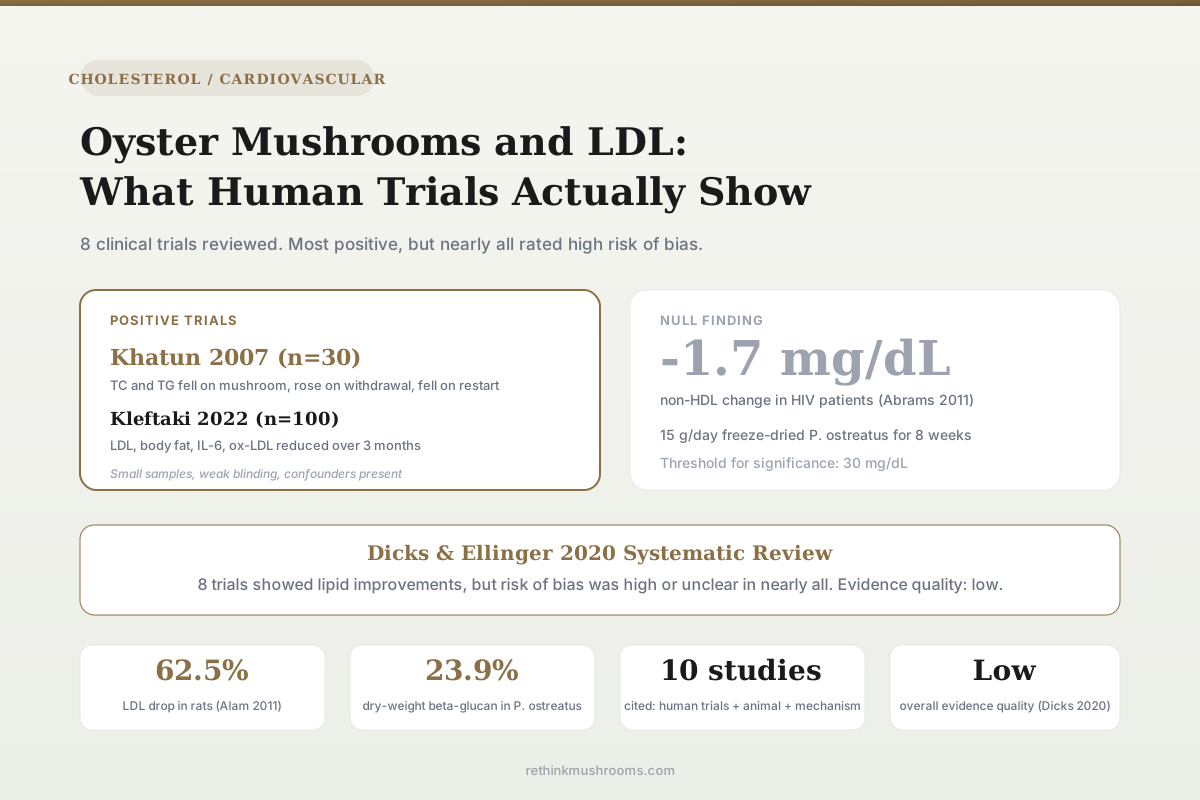
-1.7 mg/dL non-HDL change
In HIV patients with antiretroviral-induced hyperlipidemia, 15 g/day of freeze-dried oyster mushroom for 8 weeks changed non-HDL cholesterol by only 1.7 mg/dL, far below the 30 mg/dL threshold the researchers defined as clinically significant.
Abrams et al., BMC Complementary and Alternative Medicine, 2011
8 trials
reviewed by Dicks 2020; most showed lipid improvements but risk of bias was high or unclear in nearly all
62.5%
LDL reduction in hypercholesterolemic rats fed 5% Pleurotus eryngii powder (Alam et al., 2011)
30 subjects
in the Khatun 2007 diabetic crossover trial: total cholesterol and triglycerides fell on oyster mushroom, rose on withdrawal
Abrams et al., BMC Complementary and Alternative Medicine, 2011
 View as image ↗
The question "can eating oyster mushrooms lower your LDL" sits at an awkward intersection. The mechanistic case is plausible: Pleurotus ostreatus contains β-glucans that bind bile acids, it has been reported (inconsistently) to contain trace amounts of the HMG-CoA reductase inhibitor lovastatin, and animal models show dramatic lipid reductions. But the human clinical evidence is small, mostly old, and includes at least one well-designed null trial. A 2020 systematic review found eight human intervention studies and concluded the overall evidence quality was low. This is the honest picture: a handful of positive results, one notable negative, weak methodology across the board, and no definitive answer. For the broader mechanistic story tying these pieces together, see oyster mushrooms and cholesterol: the natural statin connection.
Key Takeaways
- A 2020 systematic review (Dicks & Ellinger) of eight clinical trials found that Pleurotus ostreatus intake was associated with reductions in total cholesterol, LDL cholesterol, and/or triglycerides in most studies, but risk of bias was rated high or unclear in nearly every trial[1]
- In 30 patients with type 2 diabetes, Khatun et al. (2007) reported significant reductions in total cholesterol, triglycerides, fasting glucose, and blood pressure during a 7-day oyster mushroom phase; all markers re-elevated during withdrawal and fell again on restart (n = 30 completers, 24-day protocol)
- A 2011 proof-of-concept trial in 20 HIV patients on antiretroviral therapy found that 15 g/day freeze-dried P. ostreatus for 8 weeks changed non-HDL cholesterol by only 1.7 mg/dL, far below the 30 mg/dL threshold researchers defined as clinically significant (Abrams et al., BMC CAM, 2011)
- A 3-month RCT of 100 metabolically unhealthy adults found that a daily Pleurotus eryngii (king oyster) snack baked with UV-B-enhanced vitamin D2 lowered LDL, body fat, waist circumference, IL-6, and oxidized LDL compared with dietary counseling alone (Kleftaki et al., 2022)
- A double-blind crossover trial in 22 adults with impaired glucose tolerance showed that 20 g of dried oyster mushroom (8.1 g β-glucans) added to a meal did not change postprandial glucose, insulin, or triglycerides but reduced non-esterified free fatty acids by 14% and increased GLP-1 by 17% (Dicks et al., 2022)
- In hypercholesterolemic rats, a 5% Pleurotus eryngii diet reduced plasma LDL by 62.5%, total cholesterol by 24%, and triglycerides by 46% while increasing fecal cholesterol and bile acid excretion (Alam et al., 2011), effect sizes far larger than anything observed in human trials
What the Human Clinical Trials Actually Show
Human data on oyster mushrooms and LDL cholesterol is thinner than most popular-health coverage implies. Dicks and Ellinger (2020) conducted a systematic review under PRISMA guidelines using the Cochrane Collaboration's risk-of-bias tool. They identified only eight human intervention studies that tested Pleurotus ostreatus intake on cardiometabolic outcomes. Most of those studies reported reductions in at least one of total cholesterol, LDL, or triglycerides. But the review's risk-of-bias assessment concluded that "in most studies, the risk of bias was high or unclear due to methodological weaknesses and/or inadequate reporting," and the authors stated that "evidence for this is low" and that "further clinical trials with an adequate study design are warranted."[1]
This is a critical frame. The individual trials showing LDL reductions are not wrong, but they are small, short, and underpowered, with few using rigorous blinding or placebo controls. For practical purposes, "most trials show improvement" and "the evidence is strong" are not the same claim. For a broader look at the cardiovascular evidence base, see oyster mushrooms for heart health: cardiovascular research review.
The oldest and most frequently cited trial is Khatun et al. (2007), published in the Mymensingh Medical Journal. The authors enrolled 89 subjects at BIRDEM hospital in Bangladesh, of whom 30 (17 male, 13 female, mean age 46.3 years) completed a 24-day protocol consisting of 7 days of oyster mushroom consumption, 7 days of washout, and 7 days of mushroom resumption. During the mushroom phases, subjects showed significant reductions in fasting and 2-hour postprandial plasma glucose (p < 0.001), total cholesterol, triglycerides, and both systolic and diastolic blood pressure. When mushroom was withdrawn, diastolic blood pressure, fasting glucose, 2-hour glucose, total cholesterol, and triglycerides all re-elevated. When mushroom intake resumed, the markers fell again. HDL cholesterol and body weight did not change.[2]
The on-off-on crossover design is the strongest methodological feature of this trial. Each subject served as their own control, and the reversal of the lipid reduction during withdrawal provides weak causal support for the intervention. The weaknesses: no placebo, no blinding, small sample after dropout, short duration, a single-center clinical population of diabetic patients (so direct extrapolation to non-diabetic hyperlipidemia is uncertain), and limited reporting of exact change magnitudes in the abstract.
The HIV Trial: A Well-Designed Null Result
The most methodologically careful trial in this area is Abrams et al. (2011), published in BMC Complementary and Alternative Medicine. The trial was designed specifically to test whether oyster mushrooms could help HIV patients whose antiretroviral therapy had caused hypercholesterolemia. This population can't easily take statins because of cytochrome P450 drug-drug interactions with protease inhibitors.
The design: a single-arm, open-label, 8-week proof-of-concept study. Target enrollment was 20. Of 126 patients screened, 25 were enrolled and 20 completed. Mean age was 46.4 years; mean HIV duration was 13.7 years. All participants had baseline non-HDL cholesterol above 160 mg/dL, the entry criterion. Each received 15 g/day of freeze-dried P. ostreatus to administer orally for the full 8 weeks. Lipid panels were drawn every 2 weeks, and safety monitoring included self-reported muscle aches and measurement of liver and muscle enzymes. The authors pre-specified a 30 mg/dL reduction in non-HDL cholesterol as their clinical significance threshold.[3]
The result: mean non-HDL cholesterol was 204.5 mg/dL at day 0 and 200.2 mg/dL at day 56. The mean within-person change was -1.70 mg/dL (95% CI crossing zero). HDL and triglyceride changes were small and not of clinical magnitude. The authors concluded the intervention did not lower non-HDL cholesterol enough to warrant further study in this population.
Two interpretations are possible. First, 15 g/day of freeze-dried P. ostreatus may simply be an insufficient dose for humans to achieve meaningful lipid reduction over 8 weeks. Second, the HIV/ART population may have a specific metabolic etiology (direct drug effects on lipid handling) that dietary interventions cannot easily override. Both possibilities are consistent with the observed null. The trial was open-label and not placebo-controlled, so the null cannot be attributed to blinding-induced attenuation. If anything, unblinded studies tend to exaggerate effects.
This is the kind of result that doesn't usually appear in popular health articles about mushroom cholesterol benefits, and it should. An adequately powered human trial with a pre-specified outcome threshold found no clinically meaningful lipid effect in a population that genuinely needed one.
The Strongest Recent Positive Trial
Kleftaki et al. (2022) conducted a 3-month randomized controlled trial of 100 metabolically unhealthy adults, published in Antioxidants. Both arms received conventional nutritional counseling. The intervention arm additionally consumed a daily snack made from Pleurotus eryngii (king oyster mushroom) that had been baked and then UV-B-irradiated to enrich vitamin D2 content.[4]
After three months, the intervention group showed reductions in body weight, body fat, waist and hip circumferences, fasting glucose, LDL cholesterol, and AST (SGOT) that were either statistically or clinically distinguishable from the counseling-only group. Serum 25(OH)D2 rose in the intervention arm, confirming vitamin D2 bioavailability from the UV-irradiated mushroom. Inflammatory and oxidative stress markers IL-6 and oxidized LDL decreased only in the mushroom group. Self-reported overall physical health improved.
This is the most robust positive trial in the modern literature: larger than the earlier studies, longer duration, parallel-group design, and a clinically relevant metabolic population. Its limitations are the lack of true placebo control (the mushroom snack was distinctive and participants could not be blinded), the confounding from simultaneous vitamin D2 enrichment (which has its own lipid-modulating effects through mechanisms unrelated to mushroom constituents), and the species difference: this was P. eryngii, not the more commonly studied P. ostreatus. The two species share β-glucan biology but differ in polysaccharide structure and secondary metabolite profiles.
Postprandial Effects: β-Glucans Do Something
Dicks et al. (2022) conducted a double-blind randomized controlled crossover trial in 22 adults with impaired glucose tolerance. The meal intervention fortified a breakfast with either 20 g of oven-dried Pleurotus ostreatus powder (delivering 8.1 g of β-glucans) or no enrichment. Blood was sampled repeatedly over 4 hours post-meal for glucose, insulin, triglycerides, non-esterified free fatty acids (NEFAs), glucagon-like peptide-1 (GLP-1), gastric inhibitory polypeptide (GIP), and ghrelin.[5]
Postprandial glucose, insulin, and triglycerides did not differ between conditions. But the NEFA area-under-curve was 14% lower (p = 0.026), GLP-1 was 17% higher (p = 0.001), and hunger sensation was 22% lower (p = 0.031) after the mushroom meal. The trial registered with the German Clinical Trial Register and used appropriate statistical methods for repeated measures.
What this tells us: even a single meal-level dose of oyster mushroom β-glucans produces detectable metabolic signaling effects on fatty acid flux and gut hormones, even when it doesn't move glucose or triglycerides at 4 hours. The mechanistic machinery for cholesterol modulation (β-glucan viscosity, bile acid binding, short-chain fatty acid production, GLP-1 release) is active. Whether those acute effects translate into sustained LDL reduction over weeks is a separate question the trial didn't address. For the general β-glucan mechanism, see beta-glucans and cholesterol absorption: how mushroom fiber lowers lipids.
The Mechanistic Case
Palanisamy et al. (2014) developed a pressurized water extraction method to isolate β-glucan-enriched fractions from Agaricus bisporus, Lentinula edodes, and Pleurotus ostreatus. The researchers measured the bile acid-binding capacity of the crude polysaccharide fractions in vitro and reported capacities "similar to a β-glucan enriched fraction obtained from cereals." This is a direct mechanistic link. Cereal β-glucans (from oats and barley) are the only food-derived compounds with an FDA-approved cholesterol-lowering health claim, based on their ability to bind bile acids in the gut and force hepatic cholesterol mobilization for new bile acid synthesis.[6]
The implication is that oyster mushroom β-glucans should, by the same mechanism, produce similar cholesterol reductions. The reason they may not (in human trials) is dose: the FDA oat β-glucan claim requires 3 g/day of β-glucan from oats, and cereal β-glucans are more viscous and better-characterized than fungal β-glucans. A typical serving of fresh oyster mushrooms (100 g) provides roughly 0.5-1 g of β-glucans depending on variety and maturity, well below cereal threshold doses. The Dicks 2022 meal fortification delivered 8.1 g per meal, well above the oat claim threshold, which may explain the detectable acute effect.
The lovastatin story is more complicated. Some older research reported measurable amounts of the HMG-CoA reductase inhibitor lovastatin (naturally biosynthesized by several fungi, most famously Aspergillus terreus and the Chinese red yeast rice fungus Monascus) in Pleurotus ostreatus. But Lam and Okello (2015), writing in the International Journal of Medicinal Mushrooms, reported that in their sample of P. ostreatus "lovastatin was not detected" despite the use of standard analytical methods. β-glucan content was 23.9% of dry matter, total polyphenols were 487 mg gallic acid equivalents per 100 g dry matter, and antioxidant activity was robust. But the signature compound that most directly explains any "natural statin" framing was absent.[7]
This means the popular "oyster mushrooms work like statins" claim rests on fragile foundations. Lovastatin content varies between strains, growing conditions, and extraction methods, and some commonly cited samples contain none. The bile acid binding mechanism, by contrast, is not strain-dependent and provides the more defensible mechanistic argument. For detailed analysis of the lovastatin literature, see lovastatin in oyster mushrooms: how much is actually there.
Animal Models: Much Larger Effects, Much Less Applicable
The gap between animal and human effect sizes in this literature is dramatic. Alam et al. (2011) fed hypercholesterolemic rats a 5% Pleurotus eryngii powder diet for their intervention period and reported the following reductions relative to hypercholesterolemic controls: total cholesterol -24.05%, triglycerides -46.33%, LDL cholesterol -62.50%, total lipid -24.63%, phospholipids -19.22%, and LDL/HDL ratio -57.14%. Plasma electrophoresis showed reductions in β and pre-β-lipoprotein fractions and an increase in α-lipoprotein. Fecal cholesterol and bile acid excretion increased, directly supporting the bile-acid-binding mechanism. Liver histology was normal.[8]
A 62.5% LDL reduction is biologically massive, far beyond what any human trial has ever shown for oyster mushrooms and beyond what most statin medications achieve. The effect is real in rodents but does not translate to humans at anything approaching equivalent doses. A 5% dietary inclusion level in rats is the equivalent of roughly 200-400 g of oyster mushrooms per day in a human diet at bodyweight-scaled levels, well above what any of the human trials administered.
Wei et al. (2018) showed that a Pleurotus eryngii polysaccharide produced by solid-state fermentation inhibited foam cell formation from oxidized LDL in murine macrophages (RAW264.7) and lowered lipid content in a zebrafish hyperlipidemia model.[9] Du et al. (2024) demonstrated that whole king oyster mushroom intake inhibited high-fat-diet-induced weight gain and adiposity in mice, reduced non-alcoholic fatty liver severity, modulated hepatic lipid metabolism gene expression, increased short-chain fatty acid production, and remodeled the gut microbiome toward beneficial taxa (Akkermansia, Lactobacillus, Bifidobacterium, Sutterella).[10]
The animal literature paints a consistent and mechanistically plausible picture: oyster mushrooms reduce LDL through combined β-glucan bile-acid binding, gut microbiome-mediated short-chain fatty acid production, and modulation of hepatic cholesterol synthesis and clearance genes. The human literature shows that these mechanisms are present but that clinical effect sizes are modest at best, inconsistent at worst, and not reliably reproducible in well-controlled trials. This is the dividing line between "probably does something for cardiovascular health" and "can meaningfully lower LDL in the way a statin can." For the upstream prevention question, see oyster mushrooms and atherosclerosis prevention. For the culinary angle on preserving bioactive compounds, see best ways to cook oyster mushrooms for nutrition and flavor.
What the Evidence Supports
The defensible summary of human clinical evidence for oyster mushrooms and LDL cholesterol is narrower than popular coverage suggests. Multiple small trials in metabolically compromised populations (type 2 diabetics, metabolic syndrome) have shown lipid improvements, but the trials have methodological weaknesses that prevent strong causal inference. One well-designed open-label trial in HIV patients produced a null result. The most methodologically solid recent trial (Kleftaki 2022, P. eryngii) showed LDL improvement but confounded the mushroom effect with vitamin D2 supplementation. The mechanistic basis (β-glucan bile acid binding) is real and shared with cereals, but typical serving-size doses deliver β-glucan quantities below cholesterol-lowering thresholds established for oats.
The Bottom Line
Human clinical evidence for oyster mushrooms lowering LDL cholesterol consists of roughly eight trials, most small, short, and methodologically weak. Most report improvements in at least one lipid marker, but a 2020 systematic review concluded that risk of bias was high or unclear in nearly all of them and the evidence quality is low. A well-designed proof-of-concept trial in HIV patients produced a null result (-1.7 mg/dL non-HDL change). The strongest recent positive trial used Pleurotus eryngii and was confounded by simultaneous vitamin D2 enrichment. Animal models show LDL reductions up to 62.5%, but these effect sizes do not translate to humans at dietary doses. The mechanistic case rests on β-glucan bile acid binding rather than the inconsistent lovastatin claim.
Frequently Asked Questions
Sources & References
- 1RTHM-00614·Dicks, Lisa et al. (2020). “Effect of the Intake of Oyster Mushrooms (Pleurotus ostreatus) on Cardiometabolic Parameters-A Systematic Review of Clinical Trials..” Nutrients.Study breakdown →PubMed →↩
- 2RTHM-00115·Khatun, K et al. (2007). “Oyster mushroom reduced blood glucose and cholesterol in diabetic subjects..” Mymensingh medical journal : MMJ.Study breakdown →PubMed →↩
- 3RTHM-00203·Abrams, Donald I et al. (2011). “Antihyperlipidemic effects of Pleurotus ostreatus (oyster mushrooms) in HIV-infected individuals taking antiretroviral therapy..” BMC complementary and alternative medicine.Study breakdown →PubMed →↩
- 4RTHM-00771·Kleftaki, Stamatia-Angeliki et al. (2022). “A Randomized Controlled Trial on Pleurotus eryngii Mushrooms with Antioxidant Compounds and Vitamin D2 in Managing Metabolic Disorders..” Antioxidants (Basel.Study breakdown →PubMed →↩
- 5RTHM-00753·Dicks, Lisa et al. (2022). “Fortifying a meal with oyster mushroom powder beneficially affects postprandial glucagon-like peptide-1, non-esterified free fatty acids and hunger sensation in adults with impaired glucose tolerance: a double-blind randomized controlled crossover trial..” European journal of nutrition.Study breakdown →PubMed →↩
- 6RTHM-00342·Palanisamy, Marimuthu et al. (2014). “Pressurized water extraction of β-glucan enriched fractions with bile acids-binding capacities obtained from edible mushrooms..” Biotechnology progress.Study breakdown →PubMed →↩
- 7RTHM-00384·Lam, Yu Shan et al. (2015). “Determination of Lovastatin, β-glucan, Total Polyphenols, and Antioxidant Activity in Raw and Processed Oyster Culinary-Medicinal Mushroom, Pleurotus ostreatus (Higher Basidiomycetes)..” International journal of medicinal mushrooms.Study breakdown →PubMed →↩
- 8RTHM-00204·Alam, Nuhu et al. (2011). “Dietary effect of Pleurotus eryngii on biochemical function and histology in hypercholesterolemic rats..” Saudi journal of biological sciences.Study breakdown →PubMed →↩
- 9RTHM-00534·Wei, Hua et al. (2018). “Lipid-Lowering Effect of the Pleurotus eryngii (King Oyster Mushroom) Polysaccharide from Solid-State Fermentation on Both Macrophage-Derived Foam Cells and Zebrafish Models..” Polymers.Study breakdown →PubMed →↩
- 10RTHM-00876·Du, Hengjun et al. (2024). “Dietary intake of whole king oyster mushroom (Pleurotus eryngii) attenuated obesity via ameliorating lipid metabolism and alleviating gut microbiota dysbiosis..” Food research international (Ottawa.Study breakdown →PubMed →↩