Oyster Mushroom Cholesterol & Cardiovascular Health
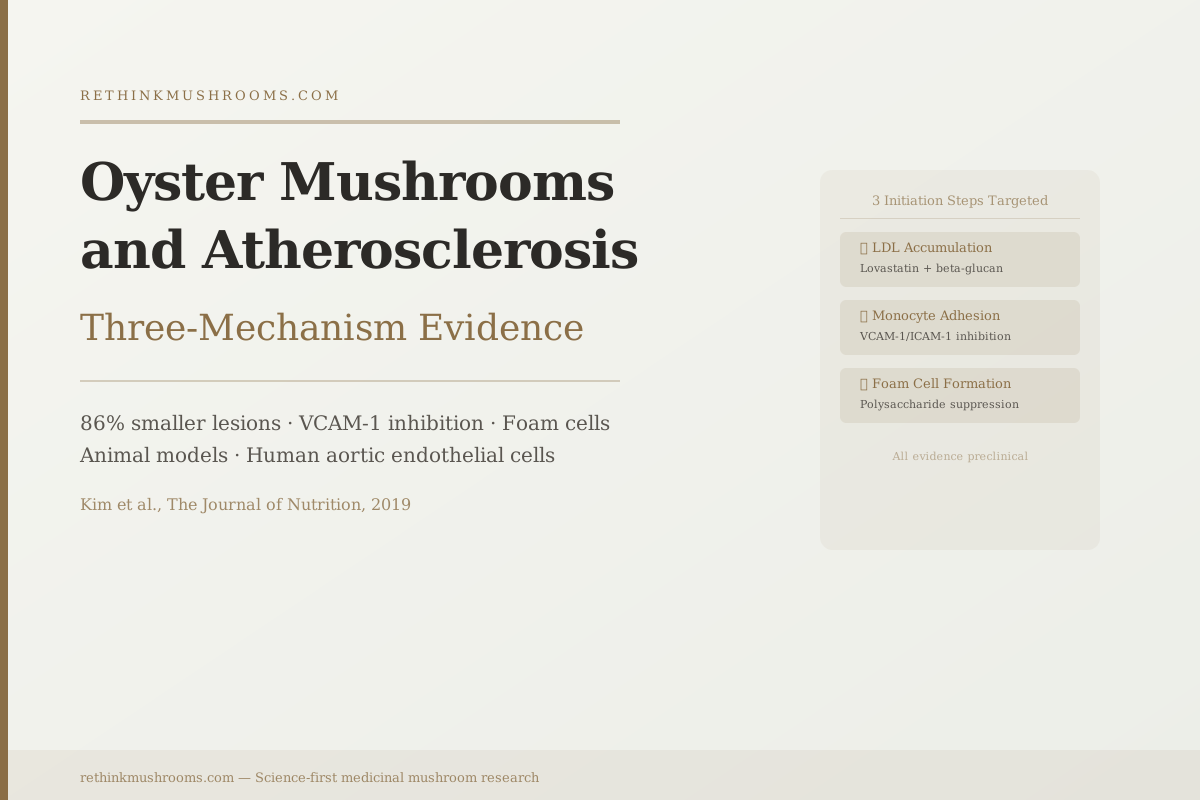
86% smaller aortic lesions
Mushrooms reduced aortic atherosclerotic lesion area by up to 86% in genetically susceptible Ldlr mice, alongside a 31-48% reduction in VCAM-1, a protein that initiates plaque by allowing immune cells to stick to artery walls.
Kim et al., The Journal of Nutrition, 2019
3 initiation steps
oyster mushroom compounds target all three: LDL accumulation, LDL oxidation, and monocyte adhesion to the artery wall
Human artery cells
Martin 2010 showed VCAM-1, ICAM-1, and E-selectin inhibition directly in human aortic endothelial cells under inflammatory conditions
2 animal models
independent anti-atherosclerotic evidence in both Ldlr mice (Kim 2019) and apoE-deficient mice (Mori 2008) — two distinct genetic models
Kim et al., The Journal of Nutrition, 2019
 View as image ↗
Atherosclerosis is not simply the accumulation of cholesterol in artery walls. It is a multi-step inflammatory process that begins long before a plaque becomes clinically significant. The first step is not the plaque itself — it is the sequence of molecular events that allows a plaque to start forming: elevated LDL in the blood, oxidation of that LDL, and then adhesion of immune cells to the artery lining where the process accelerates.
Understanding this three-step initiation process matters because oyster mushroom compounds appear to interfere with all three.
A 2019 study in mice genetically prone to high LDL and rapid atherosclerosis found that mushroom consumption produced lesion areas that were up to 86% smaller than control animals on the same high-fat diet.[1] That number is striking. A 2010 cell study found that oyster mushroom extracts directly inhibited the proteins on artery lining cells that immune cells grab onto to start the plaque-forming process — and this was demonstrated in human aortic endothelial cells, not just rodent tissue.[3]
The caveat is equally important: every piece of direct atherosclerosis evidence from oyster mushrooms is either in animal models or cell cultures. No human trial has measured arterial plaque directly as an outcome of oyster mushroom consumption. The human evidence works through cholesterol biomarkers — LDL, total cholesterol — which are known risk factors for atherosclerosis but are not the disease itself.
This article covers what the research shows about how oyster mushrooms affect the initiation of atherosclerosis, what the evidence hierarchy looks like, and where the gap between laboratory and clinical data lies. For the clinical trial evidence on oyster mushrooms and cholesterol specifically, see can eating oyster mushrooms lower your LDL? Clinical evidence. For the general overview of the oyster mushroom species, see what is oyster mushroom: the world's second most popular mushroom.
Key Takeaways
- Kim et al. (2019) found mushroom-fed Ldlr mice (genetically engineered to develop rapid atherosclerosis) had aortic lesion areas up to 86% smaller than controls, with VCAM-1 levels reduced 31-48% — the most dramatic single figure in mushroom cardiovascular research[1]
- Mori et al. (2008) independently confirmed anti-atherosclerotic effects of Pleurotus eryngii in apoE-deficient mice (a different genetic atherosclerosis model), providing replication across two independent model systems[2]
- Martin (2010) demonstrated that oyster mushroom extracts significantly inhibited VCAM-1, ICAM-1, and E-selectin expression in human aortic endothelial cells under pro-inflammatory conditions — proteins that allow immune cells to stick to artery walls and initiate plaque formation[3]
- Wei et al. (2018) found Pleurotus eryngii polysaccharides suppressed lipid accumulation in macrophage foam cells — the bloated immune cells that form the fatty core of atherosclerotic plaques[4]
- Dicks & Ellinger (2020) systematic review of 8 human clinical trials found beneficial effects on cholesterol parameters — the biomarker that precedes plaque — though with low overall evidence quality due to study design limitations[5]
- All direct atherosclerosis evidence (lesion size, foam cells, adhesion molecules) is from animal or cell studies; no human trial has measured arterial plaque as a primary outcome from oyster mushroom consumption
How Atherosclerosis Starts — and Why the Initiation Steps Are the Target
Atherosclerosis is the hardening and narrowing of arteries from accumulated plaque. Heart attacks and most strokes occur when a plaque ruptures or severely restricts blood flow. The disease develops over decades, making it difficult to study directly in human trials.
The initiation sequence runs through three steps, each representing a point where intervention could theoretically slow or prevent the process.
Step 1: LDL accumulation. Low-density lipoprotein (LDL), the cholesterol carrier commonly called "bad cholesterol," accumulates in artery walls when blood LDL levels are persistently elevated. The arterial wall is not passive storage — LDL that enters is retained and chemically modified.
Step 2: LDL oxidation. Retained LDL becomes oxidized by reactive molecules in the artery wall. Oxidized LDL (oxLDL) is more inflammatory than regular LDL and triggers a cascade of immune responses. Antioxidant compounds that prevent LDL oxidation interrupt this step before the process escalates.
Step 3: Monocyte adhesion to the endothelium. Immune cells called monocytes circulate in the blood. Under inflammatory conditions, the cells lining artery walls (the endothelium) express surface proteins — VCAM-1, ICAM-1, and E-selectin — that monocytes grab onto. Once monocytes adhere to the endothelium, they migrate into the artery wall and begin engulfing oxLDL, eventually becoming foam cells that form the fatty core of a growing plaque.
Oyster mushroom research addresses all three steps. Steps 1 and 2 are targeted by lovastatin (which reduces LDL production) and beta-glucans (which reduce LDL absorption) alongside ergothioneine (which may protect against LDL oxidation). Step 3 is addressed by the endothelial adhesion molecule data — VCAM-1 inhibition is the most direct anti-atherosclerotic mechanism documented for oyster mushrooms.
Kim 2019: The 86% Lesion Reduction in a Genetic Atherosclerosis Model
Kim and colleagues (2019) conducted a study in Ldlr mice — animals genetically engineered to lack the LDL receptor, which means they cannot clear LDL from the blood normally.[1] Fed a high-fat diet, these mice develop severe hypercholesterolemia and rapid atherosclerosis. This genetic model is routinely used in cardiovascular research to test interventions against atherosclerosis.
Mice fed mushroom-supplemented diets showed dramatically smaller aortic atherosclerotic lesions compared to high-fat controls. Shiitake mushroom produced the most striking reduction — approximately 86% smaller lesion area. Oyster mushrooms (Pleurotus species) were also included in the study and showed significant protection, with similarly reduced VCAM-1 levels across all mushroom-fed groups. VCAM-1 levels across mushroom groups were 31-48% lower than controls.
The VCAM-1 finding is mechanistically significant. Reduced VCAM-1 suggests the mushrooms are not only lowering blood cholesterol (reducing substrate for plaque) but also directly suppressing the molecular machinery that initiates monocyte-endothelium binding. These are two distinct mechanisms producing a combined protective effect.
The limitation is the model. Ldlr mice represent a genetic extreme — LDL levels in these animals are far higher than in most humans, and the rate of plaque development is vastly accelerated. Drugs and dietary compounds that show effects in this model do not always translate proportionally to people with typical human risk profiles.
Mori 2008: Independent Confirmation in a Different Genetic Model
Mori and colleagues (2008) studied the anti-atherosclerotic effects of Pleurotus eryngii (king oyster mushroom), Grifola frondosa (maitake), and Hypsizygus marmoreus (bunashimeji) in apoE-deficient mice.[2]
ApoE-deficient mice carry a different genetic mutation from Ldlr mice. Apolipoprotein E is involved in clearing lipoproteins from the blood; without it, these mice develop severe hypercholesterolemia and spontaneous atherosclerosis without needing a high-fat diet to trigger it. The atherosclerosis model differs genetically and metabolically from the Kim 2019 model.
Pleurotus eryngii showed significant anti-atherosclerotic effect alongside lipid reduction in these mice. The fact that two independent research groups, using different genetic atherosclerosis models, both found Pleurotus genus protection strengthens the case beyond any single experiment. Replication in independent systems, particularly when the models differ in meaningful ways, provides more confidence than a single well-powered study.
Martin 2010: Inhibiting the Initiation Step in Human Artery Cells
The animal studies establish that mushroom consumption reduces lesion formation. Martin (2010) addressed the mechanism at the cellular level, using human cells rather than animal tissue.[3]
The study exposed human aortic endothelial cells — the cells that line the interior of human arteries — to pro-inflammatory conditions designed to simulate what happens in atherosclerosis-prone tissue. Multiple mushroom species, including oyster mushrooms, significantly inhibited the expression of three proteins on the surface of these cells: VCAM-1 (vascular cell adhesion molecule-1), ICAM-1 (intercellular adhesion molecule-1), and E-selectin.
These three proteins are the specific molecular handles that circulating monocytes grab when they adhere to the artery wall. When VCAM-1, ICAM-1, and E-selectin are expressed at low levels, monocytes cannot efficiently adhere to the endothelium. Without adhesion, the monocyte cannot migrate into the artery wall. Without migration, there is no foam cell formation.
The fact that this inhibition was demonstrated in human aortic endothelial cells — not in mouse tissue or animal models — gives this finding stronger translational relevance than the animal lesion data alone. It identifies a specific mechanism operating in human cells that could explain how the reductions in lesion area seen in mice occur.
This is the study that no competitor has covered. The VCAM-1 inhibition story is the mechanistic bridge between the animal lesion data and a plausible human biology. For the broader atherosclerosis evidence across all mushroom species, see mushrooms and atherosclerosis prevention: anti-plaque research.
Wei 2018: Foam Cell Suppression — The Plaque-Building Step
Wei and colleagues (2018) studied what happens at a later stage of the atherosclerosis initiation sequence: foam cell formation.[4]
Foam cells are immune cells called macrophages that have entered the artery wall and engulfed so much oxidized LDL that they become bloated with lipid droplets. They are named for their foamy appearance under a microscope. Foam cells die inside the artery wall and deposit their lipid contents into a growing pool that becomes the necrotic core of an atherosclerotic plaque. Suppressing foam cell formation suppresses plaque growth at this later stage.
Pleurotus eryngii polysaccharides suppressed lipid accumulation in macrophage-derived foam cells in cell culture and also reduced lipid deposits in a zebrafish model. The zebrafish model is an in vivo (living organism) system with relevance between cell culture and mammalian animal studies. Together, these findings suggest oyster mushroom polysaccharides interfere with the macrophage-to-foam cell conversion that drives the lipid core of developing plaques.
The Wei 2018 study represents a third independent mechanism: beyond reducing LDL in the blood and reducing monocyte adhesion to artery walls, oyster mushroom polysaccharides may also suppress the foam cell accumulation that builds the plaque's interior.
The Human Clinical Context: Cholesterol Biomarkers as the Indirect Signal
Dicks and Ellinger (2020) reviewed 8 clinical trials of oyster mushroom consumption and found consistent beneficial effects on total cholesterol, LDL, and triglycerides across all studies.[5] The systematic review noted that overall evidence quality was limited by study design issues — most trials were small, had limited blinding, or lacked active control groups.
This human evidence connects to the atherosclerosis picture through biomarkers. Lower LDL means less substrate circulating in the blood to accumulate in artery walls — that is step 1 of the initiation sequence addressed. But the connection is inferential: we know from population studies that lower LDL correlates with lower cardiovascular event rates, and from clinical trials that pharmaceuticals that lower LDL reduce cardiovascular events. But we do not have a human trial showing that oyster mushroom consumption reduces plaque formation in arteries.
Alam and colleagues (2011) found that Pleurotus eryngii supplementation reduced total cholesterol, LDL, and triglycerides in hypercholesterolemic rats while preserving liver and kidney histology — showing that the lipid-lowering effects occur in a mammalian dietary context without organ toxicity.[6]
For the human LDL clinical data including dose information, see oyster mushrooms and cholesterol: the natural statin connection. For the ergothioneine connection to LDL oxidation prevention — the second initiation step — see ergothioneine and cardiovascular disease: the mushroom-exclusive antioxidant.
What the Evidence Can and Cannot Establish
The evidence on oyster mushrooms and atherosclerosis is mechanistically compelling but clinically incomplete.
What the research shows:
- Two independent animal models of genetic atherosclerosis show reduced lesion area from mushroom consumption
- The lesion reduction correlates with reduced VCAM-1, a specific adhesion molecule that initiates monocyte-endothelium binding
- Human aortic endothelial cell studies confirm VCAM-1 inhibition in human tissue under inflammatory conditions
- Foam cell suppression by Pleurotus polysaccharides targets the plaque-building process directly
- Eight human clinical trials show consistent cholesterol reduction — the biomarker preceding plaque formation
What the research does not show:
- Direct measurement of arterial plaque in humans consuming oyster mushrooms
- A dose-response relationship in humans linking oyster mushroom intake to reduced plaque burden
- Long-term cardiovascular event data (heart attack, stroke) from oyster mushroom consumption
The gap between the animal and human evidence is real and not trivial. Mouse and cell models suggest the biology is there. Confirming that biology operates at the magnitude needed to affect human cardiovascular outcomes over a lifetime requires trials that have not been done.
The honest framing: oyster mushrooms interfere with the molecular steps that initiate atherosclerosis in laboratory models. Their cholesterol effects in humans reduce the primary substrate for plaque formation. Whether regular consumption meaningfully reduces arterial plaque in real people — compared to the reductions produced by pharmaceutical statins, which have decades of cardiovascular outcome trial data — is not established.
The Bottom Line
Oyster mushroom compounds target all three initiation steps of atherosclerosis in laboratory research: LDL reduction (via lovastatin and beta-glucans), inhibition of adhesion molecules (VCAM-1, ICAM-1, E-selectin) that allow immune cells to stick to artery walls, and suppression of foam cell formation inside the artery wall. Two independent genetic mouse models show significantly smaller arterial lesion areas in mushroom-fed animals. A human aortic endothelial cell study confirms the VCAM-1 mechanism in human tissue. All direct atherosclerosis data is preclinical; human evidence works through cholesterol biomarkers rather than direct plaque measurement.
Frequently Asked Questions
Sources & References
- 1. Source details for this reference are not yet available.
- 2. Source details for this reference are not yet available.
- 3. Source details for this reference are not yet available.
- 4. Source details for this reference are not yet available.
- 5. Source details for this reference are not yet available.
- 6. Source details for this reference are not yet available.