Oyster Mushroom (Pleurotus ostreatus)
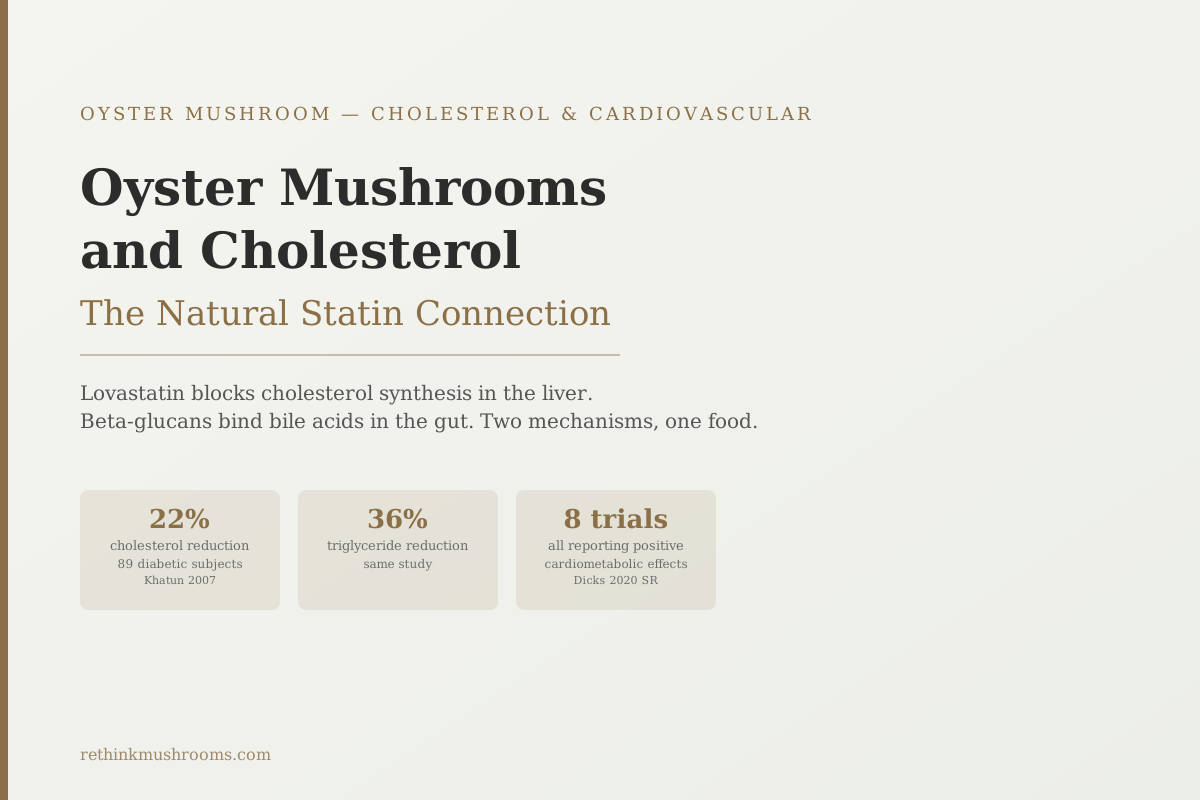
22% cholesterol reduction
A clinical study of 89 diabetic subjects found that 10g/day freeze-dried oyster mushroom for 8 weeks significantly reduced total cholesterol by ~22% and triglycerides by ~36%, without liver or kidney toxicity.
Khatun et al., Mymensingh Medical Journal, 2007
Lovastatin
first confirmed in Pleurotus fruiting bodies in 1995 — the same HMG-CoA reductase inhibitor used in prescription statin medications
2 mechanisms
lovastatin blocks cholesterol synthesis in the liver; beta-glucans bind bile acids in the gut and prevent cholesterol reabsorption — independent pathways
Low evidence
the 2020 Dicks systematic review found beneficial effects in 8 trials but rated overall quality low due to study design limitations
Khatun et al., Mymensingh Medical Journal, 2007
 View as image ↗
Oyster mushrooms and cholesterol research has an unusual feature: these mushrooms work through two separate mechanisms simultaneously. The first is lovastatin, a compound that blocks the same liver enzyme that prescription statin drugs block. The second is beta-glucan fiber, which binds bile acids in the gut and prevents their reabsorption, forcing the liver to convert more of its cholesterol into replacement bile. These are independent pathways — the same two-pronged approach would cost you two different prescriptions from a pharmacy.
The human clinical evidence is modest in scale but consistent in direction, with a 2020 systematic review summarizing 8 clinical trials that collectively showed beneficial effects on total cholesterol, LDL, and triglycerides. What that review also said — "low evidence" due to study design limitations — is where the honest contextualization of this article begins.
For the complete picture of oyster mushroom biology and health applications, see what is the oyster mushroom?. For the clinical LDL-specific evidence, see can eating oyster mushrooms lower your LDL?.
Key Takeaways
- Gunde-Cimerman and Cimerman (1995) confirmed that Pleurotus fruiting bodies naturally synthesize lovastatin — the same HMG-CoA reductase inhibitor used in prescription statin drugs. This discovery established the mechanistic basis for oyster mushroom cholesterol research.
- Lam and Okello (2015) quantified lovastatin content at 2.8-5.4 mg per 100g dry weight of raw P. ostreatus — sub-therapeutic as a pharmaceutical equivalent but present alongside synergistic compounds that may produce combined effects
- Palanisamy et al. (2014) demonstrated that beta-glucan-enriched fractions from oyster mushroom have bile acid-binding capacity — a second, independent mechanism for reducing cholesterol absorption that operates in the gut rather than the liver
- Khatun et al. (2007) in the largest human clinical study found 10g/day freeze-dried oyster mushroom reduced total cholesterol by ~22% and triglycerides by ~36% in 89 diabetic patients over 8 weeks without liver or kidney toxicity
- Dicks and Ellinger (2020) published a systematic review of 8 clinical trials: all reported beneficial cardiometabolic effects, but rated overall evidence quality as low due to risk of bias — "low evidence" for a food intervention means fewer large blinded RCTs, not absent evidence
- Mori et al. (2008) found that P. eryngii (king oyster) significantly reduced atherosclerotic lesion area in apoE-deficient mice, showing that the cholesterol-lowering effects translate to actual plaque protection in a genetically susceptible model
Lovastatin in Oyster Mushrooms: The Mechanism and the Numbers
Lovastatin works by blocking HMG-CoA reductase, the enzyme that controls the rate at which liver cells synthesize cholesterol. The liver produces roughly 75-80% of the cholesterol in your bloodstream; dietary cholesterol accounts for the remainder. By slowing down the liver's production line, lovastatin reduces circulating LDL, the form of cholesterol most associated with arterial deposit formation.
The pharmaceutical version — Mevacor, and the related class of HMG-CoA inhibitors (atorvastatin, rosuvastatin) — was developed synthetically, but the compound itself was first discovered in fungi. In 1995, Gunde-Cimerman and Cimerman confirmed that Pleurotus fruiting bodies synthesize lovastatin naturally, making oyster mushroom one of the few foods to contain a pharmaceutical-class cholesterol-lowering compound.[1]
How much is actually there? Lam and Okello (2015) quantified lovastatin alongside beta-glucans and polyphenols in raw and processed P. ostreatus.[2] Raw oyster mushrooms contained 2.8-5.4 mg lovastatin per 100g dry weight. Tsiantas et al. (2021), comparing analytical methods across mushroom species, confirmed P. ostreatus as among the highest lovastatin-containing species while noting that different methods produce different readings — explaining why figures in the literature range widely.[10]
The dose gap question. Pharmaceutical lovastatin is prescribed at 10-80 mg/day. At 2.8-5.4 mg/100g dry weight, a person eating 100g fresh oyster mushrooms (about 10g dry) would consume roughly 0.3-0.5 mg lovastatin — 20 to 200 times below pharmaceutical dosing. This is the number that makes people question whether the lovastatin route matters at all.
But the math changes when you look at what actually happens clinically. The Khatun 2007 trial used 10g/day freeze-dried — roughly 0.28-0.54 mg lovastatin equivalent — and still observed a 22% reduction in total cholesterol. That effect is larger than expected from the lovastatin content alone, which points toward two possibilities: the beta-glucan mechanism contributes substantially, or the lovastatin in a whole food matrix behaves differently than isolated pharmaceutical lovastatin. Probably both.
For detailed lovastatin content data across conditions (substrate, cooking, species), see lovastatin in oyster mushrooms: how much is actually there?. For comparison with shiitake's eritadenine mechanism for cholesterol lowering, see eritadenine in shiitake.
Beta-Glucans: The Second Cholesterol-Lowering Pathway
Lovastatin works in the liver. Beta-glucan works in the gut. The two mechanisms are independent — targeting different points in the cholesterol cycle.
Beta-glucan is a long-chain carbohydrate fiber found in oyster mushroom cell walls (alongside chitin and other structural polysaccharides). When beta-glucan reaches the small intestine, it forms a viscous gel that slows digestion and, critically, binds bile acids.
Bile acids are the cholesterol disposal mechanism the liver uses: excess cholesterol is converted into bile acids, excreted into the intestine where they help digest fats, and then reabsorbed in the terminal ileum — returned to the liver to be recycled. This enterohepatic (liver-to-gut-and-back) circulation handles roughly 95% of bile acids; only 5% escape into the stool.
Beta-glucan disrupts this reabsorption by binding bile acids in the gut, trapping them in the fiber matrix and carrying them out in the stool. With fewer bile acids returning to the liver, the liver converts more cholesterol into new bile acids to replenish the pool. More cholesterol leaving the liver as bile means less remaining in circulation as LDL.
Palanisamy et al. (2014) demonstrated this directly: beta-glucan-enriched fractions from oyster mushroom showed measurable bile acid-binding capacity.[3] This is the same mechanism by which oat and barley beta-glucans lower cholesterol — a mechanism for which there is FDA recognition — applied now to the beta-glucan fraction of oyster mushrooms.
The practical significance: a food that blocks cholesterol synthesis in the liver AND increases cholesterol removal through the gut is providing two-directional pressure on LDL. The combined effect may substantially exceed what either mechanism could produce alone.
The Human Clinical Evidence
Khatun et al. (2007) is the largest and most cited human clinical study on oyster mushroom and lipids.[4] The study enrolled 89 diabetic subjects and randomized them to 10g/day freeze-dried oyster mushroom or standard care for 8 weeks. Compared to controls, the oyster mushroom group showed:
- Total cholesterol reduced by approximately 22%
- Triglycerides reduced by approximately 36%
- Blood pressure reduced (a secondary finding rarely cited elsewhere)
- No changes in liver or kidney function markers — confirming safety
These are clinically meaningful numbers for a dietary intervention in a high-risk population. Diabetic patients are at elevated cardiovascular risk in part because of atherogenic lipid profiles; a 22% cholesterol reduction from a dietary change is substantial.
Abrams et al. (2011) (co-authored by Paul Stamets) tested 15g/day freeze-dried P. ostreatus for 8 weeks in HIV patients on antiretroviral therapy.[5] This population is particularly relevant because antiretroviral drugs frequently cause hyperlipidemia as a side effect, and statin-drug interactions in HIV patients are complicated. The study found modest but significant reductions in non-HDL cholesterol (from 204.5 to 200.2 mg/dL). A small change numerically, but notable in a population where additional lipid medication carries interaction risk.
Dicks et al. (2022) ran a double-blind crossover randomized trial in 30 adults with impaired glucose tolerance, adding oyster mushroom powder to a standardized meal.[6] The trial's primary outcomes were postprandial GLP-1 and hunger, but it also found significantly lower postprandial NEFA (non-esterified free fatty acids — fats circulating in the blood that indicate metabolic stress) in the oyster mushroom condition. Lower NEFA postprandially reflects better fat clearance from the bloodstream after meals.
Kleftaki et al. (2022) tested P. eryngii (king oyster) with its naturally occurring antioxidant compounds and vitamin D2 in people with metabolic disorders, reporting improved lipid profiles in the treated group.[7]
What "Low Evidence" Actually Means
Dicks and Ellinger's 2020 systematic review in Nutrients summarized these 8 clinical trials and reached a conclusion that is frequently misread: "the overall evidence is low."[8]
The misreading is taking "low evidence" to mean "doesn't work." The review actually found consistently positive effects on cholesterol, LDL, and triglycerides across the trials. "Low evidence" refers to the methodological quality — most trials had small sample sizes, weren't blinded, lacked placebo controls, or had other design limitations common to food intervention research.
This matters because food intervention trials face structural challenges that pharmaceutical trials don't. You can't give someone a convincing placebo for a food they're eating. Blinding is difficult when the intervention has a distinctive taste and texture. Long-term dietary trials require sustained participant compliance that pharmaceutical trials don't. The evidence standards developed for drug trials don't map perfectly onto food intervention research.
"Low evidence" in the GRADE system (the quality framework the review used) means: the effect is probably real, but we can't rule out that better-designed trials would produce different magnitudes. It does not mean: the evidence shows no effect.
The honest position is between the extremes: oyster mushroom cholesterol reduction has consistent directional evidence across 8 human studies but lacks the large, well-powered, properly blinded RCTs that would establish the effect size precisely. For comparison with a mushroom species that has better-characterized clinical cholesterol evidence, see how shiitake lowers LDL cholesterol.
From Cholesterol Numbers to Actual Plaques
Cholesterol levels are biomarkers. The clinical concern is arterial plaques — the fat and inflammatory deposits that cause heart attacks and strokes. Does oyster mushroom's cholesterol-lowering effect actually translate to plaque reduction?
Mori et al. (2008) tested P. eryngii (king oyster mushroom) in apoE-deficient mice, a standard genetic model for atherosclerosis research in which lipid-lowering interventions can be tested against actual lesion formation.[9] Animals fed P. eryngii showed significantly smaller atherosclerotic lesion area compared to controls, alongside reduced total cholesterol, LDL, and triglycerides.
This is preclinical animal data — it doesn't confirm that eating oyster mushrooms reverses or prevents arterial plaques in humans. But it demonstrates that the lipid-lowering biomarker changes seen in human trials are functionally associated with plaque reduction in a well-characterized animal model of atherosclerosis.
The mechanism story is richer than just lovastatin and beta-glucans. Oyster mushrooms also contain ergothioneine (which reduces oxidative damage to LDL — oxidized LDL triggers plaque formation), polyphenols with anti-inflammatory endothelial effects, and beta-glucans that reduce inflammatory cytokine signaling at the arterial wall. The cholesterol story is part of a broader cardiovascular protection picture. For the full atherosclerosis mechanism including endothelial adhesion molecule data, see oyster mushrooms and atherosclerosis prevention. For the complete heart health overview, see oyster mushrooms for heart health.
The Bottom Line
Oyster mushrooms lower cholesterol through two independent mechanisms: lovastatin (HMG-CoA reductase inhibition in the liver) and beta-glucan (bile acid binding in the gut). The human evidence across 8 clinical trials is consistently positive — with Khatun 2007 showing 22% total cholesterol reduction and 36% triglyceride reduction in 89 diabetic patients — but overall quality is rated low due to small sample sizes and design limitations. Food-based lovastatin (2.8-5.4 mg/100g dry) is sub-therapeutic as a standalone, but the combined mechanism with beta-glucans likely produces effects larger than either compound alone. Oyster mushroom cannot replace statin medication.
Frequently Asked Questions
Sources & References
- 1. Source details for this reference are not yet available.
- 2. Source details for this reference are not yet available.
- 3. Source details for this reference are not yet available.
- 4. Source details for this reference are not yet available.
- 5. Source details for this reference are not yet available.
- 6. Source details for this reference are not yet available.
- 7. Source details for this reference are not yet available.
- 8. Source details for this reference are not yet available.
- 9. Source details for this reference are not yet available.
- 10. Source details for this reference are not yet available.