Oyster Mushroom Cholesterol & Cardiovascular Health
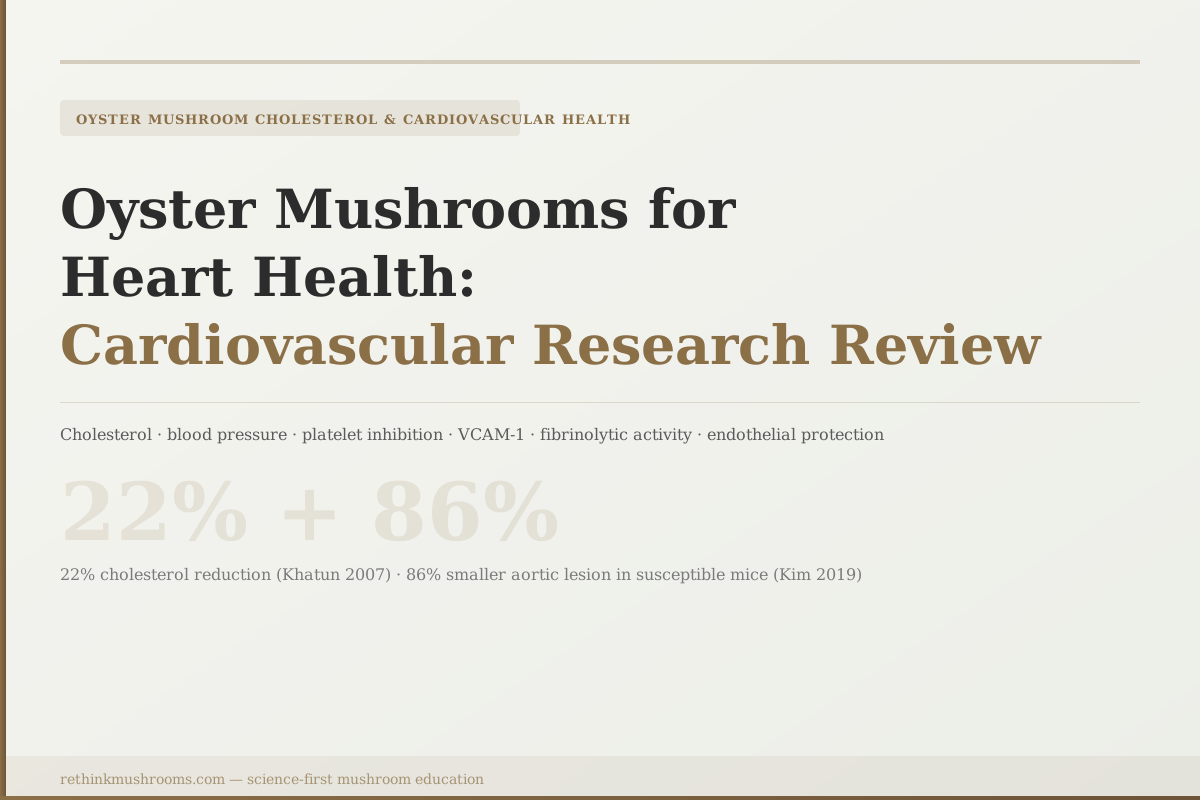
22% cholesterol reduction
Khatun and colleagues tested 10 grams of freeze-dried oyster mushroom daily in 89 diabetic patients and found total cholesterol fell by approximately 22%, triglycerides by 36%, and blood pressure also improved.
Khatun et al., Mymensingh Medical Journal, 2007
86%
smaller aortic lesion area in genetically susceptible mice fed mushrooms vs. high-fat controls (Kim et al., Journal of Nutrition, 2019)
VCAM-1
adhesion molecule inhibited in human aortic endothelial cells; the monocyte-attachment step that initiates atherosclerosis (Martin, 2010)
Fibrinolytic
enzyme activity found in oyster mushroom extracts; breaks down fibrin clots, relevant to thrombosis risk (Petraglia et al., 2022)
Khatun et al., Mymensingh Medical Journal, 2007
 View as image ↗
Most coverage of oyster mushrooms and heart health stops at cholesterol. The lovastatin story is interesting and the clinical data is real. But it misses three other cardiovascular pathways that have their own independent evidence bases, one of which (platelet aggregation inhibition) no mainstream health site appears to have written about yet.
This article is the full cardiovascular picture for Pleurotus ostreatus, organized around four mechanisms: cholesterol and triglyceride reduction, blood pressure effects, anti-thrombotic activity (platelets and fibrinolysis), and endothelial protection against early-stage atherosclerosis. Each section cites primary research. The oyster mushroom cancer evidence is covered elsewhere; for the pillar overview, see What Is Oyster Mushroom? The World's Second Most Popular Mushroom. For the cholesterol mechanism detail, see Oyster Mushrooms and Cholesterol: The Natural Statin Connection and Can Eating Oyster Mushrooms Lower Your LDL? Clinical Evidence.
Key Takeaways
- Eight controlled clinical trials of oyster mushroom supplementation showed beneficial effects on total cholesterol, LDL, and triglycerides, though overall evidence quality is low due to methodological limitations in most studies (Dicks & Ellinger systematic review, Nutrients, 2020)
- The Khatun 2007 RCT in 89 diabetic patients found 10 grams per day of freeze-dried oyster mushroom reduced total cholesterol by ~22%, triglycerides by ~36%, and blood pressure without liver or kidney toxicity
- Oyster mushroom extract significantly inhibited platelet aggregation in vitro when screened alongside seven other edible mushroom species (Poniedziałek et al., Nutrients, 2019)
- Oyster mushroom was among four species with fibrinolytic enzyme activity (the ability to break down fibrin clots) in a 2022 comparative analysis (Petraglia et al., Molecules, 2022)
- Multiple mushroom species including oyster mushroom significantly inhibited VCAM-1, ICAM-1, and E-selectin expression in human aortic endothelial cells under pro-inflammatory conditions, directly targeting the monocyte adhesion step that initiates atherosclerotic plaque formation (Martin, Nutrition Journal, 2010)
- In a genetic atherosclerosis mouse model, mushroom-fed animals showed approximately 86% smaller aortic lesion area versus high-fat controls, with 31-48% lower VCAM-1 levels across all mushroom groups (Kim et al., Journal of Nutrition, 2019)
Four Cardiovascular Pathways: Why Oyster Mushrooms Are More Than a Cholesterol Food
The cardiovascular evidence for oyster mushrooms covers four distinct biological targets. Understanding them separately matters because they operate through different mechanisms on different parts of cardiovascular disease progression.
Cholesterol and triglyceride reduction works through two parallel routes: lovastatin (a naturally produced HMG-CoA reductase inhibitor, the same mechanism as pharmaceutical statins) and beta-glucan fiber (which binds bile acids in the gut, forcing the liver to use cholesterol to produce more, thereby lowering circulating LDL). Oyster mushrooms contain both compounds.
Blood pressure effects appear in some human trials alongside cholesterol reduction. The mechanism is less well-characterized for oyster mushrooms specifically, though beta-glucans, potassium, and nitric oxide pathway effects from ergothioneine have been proposed.
Anti-thrombotic activity encompasses two related but distinct effects: inhibiting platelet aggregation (the clumping of platelets that forms the core of a blood clot) and fibrinolytic enzyme activity (breaking down fibrin, the protein mesh that holds a clot together). Both of these reduce thrombosis risk independently of cholesterol levels.
Endothelial protection refers to the protective effects on the inner lining of blood vessels. When the endothelium becomes inflamed, it expresses adhesion molecules (VCAM-1, ICAM-1, E-selectin) that attract immune cells (monocytes) which embed in the artery wall and convert into foam cells, forming atheromatous plaques. Reducing this adhesion molecule expression is an upstream prevention mechanism for atherosclerosis.
These four pathways are complementary but largely independent. A drug that only lowers LDL addresses the first but leaves the other three untouched. The research on oyster mushrooms suggests biological activity across all four.
The Clinical Picture: What Eight Controlled Trials Show
A 2020 systematic review by Dicks and Ellinger in Nutrients analyzed all available clinical trials of oyster mushroom supplementation for cardiometabolic parameters. Eight trials met inclusion criteria. The overall finding: beneficial effects on total cholesterol, LDL, and triglycerides appeared across multiple studies, but the overall evidence quality was rated low due to high risk of bias in most included trials.[1]
"Low evidence quality" is a phrase that gets misread as "doesn't work." What it actually means in this context is that the studies were often small, unblinded, or used disease-specific populations in ways that limit generalizability. The biological effects were observed. The methodology to establish those effects with high confidence in a general population has not yet been built.
For consumer health applications, the distinction matters. The clinical signals are consistently positive. The rigor needed to make a precise claim about effect size at a specific dose in a specific population is not yet there.
Cholesterol and Triglycerides: The 22% Reduction in the Khatun Trial
The best single clinical data point for oyster mushrooms and lipids is the Khatun 2007 study: 89 diabetic subjects receiving 10 grams per day of freeze-dried oyster mushroom for three weeks. Total cholesterol fell by approximately 22%, triglycerides by approximately 36%, and blood pressure declined alongside, all without detectable liver or kidney toxicity in safety measurements.[2]
The population (diabetic patients) limits generalizability to healthy adults, but diabetic populations are among the highest cardiovascular risk groups, making the finding clinically relevant for that population regardless.
Abrams and colleagues (2011, including Paul Stamets as a co-author) tested 15 grams per day of freeze-dried oyster mushroom in HIV patients taking antiretroviral therapy (ARVs) for 8 weeks. This population is pharmacologically complicated: ARVs frequently disrupt lipid metabolism. Non-HDL cholesterol fell modestly from 204.5 to 200.2 mg/dL. The effect size was small, but the finding that any lipid reduction occurred in a population whose medications actively promote dyslipidemia is notable mechanistically.[3]
The most recent crossover RCT, by Dicks and colleagues (2022), used a different endpoint: postprandial metabolic response. Thirty adults with impaired glucose tolerance received a meal fortified with oyster mushroom powder and a control meal on separate days. The mushroom-fortified meal produced significantly lower postprandial non-esterified fatty acids (NEFA) and better GLP-1 secretion than the control.[4] NEFA elevation after meals is a recognized cardiovascular risk marker. GLP-1 (glucagon-like peptide-1) is the incretin hormone targeted by GLP-1 agonist drugs for diabetes and cardiovascular risk. The double-blind design makes this the methodologically strongest recent trial. It measured one meal's effect rather than chronic supplementation, but the design quality is higher than most of the eight trials reviewed by Dicks 2020.
Kleftaki and colleagues (2022) tested King Oyster (Pleurotus eryngii) in people with metabolic disorders and found improvements in lipid profiles and antioxidant markers. P. eryngii is closely related to P. ostreatus with overlapping bioactive chemistry.[5]
Blood Pressure: The Khatun Finding Most Coverage Misses
The Khatun 2007 trial measured blood pressure alongside cholesterol. The diabetic patients who received oyster mushroom supplementation showed measurable blood pressure reduction.[2]
This finding appears in almost no competitor coverage of oyster mushrooms and cardiovascular health. Most articles focus on the cholesterol numbers and omit the blood pressure observation. The mechanism for blood pressure effects is not fully characterized in the oyster mushroom literature specifically, but oyster mushrooms contain potassium, gamma-aminobutyric acid (GABA), and ergothioneine, all of which have mechanistic links to vascular tone and blood pressure regulation.
The evidence for blood pressure effects is thinner than the cholesterol evidence, but it is not absent. The Khatun trial is the primary clinical data point.
Anti-Thrombotic Effects: Platelet Inhibition and Fibrinolytic Enzymes
Two studies cover aspects of oyster mushroom's anti-thrombotic potential that have received essentially no consumer coverage.
Poniedziałek and colleagues (2019) screened eight edible mushroom species for anti-platelet and anticoagulation activity in vitro. Oyster mushroom extract produced statistically measurable inhibition of platelet aggregation in the screening.[6] Platelet aggregation is the initial clumping process that forms the platelet plug at the start of blood clot formation. Inhibiting this process is one mechanism by which cardiovascular drugs like aspirin reduce heart attack risk.
In a related angle, Petraglia and colleagues (2022) compared four cultivated mushroom species for fibrinolytic enzyme activity, the ability of enzymes to break down fibrin, the protein mesh that reinforces a blood clot. Oyster mushroom was among the four species showing this activity.[7] Fibrinolytic activity targets a different stage of the coagulation cascade than platelet inhibition: it affects established clots rather than clot formation. Taken together, these two findings suggest that oyster mushrooms may affect multiple stages of thrombosis biology.
Both studies are in vitro. Neither demonstrates that eating oyster mushrooms reduces thrombosis risk in people. But they represent completely uncovered mechanistic angles in a well-trafficked topic.
Endothelial Protection: 86% Smaller Aortic Lesions and VCAM-1 Inhibition
The most striking number in oyster mushroom cardiovascular research comes from an animal study. Kim and colleagues (2019) fed genetically susceptible mice (Ldlr knockout) a high-fat diet or a high-fat diet with mushroom supplementation. Animals in the mushroom group showed approximately 86% smaller aortic lesion area versus the high-fat control group at the study's end. VCAM-1 levels in the mushroom-fed animals were 31 to 48% lower across all mushroom groups tested.[9]
The mouse model used (Ldlr knockout) develops atherosclerosis reliably due to a genetic defect in LDL clearance, making it a standard preclinical model for atherosclerosis research. The 86% lesion reduction is a large effect size even accounting for the model's limitations.
The mechanism linking mushrooms to lesion reduction was examined separately in a study by Martin (2010), who tested multiple mushroom species, including oyster mushroom, in human aortic endothelial cells under pro-inflammatory conditions. Oyster mushroom extract significantly inhibited expression of three key adhesion molecules: VCAM-1 (vascular cell adhesion molecule 1), ICAM-1 (intercellular adhesion molecule 1), and E-selectin.[8]
These adhesion molecules are the surface proteins that allow circulating monocytes to dock onto the artery wall. When monocytes dock and embed in the intima, they ingest oxidized LDL and become foam cells, which is the direct mechanism for atheromatous plaque formation. Inhibiting the adhesion molecules at the point of docking is an upstream intervention in plaque development. The Martin 2010 study used actual human aortic endothelial cells under simulated inflammatory conditions, making it the most mechanistically direct human-tissue evidence in this data set.
For the deeper atherosclerosis mechanism coverage, see Oyster Mushrooms and Atherosclerosis Prevention. For ergothioneine's role in protecting the vascular endothelium, see Ergothioneine and Cardiovascular Disease: The Mushroom-Exclusive Antioxidant. For comparison to shiitake's cholesterol-lowering mechanism (which uses a completely different pathway), see Eritadenine in Shiitake: The Unique Cholesterol-Lowering Nucleoside.
Honest Limits: What the Evidence Cannot Yet Tell You
The cardiovascular evidence for oyster mushrooms is real across four mechanisms, but it comes with important contextual caveats.
The clinical evidence (human trials) is primarily for cholesterol and triglyceride effects. The evidence quality is low in most studies due to small sample sizes, unblinded designs, and disease-specific populations. No large, well-designed randomized controlled trial has tested oyster mushroom supplementation for cardiovascular outcomes (heart attack, stroke, cardiovascular death) as a primary endpoint in a general adult population.
The platelet, fibrinolytic, VCAM-1, and aortic lesion evidence comes from in vitro and animal studies. These provide mechanistic plausibility but are not evidence of human cardiovascular benefit.
The dose used in clinical trials (10-15 grams per day freeze-dried) represents more than a typical serving of cooked mushrooms. Translating food-based cardiovascular effects at culinary doses to supplementation studies to potential clinical benefit involves extrapolations at each step that are not fully validated.
None of this is a reason to dismiss the data. It is the context that allows an honest reading of it.
The Bottom Line
Oyster mushroom cardiovascular research covers four pathways: cholesterol reduction (clinical trials showing 22% total cholesterol decrease at 10g/day), blood pressure effects, anti-thrombotic activity (platelet aggregation inhibition and fibrinolytic enzyme activity), and endothelial protection (VCAM-1/ICAM-1 inhibition in human aortic endothelial cells; 86% smaller aortic lesions in susceptible mice). Eight controlled clinical trials support lipid benefits but with low overall evidence quality. Platelet and fibrinolytic data are entirely preclinical.
Frequently Asked Questions
Sources & References
- 1. Source details for this reference are not yet available.
- 2. Source details for this reference are not yet available.
- 3. Source details for this reference are not yet available.
- 4. Source details for this reference are not yet available.
- 5. Source details for this reference are not yet available.
- 6. Source details for this reference are not yet available.
- 7. Source details for this reference are not yet available.
- 8. Source details for this reference are not yet available.
- 9. Source details for this reference are not yet available.