Oyster Mushroom Lovastatin & Cholesterol
8 clinical trials
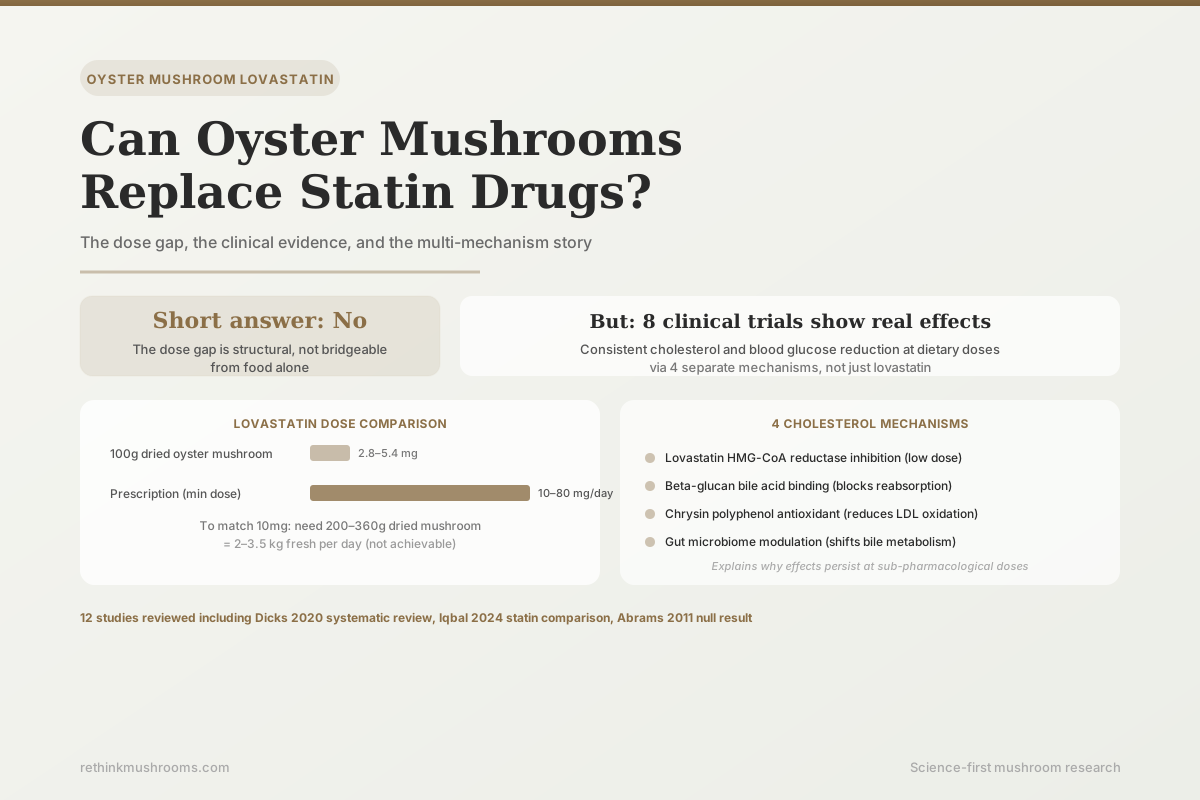
A systematic review found 8 clinical trials showing oyster mushrooms reduce cholesterol and blood glucose. Dose analysis, however, confirms they cannot pharmacologically replicate prescription statin therapy.
Dicks & Ellinger, Nutrients, 2020
Same molecule
Oyster mushroom lovastatin is structurally identical to prescription Mevacor, confirmed by chemical extraction studies
4 distinct mechanisms
Lovastatin, beta-glucan bile acid binding, chrysin polyphenols, and gut microbiome modulation all contribute to cholesterol effects
Honest null included
Abrams 2011 found no significant non-HDL improvement in HIV patients with antiretroviral-induced hyperlipidemia, an important limitation on mushroom cholesterol effects
Dicks & Ellinger, Nutrients, 2020
 View as image ↗
The short answer: no, oyster mushrooms cannot replace pharmaceutical statin drugs based on current evidence. But the reasons are more specific than "mushrooms are just food," and there is real clinical evidence from eight controlled trials showing that oyster mushrooms do affect cholesterol and blood glucose at dietary doses. The gap between those two statements is what this article explains. For the dose math specifically, see How Much Lovastatin Is in Oyster Mushrooms?. For a broader view of oyster mushroom research, see our complete oyster mushroom guide.
Key Takeaways
- A 2020 systematic review of 8 clinical trials found consistent beneficial effects of oyster mushrooms on total cholesterol, LDL, triglycerides, and blood glucose (Dicks & Ellinger, Nutrients, 2020)
- Oyster mushrooms contain the same lovastatin molecule as prescription Mevacor, but at 100-1000x lower concentrations; reaching a 10mg pharmaceutical dose from food would require 200-360g of dried mushroom daily
- The Abrams 2011 RCT, co-authored by Paul Stamets, found no significant reduction in non-HDL cholesterol in HIV patients with antiretroviral-induced hyperlipidemia, an important null result showing mushroom effects have real limits
- Oyster mushrooms affect cholesterol through at least four separate mechanisms: HMG-CoA reductase inhibition via lovastatin, bile acid binding via beta-glucan, antioxidant LDL protection via chrysin, and gut microbiome modulation
- Iqbal and colleagues' 2024 animal study included a direct statin comparison group; oyster mushroom extract reduced cholesterol and triglycerides meaningfully but at levels below the pharmaceutical statin comparator
- No published study has tested whether oyster mushroom consumption is safe or effective for patients already taking statin medications; no interaction data exists
Eight Clinical Trials Say Oyster Mushrooms Do Affect Cholesterol
The question of whether oyster mushrooms have any real effect on cholesterol in humans has an answer: they do. Dicks and Ellinger published a systematic review in Nutrients in 2020 that analyzed all clinical trials on oyster mushroom cardiometabolic outcomes published up to that point.[1]
Across 8 clinical trials, the review found consistent evidence of beneficial effects on multiple metabolic markers: reduced fasting blood glucose, reduced postprandial blood glucose, reduced total cholesterol, reduced LDL cholesterol in most studies, and reduced triglycerides. The review also found evidence of blood pressure reduction in some trials.
The authors' honest assessment was that while the direction of effects was consistently positive, the evidence quality was low: most trials were small, short-term, unblinded, or had methodological limitations. The finding is "consistent" rather than "definitive." But consistent positive trends across 8 independent trials in humans is not nothing.
The dose used across trials varied, but most used dried mushroom powder or fresh mushroom consumption at doses of 30-150g per day fresh equivalent. At these dietary doses, measurable cholesterol and glucose improvements occurred.
This is the starting point for the comparison. Oyster mushrooms have documented, human-evidence-supported effects on cholesterol. The question is whether those effects are large enough, and achievable through food, in a way that could substitute for pharmaceutical statin therapy.
Why Dietary Lovastatin Cannot Replace a Statin Prescription
Statins work by blocking HMG-CoA reductase, the enzyme that controls how much cholesterol the liver makes. When this enzyme is blocked at pharmacological doses, LDL cholesterol drops by 30-50% or more. Pharmaceutical lovastatin (Mevacor) is prescribed at doses of 10-80mg per day. High-intensity statin therapy (atorvastatin, rosuvastatin at high doses) can produce LDL reductions exceeding 50%.
Oyster mushrooms contain lovastatin, the same molecule. Typical dried oyster mushrooms contain 2.8-5.4 mg of lovastatin per 100g dry weight. To reach a 10mg pharmaceutical dose from food alone, a person would need to eat 200-360g of dried mushroom daily, equivalent to 2-3.5 kg of fresh oyster mushrooms. No one eats that much mushroom daily.
Additionally, cooking oyster mushrooms at typical temperatures destroys 69-84% of lovastatin, reducing the effective content of a cooked fresh serving to a small fraction of the already-low content in dried form.
The dose gap is not bridgeable through dietary mushroom consumption. This is the structural reason oyster mushrooms cannot replicate pharmaceutical statin pharmacology.
What the clinical trial evidence shows is that oyster mushrooms produce real cholesterol effects at dietary doses without pharmacological lovastatin levels. This means something else is contributing to the effects. That is the multi-mechanism story covered below.
The Honest Null Result: What the Stamets-Authored RCT Found
Not all clinical trials of oyster mushrooms for cholesterol produced positive results, and the negative results are as informative as the positive ones.
The most prominent null finding comes from a 2011 clinical trial co-authored by mycologist Paul Stamets and published in BMC Complementary and Alternative Medicine.[2] Abrams and colleagues tested 30g of dried oyster mushrooms daily for 6 weeks in HIV-infected patients who had developed high cholesterol as a side effect of antiretroviral therapy.
The result: oyster mushrooms produced modest improvements in some lipid markers but did not significantly reduce non-HDL cholesterol, the primary outcome. This is a meaningful null finding for two reasons.
First, antiretroviral-induced hyperlipidemia has a specific mechanism: the drugs directly cause the liver to overproduce cholesterol through pathways that may not be the primary target of oyster mushroom bioactives. A cholesterol-raising mechanism driven by a specific drug interaction may simply be different from the dietary cholesterol absorption and hepatic cholesterol synthesis pathways that oyster mushroom compounds appear to affect.
Second, the 30g dried mushroom per day dose used in this study was relatively low, potentially below the threshold for significant HMG-CoA reductase inhibition.
The Abrams 2011 result teaches a specific lesson: oyster mushrooms affect cholesterol through mechanisms that work in metabolic hyperlipidemia (too much cholesterol from diet, poor lifestyle, genetics) but may be limited against pharmacologically induced lipid dysregulation. This is not a failure of the mushroom; it is a specificity finding about which pathways it affects.
The more typical result appears in studies of people with dietary or metabolic hyperlipidemia. Khatun and colleagues' 2007 clinical study in diabetic subjects found that regular oyster mushroom consumption reduced both total cholesterol and blood glucose compared to baseline, providing early human-level evidence that dietary mushroom consumption affects lipid metabolism.[3]
Beyond Lovastatin: Four Separate Mechanisms Working Together
If lovastatin cannot reach pharmacological levels at dietary doses, what is actually driving the consistent cholesterol effects seen across 8 clinical trials?
The answer is that oyster mushrooms affect cholesterol through at least four distinct pathways, each operating independently of the lovastatin dose problem.
Mechanism 1: Beta-glucan and bile acid binding. Beta-glucan forms a viscous gel in the small intestine that traps bile acids (the digestive compounds the liver makes from cholesterol). When bile acids are trapped and excreted rather than reabsorbed, the liver must synthesize new ones from circulating cholesterol, pulling LDL out of the bloodstream. Palanisamy and colleagues established the bile acid-binding capacity of oyster mushroom beta-glucan fractions directly in vitro.[4] This is the same mechanism by which cholestyramine and psyllium fiber lower cholesterol.
Mechanism 2: Chrysin and LDL oxidation. Anandhi and colleagues identified chrysin, a flavonoid compound in Pleurotus ostreatus, as a key additional cholesterol-relevant bioactive.[5] Chrysin provides antioxidant protection against LDL oxidation, the process by which LDL cholesterol becomes the oxidized form most likely to be taken up by macrophages and deposited in artery walls. The cholesterol "lowering" effect may partly reflect improved cholesterol quality (less oxidized LDL) rather than just reduced concentration. Both are clinically relevant.
Mechanism 3: Gut microbiome modulation. Nakahara and colleagues found that king oyster mushroom (Pleurotus eryngii) polysaccharides altered gut microbiota composition in high-fat diet mice in ways associated with reduced obesity and improved lipid metabolism.[6] The gut microbiome affects cholesterol metabolism through multiple routes, including conversion of bile acids to secondary bile acids with different re-absorption properties. Oyster mushroom polysaccharides acting as prebiotics may shift the microbiome toward a composition that facilitates cholesterol excretion. Additional in vitro evidence from Dong and colleagues supports that oyster mushroom polysaccharide fractions have direct anti-hyperlipidemic activity in macrophages.[7]
Mechanism 4: Low-dose lovastatin with chronic exposure. Even at sub-pharmacological doses, chronic low-level HMG-CoA reductase inhibition over weeks may produce measurable effects in the context of a moderate cholesterol diet. This is speculative, but small consistent inhibition over time differs from a single large dose.
The point of listing four mechanisms is not to overclaim. It is to explain why dietary mushroom consumption, which cannot deliver pharmacological lovastatin doses, still shows effects in controlled trials. The mushroom is not a lovastatin delivery vehicle. It is a food with several converging cholesterol-relevant properties that add up to measurable effects at dietary doses.
The Animal Comparison: Iqbal 2024's Oyster Mushroom vs. Statin Head-to-Head
Most animal studies of oyster mushroom cholesterol effects measure changes from baseline, not comparisons against a pharmaceutical standard. The 2024 study by Iqbal and colleagues is different: it included a statin comparison group, providing an explicit head-to-head reference point.[12]
In hypercholesterolemic rats, oyster mushroom extract at 200mg/kg reduced total cholesterol by 15%, triglycerides by 34%, and VLDL (the liver's cholesterol transport particle that converts to LDL) by 22%, while improving HDL by 22%. These are meaningful reductions.
The statin comparison group in the same study produced larger effects, as expected given that pharmaceutical statins were designed specifically for maximal HMG-CoA reductase inhibition. But the oyster mushroom extract effects were not negligible.
The Iqbal 2024 data also aligns with earlier animal model studies. Hossain and colleagues demonstrated in 2003 that dietary Pleurotus ostreatus supplementation reduced atherogenic lipid levels in hypercholesterolemic rats, providing early rodent-model evidence.[8] Mori and colleagues showed in 2008 that king oyster mushroom (Pleurotus eryngii) reduced actual atherosclerotic plaque area in a genetically cholesterol-prone mouse model, demonstrating effects beyond simple cholesterol concentration to the downstream vascular pathology.[9] Choi and colleagues extended this in 2017, showing king oyster reduced lipid accumulation in fatty liver and lowered serum triglycerides in high-fat-diet rats with hyperlipidemia.[10] Wei and colleagues further confirmed in 2018 that king oyster polysaccharides reduced lipid accumulation in macrophage foam cells, the early cellular lesion of atherosclerosis.[11]
The convergent animal model evidence spans multiple research groups, multiple species of Pleurotus, multiple outcome measures (serum cholesterol, plaque area, foam cells, liver fat), and multiple mechanisms. The biological case is well-constructed. The human data is more limited: 8 trials, mostly small, mostly short-term, but directionally consistent.
Statins, Oyster Mushrooms, and Medical Safety
The practical medical context for the oyster mushroom vs. statin comparison requires direct clarity.
Statins are prescribed because cardiovascular disease kills more people globally than any other cause. The clinical evidence base for statin therapy in reducing heart attack and stroke risk spans decades and millions of patients in randomized trials. Pharmaceutical lovastatin and other statins reduce LDL cholesterol by 30-50% or more and reduce cardiovascular event rates by 25-35% in high-risk patients.
No evidence shows that oyster mushrooms produce LDL reductions in that range. The clinical trials in the Dicks 2020 systematic review showed modest effects at food doses.
No published study has tested the question of whether people on statins can safely use oyster mushrooms concurrently, or what happens to cholesterol control if statin therapy is discontinued and dietary mushroom consumption is substituted. No interaction studies exist.
Oyster mushrooms have a strong case as a dietary adjunct to a cholesterol-healthy eating pattern. The systematic review evidence supports modest effects. The multi-mechanism picture explains why those effects occur despite sub-pharmacological lovastatin doses. The clinical evidence does not support discontinuing prescribed cholesterol medication based on mushroom consumption.
For the practical consumer article on whether eating oyster mushrooms can help with cholesterol, see Oyster Mushroom Lovastatin: Can Eating Pleurotus Replace a Statin?. For the cooking stability angle (how much lovastatin survives different preparation methods), see Cooking and Lovastatin Stability in Oyster Mushrooms. For how Reishi's cholesterol mechanism compares, see Reishi and Cholesterol Management. For a species comparison using the unique nucleoside mechanism in shiitake, see Eritadenine in Shiitake.
The Bottom Line
Eight clinical trials show oyster mushrooms modestly reduce cholesterol and blood glucose at dietary doses, and a recent animal study with a statin comparison group confirms meaningful lipid effects below the pharmaceutical statin benchmark. The dose gap is structural: food-level lovastatin cannot pharmacologically replicate statin therapy. What does work is a multi-mechanism effect: beta-glucan bile acid binding, chrysin antioxidant protection against LDL oxidation, gut microbiome modulation, and low-dose chronic lovastatin exposure all contribute. No evidence supports replacing prescribed statin therapy with dietary mushrooms.
Frequently Asked Questions
Sources & References
- 1. Source details for this reference are not yet available.
- 2. Source details for this reference are not yet available.
- 3. Source details for this reference are not yet available.
- 4. Source details for this reference are not yet available.
- 5. Source details for this reference are not yet available.
- 6. Source details for this reference are not yet available.
- 7. Source details for this reference are not yet available.
- 8. Source details for this reference are not yet available.
- 9. Source details for this reference are not yet available.
- 10. Source details for this reference are not yet available.
- 11. Source details for this reference are not yet available.
- 12. Source details for this reference are not yet available.