Mushroom Nutrition & Cooking
121°C autoclaving for 15 minutes — and mushroom immune proteins still work
The immunomodulatory proteins FVE from enoki and LZ8 from reishi still triggered interferon-gamma secretion from mouse spleen cells after 30 minutes at 100°C and 15 minutes of autoclaving at 121°C. Whatever cooking does to mushrooms, destroying these proteins is not it.
Tong et al., Journal of Agricultural and Food Chemistry, 2008
One-third
agaritine remaining in cultivated Agaricus after microwave processing, versus the raw mushroom (Schulzová et al., 2002)
Boiling ↑
total glucan content rose with boiling via the beta-glucan fraction, across four cultivated species (Roncero-Ramos et al., 2017)
5 min
oven baking gave shiitake its highest total phenolic content of any method or duration tested (Yao et al., 2023)
Tong et al., Journal of Agricultural and Food Chemistry, 2008
 View as image ↗
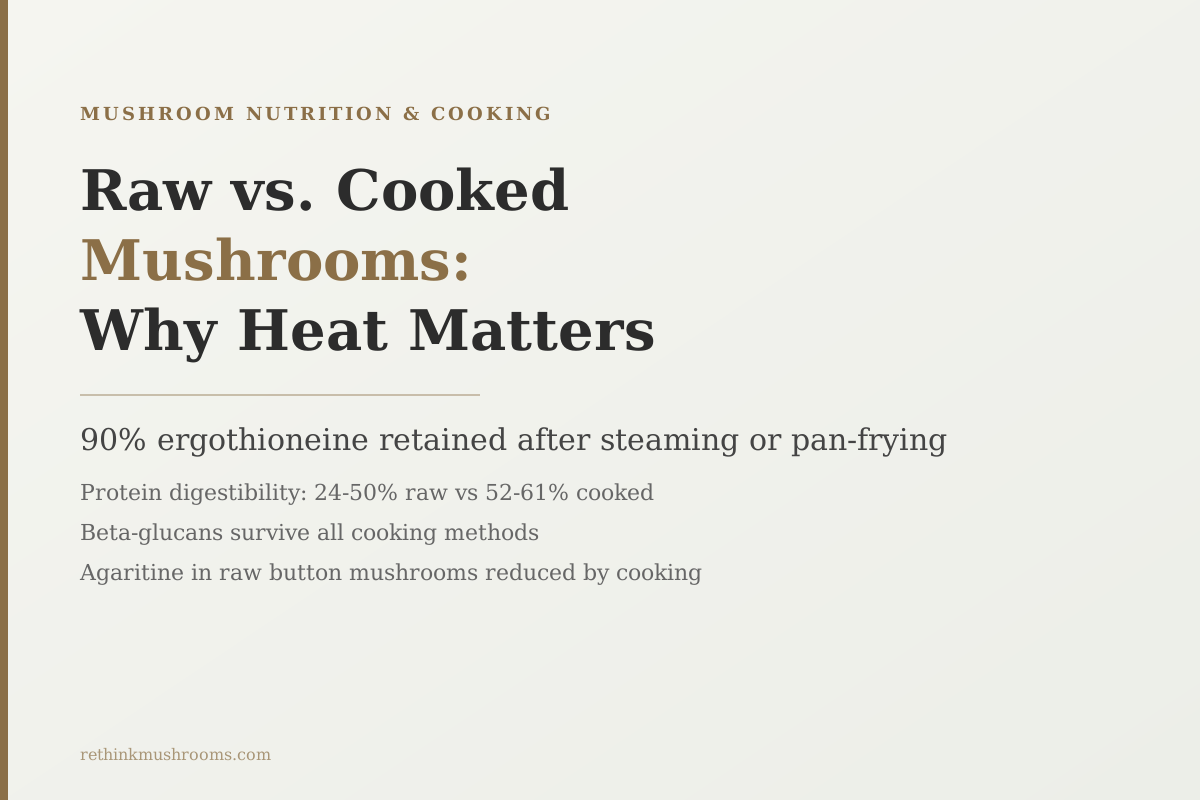
The logic that says raw food is healthier does not transfer cleanly to mushrooms. Where raw spinach retains heat-sensitive vitamins that cooking would reduce, mushrooms present a different accounting problem: a cell wall built from chitin that resists digestion, a hydrazine compound in the most commonly eaten genus, and a set of signature bioactives that turn out to be far more heat-tolerant than the raw-food argument assumes.
That does not make "cook your mushrooms" a simple rule either. The published record is more interesting than that, and in places it contradicts the tidy version of the story. This article covers what the measured data show about heat, water, and mushroom bioactives — including where the evidence is thinner than the confident version of this advice suggests. For a complete nutritional profile by species, see Mushroom Nutrition Facts: The Complete Species-by-Species Guide.
Raw Food Logic
Does Raw Always Mean More Nutritious?
The claim
“Cooking degrades nutrients, so raw mushrooms deliver the most nutritional value.”
Generalised from raw-food arguments about heat-sensitive vitamins in leafy greens and cruciferous vegetables.
What research shows
MisleadingThe compounds mushrooms are prized for behave differently under heat than vitamin C does. Immunomodulatory proteins from enoki and reishi survived 30 minutes at 100°C and 15 minutes of autoclaving at 121°C with their interferon-gamma-inducing activity intact, and boiling actually raised total glucan content across four cultivated species by enhancing the beta-glucan fraction.
The picture is method-dependent and species-dependent, not uniformly pro-cooking. Boiling and frying both cut antioxidant activity in a four-species panel; steaming, boiling and air frying each reduced all four measured bioactives in shiitake. There is no single cooking method that wins on every compound.
Tong et al., 2008; Roncero-Ramos et al., 2017; Yao et al., 2023
Key Takeaways
- Household cooking substantially reduces agaritine in cultivated Agaricus mushrooms, with measured reductions of roughly 25% for dry baking, 35-70% for frying, and a fall to one-third of the original level after microwave processing (Schulzová et al., Food Additives and Contaminants, 2002).
- The immunomodulatory proteins FVE (enoki) and LZ8 (reishi) retained their ability to induce interferon-gamma secretion after 30 minutes at 100°C and 15 minutes of autoclaving at 121°C, though vacuum dehydration cut that activity to about half (Tong et al., J Agric Food Chem, 2008).
- Boiling improved total glucan content by enhancing the beta-glucan fraction across four cultivated species, while grilling and microwaving retained the highest antioxidant activity and boiling and frying cut it (Roncero-Ramos et al., Int J Food Sci Nutr, 2017).
- Ergothioneine, mushrooms' signature antioxidant amino acid, has excellent light, thermal and acid-base stability in isolation and accounts for roughly 25% of the total antioxidant capacity of mushroom extract (Liu et al., Int J Med Mushrooms, 2020).
- Cooking method changes what is released during simulated digestion: in golden ear fungus, oil-based methods yielded essential amino acid content about 2.18 times that of boiling after in vitro digestion (Li et al., Food Research International, 2024).
- Shiitake is the clearest safety case for thorough cooking. In a systematic review of 50 shiitake dermatitis cases, most followed raw consumption, but 22% followed lightly cooked or undercooked mushrooms (Nguyen et al., Int J Dermatol, 2017).
- Soaking and cooking water from dried shiitake carries purine compounds as well as polysaccharides, with dissolution rising as soaking and cooking time increases — a reason for people managing gout to discard it rather than keep it (Zhu et al., Int J Med Mushrooms, 2019).
Why Raw Button Mushrooms Carry a Specific Risk
The mushroom most often eaten raw in Western kitchens is cultivated Agaricus — sold as button, cremini, or portobello depending on maturity. It is also the mushroom with the most quantified argument for applying heat.
Schulzová and colleagues quantified agaritine by HPLC in cultivated Agaricus bitorquis and A. hortensis and then tracked what storage and household processing did to it. Freshly harvested A. bitorquis from early flushes carried around 700 mg/kg. Supermarket samples were lower: 28 samples ranged from 165 to 457 mg/kg, averaging 272 ± 69 mg/kg. Within the mushroom, agaritine concentrated in the cap skin and gills and was lowest in the stem.[1]
Processing changed those numbers considerably, and not uniformly by method:
Agaritine Remaining · Cultivated Agaricus
Every Treatment Lowers Agaritine — But Not Equally
Bars show how much agaritine is left relative to the raw mushroom after each household treatment. Shorter is lower exposure. Note that freeze-drying, unlike ordinary drying, removed none of it.
Raw
100%
Baseline: 165-457 mg/kg in supermarket samples
Freeze-drying
100%
No reduction observed
Dry baking
~75%
Pizza-oven conditions
Cold storage / drying
25-80%
Refrigerator, freezer, or drying — depends on duration
Frying
30-65%
Oil, butter, or deep frying
Microwave
~33%
Reduced to one-third of the original level
Prolonged boiling
~10%
About 2 hours, as when reducing a sauce
Boiling, 5 minutes: reported differently — around 50% of the agaritine was extracted into the cooking broth and a further 20-25% degraded, so the loss from the mushroom and the loss from the meal are not the same number.
Agaritine concentrates in the cap skin and gills and is lowest in the stem. The authors note it is still unknown how far agaritine degrades into other biologically active compounds during cooking — less agaritine is not automatically less risk.
Boiling for five minutes extracted roughly half the agaritine into the cooking broth and degraded a further 20-25%. Prolonged boiling, as when reducing a sauce over two hours, left only about 10% in the solid mushroom. Dry baking at pizza-oven conditions cut agaritine by around 25%; frying in oil or butter, or deep frying, achieved a more marked 35-70% reduction; and microwave processing brought the content down to one-third of the original level. Refrigerated or frozen storage and drying also reduced agaritine by 20-75%, while freeze-drying did not reduce it at all.[1]
Two points of calibration matter here. First, the authors' own conclusion is comparative rather than alarmist: exposure to agaritine is substantially lower when eating processed Agaricus than raw ones. They did not report a human harm threshold, and they did not study A. bisporus specifically. Second, they flagged an open question that is still open — it is not known to what extent agaritine and related phenylhydrazines are degraded into other biologically active compounds during cooking.[1] Reduction in agaritine is not automatically the same thing as reduction in risk.
Schulzová et al. (2002) · Food Additives and Contaminants
- Population
- Cultivated Agaricus bitorquis and A. hortensis; 28 supermarket samples plus freshly harvested material
- Intervention
- Refrigeration, freezing, drying, freeze-drying, boiling, dry baking, frying, deep frying, microwave processing
- Comparator
- Raw, freshly harvested mushrooms
- Finding
- Agaritine fell to roughly one-third of the original level after microwave processing, by 35-70% with frying, and by about 25% with dry baking. Boiling for 5 minutes moved around 50% into the broth and degraded 20-25% more.
positive Robust analytical chemistry on real household methods, but conducted on A. bitorquis and A. hortensis rather than A. bisporus, and it measures exposure rather than health outcomes.
Schulzová et al., Food Additives and Contaminants, 2002
The Cell Wall Problem: What Chitin Actually Does in the Gut
Mushroom cell walls are built substantially from chitin, the same polymer found in insect exoskeletons. The popular version of this fact — that humans have no way to digest chitin at all — turns out to be wrong in an interesting way.
Chitin is the second most abundant biopolymer after cellulose. As a fibrous polysaccharide, it largely resists enzymatic degradation in the stomach and instead undergoes microbial fermentation in the colon, where it yields metabolites with plausible gut-health value. Absorption of chitin itself into the bloodstream is limited, with smaller particles faring somewhat better.[13]
But mammals are not chitinase-free. Work published in Science in 2023 described an adaptive circuit in mice: dietary chitin causes gastric distension and cytokine production by stomach tuft cells and group 2 innate lymphoid cells, which drives expansion of chief cells expressing acidic mammalian chitinase (AMCase) — an enzyme that facilitates chitin digestion. The adaptation persisted in germ-free mice, so it is host-encoded rather than microbiome-dependent. Mice lacking AMCase and fed sustained chitin showed heightened type 2 immunity, reduced adiposity, and resistance to obesity.[12]
What cooking demonstrably changes is which compounds are available after digestion — and this depends on the method. Li and colleagues cooked golden ear fungus (Naematelia aurantialba) six ways and ran the products through an in vitro simulated digestion. Amino acid content after digestion was notably higher for deep-frying and stir-frying and lower for the water-based methods; essential amino acids were most abundant in deep-fried samples at roughly 2.18 times the boiled samples. Total phenolics and flavonoids were highest with oil-based cooking, polysaccharide content rose significantly with microwaving, and oil-based methods produced higher antioxidant activity than water-based ones.[3]
That is a genuine cooking-versus-cooking result. It is worth reading with its limits attached: a single species of jelly fungus, an in vitro digestion model rather than human feeding, and no raw-versus-cooked digestibility ratio reported. It shows that the method you pick moves what survives digestion. It does not establish a percentage by which cooking improves protein availability from mushrooms generally — that number has not been pinned down.[3]
The Compounds Heat Cannot Destroy
Mushroom beta-glucans are long-chain structural polysaccharides, and they are the compounds most often cited as the basis for mushrooms' immune-related properties. They are also robust to cooking — and in at least one measured case, cooking increases them.
In a four-species panel of cultivated mushrooms (Agaricus bisporus, Lentinula edodes, Pleurotus ostreatus, Pleurotus eryngii), boiling improved total glucan content by enhancing the beta-glucan fraction.[7] The compound that the raw-food argument would predict to be most at risk from prolonged wet heat went the other way.
The more demanding test is whether mushroom proteins with immune activity survive cooking, since proteins denature far more readily than polysaccharides. Tong and colleagues put two to the test: FVE from enoki (Flammulina velutipes) and LZ8 from reishi (Ganoderma lucidum). Both proteins retained their capacity to induce interferon-gamma secretion by murine splenocytes after 30 minutes at 100°C, after 15 minutes of autoclaving at 121°C, and after freezing at −80°C. They also held up at 0.6 M hydrochloric acid (pH 2), which is relevant given what the stomach does.[4]
The same study found the limits, and they are worth stating plainly. Activity dropped sharply at 5 M sodium hydroxide (pH 13). And after vacuum dehydration, while the proteins retained most of their effect on cell proliferation, interferon-gamma secretion fell to about half of initial values.[4] Boiling is not the processing step that costs you these proteins. Drying may be.
This is also a laboratory result in mouse immune cells, not a demonstration that eating cooked enoki produces an immune effect in people.
Tong et al. (2008) · Journal of Agricultural and Food Chemistry
- Population
- FVE protein from enoki and LZ8 protein from reishi, assayed on murine splenocytes
- Intervention
- Heating to 100°C for 30 min, autoclaving at 121°C for 15 min, −80°C freezing, acid and alkaline extraction, vacuum dehydration
- Comparator
- Untreated protein preparations
- Finding
- Interferon-gamma-inducing activity was retained through boiling-temperature heating, autoclaving, freezing and strong acid, but fell sharply at pH 13 and dropped to roughly half after vacuum dehydration.
positive Strong processing-tolerance evidence, but an in vitro assay in mouse immune cells — it does not establish an immune benefit from eating cooked mushrooms.
Tong et al., J Agric Food Chem, 2008
Ergothioneine: Stable Compound, Soluble Compound
Ergothioneine is an amino acid produced almost exclusively by fungi and bacteria, and mushrooms are the dominant dietary source. Liu and colleagues characterised its antioxidant behaviour and its stability directly. Its free radical scavenging ability was not different from ascorbic acid, with IC50 values of 11.65 ± 0.31 µg/mL against hydrogen peroxide, 70.31 ± 1.59 µg/mL against hydroxyl radicals, and 160.44 ± 0.32 µg/mL against superoxide anions. Isolated from mushrooms, ergothioneine accounted for about 25% of the total antioxidant capacity of the extract. On stability, the finding was direct: excellent light, thermal, and acid-base stability.[5]
Two caveats sit alongside that. The presence of copper ions decreased ergothioneine concentration. And ergothioneine extracted from Pleurotus citrinopileatus was not as thermally stable as the purified compound — prolonged high-temperature heating decreased it.[5] "Heat-stable" is a fair summary of the molecule; it is a slightly generous summary of the molecule as it exists inside a mushroom in a hot pan.
It is worth being precise about what has and has not been measured. Ergothioneine is highly water-soluble, and the general pattern of water-soluble mushroom constituents migrating into cooking liquid is well documented (see the next section). But the studies cited here did not directly quantify ergothioneine lost into cooking water at household conditions. The leaching concern is a sound mechanistic inference rather than a measured retention figure, and any specific percentage you see attached to it should be treated with suspicion.
A broader review of Agaricus bisporus reached a compatible conclusion at a coarser resolution: bioactive concentrations — including ergothioneine, ergosterol, glucans, chitin and flavonoids — vary with the type of mushroom, the cooking method and duration, and UVB exposure. That review's strongest human finding was unrelated to heat: UVB-exposed mushrooms can raise and maintain serum 25(OH)D to a degree comparable with vitamin D supplements.[2]
Which Cooking Methods Preserve the Most?
Roncero-Ramos and colleagues tested four cultivated species (Agaricus bisporus, Lentinula edodes, Pleurotus ostreatus, Pleurotus eryngii) under boiling, microwaving, grilling, and deep frying.[7]
Method vs. Compound Class · Four Cultivated Species
Boiling Loses the Antioxidants and Wins the Beta-Glucans
Measured across Agaricus bisporus, Lentinula edodes, Pleurotus ostreatus and P. eryngii. “Best method” is only answerable once you name the compound you care about.
Grilling
Dry, high
Microwaving
Dry, rapid
Boiling
Wet, prolonged
Deep frying
Oil, very high
- Grilling: Named with microwaving as a best process for maintaining the nutritional profile.
- Microwaving: Higher antioxidant activity than raw; Maillard products proposed as a partial explanation.
- Boiling: The one method that raised total glucans, via the beta-glucan fraction — while cutting antioxidant activity.
- Deep frying: Most severe protein, ash and carbohydrate losses, plus added fat and energy. Not a middle option.
Ergothioneine is deliberately absent from this matrix: this study did not measure it, and no retention figure for it across these methods should be inferred from these data.
Grilled and microwaved mushrooms reached the highest antioxidant activity values, and the authors established microwaving and grilling as the best processes for maintaining the nutritional profile. Antioxidant activity fell significantly after boiling and after frying — deep frying is not a middle option on this measure. Frying also caused more severe losses of protein, ash and carbohydrate while raising fat and energy content.[7]
One mechanistic detail is frequently misreported. The rise in antioxidant activity with grilling and microwaving was not attributed to heat liberating bound polyphenols. The authors proposed that Maillard reaction products could be partially responsible, supported by absorbance measurements at 420 nm — that is, browning chemistry generating new antioxidant species, not existing ones being unlocked.[7]
And boiling was not a uniform loss. It cut antioxidant activity while raising the beta-glucan fraction. Which method is "best" depends entirely on which compound you are optimising for.
For a detailed look at why microwave performs well among wet-adjacent methods, plus practical guidance on timing and power, see Microwaving Mushrooms: The Surprising Best Method for Nutrient Retention.
The Shiitake Exception: When Oven Baking Wins
Species-level results do not follow the four-species panel. Yao and colleagues tested shiitake specifically under four methods — steaming, boiling, air frying, and oven baking — at 0, 5, 10, 15 and 20 minutes, measuring total phenol, total flavonoid, crude polysaccharides, and eritadenine.[8]
Steaming, boiling and air frying for 5-20 minutes each decreased all four bioactive components. Oven baking was the exception: 5 minutes produced the highest total phenolic content and 10 minutes the highest total flavonoid content of anything tested. Oven baking also gave the lowest losses of crude polysaccharides at 5 minutes and of eritadenine at 15 minutes.[8]
Duration mattered as much as method. Microstructure was damaged by every method, most severely by air frying at 20 minutes; steaming at 20 minutes produced the greatest softening. Every treatment reduced flavour complexity and volatile content, with the lowest volatiles after 5 minutes of boiling.[8] Note that this study did not test microwaving or deep frying, so it cannot rank oven baking against them.
Oyster mushrooms diverge again. Tan and colleagues tested boiling, microwaving and pressure cooking across six Pleurotus species. Pressure cooking improved DPPH radical scavenging relative to uncooked samples by more than 200% in P. floridanus, 117.6% in P. flabellatus, and 49.1% in P. pulmonarius, while microwaved P. eryngii showed a 17% higher TEAC value. Critically, there was no correlation between total phenolic content and antioxidant activity — meaning the responsible compounds have not been identified.[9]
The pattern across these three studies is the real finding: the best method is species-specific, and within Pleurotus it is species-specific even at the genus level. Category-level cooking advice for "mushrooms" is coarser than the data.
The best cooking strategies for medicinal mushrooms, including how heat affects the bioactives in reishi, lion's mane and chaga, are covered in Best Cooking Methods for Medicinal Mushrooms: How Heat Affects Bioactive Compounds.
Mushroom Broth: What Actually Ends Up in the Liquid
Zhu and colleagues quantified what dissolves out of dried shiitake fruiting bodies during cleaning, soaking and cooking. The answer includes polysaccharides — and it also includes purine compounds: eritadenine, adenosine, guanosine, guanosine monophosphate, adenosine monophosphate, xanthine, and adenine. Simply cleaning with tap water produced dissolution rates between 3.77% and 24.30%. Dissolution rose linearly with longer soaking and cooking, and adding acetic acid or sodium bicarbonate to the soaking or cooking solution significantly inhibited or promoted it, depending on the compound.[6]
That study was designed around a clinical question, and it points in two directions rather than one. Keeping the liquid retains dissolved polysaccharides. It also retains the purines.
Gout and Purine Intake
ModerateShiitake Soaking Water Is Purine-Rich
Concern
The soaking and cooking water from dried shiitake carries dissolved purine compounds — adenine, xanthine, guanosine, adenosine and their monophosphates — with dissolution increasing the longer mushrooms soak and cook. Advice to always save and drink the soaking liquid ignores this.
What the research says
Zhu and colleagues framed their results as guidance for two different groups: people managing gout, who benefit from discarding the liquid and from longer soaking to draw purines out, and everyone else, for whom retaining it preserves dissolved polysaccharides.
Particularly relevant for: People with gout or hyperuricaemia, or anyone advised to limit dietary purines
What to do
If you are managing gout, discard shiitake soaking and cooking water rather than using it as a broth base. Discuss dietary purine targets with your clinician.
Zhu et al., Int J Med Mushrooms, 2019
Mushroom soup itself has been measured directly. Sun and colleagues compared autoclaving, microwaving, sous vide and stewing for Hypsizygus marmoreus soup. All four methods increased polysaccharide, polyphenol and amino acid levels relative to uncooked soup. Stewing raised protein content where the others did not. Sous vide increased nucleotide content while the other methods decreased it, and was best for polyphenols and flavour compounds. Autoclaving — the highest-temperature method in the set — generated the highest polysaccharide levels.[10]
That last result cuts against the intuition that gentler is always better. Boiling was not among the methods tested, so this study cannot support a "simmer rather than boil" recommendation. What it does support is narrower and still useful: cooking mushroom soup improves its nutritional profile relative to not cooking it, by releasing macro- and micronutrients into a liquid you then consume.[10]
Species Quick Reference: Raw vs. Cooked
Four Studies, Four Different Winners
There Is No Universal Best Way to Cook a Mushroom
Each study below crowned a different method — and each tested a different, partly non-overlapping set of methods. The disagreement is as much about study design as about biology, which is why genus-level or category-level cooking advice outruns the evidence.
Four-species panel
[7]A. bisporus, L. edodes, P. ostreatus, P. eryngii
Best method here
Microwaving & grilling
on Overall nutritional profile
Grilled and microwaved samples reached the highest antioxidant activity; boiling and frying both reduced it. Boiling alone raised total glucans.
Not tested: Oven baking, steaming, pressure cooking, sous vide
Single species
[8]Shiitake (Lentinula edodes)
Best method here
Oven baking, 5-10 min
on Total phenolics and flavonoids
Steaming, boiling and air frying each decreased all four measured bioactives. Oven baking at 5 min gave peak phenolics, 10 min peak flavonoids.
Not tested: Microwaving, deep frying, grilling
Six species, one genus
[9]Pleurotus spp. (oyster)
Best method here
Pressure cooking
on DPPH radical scavenging
Improved scavenging by more than 200% in P. floridanus, 117.6% in P. flabellatus and 49.1% in P. pulmonarius. Microwaved P. eryngii gained 17% TEAC.
Not tested: Grilling, oven baking, frying
Soup preparation
[10]Hypsizygus marmoreus (shimeji)
Best method here
Sous vide / autoclaving
on Polyphenols & flavour / polysaccharides
All four methods beat uncooked soup on polysaccharide, polyphenol and amino acid levels. Sous vide led on polyphenols and flavour; autoclaving, the hottest method, led on polysaccharides.
Not tested: Boiling, grilling, frying
None of these studies measured a human health outcome. They compare compound retention between cooking methods, not the effect of eating the result.
Button, cremini, portobello (cultivated Agaricus): The agaritine argument is specific to this genus. Microwave processing brought agaritine to one-third of the raw level, frying achieved 35-70% reduction, and dry baking around 25%.[1] Raw consumption carries the full load. The honest framing is reduced exposure to a compound of uncertain human significance, not a demonstrated health benefit.
Oyster mushrooms (Pleurotus spp.): Response varies by species within the genus. Pressure cooking raised radical scavenging by more than 200% in P. floridanus but 49.1% in P. pulmonarius; microwaving raised TEAC by 17% in P. eryngii.[9] No safety-driven cooking requirement is established for oyster mushrooms.
Shiitake (Lentinula edodes): This is the strongest safety case for thorough cooking. Shiitake dermatitis is a rare reaction attributed to lentinan in the cell walls. A systematic review of 50 reported patients found that the majority followed raw consumption, but 22% of cases followed lightly cooked or undercooked mushrooms. Linear flagellated dermatitis appeared in 98% of cases and itching in 78%, with fever, diarrhoea and mucosal ulcers also reported. The condition is self-limiting, resolving in about 12.5 days without treatment.[11] "Lightly cooked" is not sufficient; thorough cooking is the mitigation.
Reishi and enoki: These are consumed cooked or as hot water extracts in practice, and the processing-tolerance data support that habit — the immune proteins survive boiling and autoclaving, though drying costs roughly half the interferon-gamma-inducing activity.[4]
Raw Shiitake
ModerateRaw and Undercooked Shiitake Can Trigger Flagellate Dermatitis
Concern
Shiitake dermatitis is a cutaneous reaction attributed to lentinan. Across 50 reviewed cases, most followed raw consumption and 22% followed lightly cooked or undercooked mushrooms, with linear flagellated dermatitis in 98% and pruritus in 78%.
What the research says
Cook shiitake thoroughly rather than briefly. The condition is self-limiting and resolved in approximately 12.5 days without treatment in the reviewed cases; reported treatments shortened this only modestly, to 9-11 days.
Particularly relevant for: Anyone eating raw or lightly cooked shiitake; the reviewed cases skewed male with a mean age of 44.6 years
What to do
Avoid raw shiitake. If a linear, whip-like rash develops after eating shiitake, avoid re-exposure and seek medical assessment.
Nguyen et al., International Journal of Dermatology, 2017
How Strong Is This Evidence, Really?
- Mechanism and compound chemistrycompleted
Agaritine reduction, chitin structure, beta-glucan and protein thermal tolerance are all directly measured.
- In vitro and simulated digestioncompleted
Multiple studies measure bioactive retention and post-digestion availability across cooking methods and species.
- Animal modelscurrent
Chitin adaptation via AMCase is demonstrated in mice; immune protein activity is assayed in mouse splenocytes.
- Small human trialsmissing
No trial has compared raw versus cooked mushroom consumption for a health outcome in people.
- Large or replicated human trialsmissing
None. Human data on Agaricus bisporus is strongest for UVB-driven vitamin D status, which is not a cooking question.
The cooking-and-mushrooms literature is strong food chemistry and weak clinical science. We can say with confidence what happens to the compounds. We cannot say what that does to human health outcomes, because that comparison has not been run.
Schulzová et al., 2002; Tong et al., 2008; Roncero-Ramos et al., 2017; Blumfield et al., 2020; Kim et al., 2023
The Bottom Line
Cooking changes mushrooms in ways that are well measured at the level of chemistry and poorly measured at the level of human health. Heat substantially reduces agaritine in cultivated Agaricus, with microwave processing bringing it to a third of the raw level. The bioactives most associated with mushrooms are more robust than the raw-food argument assumes: beta-glucans rose with boiling in a four-species panel, and enoki and reishi immune proteins survived 121°C autoclaving intact. Beyond that, the picture is method- and species-specific rather than uniformly pro-cooking — grilling and microwaving preserved antioxidant activity while boiling and frying reduced it, oven baking for 5-10 minutes was best for shiitake phenolics, and pressure cooking outperformed for some oyster species. The clearest practical rules are narrow and well grounded: cook shiitake thoroughly to avoid flagellate dermatitis, and if you are managing gout, discard the purine-rich soaking water rather than saving it. This article is for information only and is not medical advice; discuss dietary changes with a qualified clinician, particularly if you have gout or a known food sensitivity.
Frequently Asked Questions
Sources & References
- 1RTHM-00049·Schulzová, V et al. (2002). “Influence of storage and household processing on the agaritine content of the cultivated Agaricus mushroom..” Food additives and contaminants.Study breakdown →PubMed →↩
- 2RTHM-00610·Blumfield, Michelle et al. (2020). “Examining the health effects and bioactive components in Agaricus bisporus mushrooms: a scoping review..” The Journal of nutritional biochemistry.Study breakdown →PubMed →↩
- 3RTHM-00889·Li, Guangzhi et al. (2024). “The effects of different cooking methods on nutrients, bioactive components and antioxidant activities of Naematelia aurantialba were revealed by simulating in vitro digestion..” Food research international (Ottawa.Study breakdown →PubMed →↩
- 4RTHM-00278·Tong, Man-Hua et al. (2008). “High processing tolerances of immunomodulatory proteins in Enoki and Reishi mushrooms..” Journal of agricultural and food chemistry.Study breakdown →PubMed →↩
- 5RTHM-00633·Liu, Xinqi et al. (2020). “A Study on the Antioxidant Properties and Stability of Ergothioneine from Culinary-Medicinal Mushrooms..” International journal of medicinal mushrooms.Study breakdown →PubMed →↩
- 6RTHM-01158·Zhu, Lina et al. (2019). “Dissolution of Bioactive Components from Dried Fruiting Bodies of the Culinary-Medicinal Shiitake Mushroom, Lentinus edodes (Agaricomycetes), during Cleaning, Soaking, and Cooking..” International journal of medicinal mushrooms.Study breakdown →PubMed →↩
- 7RTHM-00488·Roncero-Ramos, Irene et al. (2017). “Effect of different cooking methods on nutritional value and antioxidant activity of cultivated mushrooms..” International journal of food sciences and nutrition.Study breakdown →PubMed →↩
- 8RTHM-00859·Yao, Fen et al. (2023). “Effect of Different Cooking Methods on the Bioactive Components, Color, Texture, Microstructure, and Volatiles of Shiitake Mushrooms..” Foods (Basel.Study breakdown →PubMed →↩
- 9RTHM-00403·Tan, Yee-Shin et al. (2015). “Influence of customized cooking methods on the phenolic contents and antioxidant activities of selected species of oyster mushrooms (Pleurotus spp.)..” Journal of food science and technology.Study breakdown →PubMed →↩
- 10RTHM-00589·Sun, Yujing et al. (2019). “Domestic cooking methods affect nutrient, phytochemicals, and flavor content in mushroom soup..” Food science & nutrition.Study breakdown →PubMed →↩
- 11RTHM-00901·Nguyen, Austin H et al. (2017). “Clinical features of shiitake dermatitis: a systematic review..” International journal of dermatology.Study breakdown →PubMed →↩
- 12RTHM-01719·Kim, Do-Hyun et al. (2023). “A type 2 immune circuit in the stomach controls mammalian adaptation to dietary chitin..” Science (New York.Study breakdown →PubMed →↩
- 13RTHM-00915·Wijesekara, Tharuka et al. (2024). “New Insights into Sources, Bioavailability, Health-Promoting Effects, and Applications of Chitin and Chitosan..” Journal of agricultural and food chemistry.Study breakdown →PubMed →↩