Shiitake Nutrition & Culinary
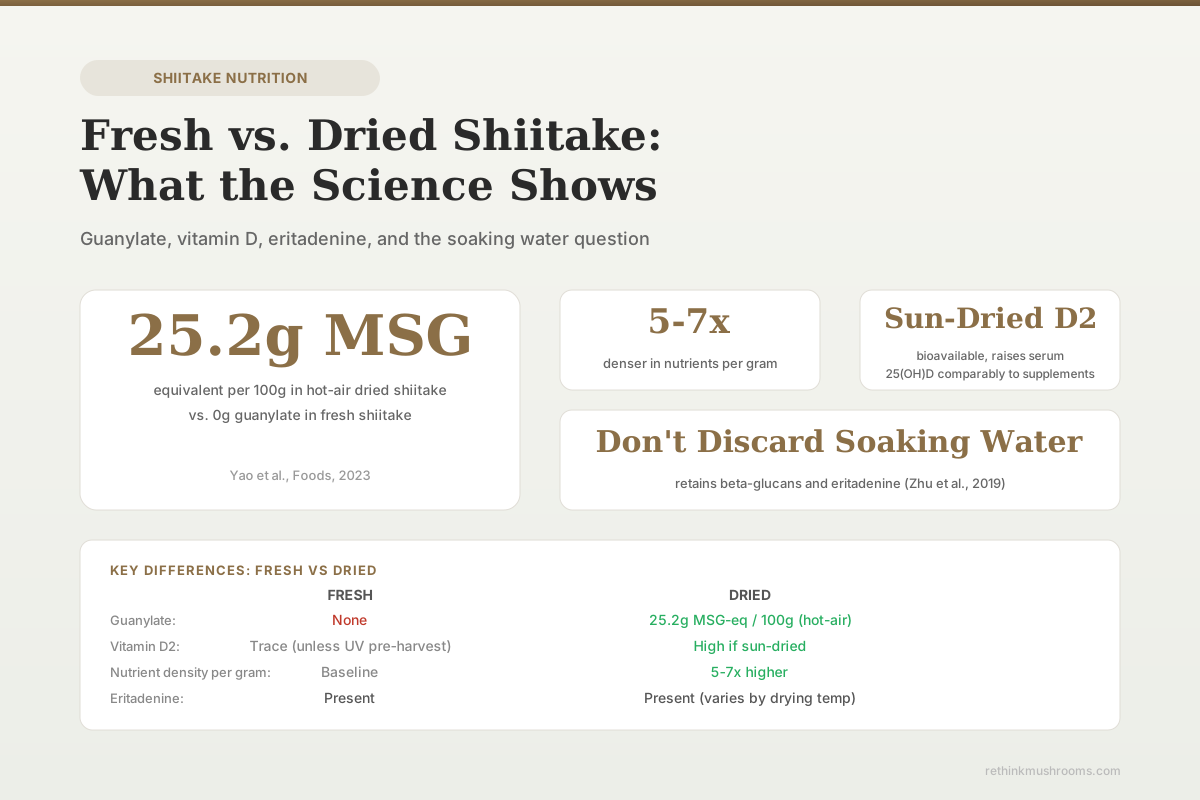
25.2g MSG-equivalent per 100g
Hot-air drying at 70°C transforms shiitake's RNA into guanylate, generating 25.2g MSG-equivalent per 100g. This compound doesn't exist in fresh shiitake at all. It's created by the drying process itself.
Yao et al., Foods, 2023
5-7x
more nutrients per gram by weight in dried vs fresh
0g guanylate
in fresh shiitake; it only forms during enzymatic drying
Bioavailable D2
sun-dried shiitake raises serum vitamin D comparably to supplements
Yao et al., Foods, 2023
 View as image ↗
The standard answer to "fresh vs dried shiitake" is that dried is more concentrated because moisture has been removed. That's true, but it misses the more interesting story: drying doesn't just concentrate nutrients, it creates compounds that don't exist in fresh shiitake at all.
The most important is guanylate, a flavor-active nucleotide that forms only when RNA breaks down during the enzymatic drying process. Fresh shiitake contains zero guanylate. Dried shiitake, depending on how it was dried, contains enough to deliver 25.2 grams of MSG-equivalent umami intensity per 100 grams of mushroom.[1]
The drying method also determines vitamin D content in ways that matter: sun-dried shiitake converts ergosterol to vitamin D2 via photochemical reaction, while machine-dried shiitake largely does not. And the water you soak dried shiitake in retains substantial bioactives that most people discard.
For background on shiitake's full nutritional profile and the research behind its bioactive compounds, see what is shiitake mushroom: the culinary mushroom with medicinal power.
Key Takeaways
- Guanylate (GMP) does not exist in fresh shiitake; it forms only when RNA breaks down during enzymatic drying; hot-air drying at 70°C produces 25.2g MSG-equivalent per 100g vs 12.0g from freeze-drying (Yao et al., Foods, 2023)
- The soaking water from rehydrating dried shiitake retains substantial beta-glucans and eritadenine; discarding it loses meaningful bioactive content (Zhu et al., Int J Med Mushrooms, 2019)
- Sun-drying converts ergosterol to vitamin D2 via UV photochemical reaction; machine-drying without UV exposure produces minimal D2; the method of drying determines vitamin D content (Jiang et al., Trends Food Sci Tech, 2020)
- Vitamin D2 from UV-exposed shiitake is bioavailable in humans, raising serum 25(OH)D comparably to D2 supplements, though D3 from animal sources remains more potent (Leung et al., Int J Med Mushrooms, 2021)
- Heat stress during drying affects eritadenine synthesis; very high-temperature drying may alter eritadenine production relative to lower-temperature methods (Zhang et al., Int J Med Mushrooms, 2021)
- Boiling causes greater losses of water-soluble nutrients and antioxidants in shiitake than sautéing or grilling; the soaking liquid from dried shiitake should be kept and added to recipes rather than discarded (Roncero-Ramos et al., 2017)
Fresh vs. Dried Shiitake: A Quick Comparison
The most useful way to frame the comparison is by what each form provides and where each has advantages.
| Nutrient or Compound | Fresh Shiitake | Dried Shiitake |
|---|---|---|
| Nutrient density per gram | Lower (high water content) | 5-7x higher by weight |
| Guanylate (GMP) | None | Substantial (enzymatic formation) |
| Vitamin D2 | Trace unless UV-exposed before harvest | High if sun-dried or UV-treated |
| Eritadenine | Present | Present (may vary by drying temperature) |
| Beta-glucans | Present | Present and concentrated |
| Lentinan | Present | Present and concentrated |
| B-vitamins | Higher in absolute amount per piece | May have partial losses from high-heat drying |
| Ergothioneine | Present | Present and concentrated |
The single most important row is guanylate. Everything else is a question of concentration or method. Guanylate is a categorical difference: fresh shiitake simply does not contain it.
The Thing That Only Exists in Dried: Guanylate
Guanylate is a nucleotide (specifically guanosine-5-monophosphate, or GMP) that is classified as a powerful flavor compound in the same family as glutamate. In combination with glutamate, guanylate creates synergistic umami at roughly 30 times the intensity of either compound alone.
Fresh shiitake mushrooms contain RNA as a normal cellular component. When a fresh mushroom is alive or freshly harvested, enzymes that would break down this RNA are either inactive or quickly compartmentalized. No breakdown occurs. No guanylate forms.
Drying changes this. As the mushroom cell structure disrupts and moisture levels drop over the drying period, RNA-degrading enzymes become active. The RNA breaks down into its constituent nucleotides, including GMP. The longer and more complete this enzymatic breakdown, the more guanylate forms in the final product.
Yao and colleagues quantified this directly in 2023.[1] Using the equivalent umami concentration (EUC) metric, which converts all flavor-active nucleotides and free amino acids into a single MSG-equivalent number, they found that hot-air drying at 70°C produced 25.2g MSG-equivalent EUC per 100g of dried shiitake. Freeze-drying produced 12.0g MSG-equivalent EUC. The difference between methods is almost entirely explained by how much enzymatic RNA breakdown occurred during drying.
This has a practical implication that extends beyond flavor. Guanylate is not just a taste compound; it reflects the completeness of the enzymatic transformation that dried shiitake undergoes. Hot-air drying at 70°C, which allows more enzymatic activity before the mushroom fully desiccates, produces a different chemical product than rapid freeze-drying, which halts enzymatic activity quickly.
For the broader context on shiitake's unique bioactive compounds, see shiitake bioactive compounds: lentinan, eritadenine, and beyond.
The Vitamin D Difference: Why Drying Method Determines D2 Content
Fresh shiitake from a shaded growing environment contains very little vitamin D. The mushroom contains ergosterol, a precursor compound, but conversion to vitamin D2 requires UV light exposure, specifically UV-B radiation.
Hu and colleagues demonstrated the photochemical mechanism directly: UV irradiation of shiitake converts ergosterol to vitamin D2, with ergosterol levels and D2 levels tracking in opposite directions as UV exposure increases, confirming the direct conversion relationship.[4]
Jiang and colleagues reviewed the drying condition variables that determine how much conversion occurs.[3] Sun-drying, which exposes mushrooms to natural UV-B, substantially increases D2 content. Shade-drying or machine-drying without UV exposure produces far less D2. Temperature, duration, and UV intensity all modulate the conversion rate, meaning two bags of "dried shiitake" can have dramatically different vitamin D content depending on how they were produced.
Traditional Japanese and Chinese drying methods, which often place mushrooms gill-side-up in sunlight, have been producing high-D2 shiitake for centuries without knowing the photochemical mechanism. The research explains why this matters nutritionally: gills-facing-up during sun exposure maximizes the gill surface area that receives UV-B, since the ergosterol is concentrated in the mushroom tissue near the surface.
The more consequential question for most people is whether the vitamin D2 in dried shiitake actually works in the body. Leung and colleagues reviewed the bioavailability data and found that mushroom-derived D2 from UV-exposed shiitake raises serum 25(OH)D levels comparably to D2 supplement capsules, though D3 from animal sources remains more potent at raising serum levels per dose.[5] The D2 in sun-dried shiitake is not inert. It does raise circulating vitamin D levels in humans.
Eritadenine: How Drying Temperature Affects This Unique Compound
Eritadenine is one of the most pharmacologically studied compounds in shiitake, with documented effects on cholesterol metabolism. It is present in both fresh and dried shiitake, but the amount in dried shiitake depends on how the drying was done.
Zhang and colleagues investigated the relationship between heat stress and eritadenine synthesis in shiitake liquid fermentation, finding that heat stress and purine availability both modulate eritadenine production.[6] The implication for drying: very high-temperature drying conditions may alter eritadenine levels relative to lower-temperature methods, because temperature affects the biochemical pathways producing eritadenine.
The practical guidance is that moderate-temperature drying methods (such as hot-air drying at 70°C, or sun-drying) may better preserve eritadenine than extreme high-heat industrial drying, though research on this specific question in finished dried mushroom products is limited. For more on eritadenine's documented health effects, see eritadenine in shiitake: the unique cholesterol-lowering nucleoside.
The Soaking Water Finding That Changes How You Should Cook with Dried Shiitake
Most people who use dried shiitake soak the mushrooms in water for 20-30 minutes, use the rehydrated mushrooms in a recipe, and discard the soaking liquid. Based on 2019 research from Zhu and colleagues, this practice wastes a meaningful fraction of the bioactive content.[2]
Zhu's team measured what actually dissolves into the soaking water when dried shiitake is rehydrated. The soaking water retained substantial concentrations of bioactive polysaccharides and eritadenine. These are water-soluble compounds that migrate from the mushroom tissue into the soaking liquid during rehydration.
The practical implication: using the soaking water in cooking (as a broth base, sauce addition, or soup liquid) recovers bioactive content that would otherwise be lost. This is consistent with traditional East Asian cooking practice, where dried shiitake soaking liquid has been used as a flavor base in dashi, hotpot broth, and braising liquids for centuries.
Roncero-Ramos and colleagues' research on cooking methods reinforces the soaking water principle from a different angle: boiling shiitake in water caused greater losses of water-soluble nutrients and antioxidants than other cooking methods.[7] The water that shiitake cooks in becomes nutritionally significant. Discarding it means discarding some of what made the shiitake worth buying.
This cooking-method context connects to the companion article on cooking shiitake for maximum bioactive retention, which covers the full hierarchy of cooking methods and their effects on shiitake's bioactive profile.
What Gets Lost When Shiitake Is Dried
The honest side of the dried shiitake advantage is that some things are also lost or degraded during processing.
B-vitamins, particularly riboflavin (B2) and other water-soluble vitamins, are somewhat susceptible to heat and light during drying. High-temperature drying conditions can degrade a fraction of the initial B-vitamin content. The extent of this loss depends on temperature, duration, and method, and the overall nutrient concentration effect typically offsets it in dried shiitake by weight.
Roncero-Ramos et al. documented these trade-offs clearly: cooking method and preparation conditions matter for final nutrient delivery, and not all processing is neutral.[7] Boiling is consistently the worst method across mushroom preparations for retaining water-soluble compounds.
Fresh shiitake has its own advantages: it's eaten closer to the time of harvest, has softer texture that integrates differently in cooking, and hasn't undergone the processing variability that dried shiitake's vitamin D and eritadenine content is subject to.
Fresh vs. Dried: Which Should You Buy?
They serve different purposes, and the honest answer is that neither is universally superior.
Fresh shiitake is the right choice when texture matters, when you're cooking within a few days of purchase, and when you want predictable and familiar nutrition without depending on knowing the producer's drying method.
Dried shiitake is the right choice when you want guanylate for flavor, when you need a shelf-stable pantry ingredient, when you're making broth-based dishes where the soaking liquid can be incorporated, and when you have reason to believe the product was sun-dried (look for "sun-dried" on the label or gill-side-up sun exposure as a production detail).
Sun-dried dried shiitake specifically is worth seeking out if vitamin D content is a nutritional priority. The difference between sun-dried and shade-dried or machine-dried shiitake for vitamin D content is substantial, and this information is not consistently disclosed on packaging.
For practical guidance on how cooking method affects the bioactive compounds in both forms, see dried vs. fresh shiitake: how cooking method affects bioactive compound availability. And for a broader comparison of how drying affects all medicinal mushrooms, see dried vs. fresh mushrooms: do drying methods affect health benefits?.
The nutritional differences between fresh and dried shiitake are real and meaningful, particularly for guanylate, vitamin D, and the soaking water question. But they are differences in degree and method rather than a clear winner. A well-sourced sun-dried shiitake used with its soaking water has a different nutritional profile than fresh. A machine-dried shiitake soaked and drained has a different one again. Knowing this makes the choice intentional rather than arbitrary.
For more on shiitake's culinary applications and which cooking techniques preserve its bioactives, see shiitake in global cuisine: culinary applications and tips and shiitake nutritional profile: vitamins, minerals, and macros.
The Bottom Line
Fresh and dried shiitake have different nutritional profiles rather than one being simply "better" than the other. Dried shiitake contains guanylate (GMP) that is absent in fresh, is 5-7x more nutrient-dense per gram by weight, and has substantially higher vitamin D2 if sun-dried. The soaking water from rehydrating dried shiitake retains bioactive polysaccharides and eritadenine that are typically discarded. High-temperature drying may partially reduce some water-soluble vitamins while creating the enzymatic guanylate that makes dried shiitake flavonically and nutritionally distinct from fresh.
Frequently Asked Questions
Sources & References
- 1. Source details for this reference are not yet available.
- 2. Source details for this reference are not yet available.
- 3. Source details for this reference are not yet available.
- 4. Source details for this reference are not yet available.
- 5. Source details for this reference are not yet available.
- 6. Source details for this reference are not yet available.
- 7. Source details for this reference are not yet available.