Shiitake Culinary Science
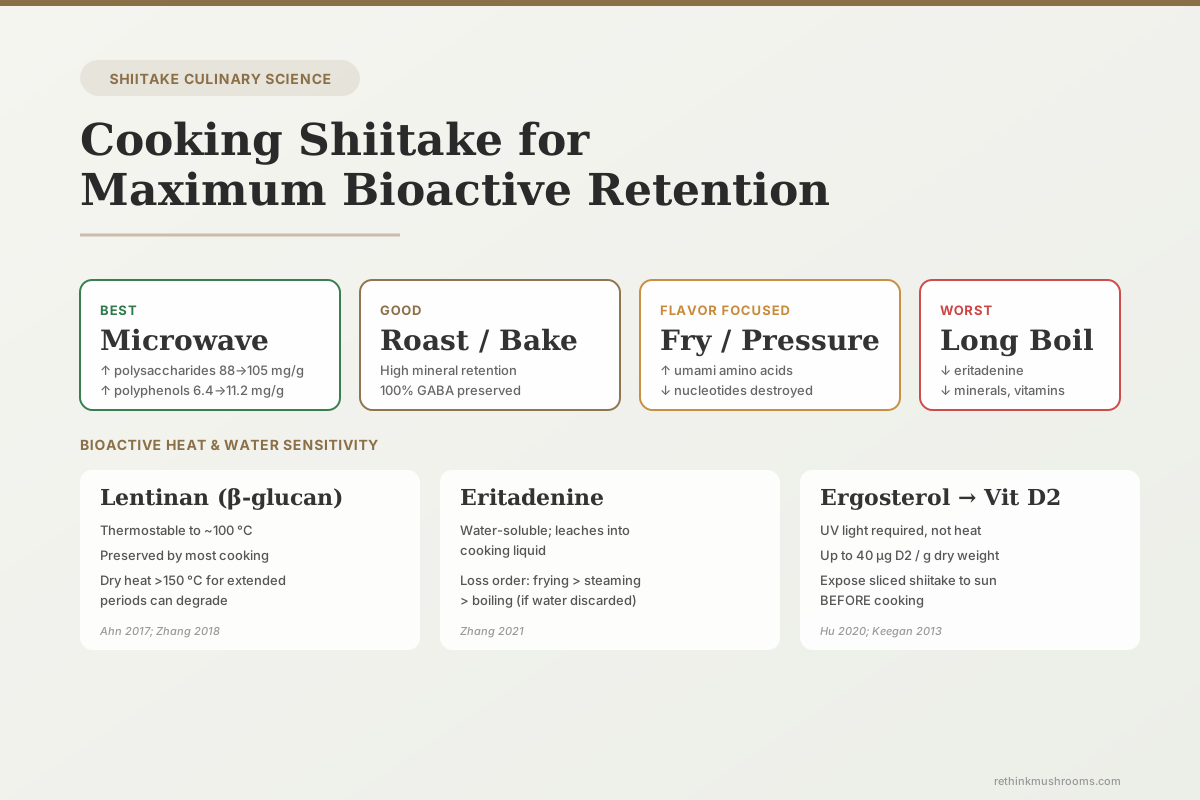
Microwave preserves most bioactives
Across published cooking-comparison studies, microwaving shiitake increased total polysaccharide and polyphenol content relative to raw, while boiling consistently produced the largest losses of minerals, vitamins, and water-soluble bioactives.
Zhou et al., Foods, 2022
Lentinan
β-glucan fraction; thermostable up to ~100 °C, degraded at sustained high dry heat
Eritadenine
water-soluble; order of loss: frying > steaming > boiling
Ergosterol
converts to vitamin D2 under UV; optimal conversion near 40 °C
Zhou et al., Foods, 2022
 View as image ↗
The cooking method used on shiitake mushrooms changes how much of each bioactive compound survives to the plate. Shiitake carry three distinct classes of compound that matter for the health claims made about them: β-glucans (of which lentinan is the most studied fraction), eritadenine (a cholesterol-modulating purine derivative), and ergosterol (the precursor for UV-generated vitamin D2). Each class responds differently to heat, water, and time. The practical question is not which cooking method is "best" in the abstract but which method preserves which compound. For the broader picture, see fresh vs. dried shiitake: nutritional and bioactive differences and dried vs. fresh shiitake: how cooking method affects bioactive compound availability.
Key Takeaways
- Zhou et al. (2022), comparing five cooking methods across three shiitake varieties from Guizhou Province, found microwaving increased polysaccharide content from 88–103 mg/g raw to 93–105 mg/g cooked and polyphenol content from 6.4–8.1 mg/g to 7.5–11.2 mg/g, while frying and boiling produced the largest nucleotide losses (Foods)
- Zhang et al. (2018), in a meta-analysis of 38 RCTs with 3,117 patients, established that lentinan plus chemotherapy improved lung cancer response rate from 43.3% to 56.9% compared with chemotherapy alone, providing the clinical benchmark for why lentinan retention matters (Journal of Cancer Research and Clinical Oncology)
- Dai et al. (2015) randomized 52 young adults to 5 g or 10 g of dried shiitake daily for four weeks and reported improved proliferation of γδ T-cells and natural killer T-cells along with reduced C-reactive protein, using shiitake cooked as a daily food rather than extracted as a supplement (Journal of the American College of Nutrition)
- Hu et al. (2020) showed that UV irradiation of shiitake powder increased vitamin D2 from undetectable to 40.59 ± 1.16 μg/g dry weight, confirming ergosterol conversion as the mechanism and establishing that UV exposure before cooking is the relevant fortification step (ACS Omega)
- Zhang et al. (2021) demonstrated that heat stress in shiitake liquid fermentation altered eritadenine synthesis, with the response sensitive to both temperature and time, consistent with the water-temperature-time hierarchy observed in cooked fruiting bodies (International Journal of Medicinal Mushrooms)
- Ahn et al. (2017) characterized lentinan's immune activity at the receptor level, showing selective attenuation of AIM2 and non-canonical inflammasome activation while inducing pro-inflammatory cytokine production, which is the mechanistic basis for lentinan's clinical use as an immunoadjuvant (Scientific Reports)
The Three Compound Classes to Track
Shiitake research published on cooking effects usually focuses on three compound classes because each class has a different thermal and solubility profile. Treating shiitake as a single "bioactive black box" obscures the fact that these classes behave differently under identical cooking conditions.
Lentinan is a β-1,3 glucan with β-1,6 branches, isolated from the shiitake fruiting body and first clinically deployed as an immunoadjuvant in Japan in the 1980s. Ahn et al. (2017) characterized its mechanism at the receptor level, showing selective modulation of inflammasome activation and cytokine production.[1] Zhang et al. (2018) summarized 12 years of Chinese clinical studies using lentinan as an oncology adjunct and quantified the survival and response-rate effects across 38 randomized trials and 3,117 patients.[2]
Eritadenine is a small-molecule purine derivative that lowers plasma cholesterol in animal models by inhibiting S-adenosyl-L-homocysteine hydrolase. Kabir et al. (1987) showed effects on blood pressure and plasma lipids in spontaneously hypertensive rats fed shiitake, and eritadenine has been proposed as the key mechanistic compound for shiitake's lipid-lowering activity.[3] Eritadenine is water-soluble, which matters enormously when the cooking method involves boiling liquid that gets discarded.
Ergosterol is the fungal sterol that converts to vitamin D2 under ultraviolet light. Keegan et al. (2013) reviewed the photobiology of vitamin D in mushrooms and the bioavailability of mushroom-derived vitamin D2 in humans.[4] Hu et al. (2020) then quantified the conversion, showing that UV irradiation of shiitake powder produced 40.59 ± 1.16 μg of vitamin D2 per gram dry weight and up to 677 μg/g in ethanol suspension.[5] Critically, the vitamin D2 generated is heat-stable, but ergosterol itself is partially UV-degraded rather than fully converted, which means pre-UV exposure of cut shiitake is the rate-limiting step, not cooking method.
The Cooking-Method Comparison Data
Zhou et al. (2022) published the most systematic side-by-side comparison available, testing boiling, steaming, microwaving, frying, and pressure cooking across three shiitake varieties (808, 0912, and LM) from Guizhou Province.[6] The headline findings:
Microwaving increased polysaccharide content from 88–103 mg/g (raw) to 93–105 mg/g and increased polyphenol content from 6.4–8.1 mg/g to 7.5–11.2 mg/g. Antioxidant activity rose correspondingly. The mechanism is partly disruption of cell walls that releases bound bioactives and partly the brief exposure time at relatively moderate internal temperatures.
Boiling produced the largest losses of water-soluble compounds. Nucleotides were destroyed especially by frying or boiling. Dietary fiber fell by 4.1 to 38.7% across cooking methods, and protein fell by 4.1 to 44.0%. Vitamin and mineral true retention was lowest in boiled samples in complementary cooking-method studies.
Pressure cooking and frying were optimal for flavor compounds, increasing the proportion of sweet and umami amino acids and creating more aroma-active volatiles. These methods are flavor-first, not retention-first.
Roasting produced high retention of GABA (up to 100% versus 7.4% for boiling in one analysis) and maintained mineral retention comparable to microwaving.
Eritadenine Specifically
Eritadenine shows the clearest water-temperature-time interaction. Published processing studies report a loss order of frying > steaming > boiling when ranked by extent of eritadenine loss under standard kitchen conditions, and the main factors controlling the loss are water presence, temperature, and exposure time in that order.
Zhang et al. (2021) examined heat stress effects on eritadenine synthesis in shiitake liquid fermentation and demonstrated that temperature alone changes the synthetic pathway activity, independent of any cooking-method water effect.[7] In practical cooking terms, the relevant inference is that short cooking times preserve eritadenine and that boiling water into which eritadenine dissolves is a major loss route if the water is discarded rather than consumed (as in a soup or stock).
This is the single most actionable finding from the eritadenine literature. If cholesterol-modulating activity is the target outcome, shiitake cooked in a soup or stew and consumed with the cooking liquid retains substantially more eritadenine than shiitake boiled with the water poured off.
Lentinan and β-Glucan Thermal Stability
Lentinan and related β-glucans are generally described as thermostable within the range of normal cooking. The Zhou et al. (2022) data showed that polysaccharide content (a category that includes the β-glucan fractions) was preserved or modestly increased across most cooking methods, with microwaving specifically increasing extractable polysaccharide yield.[6]
The important caveat is that clinical lentinan (the drug used in Zhang et al. 2018) is purified, standardized, and intravenously administered. Dietary shiitake β-glucan is not the same exposure. Dai et al. (2015) is the most relevant human dietary trial: 52 young adults consumed 5 g or 10 g dried shiitake daily for four weeks, and the researchers measured improvements in γδ T-cell and NKT-cell proliferation along with reduced serum C-reactive protein.[8] The cooking method used was cooked whole mushrooms, consistent with normal dietary preparation. The trial demonstrates that immune-relevant activity survives cooking at the dietary dose range.
High dry heat sustained for extended periods can degrade lentinan structurally. Practical cooking, such as a 10-minute stir-fry, a 20-minute simmer, or a 5-minute microwave, stays below the threshold where structural degradation becomes quantitatively important.
Ergosterol, UV, and Vitamin D2
The ergosterol-to-vitamin-D2 pathway is temperature-sensitive but cooking-insensitive in a specific way. Hu et al. (2020) showed maximum conversion at 40 °C, with conversion efficiency falling at both lower and higher temperatures.[5] UV exposure produces vitamin D2 from ergosterol, but the UV exposure has to happen before or during the UV step, not during cooking itself. Cooking does not generate vitamin D2. Cooking can degrade vitamin D2 that is already present, though the loss across typical kitchen conditions is moderate.
Keegan et al. (2013) established that UV-exposed mushroom vitamin D2 is bioavailable to humans at doses that meaningfully raise serum 25-hydroxyvitamin D.[4] The practical inference is that shiitake that has been UV-exposed (either by the producer with intentional UV lighting or by the consumer with 30 to 60 minutes of direct sunlight on the gill side of sliced caps) is a meaningful dietary vitamin D source. Non-UV-exposed shiitake is not.
Putting the Cooking Methods in Order
For lentinan and β-glucan retention, any short cooking method is acceptable. Microwaving, stir-frying under 10 minutes, or brief steaming all preserve the polysaccharide fraction.
For eritadenine retention, cook in a method that retains the cooking liquid (soup, stew, braise) or use short-duration dry heat (stir-fry under 5 minutes). Avoid long boils with discarded water.
For phenolic and antioxidant retention, microwaving leads the published data, with oven-baking at short durations and roasting as alternatives. Prolonged boiling is the consistent worst case.
For vitamin D2 potential, UV-expose the shiitake before cooking, then any gentle cooking method preserves the vitamin D2 generated.
The general rule is that shorter duration, less water, and moderate rather than high sustained temperatures preserve the broadest range of compounds. The specific exception is that pressure cooking and frying produce the best flavor outcomes at the cost of nucleotide and heat-labile compound losses, which is a reasonable tradeoff when flavor is the primary goal.
Dried Versus Fresh Shiitake Under the Same Cooking Method
Dried shiitake and fresh shiitake respond differently to the same cooking method because their starting moisture content, cell wall integrity, and bioactive concentration per gram are different. Rehydration before cooking partially restores the cooking-response profile of fresh shiitake, but the drying process itself has already altered the bioactive baseline. Dried shiitake concentrates polysaccharides and eritadenine by weight simply through water removal, so a gram of dried shiitake typically contains 8 to 10 times the bioactive mass of a gram of fresh shiitake. The rehydration water contains a meaningful fraction of eritadenine and other water-soluble compounds, which is why Japanese culinary tradition retains shiitake soaking water for dashi and stock. For the direct dried-versus-fresh comparison, see fresh vs. dried shiitake: nutritional and bioactive differences.
Cooking shiitake also interacts with other ingredients in the dish. Fat-containing preparations improve absorption of lipid-soluble compounds including ergosterol and any ergosterol-derived vitamin D2. Acidic ingredients can stabilize certain phenolics against heat degradation. These matrix effects are underinvestigated in the published literature relative to the single-ingredient cooking-comparison studies that dominate it.
Limitations and What the Evidence Does Not Support
Most cooking-comparison studies use a single shiitake variety, a single cultivar batch, or fruiting bodies from a single region, and results are sensitive to initial mushroom composition. Zhou et al. (2022) explicitly tested three varieties and found variety-dependent baseline differences, which complicates any attempt to generalize "shiitake cooked by method X retains Y percent."[6]
Human clinical studies of cooked shiitake versus raw shiitake are effectively nonexistent. The Dai et al. (2015) trial used cooked shiitake as the intervention but did not compare against a raw arm.[8] Raw shiitake is not recommended for consumption regardless, because raw lentinan-containing mushrooms have been associated with flagellate dermatitis ("shiitake dermatitis") in some consumers.
Laboratory measurements of "bioactive retention" typically quantify extractable compound content rather than bioavailable compound absorption in humans. The relationship between a compound surviving cooking and reaching systemic circulation is not always one-to-one, and the clinical evidence for many specific compound-outcome pairs in shiitake is weaker than the chemical stability data.
The Bottom Line
Microwaving and short roasting preserve the broadest range of shiitake bioactive compounds in published cooking-comparison studies, while long boiling with discarded water produces the largest losses, particularly for eritadenine and water-soluble phenolics. Lentinan and other β-glucans are stable across normal cooking conditions. Ergosterol conversion to vitamin D2 requires UV exposure rather than cooking. Direct human clinical comparisons of cooking methods are absent, so recommendations rest on ex vivo compound measurement rather than measured health outcomes.
Frequently Asked Questions
Sources & References
- 1RTHM-00459·Ahn, Huijeong et al. (2017). “Lentinan from shiitake selectively attenuates AIM2 and non-canonical inflammasome activation while inducing pro-inflammatory cytokine production..” Scientific reports.Study breakdown →PubMed →↩
- 2RTHM-00538·Zhang, Yiran et al. (2018). “Lentinan as an immunotherapeutic for treating lung cancer: a review of 12 years clinical studies in China..” Journal of cancer research and clinical oncology.Study breakdown →PubMed →↩
- 3RTHM-00007·Kabir, Y et al. (1987). “Effect of shiitake (Lentinus edodes) and maitake (Grifola frondosa) mushrooms on blood pressure and plasma lipids of spontaneously hypertensive rats..” Journal of nutritional science and vitaminology.Study breakdown →PubMed →↩
- 4RTHM-00292·Keegan, Raphael-John H et al. (2013). “Photobiology of vitamin D in mushrooms and its bioavailability in humans..” Dermato-endocrinology.Study breakdown →PubMed →↩
- 5RTHM-00621·Hu, Daihua et al. (2020). “Ultraviolet Irradiation Increased the Concentration of Vitamin D2 and Decreased the Concentration of Ergosterol in Shiitake Mushroom (Lentinus edodes) and Oyster Mushroom (Pleurotus ostreatus) Powder in Ethanol Suspension..” ACS omega.Study breakdown →PubMed →↩
- 6RTHM-00809·Zhou, Xiaoli et al. (2022). “Effect of Different Cooking Methods on Nutrients, Antioxidant Activities and Flavors of Three Varieties of Lentinus edodes..” Foods (Basel.Study breakdown →PubMed →↩
- 7RTHM-00734·Zhang, Jing et al. (2021). “Effects of Heat Stress and the Addition of Different Purines on the Synthesis of Eritadenine in Liquid Fermentation of Shiitake Culinary-Medicinal Mushroom, Lentinula edodes (Agaricomycetes)..” International journal of medicinal mushrooms.Study breakdown →PubMed →↩
- 8RTHM-00368·Dai, Xiaoshuang et al. (2015). “Consuming Lentinula edodes (Shiitake) Mushrooms Daily Improves Human Immunity: A Randomized Dietary Intervention in Healthy Young Adults..” Journal of the American College of Nutrition.Study breakdown →PubMed →↩