Enoki & Cardiovascular Health
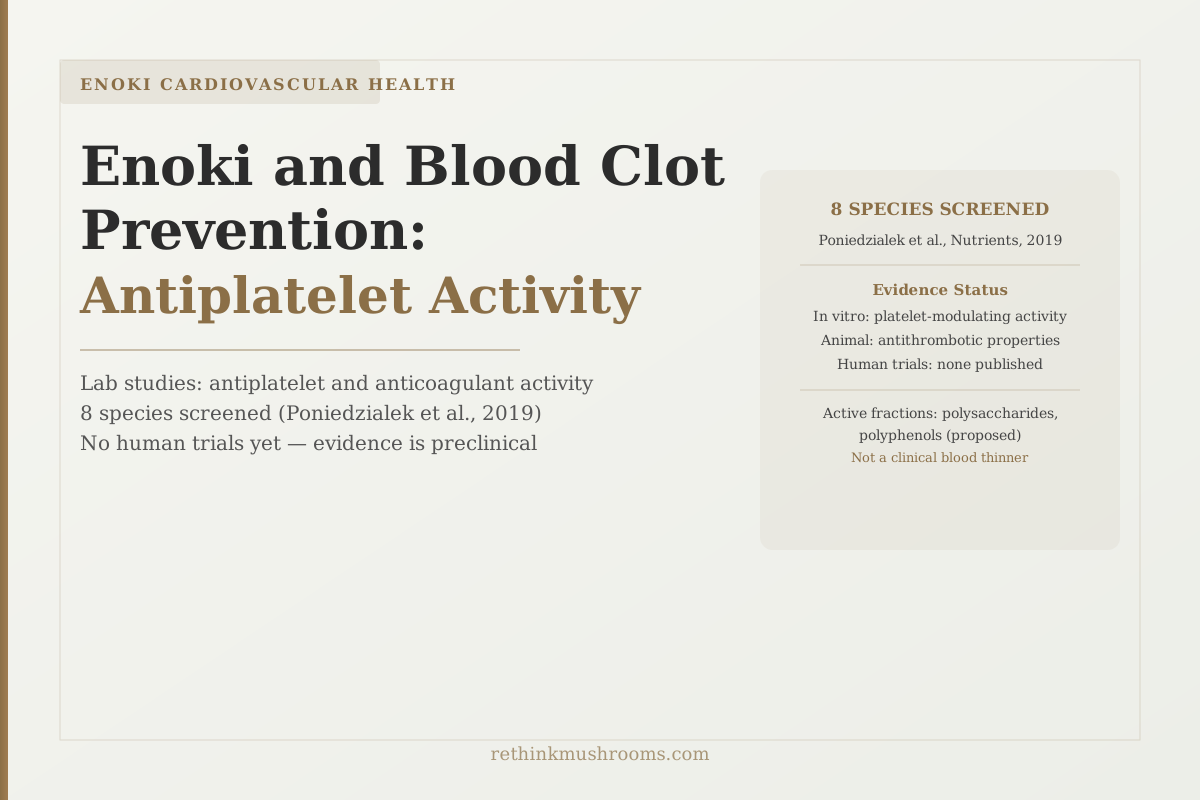
8 mushroom species screened for antiplatelet activity
Poniedzialek et al. (2019) ran the most comprehensive in vitro screening of edible mushroom platelet effects, testing 8 species. Enoki showed differential platelet-modulating activity, but no human trial has confirmed these effects in people.
Poniedzialek et al., Nutrients, 2019
In vitro only
no human trials have confirmed antiplatelet effects in people
2 pathways
antiplatelet and anticoagulant are distinct mechanisms
Polysaccharides
and polyphenols are the proposed active fractions in enoki
Poniedzialek et al., Nutrients, 2019
 View as image ↗
Enoki mushrooms (Flammulina velutipes) contain polysaccharides and polyphenols that have shown antiplatelet and anticoagulant activity in laboratory studies. Traditional Asian medicine has long included enoki as an antithrombotic food. Modern research has begun probing the underlying chemistry. The honest summary is this: the in vitro evidence points toward real biological activity at the platelet and coagulation level, but no human clinical trial has established whether eating enoki, or taking enoki supplements, produces meaningful blood-clot-preventing effects in people. Understanding what the current evidence actually shows, and what it does not, is more useful than either dismissing the research or overstating it. This article also addresses the "blood thinner" safety question directly, because the answer matters practically. For the broader picture of enoki's cardiovascular research, see Enoki and Heart Health: Cardiovascular Research Review and for the pillar overview, What Is Enoki Mushroom? The Tiny Mushroom with Big Research.
Key Takeaways
- Antiplatelet activity (preventing platelets from clumping together) and anticoagulant activity (slowing the blood clotting cascade) are two distinct mechanisms; both have been studied in enoki extracts in laboratory conditions
- Poniedzialek et al. (2019) screened 8 edible mushroom species for platelet and coagulation effects in vitro, demonstrating differential activity across species including enoki
- Tang et al.'s 2016 comprehensive review of enoki (Frontiers in Pharmacology) documented antithrombotic properties alongside antihypertensive, cholesterol-lowering, and antioxidant effects, citing the polysaccharide and polyphenol fractions as the likely active agents
- The proposed mechanisms include polysaccharide inhibition of platelet activation pathways and polyphenol suppression of arachidonic acid metabolism, a key step in platelet aggregation signaling
- No human randomized controlled trials have confirmed enoki's antiplatelet effects in people; all current evidence is from cell studies and animal experiments
- Enoki is not a blood thinner in any clinically documented sense; the in vitro data does not translate directly into drug-equivalent activity, and the safety question most relevant to people on anticoagulant medications is unanswered
Antiplatelet vs. Anticoagulant: Why the Distinction Matters
Most discussions of blood clot prevention blur two distinct processes together. Separating them matters for understanding what the enoki evidence actually shows.
Platelet aggregation is the first phase of blood clot formation. When a blood vessel is damaged, platelets, the small cell fragments that circulate in the blood, stick to the injury site and clump together to form a temporary plug. In normal physiology, this is the first response to a wound. When it happens pathologically, inside an intact artery, it contributes to the arterial blockages behind most heart attacks and strokes.
Antiplatelet agents interfere with this clumping process. They work at the platelet level, blocking the signals that cause platelets to activate and stick together. Aspirin is the most widely used antiplatelet drug: it inhibits thromboxane A2, a chemical signal that promotes platelet clumping.
Blood coagulation is the second phase: a cascade of chemical reactions that converts fibrinogen to fibrin, the stringy protein that hardens a soft platelet plug into a stable clot. Anticoagulant drugs (warfarin, heparin, the newer direct oral anticoagulants) work at various points in this cascade.
The distinction is important because different compounds inhibit different phases, and the research on mushrooms has addressed both without always clearly distinguishing between them. Tang et al.'s 2016 comprehensive review documented enoki's antithrombotic properties under the general term "antithrombotic," which encompasses both mechanisms.[2] Understanding which phase a given compound affects has clinical implications, particularly for the safety question addressed at the end of this article.
The 8-Species Screening Study: What Poniedzialek Found
The most rigorous comparative data on mushroom antiplatelet activity comes from Poniedzialek et al. (2019), published in Nutrients. The researchers took extracts from eight commonly consumed edible mushroom species and tested them against human platelets and blood coagulation factors in vitro, using standardized protocols to measure platelet aggregation, platelet activation markers, and clotting time.[1]
The study found differential effects across species: different mushrooms produced different magnitudes of platelet-modulating activity, confirming that not all mushrooms are interchangeable from a cardiovascular chemistry standpoint. Enoki was among the species tested, and the screening demonstrated measurable activity in platelet-relevant assays.
Several features of the study design make it a useful reference point. The comparative format allows ranking by relative potency rather than just asking "does it work or not?" The use of human-derived platelets provides more physiological relevance than some animal models. And the standardized extraction method means results are more directly comparable across species than studies using different protocols.
The limitation is inherent to in vitro research: test-tube conditions are not body conditions. Platelet activation in vivo involves complex interactions with the vessel wall, circulating proteins, and blood flow dynamics that a bench assay cannot replicate. What happens to polysaccharides and polyphenols after digestion and absorption (whether they reach platelets in their active form, and at what concentrations) is unknown for enoki specifically. Poniedzialek's work establishes biological plausibility, not clinical efficacy.
What Tang 2016's Comprehensive Review Identified
Tang et al.'s 2016 review in Frontiers in Pharmacology, titled "Golden Needle Mushroom: A Culinary Medicine with Evidenced-Based Biological Activities and Health Promoting Properties," synthesized the accumulated research on enoki across multiple health categories.[2] Among its documented properties were antithrombotic effects, which the review attributed to enoki's polysaccharide and polyphenol fractions as the likely active agents.
The review identified several cardiovascular-relevant properties of enoki simultaneously: antithrombotic, antihypertensive, hypocholesterolaemic, and antioxidant. The co-occurrence of these properties matters because the cardiovascular risk factors they address interact with each other. High cholesterol, high blood pressure, and platelet hyperactivity all converge on the same outcome: arterial disease. A compound that modestly addresses multiple pathways may have cumulative cardiovascular relevance even if each individual effect is mild.
The Tang review also identified mycosterol, dietary fiber, and polysaccharides as the key cardiovascular-active components of enoki specifically. Each operates through a different mechanism: fiber affects cholesterol metabolism in the gut, polysaccharides modulate immune and metabolic signaling, and mycosterol competes with cholesterol absorption in the intestinal wall. The antithrombotic activity reviewed by Tang is attributed to polysaccharide and polyphenol fractions, rather than the same fiber and mycosterol mechanisms responsible for cholesterol effects. These are chemically distinct parts of the mushroom acting through distinct pathways.
What Compounds Likely Drive the Antiplatelet Effects
The specific chemistry behind enoki's potential antiplatelet activity has not been fully characterized, but the research literature points toward two compound classes: polysaccharides and polyphenols.
Polysaccharides from various mushroom species have been shown to modulate platelet activation through immune-signaling pathways. Mushroom polysaccharides interact with cell surface receptors, including the beta-glucan receptor Dectin-1, which is expressed on platelets and immune cells. Downstream signaling from these receptors can influence platelet activation thresholds. Whether enoki's specific polysaccharide structures have this activity, and how potently, requires more targeted characterization than currently exists in the published literature.
Polyphenols are the more studied compound class for antiplatelet activity. Phenolic compounds inhibit arachidonic acid metabolism, which is a key step in the signaling cascade that activates platelets. Arachidonic acid is converted by cyclooxygenase enzymes to thromboxane A2, the same molecule that aspirin inhibits. Polyphenols that block earlier steps in this pathway, or that compete with arachidonic acid at the enzyme level, produce aspirin-like antiplatelet effects at the biochemical level. Rahman et al.'s 2015 work on enoki polyphenols (documented in the context of LDL oxidation in the sibling article Enoki and Endothelial Health: Vascular Protection Research) established that enoki contains active polyphenolic compounds with significant antioxidant and anti-inflammatory properties. Whether those specific polyphenol fractions are the ones driving the antiplatelet effects measured in studies like Poniedzialek's requires head-to-head compound isolation work that has not yet been published.
For a deeper explanation of the specific bioactive compounds in enoki, including flammulin, proflamin, and the polysaccharide structures, see Enoki Bioactive Compounds: Flammulin, Proflamin, and Polysaccharides.
The Evidence Gap: In Vitro to Human Physiology
The honest state of the evidence is this: laboratory data supports the existence of antiplatelet-active compounds in enoki extracts, but there is no human evidence.
For context, this is not unique to enoki. Most medicinal mushroom antiplatelet claims rest entirely on in vitro or animal data. The field has not prioritized human platelet studies for dietary mushrooms. The absence of human data is not evidence that the effects are absent in people. It is evidence that the question has not been adequately tested.
What would be needed to establish clinical relevance: a pharmacokinetic study showing that enoki's antiplatelet-active compounds (whichever they turn out to be) survive digestion and reach the bloodstream in active form, followed by a randomized trial measuring platelet function in people consuming enoki at realistic dietary doses over a sustained period. Neither of those studies exists.
The gap matters most for people asking whether enoki could substitute for prescribed antiplatelet or anticoagulant therapy. On current evidence, the answer is no. The evidence does not support drug-equivalent efficacy at any tested dose.
Is Enoki a Blood Thinner? The Safety Question
The phrase "blood thinner" is a colloquial term that usually refers to either antiplatelet drugs (aspirin, clopidogrel) or anticoagulant drugs (warfarin, rivaroxaban). Enoki does not qualify as a blood thinner in any clinically documented sense.
The in vitro studies show platelet-relevant activity in isolated cell assays. This does not translate to dose-equivalent blood thinning in a person. The doses used in vitro are typically far higher than what someone would absorb from eating or supplementing enoki, and the mechanisms have not been validated in human physiology.
However, the question has a safety corollary worth addressing directly. People who take anticoagulant or antiplatelet medications should be aware that any food compound with theoretical platelet-modulating activity is a candidate for interaction with their medications. The interaction risk for enoki specifically has not been studied. In the absence of evidence, the precautionary principle applies: people on anticoagulant therapy who are interested in consuming enoki supplements (rather than culinary amounts of the mushroom) should discuss this with the prescribing clinician. Culinary amounts of enoki as part of a normal diet present no documented risk.
One safety distinction is critical: the mushroom relevant to these health discussions is commercially cultivated white enoki (Flammulina velutipes, the variety found in Asian grocery stores). Wild brown forms of Flammulina velutipes have been documented to cause cardiotoxic and myotoxic effects in animal studies. Mustonen et al. (2018) found wild F. velutipes caused myocardial and skeletal muscle damage in mice. Commercially cultivated white enoki does not share these risks. The two forms are different products, and the safety data from wild forms does not apply to the cultivated variety. For more on the wild versus cultivated distinction, see Flammulina velutipes: The Supermarket Mushroom With Hidden Research Credentials.
How Enoki's Antiplatelet Effects Fit the Broader Cardiovascular Picture
Enoki's potential antiplatelet activity is one of at least five distinct cardiovascular-relevant mechanisms that have been studied in the species. The others include lipid-lowering effects (reduced total cholesterol and triglycerides in animal studies), LDL oxidation inhibition (polyphenols extend LDL oxidation lag time in vitro), ACE inhibition (novel peptides identified in a 2025 study by Zhang et al.), and endothelial protection via ergothioneine. The antithrombotic angle covered here is arguably the least evidence-supported of the five, with the fewest studies and the most tenuous mechanistic path from in vitro assay to human physiology.
That assessment is itself useful information. The comparative weakness of the antiplatelet evidence does not invalidate the other cardiovascular mechanisms. It simply indicates where the research frontier is and where claims should be made with more caution. The cholesterol and LDL oxidation data are more developed; the antiplatelet data is a preliminary signal that warrants further investigation rather than clinical application.
For the full cardiovascular evidence synthesis across all five mechanisms, see Enoki and Heart Health: Cardiovascular Research Review. For the blood pressure and ACE inhibition research, see Enoki and Blood Pressure: Anti-Hypertensive Research.
The Bottom Line
Enoki mushrooms show antiplatelet and anticoagulant activity in laboratory studies, with Poniedzialek et al. (2019) providing the most systematic comparative screening across eight mushroom species, and Tang et al. (2016) documenting enoki's antithrombotic properties in a comprehensive review. The active fractions are proposed to be polysaccharides and polyphenols. No human trials have confirmed these effects in people. Enoki is not a documented blood thinner in any clinical sense, and the preclinical evidence does not support substituting it for prescribed anticoagulant or antiplatelet medications.
Frequently Asked Questions
Sources & References
- 1RTHM-01114·Poniedziałek, Barbara et al. (2019). “The Effect of Mushroom Extracts on Human Platelet and Blood Coagulation: In vitro Screening of Eight Edible Species..” Nutrients.Study breakdown →PubMed →↩
- 2RTHM-00831·Tang, Calyn et al. (2016). “Golden Needle Mushroom: A Culinary Medicine with Evidenced-Based Biological Activities and Health Promoting Properties..” Frontiers in pharmacology.Study breakdown →PubMed →↩