Enoki (Flammulina velutipes)
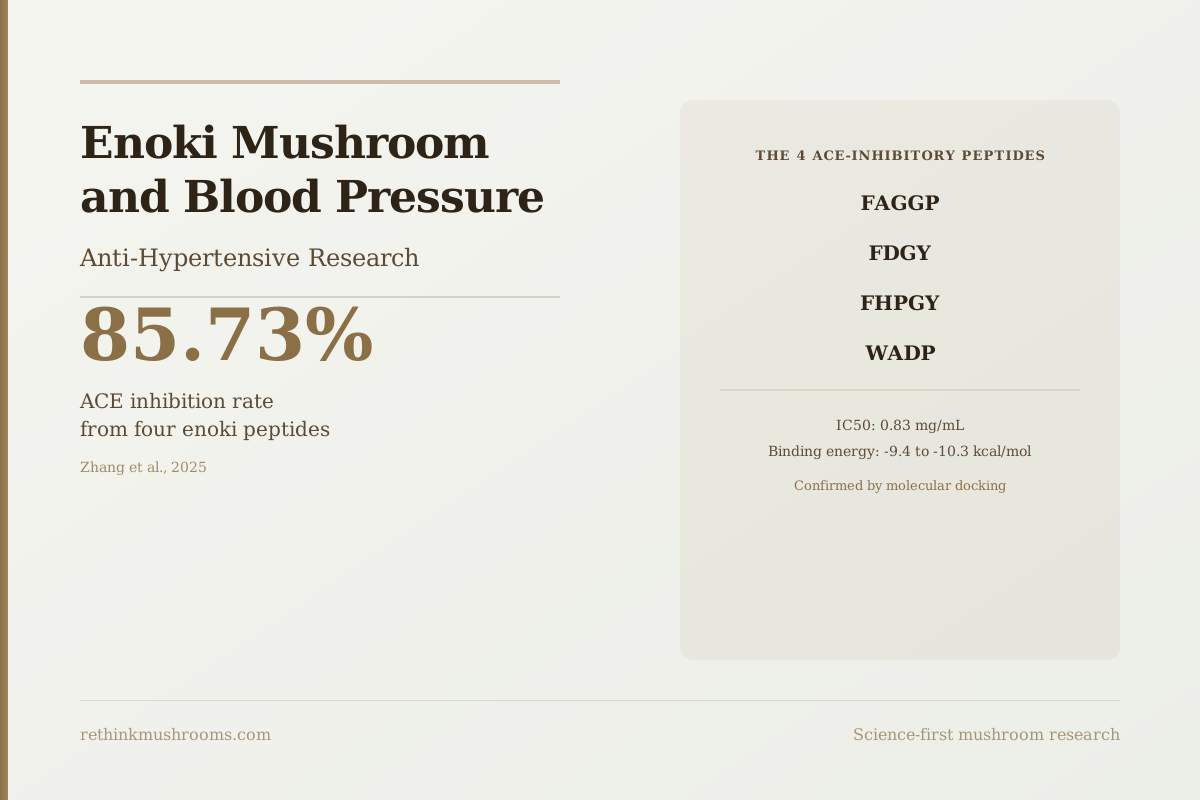
85.73% ACE inhibition rate in 2025 peptide study
In 2025, researchers identified four specific peptides in enoki mushrooms that inhibit the same enzyme targeted by a major class of blood pressure drugs. All evidence is still in-lab, but the mechanism is real and surprisingly specific.
Zhang et al., 2025
IC50 0.83
mg/mL for four novel ACE-inhibitory peptides from enoki (Zhang 2025)
52.8%
ACE inhibition from enoki, highest among all basidiomycetes tested (Kim 2002)
Wild ≠ Safe
wild Flammulina velutipes caused cardiotoxicity in mice; cultivated white enoki did not
Zhang et al., 2025
 View as image ↗
When researchers ran enoki mushroom proteins through enzymatic hydrolysis in 2025 and measured what came out, they found four peptides with a specific and measurable ability to block ACE, the enzyme that triggers blood vessel constriction and drives blood pressure upward. The overall inhibition rate was 85.73%. The compounds were isolated, named, and their binding mechanisms confirmed by molecular modeling.
This is not a claim that enoki mushrooms treat hypertension. No human clinical trial has tested that. But the mechanistic evidence for why enoki might affect blood pressure is specific enough to be worth understanding. The 2025 finding is too recent to appear in any consumer content. This article is part of the enoki mushroom research overview and covers the full blood pressure evidence set.
Key Takeaways
- Zhang et al. 2025 identified four ACE-inhibitory peptides from enoki mushrooms (FAGGP, FDGY, FHPGY, WADP) with an overall inhibition rate of 85.73% and IC50 of 0.83 mg/mL, confirmed by molecular docking with binding energies of -9.4 to -10.3 kcal/mol
- Kim et al. 2002 found enoki produced the highest ACE inhibitory activity among all basidiomycetes tested, at 52.8%, establishing this mechanism more than 20 years before the 2025 peptide isolation
- ACE (angiotensin-converting enzyme) converts an inactive compound in the blood into angiotensin II, which constricts blood vessels; blocking ACE is the mechanism of widely prescribed blood pressure medications including lisinopril
- Tang et al. 2016 review documented enoki's antihypertensive properties among five cardiovascular mechanisms, attributing activity to dietary fiber, polysaccharides, and mycosterol alongside the peptide activity
- All blood pressure evidence for enoki is preclinical (in vitro: cell and molecular studies); no human clinical trial has tested enoki for blood pressure reduction in people
- Mustonen et al. 2018 found that wild Flammulina velutipes caused myocardial and skeletal muscle toxicity in mice; commercially cultivated white enoki is a genetically and phenotypically different product without this risk
What ACE Inhibition Means for Blood Pressure
To understand why enoki's peptide finding matters, it helps to know what ACE does.
ACE is an enzyme present in blood vessels throughout the body. Its job is to convert an inactive compound called angiotensin I into an active one called angiotensin II. Angiotensin II tells blood vessels to constrict and tells the kidneys to retain sodium and water. Both actions raise blood pressure.
One of the most common classes of blood pressure medications, called ACE inhibitors, blocks this conversion step. Familiar drug names in this class include lisinopril, enalapril, and ramipril. By preventing the formation of angiotensin II, ACE inhibitors keep blood vessels more relaxed and reduce fluid retention. The result is lower blood pressure.
Certain food-derived peptides can block ACE through the same basic mechanism, though typically with much weaker potency than pharmaceutical drugs and with the practical question of whether they survive digestion to reach the bloodstream intact.
Enoki mushrooms produce proteins that, when broken down by enzymatic digestion, release peptides with this ACE-blocking activity. The 2025 Zhang study identified which specific peptides are responsible and how strongly they bind.
The 2025 Study: Four Named Peptides
Zhang et al. subjected enoki mushroom proteins to enzymatic hydrolysis, then isolated and characterized the peptides produced.[1] Four novel ACE-inhibitory peptides were identified:
- FAGGP (phenylalanine-alanine-glycine-glycine-proline)
- FDGY (phenylalanine-aspartate-glycine-tyrosine)
- FHPGY (phenylalanine-histidine-proline-glycine-tyrosine)
- WADP (tryptophan-alanine-aspartate-proline)
These are amino acid sequences, chains of protein building blocks that slot into ACE and block it from operating. The peptide names are shorthand for the sequence of amino acids in each chain.
The overall ACE inhibition rate across these four peptides was 85.73 plus or minus 0.95 percent. The IC50, which measures potency as the concentration required to inhibit half of the enzyme activity, was 0.83 mg/mL.[1]
The researchers also ran molecular docking simulations, a computational method that predicts how tightly a compound binds to its target protein. The binding energies for the four peptides ranged from -9.4 to -10.3 kcal/mol. More negative values indicate stronger binding. These values confirmed that the peptides are not just loosely interacting with ACE but binding with meaningful affinity at specific sites.[1]
What this study does not show: whether these peptides, when consumed as part of an enoki meal or supplement, survive gastrointestinal digestion and reach the bloodstream in sufficient quantities to inhibit ACE in a living human. That step, from in vitro potency to physiological effect, requires additional research.
The Track Record Going Back 20 Years
The 2025 finding did not come from nowhere. Kim et al. published evidence of enoki's ACE inhibitory activity in 2002, making it one of the earlier documented food-derived ACE inhibitors in the scientific literature.[2]
That study cultured enoki in submerged fermentation conditions and tested the resulting compounds for ACE inhibition. The enoki strain produced a 52.8% ACE inhibition rate, and it was the highest ACE inhibitory activity among all basidiomycetes tested in that screen.[2]
This matters for two reasons. First, it means the ACE inhibitory mechanism in enoki is not a single-study curiosity. Two independent research groups, over two decades apart, identified the same mechanism in the same species. Second, the 2002 study was a broader comparative screen, not just an enoki study, and enoki outperformed every other mushroom tested, which puts the finding in competitive context.
The 23-year gap between Kim 2002 and Zhang 2025 was not filled with human trials. It was filled with incremental mechanistic work. The specific peptides responsible for the 2002 finding were not characterized until 2025.
Beyond ACE: The Broader Antihypertensive Profile
ACE inhibition is not the only cardiovascular mechanism documented in enoki research. Tang et al. conducted a comprehensive review of enoki's bioactive components and documented a multimechanistic cardiovascular profile that includes antihypertensive, antithrombotic, hypocholesterolaemic, and antioxidant properties.[3]
Three compound classes contribute to the blood pressure and vascular picture:
Dietary fiber: Enoki contains dietary fiber that, according to the Tang review, contributes to blood pressure regulation through gut-mediated mechanisms including short-chain fatty acid production and secondary effects on the renin-angiotensin system, the same pathway that ACE inhibitors target.[3]
Polysaccharides: The beta-glucan and hetero-polysaccharide fraction of enoki shows vasodilatory properties in some preclinical models, a separate mechanism from ACE inhibition.
Mycosterol: Sterols in enoki's cell membrane fraction contribute to lipid modulation that intersects with cardiovascular risk factors. The Tang review attributed cholesterol-lowering activity partly to mycosterol competing with cholesterol absorption, which reduces atherosclerotic risk upstream of hypertension-related events.[3]
For the cholesterol-specific evidence in enoki, see Enoki and Cholesterol Reduction: Lipid-Lowering Evidence. For the full cardiovascular mechanism overview: Enoki and Heart Health: Cardiovascular Research Review.
A Common Error Worth Correcting
Some consumer content incorrectly attributes eritadenine to enoki mushrooms. Eritadenine is not an enoki compound. It is a shiitake-specific metabolite (found in Lentinula edodes) with documented cholesterol-lowering activity through a different mechanism: it competes with adenosine receptor activity involved in cholesterol metabolism.
The confusion may arise from enoki and shiitake both being used in East Asian cuisines and both having cardiovascular research behind them. But they are different compounds, different species, and different mechanisms. Enoki's cardiovascular activity does not include eritadenine and should not be described as doing so. For an exploration of enoki's own bioactive compounds, see Enoki Bioactive Compounds: Flammulin, Proflamin, and Polysaccharides.
What the Evidence Cannot Tell Us
The honest summary of the blood pressure evidence is this: the mechanism is plausible, the in vitro data is real, and the preclinical evidence points in a consistent direction. What does not exist is a human clinical trial testing enoki's effect on blood pressure in people.
The limitations of each study type present in this evidence base:
In vitro peptide studies (Zhang 2025, Kim 2002): Measure ACE inhibition in a controlled solution. The peptides do not have to survive digestion, cross intestinal walls, or find their target in a complex biological system. Many food-derived ACE inhibitors with strong in vitro activity show little or no blood pressure effect in human trials.
Review studies (Tang 2016): Synthesize available evidence but cannot upgrade preclinical evidence to clinical evidence. A review that summarizes promising preclinical data is still a summary of preclinical data.
The gap: No researcher has given people a measured dose of enoki and observed blood pressure changes in a randomized controlled design. This is the missing link between the current evidence and a clinical claim. For parallel human evidence on mushrooms and cardiovascular outcomes, see Daily Shiitake Consumption and Cardiovascular Biomarkers, which includes the human data that enoki research has not yet generated.
The Wild vs. Cultivated Safety Distinction
One piece of research is rarely mentioned in consumer enoki content but is directly relevant to anyone eating or supplementing with this mushroom.
Mustonen et al. fed wild Flammulina velutipes to mice and documented myocardial (heart muscle) and skeletal muscle toxicity as an outcome.[4] The wild mushroom contains compounds, including some toxins, that the commercially cultivated white enoki does not. The cultivated form, grown indoors on substrate under controlled conditions, has a different chemical profile from the wild form because the cultivation environment (no UV, no substrate variation, no soil interaction) affects secondary metabolite production.[4]
The enoki sold at supermarkets, the thin white clusters packaged in plastic bags, is commercially cultivated Flammulina velutipes and does not share the toxicity profile of the wild form. This distinction matters because some supplement products label themselves as "wild enoki" or "wild Flammulina," terminology that should be investigated before purchase. Cultivated enoki is safe as a food and as a supplement extract. Wild-harvested enoki has not demonstrated the same safety record in animal models.
For more on the cultivated versus wild species distinction and how it affects research interpretation, see Flammulina velutipes: The Supermarket Mushroom With Hidden Research Credentials.
The Bottom Line
The blood pressure evidence for enoki mushrooms centers on ACE inhibitory activity documented across two independent studies spanning 23 years. Zhang et al. 2025 identified four specific peptides with 85.73% ACE inhibition and strong molecular docking confirmation. Kim et al. 2002 established that enoki had the highest ACE activity among tested basidiomycetes. Tang et al. 2016 documented the broader antihypertensive profile. All evidence is preclinical. No human trial has tested enoki for blood pressure reduction. Mustonen et al. 2018 found wild Flammulina velutipes cardiotoxic in mice; commercially cultivated white enoki carries no equivalent documented risk. The eritadenine attribution common in some enoki content is an error; eritadenine is a shiitake compound.
Frequently Asked Questions
Sources & References
- 1RTHM-02218·Zhang, Yajie et al. (2025). “Activity Analysis and Inhibition Mechanism of Four Novel Angiotensin I-Converting Enzyme Inhibitory Peptides Prepared from Flammulina velutipes by Enzymatic Hydrolysis..” Foods (Basel.Study breakdown →PubMed →↩
- 2RTHM-00094·Kim, J M et al. (2002). “Optimization of submerged culture conditions for the production of angiotensin converting enzyme inhibitor from Flammulina velutipes..” Journal of industrial microbiology & biotechnology.Study breakdown →PubMed →↩
- 3RTHM-00831·Tang, Calyn et al. (2016). “Golden Needle Mushroom: A Culinary Medicine with Evidenced-Based Biological Activities and Health Promoting Properties..” Frontiers in pharmacology.Study breakdown →PubMed →↩
- 4RTHM-00986·Mustonen, Anne-Mari et al. (2018). “Myo- and cardiotoxic effects of the wild winter mushroom ( Flammulina velutipes) on mice..” Experimental biology and medicine (Maywood.Study breakdown →PubMed →↩