Enoki (Flammulina velutipes)
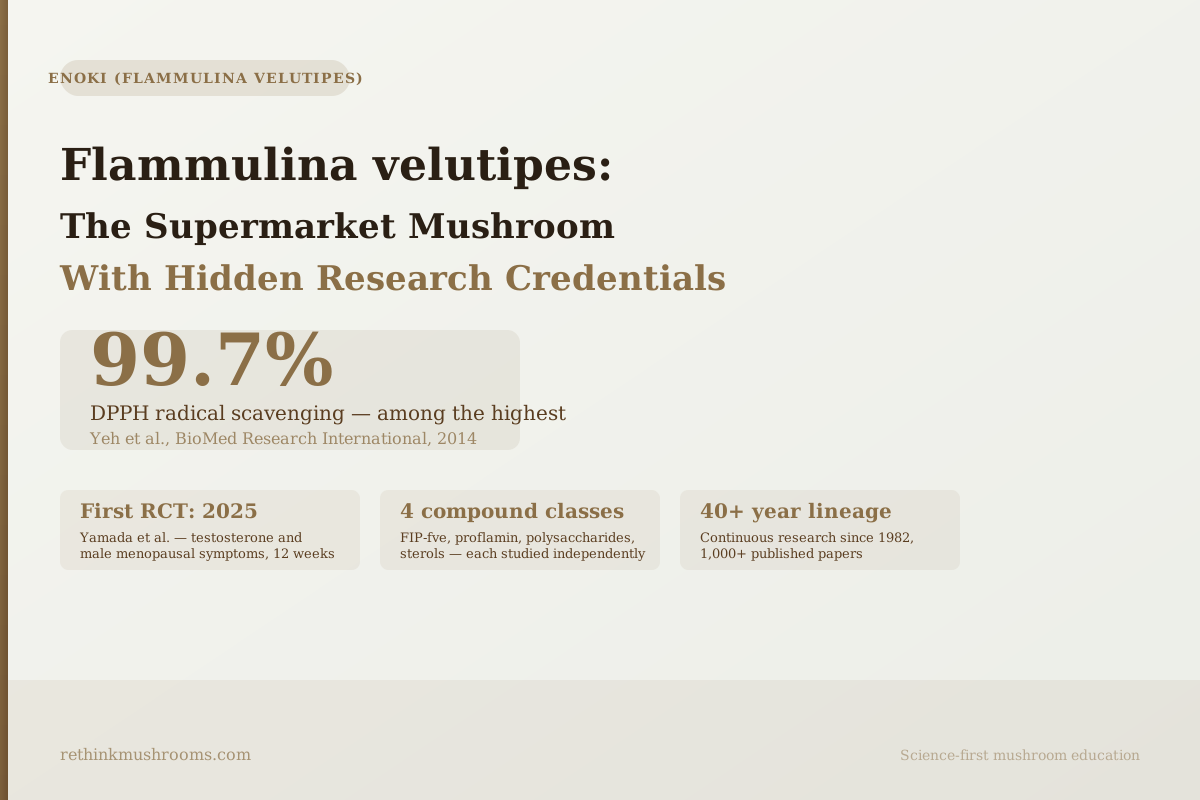
99.7% DPPH radical scavenging activity
Enoki mushroom extract reached 99.7% antioxidant activity in standardized DPPH assays — alongside significant cholesterol and triglyceride reduction in animal models.
Yeh et al., BioMed Research International, 2014
First human RCT
published in 2025: enoki extract improved the sexual symptom subscale and raised testosterone in more men vs placebo (Yamada 2025)
4 compound classes
FIP-fve protein, proflamin, polysaccharides, and sterols — each studied independently across decades (Tang 2016)
Dual function
2024 study found a single FV polysaccharide reduced total cholesterol AND activated macrophages in the same experiment (Jia 2024)
Yeh et al., BioMed Research International, 2014
 View as image ↗
The white enoki mushroom — Flammulina velutipes — sells for less than two dollars a pack in most Asian grocery stores. It is among the most visually unremarkable foods in the produce aisle: long, pale, thread-thin stems capped with tiny white buttons, grown in CO2-enriched darkness to produce the elongated supermarket form. Nothing about it signals depth.
And yet Flammulina velutipes research stretches back to 1982, spans hundreds of published papers (649 indexed in PubMed alone as of 2025), and produced its first human randomized controlled trial in 2025. It contains four structurally distinct classes of bioactive compounds that have each been studied independently for decades. It is, by research volume, among the more extensively investigated edible fungi. That gap between what the grocery store version looks like and what the scientific literature contains is the subject of this article. For the full biological overview of the species, see What Is Enoki Mushroom? The Tiny Mushroom with Big Research.
Key Takeaways
- Enoki mushroom extract reached 99.7% antioxidant activity in DPPH assays, alongside significant reduction in triglycerides, total cholesterol, and LDL in hamsters fed the extract or powder (Yeh 2014)
- The first randomized controlled trial on enoki, published in 2025, found 12 weeks of enoki extract supplementation significantly improved the sexual subscale of the Aging Males' Symptoms scale, and a significantly greater share of men saw testosterone rise by 0.5 ng/mL or more vs placebo (Yamada 2025)
- A 2025 mechanistic study identified FV polysaccharide FVP-1 activates immunity via the RSAD2 protein, which then triggers the NF-kB/MAPK signaling pathway — one of the most detailed mechanistic descriptions yet (Wang 2025)
- Enoki compounds survive digestion and retain biological activity: oral administration of FVE protein in mice activated both innate and adaptive immunity and produced anti-tumor effects against hepatocellular carcinoma (Chang 2010)
- A 2025 neuroprotective study found FV methanolic extract enhanced neurite outgrowth and protected hippocampal neurons from oxidative stress via NTRK receptor activation (Mitra 2025)
- Most of the research is animal studies and cell experiments; the Yamada 2025 RCT is the only human clinical trial to date, and it tested a specific commercial extract, not raw mushroom consumption
Why Scientists Have Studied a $2 Grocery Store Mushroom for 40 Years
The research interest in Flammulina velutipes began in Japan, where the mushroom is called enokitake and has been eaten for centuries. In the 1980s, epidemiological observations from Nagano prefecture suggested that communities where enoki farming was a primary occupation had substantially lower cancer mortality rates than the surrounding general population. That observation drove formal research interest into what the mushroom contained and whether any of it could explain the pattern.
Tang and colleagues published the most comprehensive synthesis of that research lineage in 2016, cataloguing the full range of bioactive compounds and their documented activities across dozens of studies.[1] The picture that emerged is not a single compound story. Flammulina velutipes contains at least four structurally distinct compound classes that have each been studied independently: FIP-fve, a fungal immunomodulatory protein; proflamin, an antitumor glycoprotein from the mycelium; polysaccharides including characterized beta-glucan fractions; and sterols and sesquiterpenes with cytotoxic activity. Each of these compound classes has its own research lineage, its own mechanism, and its own evidence base.
That compound diversity helps explain the sustained research interest. Unlike mushrooms with one primary bioactive that researchers follow, enoki offers multiple chemically distinct fractions that can be isolated, studied independently, and compared. The result over four decades is a layered evidence base that no other grocery store mushroom comes close to matching.
Four Decades, One Grocery-Store Mushroom
Enoki Research: From a 1982 Observation to the First Human Trial
For most of its history, Flammulina velutipes evidence lived in cell cultures and animal models. The arc below shows how the preclinical record accumulated across compound classes for four decades before the first human randomized controlled trial appeared in 2025.
- 1982Observation
The observation
Epidemiological observations from Nagano, Japan — a major enoki-farming region — link enoki-farming communities to lower cancer mortality, sparking formal investigation. The earliest Flammulina velutipes records indexed in PubMed date to this year.
- 2010Preclinical (cell & animal)
Oral bioactivity established
Chang et al. show that oral FVE protein survives digestion and activates both innate and adaptive immunity, with anti-tumor effect in a murine hepatoma model — the basis for treating enoki as supplement-relevant, not just a lab curiosity.
- 2014Preclinical (cell & animal)
Antioxidant + lipid data
Yeh et al. report enoki extract reaching a 99.7% DPPH radical-scavenging rate, alongside significantly lower triglycerides, total cholesterol, and LDL in high-fat-diet hamsters.
- 2016Preclinical (cell & animal)
Comprehensive synthesis
Tang et al. catalogue four decades of evidence across four structurally distinct compound classes — the FIP-fve immunomodulatory protein, proflamin glycoprotein, polysaccharides, and sterols — the most complete review to date.
- 2020–2022Preclinical (cell & animal)
The gut–immune axis
Ye (2020), Hao (2021), Liang (2022), and Ma (2022) show FV polysaccharides reshape gut microbiota and modulate immunity through intestinal flora; fermentation further boosts anti-inflammatory potency.
- 2024Preclinical (cell & animal)
One compound, two functions
Jia et al. characterize a single FV polysaccharide that lowers cholesterol and triglycerides and activates macrophages at the same time — lipid-lowering and immune activity in one fraction.
- 2025Human clinical trial
First human clinical trial
Yamada et al. run a 12-week randomized, placebo-controlled trial: enoki extract significantly improves the sexual subscale of the Aging Males’ Symptoms scale, and a significantly greater share of men see testosterone rise by 0.5 ng/mL or more.
- 2025Preclinical (cell & animal)
Mechanism + neuroprotection
The same year, Wang et al. map FVP-1 immune signaling through the RSAD2 effector to the NF-κB/MAPK pathways, and Mitra et al. show FV extract enhances neurite outgrowth via NTRK receptors in hippocampal neurons.
Dates and findings per the cited studies: Chang et al. (2010); Yeh et al., BioMed Research International (2014); Tang et al., EXCLI Journal (2016); Ye (2020), Hao (2021), Liang (2022), Ma (2022); Jia et al. (2024); and Yamada, Wang, and Mitra et al. (2025). Nearly all pre-2025 evidence is preclinical (cell and animal models); the 2025 Yamada RCT is the only human trial to date and tested a specific commercial extract, not raw mushroom consumption.
The 2025 Breakthrough: First Human Clinical Trial
For most of its 40-year research history, Flammulina velutipes evidence lived exclusively in cell cultures and animal models. That changed in 2025.
Yamada and colleagues published results from a 12-week randomized, double-blind, placebo-controlled trial in middle-aged and older men with male menopausal symptoms, screened by their Aging Males' Symptoms score (27–49) rather than by a testosterone threshold.[2] Participants received either enoki extract containing adenosine or placebo. The primary outcome was the Aging Males' Symptoms scale, a validated questionnaire covering psychological, somatic, and sexual domains. After 12 weeks, the treatment group showed significant improvement specifically on the sexual subscale. More participants in the treatment group also showed testosterone increases of 0.5 ng/mL or greater compared to the placebo group.
Two points are important about this result. First, it is a specific human clinical outcome from a randomized trial with a placebo control — a genuine step up from the animal and cell studies that constitute most of the enoki literature. Second, the mechanism involved is adenosine, a specific compound in the extract that may influence testosterone signaling pathways, rather than the immune-modulating polysaccharides or FIP-fve protein that most of the earlier research focused on. This underscores the breadth of the compound profile: the 2025 human trial result comes from a different compound class than most of the preceding research.
The trial was in a specific population (middle-aged and older men with male menopausal symptoms), using a specific commercial extract preparation, for one specific outcome. These constraints limit how far the results generalize, but they establish a meaningful precedent: enoki extract can produce measurable physiological effects in humans in a controlled trial context.
Neuroprotective Effects: The 2025 Cell Study
The same year as the Yamada RCT, a separate team published mechanistic data on enoki's effects on brain cells.
Mitra and colleagues tested Flammulina velutipes methanolic extract on primary hippocampal neurons — the type of neurons that are most affected in Alzheimer's disease and hypoxic brain injury.[4] The extract significantly enhanced neurite outgrowth, which refers to the growth of new neural connections. It also protected neurons from damage caused by oxidative stress and hypoxia. The mechanism involved NTRK receptors, which are tyrosine kinase receptors that regulate nerve growth factor signaling. The NTRK pathway is one of the primary targets in neurodegeneration research.
This is entirely in vitro research. The cells were hippocampal neurons in culture, not a human brain. The concentrations used are not directly comparable to what would be achieved through dietary consumption. What the study does is identify a mechanistic pathway and confirm that enoki compounds can interact with it at the cellular level, providing a biochemical rationale for the pattern of neuroprotective effects observed in several earlier animal studies. For deeper coverage of this research direction, see Enoki and Brain Health: Neuroprotective Research.
Immune Research: Gut, Macrophage, and T-Cell Activation
The largest body of Flammulina velutipes research covers immune function, with multiple mechanisms identified across different compound classes and different experimental models.
Chang and colleagues established a crucial foundational point in 2010: FVE protein, an enoki protein-polysaccharide complex, retained biological activity after oral administration in mice.[9] This matters because it is easy to show effects when you inject a compound directly into a biological system. It is harder to show that the compound survives digestion, reaches target tissues, and retains function in the intact organism after oral consumption. Chang's mice that received oral FVE showed activation of both innate immunity (natural killer cells, macrophages) and adaptive immunity (T-cells and B-cells), and demonstrated significant anti-tumor activity against hepatocellular carcinoma. This oral bioactivity data is the biological basis for treating enoki as a supplement-relevant species, not just a laboratory curiosity.
The polysaccharide fraction drives much of the immune research. Wang and colleagues published the most mechanistically detailed picture to date in 2025, identifying the signaling chain through which FVP-1 polysaccharide activates macrophages: the polysaccharide engages the RSAD2 protein, which then activates both the NF-kB and MAPK signaling pathways.[6] NF-kB controls the production of cytokines, the communication molecules that direct immune responses. MAPK pathways regulate cell survival and proliferation. The Wang 2025 study found FVP-1 increased TNF-alpha, IL-6, and IL-1beta, enhanced reactive oxygen species release in macrophages, and improved phagocytic activity (the physical engulfment of foreign material). This is the upstream mechanism behind the macrophage activation observed in dozens of earlier studies.
The gut microbiome is a more recent research direction. Ye and colleagues found in 2020 that a novel FV polysaccharide altered gut microbiota composition in rats and enhanced macrophage activity alongside the microbiome changes, suggesting the immune effects partly operate through changes in gut bacterial populations.[10] Hao and colleagues in 2021 extended this finding, showing that FV polysaccharide administration in mice produced changes not just in gut microbiota but also in immune repertoire diversity (the range of immune receptor types present in the immune system) and in heart gene expression patterns.[11] The heart transcriptome finding is unexpected and warrants further investigation; the study does not claim clinical relevance, only that systemic effects extend beyond the gut and immune system.
Liang and colleagues in 2022 found that FV polysaccharides modulate immune function through changes in intestinal flora and multiple proteomics pathways in mice.[7] Ma and colleagues in 2022 showed that fermented FV polysaccharides, where fermentation is used to pre-process the polysaccharide before consumption, significantly suppressed intestinal inflammation markers in mice, suggesting that fermentation may improve the bioavailability and anti-inflammatory potency of the polysaccharide fraction.[8] For dedicated coverage of the immunomodulatory research, see Enoki and the Immune System: Immunomodulatory Research.
Antioxidant and Lipid-Lowering Research
The antioxidant data on Flammulina velutipes is among the most dramatic in the edible mushroom literature.
Yeh and colleagues in 2014 tested FV extract and powder in hamsters given a high-fat diet.[3] Animals receiving the supplement had significantly lower triglycerides, total cholesterol, and LDL cholesterol compared to the high-fat diet control group. The antioxidant activity of the extract, measured in a standard DPPH radical scavenging assay, reached 99.7%. In the DPPH assay, higher is better, and 99.7% represents near-complete radical scavenging — Yeh and colleagues noted this was one of the strongest readouts for any mushroom extract in comparable literature.
These were hamsters, not humans, and the study used relatively high doses of extract for the animal's body weight. The result establishes that the relevant compounds exist in the mushroom in quantities sufficient to produce these effects in a living system, but does not predict the magnitude of effect at human dietary or supplement doses.
Jia and colleagues published a structurally distinct finding in 2024: a newly characterized FV polysaccharide reduced total cholesterol and triglycerides in vitro and also activated macrophages, demonstrating that a single polysaccharide fraction can carry both lipid-lowering and immunomodulatory functions simultaneously.[5] This dual-function finding matters because it suggests the same compound class is active across two of the most studied health applications in the enoki literature. For the dedicated antioxidant research, see Enoki and Antioxidant Activity: Free Radical Research.
What the Research Actually Means
The Flammulina velutipes literature, comprehensively reviewed by Tang et al. in 2016 and continuously updated through 2025, shows a consistent pattern: multiple biologically active compound classes, each with documented effects in cell and animal models, converging on immune modulation, antioxidant defense, lipid metabolism, and emerging neuroprotective and hormonal effects.[1]
The honest calibration: nearly all of this evidence is preclinical. Cell culture studies use concentrations that are difficult to achieve in the bloodstream through food consumption. Animal models don't always predict human outcomes. Yamada 2025 is the single human randomized controlled trial in the database, and it covers one specific outcome (male menopausal symptoms) in one specific population (middle-aged and older men with male menopausal symptoms) using one specific commercial extract preparation.
The fact that the research is overwhelmingly preclinical does not make it meaningless. It makes it directional evidence rather than proven efficacy. The 40-year research investment in this species, by independent groups across Japan, China, Korea, Taiwan, and Western institutions, consistently finds biological activity across multiple mechanisms. The compound characterization is detailed enough to support rational drug development — several enoki compounds are being evaluated in pharmaceutical contexts, not just supplement contexts.
What enoki is not is a proven treatment for any condition. What it is is a food with an unusually dense and well-characterized biological research record, an emerging human trial program, and a compound profile that justifies the ongoing scientific attention it has received since the 1980s.
The white supermarket form retains the core bioactive compounds despite looking nothing like wild Flammulina velutipes. The elongated pale appearance results from CO2 manipulation during cultivation and does not indicate reduced bioactive content. The research that uses cultivated enoki includes Yeh 2014 (which used the supermarket form) and Yamada 2025 (which used an extract derived from the cultivated form) — meaning the scientific results apply directly to what is commercially available.
The Bottom Line
Flammulina velutipes research spans four decades and multiple compound classes: the FIP-fve immunomodulatory protein, proflamin glycoprotein, polysaccharides with documented immune and lipid-lowering effects, and sterols with cytotoxic activity. The 2025 Yamada randomized controlled trial is the first human clinical evidence, showing improvements in male menopausal symptoms and testosterone with enoki extract. The 2025 Mitra and Wang mechanistic studies continue refining the biological picture. Most evidence remains preclinical, but the depth and consistency of the research record distinguishes this species from mushrooms with thinner scientific backing.
Frequently Asked Questions
Sources & References
- 1RTHM-00831·Tang, Calyn et al. (2016). “Golden Needle Mushroom: A Culinary Medicine with Evidenced-Based Biological Activities and Health Promoting Properties..” Frontiers in pharmacology.Study breakdown →PubMed →↩
- 2RTHM-02214·Yamada, Shizuo et al. (2025). “Beneficial Effects of Enoki Mushroom Extract on Male Menopausal Symptoms in Japanese Subjects: A Randomized, Double-Blind, Placebo-Controlled Study..” Nutrients.Study breakdown →PubMed →↩
- 3RTHM-00663·Yeh, Ming-Yei et al. (2014). “Hypolipidemic and antioxidant activity of enoki mushrooms (Flammulina velutipes)..” BioMed research international.Study breakdown →PubMed →↩
- 4RTHM-02150·Mitra, Sarmistha et al. (2025). “Neuroprotective and Neurotrophic Potential of Flammulina velutipes Extracts in Primary Hippocampal Neuronal Culture..” Nutrients.Study breakdown →PubMed →↩
- 5RTHM-01910·Jia, Wei et al. (2024). “Structural Elucidation of a Polysaccharide from Flammulina velutipes and Its Lipid-Lowering and Immunomodulation Activities..” Polymers.Study breakdown →PubMed →↩
- 6RTHM-02206·Wang, Qiuyi et al. (2025). “Flammulina velutipes polysaccharide exerts immunomodulatory function involving RSAD2 to regulate the NF-κB/MAPK signaling pathway in RAW264.7 macrophage cells and in mouse spleen cells..” International journal of biological macromolecules.Study breakdown →PubMed →↩
- 7RTHM-01567·Liang, Qiongxin et al. (2022). “The Effect of Flammulina velutipes Polysaccharide on Immunization Analyzed by Intestinal Flora and Proteomics..” Frontiers in nutrition.Study breakdown →PubMed →↩
- 8RTHM-01578·Ma, Sheng et al. (2022). “Inhibitory Effect of Fermented Flammulina velutipes Polysaccharides on Mice Intestinal Inflammation..” Frontiers in nutrition.Study breakdown →PubMed →↩
- 9RTHM-00328·Chang, Hui-Hsin et al. (2010). “Oral administration of an Enoki mushroom protein FVE activates innate and adaptive immunity and induces anti-tumor activity against murine hepatocellular carcinoma..” International immunopharmacology.Study breakdown →PubMed →↩
- 10RTHM-01306·Ye, Jufeng et al. (2020). “A novel polysaccharide isolated from Flammulina velutipes, characterization, macrophage immunomodulatory activities and its impact on gut microbiota in rats..” Journal of animal physiology and animal nutrition.Study breakdown →PubMed →↩
- 11RTHM-01362·Hao, Yuting et al. (2021). “The biological regulatory activities of Flammulina velutipes polysaccharide in mice intestinal microbiota, immune repertoire and heart transcriptome..” International journal of biological macromolecules.Study breakdown →PubMed →↩