Enoki Mushroom Antioxidant Activity
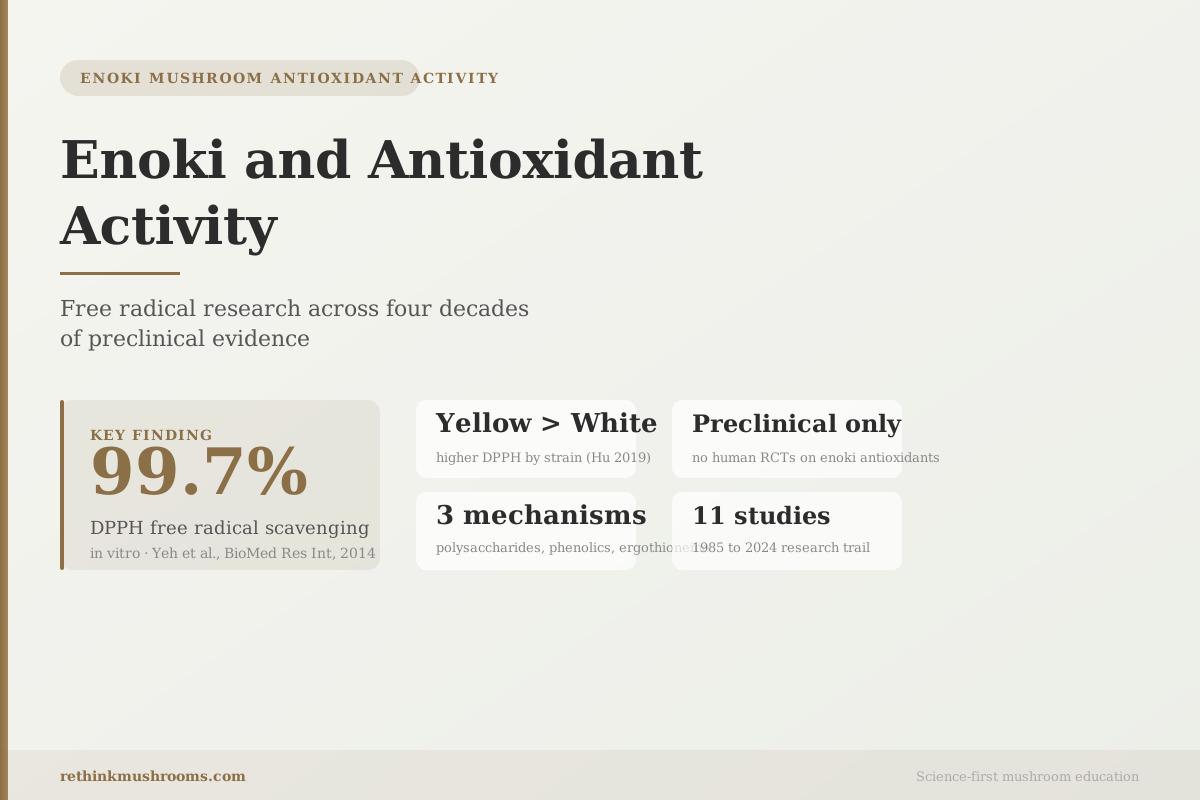
0 human RCTs on enoki antioxidant outcomes
Enoki (Flammulina velutipes) has been studied for antioxidant activity across more than three decades — through DPPH and hydroxyl-radical assays, LDL-oxidation models, and animal experiments measuring tissue MDA, SOD, and catalase — but no randomized human trial has tested whether eating enoki changes oxidative-stress markers in people.
Tang et al., Journal of Medicinal Food, 2016 (review)
Yellow > White
yellow-strain (Jinhua) F. velutipes polysaccharides showed higher DPPH, hydroxyl-radical, and metal-chelating activity than the white cultivar (Hu et al., 2019)
3 compound classes
polysaccharides, phenolics/flavonoids, and ergothioneine each contribute to in vitro antioxidant activity
Preclinical only
no human RCTs on enoki antioxidant activity exist; all evidence is in vitro and animal data
Tang et al., Journal of Medicinal Food, 2016 (review)
 View as image ↗
A note that gets cited often in enoki coverage is a high in-vitro DPPH (2,2-diphenyl-1-picrylhydrazyl) free-radical scavenging score for an enoki extract — a laboratory test using a synthetic radical, not a human outcome. The exact percentage values vary by study, strain, extract type, and assay conditions, and the published abstracts of the most-cited papers do not always specify a single headline number.
That distinction matters more than most coverage suggests. In vitro antioxidant scores like DPPH scavenging are useful for characterizing what a compound class can do under controlled chemical conditions. They do not translate directly into what happens when a person eats enoki mushrooms and the compounds encounter human digestive, absorptive, and tissue conditions. The enoki antioxidant activity research is actually more interesting than any single in-vitro percentage implies, but the evidence has to be read at the correct resolution.
This article covers the enoki mushroom antioxidant activity evidence: the specific compounds responsible, the mechanisms by which they neutralize different types of free radicals, what animal studies show about in vivo effects, and the honest assessment of where human evidence is and isn't. For species context, what is enoki mushroom covers the biology and the full research base.
Key Takeaways
- Yeh et al. (2014) studied Flammulina velutipes powder (FVP) and Flammulina velutipes extract (FVE) in hyperlipidemic hamsters fed a high-fat diet for 8 weeks, finding significant reductions in total cholesterol, triglycerides, and LDL/HDL ratio at 3% dietary FVP or FVE; the paper title also reports antioxidant activity, though specific in-vitro DPPH percentages from the original report should be verified directly against the full text rather than relying on a single headline number
- Three distinct compound classes contribute to enoki's antioxidant activity: polysaccharides (cell wall sugars that scavenge radicals), phenolics/flavonoids (plant-like compounds inhibiting LDL oxidation), and ergothioneine (a heat-stable amino acid antioxidant unique to mushrooms)
- The extraction method used to prepare enoki extracts significantly changes the antioxidant potency; hot water extraction, ultrasonic, and microwave methods yield polysaccharides with measurably different DPPH scavenging capacity (Zhang et al., 2013)
- Yellow-strain enoki (Jinhua mushroom) has measurably higher polysaccharide antioxidant activity than the standard white cultivar sold in most grocery stores (Hu et al., 2019)
- Animal studies show reduced oxidative damage markers (lower MDA, higher SOD and CAT) in enoki-supplemented groups across liver, kidney, and metabolic stress models (Yuan 2019, Luo 2022, Liang 2022)
- No human randomized controlled trials on enoki mushroom antioxidant activity currently exist; the entire evidence base is in vitro and animal data from 1985 to the present
What the In-Vitro Antioxidant Numbers Mean (and Don't Mean)
DPPH is a synthetic free radical compound used in standardized laboratory tests to measure antioxidant capacity. When an antioxidant substance is added to a DPPH solution, it donates a hydrogen atom to the radical, neutralizing it and causing a measurable color change. The percentage of DPPH neutralized at a given concentration is reported as the radical-scavenging activity. ABTS, hydroxyl-radical scavenging, and metal-chelating assays are conceptually similar in-vitro readouts that probe different chemistry.
Several enoki studies have reported substantial DPPH and hydroxyl-radical scavenging in extract or polysaccharide preparations, alongside metal-chelating activity (which captures iron and copper that would otherwise catalyze radical formation through Fenton chemistry). These are useful for characterizing the antioxidant profile of a particular extract. They are not direct predictors of what happens when a person eats enoki mushrooms — DPPH is a small organic radical that does not exist in human biology, and high in-vitro scavenging does not guarantee that the active compounds survive digestion, reach target tissues, or engage with the radical species that damage cells in vivo.
Tang's 2016 review of F. velutipes biological activities frames the evidence at the right resolution: rich in-vitro and animal data, with the human translation step still missing.[4]
Three Mechanisms: How Enoki Fights Free Radicals
Enoki's antioxidant activity comes from three structurally distinct compound classes that operate through different chemical mechanisms.
Polysaccharide-based scavenging. Wu and colleagues isolated a specific polysaccharide fraction from F. velutipes (called FVP) and measured its DPPH and hydroxyl radical scavenging activity independently.[2] The hydroxyl radical is one of the most reactive and biologically damaging radicals in living systems. The FVP fraction showed strong scavenging of both DPPH and hydroxyl radicals in a concentration-dependent manner. The same fraction also stimulated macrophage activity in cell culture, suggesting that the polysaccharide's antioxidant and immune-modulating effects may be mechanistically linked.
The polysaccharide mechanism works because these long-chain sugar molecules contain hydroxyl groups that can donate hydrogen atoms to neutralize radicals. It is essentially the same chemistry as DPPH scavenging but applied to biologically relevant radical species.
Phenolic inhibition of LDL oxidation. Rahman and colleagues identified the specific polyphenolic compounds in F. velutipes responsible for antioxidant activity and measured their capacity to inhibit LDL oxidation in vitro.[3] The flavonoids identified included arbutin, epicatechin, phillyrin, apigenin, kaempferol, and formononetin. The IC50 for DPPH scavenging (the concentration needed to neutralize half the radicals in a test sample) from the polyphenolic fraction was 0.86 mg/mL.
The LDL oxidation inhibition angle is more clinically significant than raw DPPH scores, because oxidized LDL, a blood fat particle that has been damaged by free radicals, is a key driver of arterial plaque formation. Demonstrating that enoki phenolics can slow this specific oxidation process in vitro at least establishes a mechanistically plausible pathway from enoki consumption to cardiovascular protection. The limitation remains: in vitro LDL oxidation inhibition has not been tested in humans eating enoki.
Ergothioneine stability. Ergothioneine is a sulfur-containing amino acid compound that mushrooms produce and humans cannot synthesize. Tang's comprehensive review covers ergothioneine as one of the documented antioxidant compounds in F. velutipes.[4] What makes ergothioneine distinct from the polysaccharide and phenolic mechanisms is its stability: ergothioneine is not significantly degraded by cooking temperatures, which means it survives standard food preparation. This is discussed in more detail in the enoki phenolic compounds article.
The Yellow Strain Difference: Why Not All Enoki Has Equal Antioxidant Potency
Most enoki mushrooms sold in grocery stores are the cultivated white variety, grown in the absence of light which suppresses pigment development. There is also a yellow-brown cultivar, sometimes called Jinhua mushroom in Chinese markets, that develops its natural coloration under different growing conditions.
Hu and colleagues specifically characterized the polysaccharides from yellow-strain F. velutipes and compared their antioxidant activity to the standard white cultivar.[6] The yellow-strain polysaccharides showed higher DPPH scavenging, higher hydroxyl radical scavenging, and stronger metal chelating activity than the white cultivar. Crucially, the yellow-strain polysaccharides also reduced intracellular reactive oxygen species (ROS) in L929 cell culture, which is a step closer to biological relevance than external DPPH measurements.
The reasons behind this strain difference are likely related to pigmentation and secondary metabolism. The same growing conditions that produce pigment in the yellow strain also appear to drive higher polysaccharide yields with different structural characteristics, which translate to higher antioxidant potency.
Zhang and colleagues documented a separate source of inter-extract variation: the extraction method itself.[5] Hot water, ultrasonic, and microwave extraction methods all yielded F. velutipes polysaccharides with significantly different DPPH and hydroxyl radical scavenging capacity. This has practical implications for supplement products: an enoki mushroom supplement's antioxidant activity depends on which strain was used AND how the extract was prepared, neither of which is typically disclosed on the label.
These two findings together (strain variation from Hu 2019, extraction variation from Zhang 2013) mean any single in-vitro antioxidant figure for "enoki extract" should not be generalized to all enoki products. Strain selection and extraction method materially shift the antioxidant potency of the finished material.
Beyond the Test Tube: What Animal Studies Show About In Vivo Effects
The most biologically interesting enoki antioxidant evidence comes from studies that moved beyond DPPH assays to measure what happens inside living systems under oxidative stress.
Yuan and colleagues tested sulfated polysaccharides from F. velutipes in a Drosophila (fruit fly) aging model.[7] The sulfated fraction extended median lifespan, reduced MDA accumulation, and increased SOD (superoxide dismutase, an enzyme that neutralizes the superoxide radical inside cells) and CAT (catalase, an enzyme that breaks down hydrogen peroxide) activity in organs. The study also showed reduced oxidative damage in liver and kidney tissue. The fruit fly model is far from human biology, but the consistency of the markers (lower MDA, higher SOD and CAT) with a dose-dependent lifespan effect is a substantive signal for whole-organism antioxidant activity.
Liang and colleagues (2022) examined a different angle in immunosuppressed mice: how F. velutipes polysaccharide affects intestinal flora alongside immune and antioxidant readouts.[8] The polysaccharide increased thymus and spleen indices, increased IL-2 and IL-4, decreased IL-6 and TNF-α, and increased serum total antioxidant capacity (T-AOC) along with ACP and LDH activities, while shifting the gut microbial composition. The combination — gut-flora change plus elevated total antioxidant capacity — is interesting as a potential indirect mechanism, though the paper's framing centers on immune modulation rather than antioxidant enzyme expression specifically.
Luo and colleagues (2022) studied F. velutipes mycorrhizae, the by-products of FV cultivation, in mice on a high-fat diet.[9] A 4% mycorrhizae diet attenuated lipid disorder, oxidative stress, and inflammatory cytokines in liver and perirenal adipose tissue. This is notable because metabolic stress from high-fat feeding produces sustained oxidative damage in the liver, exactly the tissue context where preventive antioxidant compounds are hypothesized to be most relevant.
Zhao and colleagues (2024) documented a more complex interaction: F. velutipes polysaccharide appeared to selectively induce oxidative stress in A549 lung adenocarcinoma cancer cells while not producing the same effect in normal cells.[10] This selective pro-oxidant behavior in cancer cells (opposite of the antioxidant behavior in normal cells) reflects a context-dependent mechanism where the same compounds act differently depending on the cellular environment. This research is early-stage and entirely preclinical.
The Evidence Gap: Forty Years of Preclinical Data, Still No Human Trials
The most honest statement about enoki mushroom antioxidant activity is that the research base goes back to 1985 and none of it includes a randomized controlled trial in humans.
Chen and colleagues (2023) are among the most recent to add to the preclinical case, specifically characterizing antioxidant activity in F. velutipes stipe (stem) extracts and finding strong DPPH and ABTS (another standardized radical scavenging assay) scores.[11] This research also noted that the stipe, the part of the mushroom typically discarded or composted, contains meaningful antioxidant compounds, which has implications for both whole-mushroom consumption and for supplement sourcing.
But the evidence gap at the human level is real. DPPH scavenging activity, in vitro LDL oxidation inhibition, Drosophila lifespan extension, and mouse liver MDA reduction are all biologically plausible indicators that enoki's antioxidant compounds do something relevant. They are not the same as a controlled human study showing that people who eat enoki have lower markers of oxidative stress in blood or tissue samples.
Why does this gap exist after four decades of research? Partly because enoki has historically been studied primarily for its immune and anticancer properties (proflamin research, lentinan analogs), and the antioxidant angle is a secondary research thread. Partly because conducting antioxidant intervention trials in humans is technically difficult: baseline oxidative stress varies enormously between individuals, endpoint markers are debated, and the dose needed to produce measurable effects in a short trial is unclear.
For readers evaluating whether the antioxidant properties of enoki justify including it in the diet, the answer the research supports is: the mechanisms are plausible and preclinical evidence is consistently positive across independent research groups spanning three decades. Human trial evidence does not yet exist. For a comparison of how enoki's antioxidant activity compares to other culinary mushrooms, see enoki vs. other culinary mushrooms: antioxidant comparison.
For the cooking angle (which preparation methods preserve enoki's antioxidants most effectively), see how cooking methods affect enoki's antioxidant capacity.
The Bottom Line
Enoki mushrooms contain polysaccharides, phenolics, and ergothioneine that demonstrate free-radical scavenging activity in laboratory DPPH, hydroxyl-radical, and ABTS assays. Yellow-strain (Jinhua) enoki polysaccharides show higher activity than the standard white cultivar. Animal studies — including high-fat-diet hamster lipid models, fruit-fly aging models, immunosuppressed-mouse studies, and high-fat-diet mouse studies of FV mycorrhizae — consistently show reduced oxidative damage markers and improved antioxidant readouts. The entire evidence base remains preclinical: no human RCTs on enoki antioxidant outcomes have been conducted, and the translation from in vitro and animal data to human health outcomes is not established.
Frequently Asked Questions
Sources & References
- 1RTHM-00663·Yeh, Ming-Yei et al. (2014). “Hypolipidemic and antioxidant activity of enoki mushrooms (Flammulina velutipes)..” BioMed research international.Study breakdown →PubMed →↩
- 2RTHM-00656·Wu, Ming et al. (2014). “Antioxidant and immunomodulatory activities of a polysaccharide from Flammulina velutipes..” Journal of traditional Chinese medicine = Chung i tsa chih ying wen pan.Study breakdown →PubMed →↩
- 3RTHM-00729·Rahman, Mohammad Azizur et al. (2015). “Antioxidative Effects and Inhibition of Human Low Density Lipoprotein Oxidation In Vitro of Polyphenolic Compounds in Flammulina velutipes (Golden Needle Mushroom)..” Oxidative medicine and cellular longevity.Study breakdown →PubMed →↩
- 4RTHM-00831·Tang, Calyn et al. (2016). “Golden Needle Mushroom: A Culinary Medicine with Evidenced-Based Biological Activities and Health Promoting Properties..” Frontiers in pharmacology.Study breakdown →PubMed →↩
- 5RTHM-00574·Zhang, Zuofa et al. (2013). “Effects of extraction methods on the antioxidant activities of polysaccharides obtained from Flammulina velutipes..” Carbohydrate polymers.Study breakdown →PubMed →↩
- 6RTHM-01065·Hu, Yu-Ning et al. (2019). “Characterization and Antioxidant Activities of Yellow Strain Flammulina velutipes (Jinhua Mushroom) Polysaccharides and Their Effects on ROS Content in L929 Cell..” Antioxidants (Basel.Study breakdown →PubMed →↩
- 7RTHM-01150·Yuan, Fangfang et al. (2019). “Characterization, Antioxidant, Anti-Aging and Organ Protective Effects of Sulfated Polysaccharides from Flammulina velutipes..” Molecules (Basel.Study breakdown →PubMed →↩
- 8RTHM-01567·Liang, Qiongxin et al. (2022). “The Effect of Flammulina velutipes Polysaccharide on Immunization Analyzed by Intestinal Flora and Proteomics..” Frontiers in nutrition.Study breakdown →PubMed →↩
- 9RTHM-01575·Luo, Zhen et al. (2022). “Flammulina velutipes Mycorrhizae Attenuate High Fat Diet-Induced Lipid Disorder, Oxidative Stress and Inflammation in the Liver and Perirenal Adipose Tissue of Mice..” Nutrients.Study breakdown →PubMed →↩
- 10RTHM-02038·Zhao, Fei et al. (2024). “Effect of Flammulina velutipes polysaccharide on mitochondrial apoptosis in lung adenocarcinoma A549 cells..” Scientific reports.Study breakdown →PubMed →↩
- 11RTHM-01671·Chen, Chien-Chin et al. (2023). “In Vitro Assessment of the Antioxidant and Anticancer Properties of Flammulina velutipes Stipe Extracts..” Anticancer research.Study breakdown →PubMed →↩