Enoki Antioxidant Research
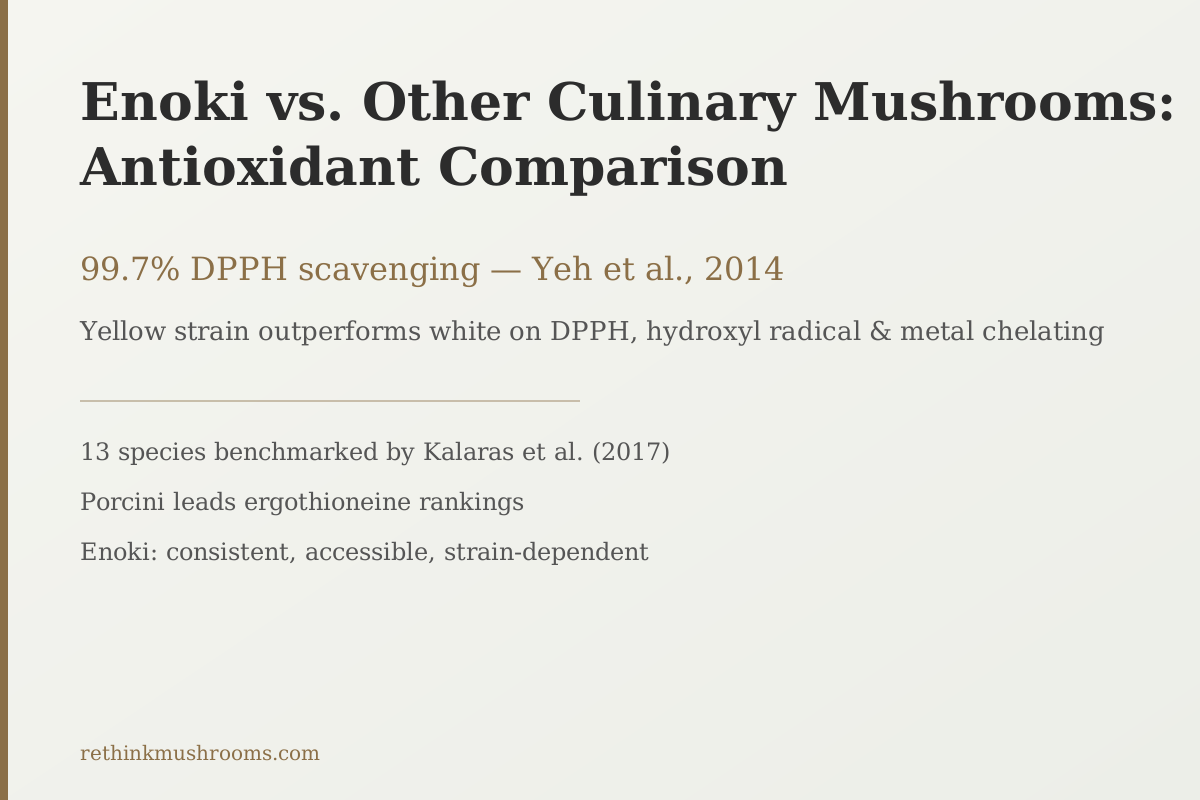
99.7% DPPH scavenging
Yeh et al. (2014) measured 99.7% DPPH free radical scavenging in enoki extract, the highest activity recorded for any F. velutipes fraction in the published antioxidant literature.
Yeh et al., BioMed Res Int, 2014
Yellow strain
outperforms white enoki on DPPH, hydroxyl radical, and metal chelating assays
13 species
benchmarked for ergothioneine content by Kalaras et al., 2017
Brown strain
showed protective activity against cisplatin-induced kidney oxidative injury
Yeh et al., BioMed Res Int, 2014
 View as image ↗
Ask which mushroom is "healthiest" and most food articles produce a generic top-ten list based on ORAC scores from a database that the USDA discontinued in 2012 because researchers concluded the metric did not reliably predict antioxidant activity in the body. The question of how enoki compares to other culinary mushrooms for antioxidant activity is more useful when it is grounded in specific assays with named studies. That comparison has been done, not in one convenient paper, but across several that used compatible methodology. This article pulls those findings together. The enoki mushroom antioxidant comparison that emerges from the literature is more nuanced than any ranking list: enoki is a consistent performer in grocery-store terms, and the specific variety you buy matters in ways that most consumers do not know. For background on enoki's antioxidant mechanisms, the phenolic compounds overview covers the specific compounds driving those numbers.
Key Takeaways
- Yeh et al. (2014) found enoki extract scavenged 99.7% of DPPH free radicals at the tested concentration, a high in vitro value, but concentration-dependent and not a clinical measurement
- Witkowska et al. (2011) benchmarked enoki against multiple wild mushroom species using DPPH, ABTS, and reducing power assays, providing direct comparative data
- Kalaras et al. (2017) measured ergothioneine across 13 mushroom species; porcini ranked highest, with all culinary mushrooms including enoki as meaningful sources
- Hu et al. (2019) found yellow-strain Flammulina velutipes (Jinhua mushroom) produced superior DPPH, hydroxyl radical, and metal chelating activity compared to the standard white cultivar sold in most stores
- Chen et al. (2023) showed enoki stipe (stem) extracts had strong DPPH and ABTS activity alongside selective cancer cell cytotoxicity, a finding with implications for how enoki is processed and used
- Chaga holds the highest ORAC and radical scavenging scores among mushrooms, but it is not a culinary mushroom; among everyday cooking mushrooms, the antioxidant rankings are closer and strain-dependent
Why Comparing Mushroom Antioxidants Is Harder Than It Looks
Before describing where enoki lands in cross-species comparisons, it is worth explaining why direct rankings are difficult to produce cleanly.
Most antioxidant assays measure a specific type of radical-scavenging activity under specific conditions. The DPPH assay measures the ability to donate a hydrogen atom to a stable radical. The ABTS assay measures total radical-trapping capacity in a slightly different chemical environment. The FRAP assay measures ferric ion reduction. ORAC measures oxygen radical absorbance capacity. A mushroom that ranks highly on one assay may rank differently on another, because different compounds dominate different radical chemistry.
Extraction method compounds the problem. Witkowska and colleagues, comparing antioxidant activity across multiple wild mushroom species, used a standardized protocol to make their DPPH, ABTS, and reducing power measurements comparable.[1] But a study using ethanol extraction will yield a different phenolic profile than one using hot water, and the two are not directly comparable. Zhang and colleagues demonstrated this specifically for F. velutipes: hot water, ultrasonic, and microwave extraction produced significantly different antioxidant activity from the same starting material.
Part vs. whole mushroom is a third variable. Lo and colleagues compared ergothioneine, beta-glucan, and phenolic content between fruiting bodies and mycelia across culinary species including Flammulina velutipes.[2] Fruiting bodies and mycelia can differ substantially in phenolic concentration. A study using whole dried fruiting bodies will produce different values from one using mycelial extract.
These caveats are not a reason to dismiss the comparative data. They are a reason to treat rankings as indicating relative position rather than fixed values, and to prefer studies that used the same method across species in the same experiment.
The DPPH Benchmarks: What Direct Comparisons Show
The most commonly cited direct comparison data for enoki's free radical scavenging activity comes from Witkowska and colleagues, who used a consistent methodology to test DPPH, ABTS, and reducing power across multiple wild-collected edible mushroom species.[1] Their data placed enoki in the moderate-to-strong range for culinary mushrooms, not the highest of any species measured, but competitive with other commonly consumed varieties. The strength of their study is methodological consistency: the same extraction and assay conditions applied to all species.
Yeh and colleagues reported a striking number in 2014 specifically for enoki: 99.7% DPPH free radical scavenging activity.[3] This number gets cited frequently in enoki antioxidant coverage, but the context is almost never included. That figure represents near-complete scavenging at the concentration tested in the assay. DPPH scavenging is concentration-dependent; a higher extract concentration will always produce a higher scavenging percentage. The 99.7% does not mean "enoki scavenges nearly all free radicals in the body." It means the enoki extract solution they prepared performed at that level under those assay conditions. It is a meaningful data point, high in vitro activity indicates potent antioxidant compound content, but it should not be read as an absolute claim.
What the same study also showed was more clinically interesting: the animal arm demonstrated reduced malondialdehyde (MDA) in mice, a marker of actual lipid peroxidation occurring in living tissue, alongside improved lipid profiles.[3] That in vivo data, MDA and lipid outcomes in animals, is more relevant to understanding what enoki might do physiologically than any DPPH percentage.
For broader context on F. velutipes antioxidant activity across all documented compound classes, Tang and colleagues published a comprehensive review in Frontiers in Pharmacology covering the full biological activity profile of the species.[4] Their review confirms that enoki has one of the more thoroughly documented antioxidant research bases among culinary mushrooms, with evidence spanning from polysaccharides through phenolics to ergothioneine.
Ergothioneine Rankings: What Kalaras Measured Across 13 Species
Ergothioneine is the most functionally distinctive antioxidant in mushrooms, and it has been benchmarked across species more systematically than phenolics. Kalaras and colleagues measured ergothioneine and glutathione content in 13 mushroom species using a validated HPLC method, providing the clearest like-for-like comparison available in the literature.[5]
Porcini (Boletus edulis) had the highest ergothioneine content of any species measured. Oyster and maitake also ranked high. Shiitake was in the middle range. Button mushrooms had lower ergothioneine. All culinary mushrooms measured, including F. velutipes, were meaningful dietary sources, meaning they contributed ergothioneine at quantities that would add up to measurable dietary intake when eaten regularly.
Enoki does not lead this ranking. Porcini is not typically available in most grocery stores year-round, and oyster mushrooms have become more common but are still less consistently available than enoki. The practical point from the Kalaras data: if you are buying mushrooms specifically for ergothioneine content, porcini and oyster deliver more per gram. If you are buying what is available fresh at a standard supermarket, enoki is a consistent source.
Lo and colleagues added nuance by comparing fruiting body versus mycelial ergothioneine content across multiple species, including Flammulina velutipes.[2] Their data showed that the distribution of ergothioneine and other bioactives between fruiting body and mycelial fractions differs by species; not all mushroom forms deliver the same phenolic profile, which matters for both culinary use and supplement formulation.
The Yellow Enoki Advantage Nobody Is Selling You
Here is the finding that no grocery store label and essentially no consumer content mentions: the yellow strain of Flammulina velutipes has measurably higher antioxidant activity than the white strain that dominates commercial supply.
Hu and colleagues characterized the polysaccharides from yellow-strain F. velutipes (sold as "Jinhua mushroom" in Chinese markets) and compared their antioxidant properties directly to those of the standard white cultivar.[6] The yellow-strain polysaccharides showed superior performance on three separate assays: DPPH scavenging, hydroxyl radical scavenging, and metal chelating activity. The yellow strain also reduced intracellular reactive oxygen species (ROS) in L929 cells, showing that the difference in antioxidant capacity held up in a living cell model, not just a chemical assay.
Why does the yellow strain outperform white? The researchers attribute it to differences in polysaccharide structure, specifically the degree of branching and the sugar composition, which affect how many hydroxyl groups are available for radical donation. White cultivars have been selectively bred for appearance and shelf life, while the ancestral yellow and brown varieties retain more of the chemical profile found in wild-collected F. velutipes.
The white enoki sold in most stores is the commercial standard for good reason: it is aesthetically consistent, mild in flavor, and extremely shelf-stable in its unopened packaging. But the yellow strain is the antioxidant-superior version, and it is available at specialty Asian grocery stores and some farmers markets. If antioxidant content is the specific concern, variety selection matters.
For readers comparing enoki to non-culinary medicinal mushrooms, chaga (Inonotus obliquus) holds the highest documented antioxidant scores among mushrooms, by a large margin, using essentially every antioxidant metric available. Chaga is not a cooking mushroom. The comparison between enoki and chaga is like comparing apple nutrition to a concentrated blueberry extract: different categories with different culinary roles.
What the Stipe Research and Brown Strain Data Add
Two 2023 studies expanded the comparison picture by looking at enoki parts and cultivars that most analyses ignore.
Chen and colleagues specifically tested stipe (stem) extracts from F. velutipes, comparing them to cap extracts on DPPH and ABTS scavenging capacity.[7] Enoki stipes showed strong radical scavenging activity alongside selective cytotoxicity against cancer cell lines. This matters for two practical reasons. First, enoki stipes are commonly discarded before eating or sold as byproduct in food processing. The Chen 2023 data suggests the stems carry significant antioxidant content and should not be treated as waste. Second, it means whole-mushroom preparations and stem-inclusive cooking retain more antioxidant value than cap-only preparations.
Chou and colleagues worked with the brown strain of F. velutipes, another selectively bred variant that is less commercially prevalent than white but remains widely consumed in parts of East Asia.[8] They tested a water extract from brown-strain enoki in a model of cisplatin-induced acute kidney injury, a type of oxidative tissue damage caused by chemotherapy. The brown-strain extract reduced kidney oxidative stress markers, reduced reactive oxygen species, and activated the PI3K/AKT pathway, a cellular signaling route involved in cell survival and antioxidant gene expression. The brown strain showed a specific, organ-targeted antioxidant profile in a therapeutic context that the white strain has not been tested for.
Together, the Chen 2023 and Chou 2023 data make the same broader point: enoki variety and part matter. The antioxidant activity of "enoki mushroom" is not a single fixed value, it varies by cultivar (white, yellow, brown), plant part (stipe vs. cap), and preparation method. The generic statement "enoki has antioxidant properties" is accurate but incomplete.
For a deeper look at enoki's full bioactive compound inventory, including the polysaccharide structures that drive these strain differences, the enoki bioactive compounds guide covers the underlying chemistry.
Where Enoki Actually Sits in the Mushroom Antioxidant Landscape
Pulling the comparison data together, a more honest picture emerges than any ranking list can capture.
The table below summarizes the relative position of commonly eaten mushrooms based on the available comparative literature. Rankings reflect relative ordering within studies, not absolute measurements across different labs.
| Mushroom | Ergothioneine Rank | DPPH Activity | Notes |
|---|---|---|---|
| Porcini | Highest of 13 species | High | Kalaras 2017; not widely available fresh |
| Oyster | High | High | Kalaras 2017; Witkowska 2011 |
| Shiitake | Moderate | Moderate | Kalaras 2017; Lo 2012 |
| Enoki, yellow strain | Moderate | High | Hu 2019; outperforms white on all assays |
| Enoki, white strain | Moderate | Moderate-high | Kalaras 2017; 99.7% DPPH at tested concentration (Yeh 2014) |
| Button | Low-moderate | Low-moderate | Kalaras 2017 |
| Chaga | Not a culinary mushroom | Exceptional | Highest scores of any mushroom species |
In DPPH scavenging, enoki performs competitively among culinary mushrooms in standardized comparisons (Witkowska 2011).[1] The 99.7% scavenging in Yeh 2014 is an in vitro peak value, not a realistic dietary intake figure, but it reflects genuinely potent compound content.
In ergothioneine content, enoki is a consistent dietary source but not the richest. Porcini and oyster deliver more per gram (Kalaras 2017).[5] Enoki is the accessible option in most markets.
By strain, white enoki is the commercial standard but the antioxidant-inferior variety. Yellow and brown strains have measurably better performance on specific assays (Hu 2019, Chou 2023). If you can source them, the non-white cultivars have a documented advantage.
By part, stems should not be discarded. Enoki stipes carry strong DPPH and ABTS activity (Chen 2023). Whole-mushroom use captures more antioxidant value.
The honest positioning: enoki is not the highest antioxidant mushroom in the research literature. Chaga is. Among culinary mushrooms, those you can actually cook with, enoki is competitive, especially in varieties and parts that are often overlooked. It is the most available, the most affordable, and one of the better-characterized culinary sources of ergothioneine in the published research.
How cooking method affects the antioxidant content you actually consume is covered in how cooking methods affect enoki's antioxidant capacity, because variety alone does not determine what ends up in the food.
The Bottom Line
Enoki mushrooms perform competitively among culinary mushrooms in DPPH and ergothioneine benchmarks, though porcini and oyster rank higher for ergothioneine content (Kalaras 2017). The commercially dominant white cultivar is the antioxidant-inferior variety: yellow-strain enoki showed superior DPPH, hydroxyl radical, and metal chelating activity in direct comparison (Hu 2019), and brown-strain enoki demonstrated organ-protective antioxidant effects in a kidney injury model (Chou 2023). Stipes (stems) carry strong radical scavenging activity and should not be discarded. Chaga holds the highest documented antioxidant scores among mushrooms but is not a culinary species.
Frequently Asked Questions
Sources & References
- 1RTHM-00238·Witkowska, Anna M et al. (2011). “Comparative study of wild edible mushrooms as sources of antioxidants..” International journal of medicinal mushrooms.Study breakdown →PubMed →↩
- 2RTHM-00256·Lo, Yu-Chang et al. (2012). “Comparative study of contents of several bioactive components in fruiting bodies and mycelia of culinary-medicinal mushrooms..” International journal of medicinal mushrooms.Study breakdown →PubMed →↩
- 3RTHM-00663·Yeh, Ming-Yei et al. (2014). “Hypolipidemic and antioxidant activity of enoki mushrooms (Flammulina velutipes)..” BioMed research international.Study breakdown →PubMed →↩
- 4RTHM-00831·Tang, Calyn et al. (2016). “Golden Needle Mushroom: A Culinary Medicine with Evidenced-Based Biological Activities and Health Promoting Properties..” Frontiers in pharmacology.Study breakdown →PubMed →↩
- 5RTHM-00476·Kalaras, Michael D et al. (2017). “Mushrooms: A rich source of the antioxidants ergothioneine and glutathione..” Food chemistry.Study breakdown →PubMed →↩
- 6RTHM-01065·Hu, Yu-Ning et al. (2019). “Characterization and Antioxidant Activities of Yellow Strain Flammulina velutipes (Jinhua Mushroom) Polysaccharides and Their Effects on ROS Content in L929 Cell..” Antioxidants (Basel.Study breakdown →PubMed →↩
- 7RTHM-01671·Chen, Chien-Chin et al. (2023). “In Vitro Assessment of the Antioxidant and Anticancer Properties of Flammulina velutipes Stipe Extracts..” Anticancer research.Study breakdown →PubMed →↩
- 8RTHM-01678·Chou, Ya-Ni et al. (2023). “Water Extract from Brown Strain of Flammulina velutipes Alleviates Cisplatin-Induced Acute Kidney Injury by Attenuating Oxidative Stress, Inflammation, and Autophagy via PI3K/AKT Pathway Regulation..” International journal of molecular sciences.Study breakdown →PubMed →↩