Enoki Antioxidant Research
Boiling = worst method for antioxidants
Roncero-Ramos et al. (2017) found boiling significantly decreased antioxidant activity in cultivated mushrooms, while grilling and microwaving preserved or increased antioxidant values across all assays.
Roncero-Ramos et al., Int J Food Sci Nutr, 2017
Water-soluble
ergothioneine leaches into boiling water rather than being destroyed by heat
Heat-stable
ergothioneine maintains antioxidant capacity across normal cooking temperatures (Liu 2020)
Always cook
raw enoki carries Listeria risk, cooking to 70°C eliminates it
Roncero-Ramos et al., Int J Food Sci Nutr, 2017
 View as image ↗
Most cooking advice for enoki mushrooms focuses on texture: cook briefly, keep crunch, don't let them turn to mush. The antioxidant question is separate, and the research answer is genuinely counterintuitive. How to cook enoki mushrooms to preserve antioxidants is not primarily a question about heat. It is a question about water. Enoki's main antioxidant compounds, particularly ergothioneine, are heat-stable but water-soluble. Boiling does not destroy them through thermal degradation; it leaches them into the water that gets poured down the drain. The pan gets hot in every cooking method, but only boiling creates a large pool of water for the antioxidants to escape into. That single distinction determines the cooking hierarchy almost entirely. For background on the mushroom itself, the full enoki guide covers species and cultivation context. For detail on which compounds are at stake, the enoki phenolic compounds article covers what is in enoki and what those compounds have been shown to do.
Key Takeaways
- Ergothioneine, enoki's most distinctive antioxidant, is heat-stable but water-soluble; boiling leaches it into cooking water rather than destroying it thermally (Liu 2020)
- Roncero-Ramos et al. (2017) tested cultivated mushrooms across boiling, frying, grilling, and microwaving; grilling and microwaving preserved or increased antioxidant activity while boiling and frying caused significant losses
- Yao et al. (2023) found steaming and microwaving consistently outperformed boiling for bioactive compound retention in delicate culinary mushrooms; the shiitake findings transfer directly to enoki
- Yang et al. (2020) showed that cultivation conditions (light, temperature, substrate) regulate ergothioneine biosynthesis; mushrooms grown under more oxidative stress produce more ergothioneine before cooking begins
- Raw enoki carries documented Listeria monocytogenes risk; brief cooking to 70°C is sufficient to eliminate it without destroying ergothioneine
- The practical hierarchy from the research: stir-fry or grill, then brief microwave, then steam; boiling last
The Counterintuitive Finding: Heat Isn't What Destroys Enoki's Antioxidants
The conventional thinking about antioxidants and cooking is that heat is the enemy. At high enough temperatures, phenolic compounds oxidize, degrade, or rearrange into less active forms. This is true for some compounds in some vegetables; it is a large part of why raw food proponents argue for minimal cooking. For enoki's main antioxidant, ergothioneine, this framing is wrong.
Liu and colleagues tested ergothioneine from culinary mushrooms across a range of temperatures and pH levels designed to simulate conditions experienced during actual cooking.[2] Ergothioneine maintained its antioxidant capacity across all tested ranges. It was notably more stable than conventional phenolics under the same conditions. Where standard plant-derived polyphenols begin degrading progressively above around 60°C, ergothioneine does not follow this pattern.
The reason is chemical structure. Ergothioneine's sulfur-containing imidazole ring is unusually resistant to oxidative degradation compared to the hydroxyl-bearing aromatic rings of most dietary phenolics. The molecule was apparently designed, by evolutionary pressure on the fungi that synthesize it, to function in high-oxidative-stress environments. It is stable because its biological job requires stability.
What ergothioneine is not stable against is dissolution in water. It is water-soluble, and when enoki sits in boiling water for any extended period, ergothioneine migrates into the cooking liquid. The same is true for the phenolic acids and water-soluble flavonoids in the enoki's phenolic fraction. They are not decomposed by the heat; they are relocated into a liquid that typically gets discarded.
This reframes the whole cooking question. The goal is not to use the lowest possible temperature. The goal is to use a method with the least direct contact between the mushroom and bulk water.
What Happens to Each Cooking Method
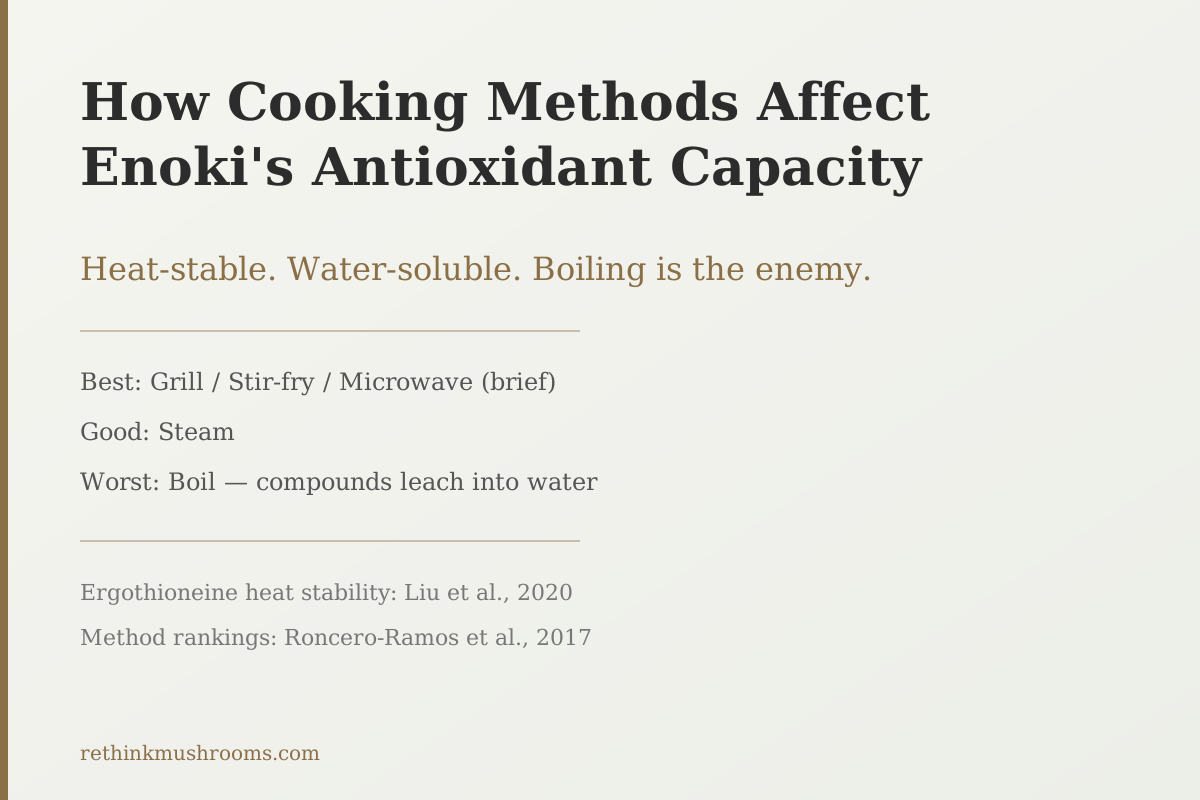
Roncero-Ramos and colleagues conducted a systematic comparison of how different cooking methods affected antioxidant activity in cultivated mushrooms, testing boiling, frying, grilling, and microwaving with a consistent assay protocol.[1] Their results established a clear hierarchy: boiling and frying caused significant decreases in antioxidant activity; grilling and microwaving preserved or in some cases increased antioxidant values.
Yao and colleagues, working specifically with shiitake but using methods and a mushroom structure directly comparable to enoki (both are delicate, thin-fleshed culinary species), found that steaming and microwaving consistently outperformed boiling for bioactive compound retention across all assay methods tested.[4] The boiling disadvantage was most pronounced for water-soluble compounds, exactly the category that includes ergothioneine and most of enoki's phenolic content.
The table below summarizes the cooking method hierarchy based on the available research:
| Cooking Method | Antioxidant Retention | Mechanism |
|---|---|---|
| Grilling | High | No cooking water; brief high-heat contact |
| Stir-frying | High | Fast heat, minimal water contact |
| Microwaving (brief) | High | Fast, no water contact |
| Steaming | Moderate-high | No direct water contact; gentle heat |
| Frying (oil) | Moderate | High temp degrades some phenolics; no water leaching |
| Boiling | Low | Compounds leach into cooking water |
Frying occupies a middle position. Oil at high temperature does degrade some phenolic compounds thermally; frying temperatures (typically 160-180°C) exceed the range covered by ergothioneine's stability data. But there is no water-leaching mechanism. Frying is not as bad as boiling for antioxidant retention, but it is worse than grilling or steaming.
A practical note: "microwaving" is specified as brief. Extended microwaving with added water reintroduces the leaching problem. The advantage of the microwave is quick, dry heat exposure. Short microwave times (60-90 seconds) achieve this; long microwave times with water approach steaming and then boiling in their effects.
Why Ergothioneine Behaves Differently from Plant Phenolics
Understanding why ergothioneine is heat-stable matters for practical cooking decisions, because it changes how you should interpret general "cooking destroys antioxidants" advice.
Liu and colleagues specifically noted that ergothioneine's stability advantage over conventional phenolics was consistent across both temperature and pH variation.[2] Cooking mushrooms in an acidic sauce, for example, with tomatoes or vinegar, does not degrade ergothioneine the way it might reduce some polyphenols in other ingredients. Ergothioneine's imidazolethione form is the stable tautomer across a wide pH range.
This stability has a practical implication that most cooking guides get backwards. The advice to add acid (lemon, vinegar) to vegetables to "preserve color and nutrients" can actually harm some phenolics in other vegetables. For enoki, acidic cooking conditions are not a concern for ergothioneine retention. The sole enemy is water.
The flavonoids in enoki, epicatechin, kaempferol, apigenin, and the others identified by Hu 2016 and Rahman 2015, are more conventionally heat-sensitive than ergothioneine. But they too are water-soluble, meaning boiling harms them both through leaching and through mild thermal degradation at boiling temperatures. Grilling and stir-frying expose these compounds to higher temperatures for shorter times with no extraction medium; the net retention is better.
For readers interested in how processing affects mushroom phenolic content more broadly, that article covers the post-harvest handling, drying, and extraction effects that determine bioactive content before food preparation even starts.
How Growing Conditions Affect Antioxidants Before You Even Start Cooking
The cooking discussion assumes you are starting from a fixed baseline of antioxidant content. That assumption is not fully accurate.
Yang and colleagues mapped the ergothioneine biosynthesis pathway in Flammulina velutipes and showed that the pathway genes respond to environmental conditions during cultivation.[3] Enoki grown under higher oxidative stress, from specific light conditions, substrate composition, or temperature variation, upregulates the enzymes that synthesize ergothioneine. The mushroom responds to environmental pressure by making more of the compound that protects it from that pressure.
This means two batches of enoki from different growing operations can have meaningfully different ergothioneine content before any cooking decision is made. Wild-type and naturally grown enoki (particularly yellow and brown cultivars, which retain more of the ancestral growth pattern) will generally have higher ergothioneine content than the white commercial cultivar bred for appearance and shelf life. This is consistent with the finding from Hu 2019 in the comparison data, showing that yellow-strain F. velutipes outperformed white on multiple antioxidant assays.
The practical consequence: cooking method is one variable, but starting material is another. Choosing yellow or brown enoki when available, and buying from operations that prioritize functional quality over purely cosmetic standards, affects your antioxidant baseline before the pan heats up. More on how to read enoki variety differences is in the antioxidant comparison article.
The Safety Consideration: Why Raw Enoki Is Not the Answer
The logical extension of "boiling leaches antioxidants" is "eat enoki raw and skip the problem entirely." The food safety literature directly argues against this for enoki specifically.
Flammulina velutipes grown in commercial pack operations has been repeatedly linked to Listeria monocytogenes contamination. Multiple recalls have occurred across the United States, Canada, and Australia, with enoki identified as a high-risk product for Listeria in packed fresh form. Listeria is a cold-tolerant bacterium that grows at refrigerator temperatures and can cause serious illness in pregnant women, older adults, and immunocompromised individuals.
Cooking to 70°C for at least 3 minutes is sufficient to kill Listeria monocytogenes. That temperature is achievable with a brief stir-fry, a short time on a grill, or a quick microwave burst. It is not achievable with a cursory rinse.
The ergothioneine data from Liu 2020 is directly relevant here: ergothioneine maintains its antioxidant capacity across cooking-relevant temperatures.[2] Cooking enoki to food-safe temperatures does not destroy its main antioxidant compound. The two goals, food safety and antioxidant preservation, are compatible. The methods that achieve both are the same: brief dry heat (grill, stir-fry, microwave) rather than prolonged boiling or raw consumption.
The recommended approach from the research: cook enoki briefly in a dry or oil-based method. Reach the 70°C food safety threshold (a brief sauté achieves this easily). Avoid prolonged boiling. If you do use boiling water, consider consuming the cooking liquid, in a soup or broth, rather than discarding it, since the water-soluble compounds will have migrated there.
The enoki antioxidant activity overview covers the full compound profile across all enoki fractions if you want to understand which other bioactives are affected by heat and water beyond ergothioneine and the phenolics covered here.
The Bottom Line
Enoki's main antioxidant compounds, particularly ergothioneine, are heat-stable but water-soluble. Boiling causes significant antioxidant losses by leaching compounds into cooking water, not through thermal degradation. Grilling, stir-frying, and brief microwaving preserve antioxidant capacity best; steaming is a good middle option (Roncero-Ramos 2017, Yao 2023). Ergothioneine specifically maintains stability across cooking-relevant temperatures and pH (Liu 2020). Raw enoki is not a safe alternative due to documented Listeria risk in commercial production; brief cooking to 70°C addresses food safety without destroying ergothioneine.
Frequently Asked Questions
Sources & References
- 1RTHM-00488·Roncero-Ramos, Irene et al. (2017). “Effect of different cooking methods on nutritional value and antioxidant activity of cultivated mushrooms..” International journal of food sciences and nutrition.Study breakdown →PubMed →↩
- 2RTHM-00633·Liu, Xinqi et al. (2020). “A Study on the Antioxidant Properties and Stability of Ergothioneine from Culinary-Medicinal Mushrooms..” International journal of medicinal mushrooms.Study breakdown →PubMed →↩
- 3RTHM-01305·Yang, Xueqin et al. (2020). “The Biosynthetic Pathway of Ergothioneine in Culinary-Medicinal Winter Mushroom, Flammulina velutipes (Agaricomycetes)..” International journal of medicinal mushrooms.Study breakdown →PubMed →↩
- 4RTHM-00859·Yao, Fen et al. (2023). “Effect of Different Cooking Methods on the Bioactive Components, Color, Texture, Microstructure, and Volatiles of Shiitake Mushrooms..” Foods (Basel.Study breakdown →PubMed →↩