Enoki Antioxidant Research
6 flavonoids, one paper
In 2016, Hu and colleagues isolated the flavonoid fraction of enoki and identified six compounds in it. That list is repeated everywhere as settled chemistry. It has never been independently replicated, and the 2015 paper usually cited alongside it found something else entirely.
Hu et al., Food Chem, 2016
125 min
lag time before LDL oxidation began, at 1 µg/mL
48.71%
inhibition of TBARS formation, at 1 mg/mL
NTRK
receptor pathway behind the 2025 neuron result
Hu et al., Food Chem, 2016
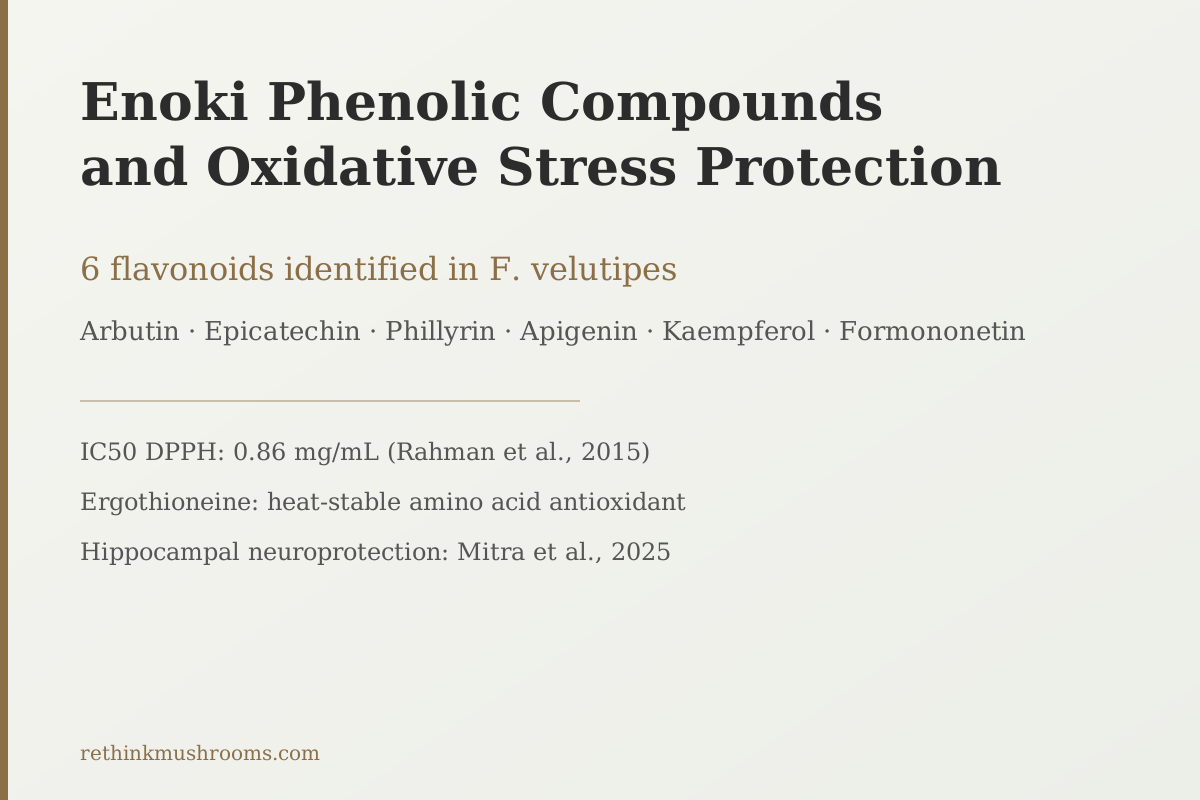 View as image ↗
In 2025, a team published findings in Nutrients showing that a methanolic extract of Flammulina velutipes protected primary hippocampal neurons from oxidative damage and prompted those neurons to extend new branches, acting through the NTRK receptor family.[8] That is a specific, recent, mechanistically anchored result, not marketing language. It sits on top of a decade of work trying to pin down which enoki mushroom phenolic compounds do this kind of thing.
That decade is less tidy than it is usually made to look. The two papers most often cited together as having identified enoki's phenolic profile did not find the same compounds, or even the same class of compound. The heat-stability claim attached to ergothioneine comes from a study that also reported the opposite result for mushroom-derived material. And the most widely repeated statement about how cultivation changes enoki's antioxidant content does not appear in the paper it is credited to. This article covers what has actually been measured, how firmly, and where the evidence stops. For background on the mushroom itself, the full enoki guide covers species, cultivation, and culinary context.
Key Takeaways
- Six flavonoids were identified in enoki by Hu et al. (2016): arbutin, epicatechin, phillyrin, apigenin, kaempferol, and formononetin. This is one paper, one fraction, one method, and it has not been independently replicated
- Rahman et al. (2015) is routinely cited as confirming that list. It did not. It identified three phenolic acids in a different fraction: protocatechuic acid, p-coumaric acid, and ellagic acid. The overlap between the two lists is zero
- The strongest of the five solvent fractions Rahman tested lengthened the lag time before LDL oxidation to 125 minutes at 1 µg/mL and inhibited TBARS formation by 48.71% at 1 mg/mL; its DPPH IC50 was 0.86 mg/mL
- Ergothioneine has excellent light, thermal and acid-base stability as a purified compound, but the same study found that copper degraded it and that mushroom-extracted ergothioneine was less thermally stable, declining under long-term high-temperature heating (Liu 2020)
- Yang et al. (2020) established that F. velutipes builds ergothioneine de novo from histidine, cysteine and pyridoxal phosphate via three enzymes. The paper does not test cultivation conditions, contrary to how it is usually cited
- In primary hippocampal neurons, the methanolic enoki extract protected against oxidative damage and stimulated neurite outgrowth through NTRK receptor activation; the ethanolic extract produced only moderate effects (Mitra 2025)
- The entire evidence base is preclinical. No human clinical trial has tested enoki phenolics, and no bioavailability data exists
What Two Labs Actually Found in Enoki
Most coverage of mushroom antioxidants stays at the category level. "Contains flavonoids." "Rich in phenolic compounds." Enoki is specific enough to go further, and it is usually taken further, but in the wrong direction: the standard account says two independent labs found the same six flavonoids in 2015 and 2016, and treats that convergence as proof the list is real.
Reading the two papers side by side does not support that account.
Compound Identification · 2015 vs 2016
The Two Enoki Phenolic Papers Found Nothing In Common
These two studies are frequently described as independent labs confirming the same six flavonoids. They are not. They examined different fractions with different methods and recovered different classes of compound. The overlap between the two lists is zero.
Rahman et al. (2015)
Oxid Med Cell Longev · LC-MS/MS
Compound class
Phenolic acids
- Protocatechuic acid
- p-Coumaric acid
- Ellagic acid
Analysed: M : DCM fraction (1 of 5 solvent fractions screened)
Hu et al. (2016)
Food Chemistry · HPLC/MS
Compound class
Flavonoids
- Arbutin
- Epicatechin
- Phillyrin
- Apigenin
- Kaempferol
- Formononetin
Analysed: FVF, the isolated flavonoid fraction
Read it this way: two labs recovering two different phenolic families from the same mushroom widens what we know is in enoki. It does not replicate anything. The six flavonoids that most enoki coverage treats as established chemistry have been reported by a single research group, once, in one fraction, and have not been independently confirmed. That is a materially weaker footing than the usual framing implies, and it is the honest starting point for everything downstream.
Sources: Rahman et al. (2015), Oxidative Medicine and Cellular Longevity 2015:403023; Hu et al. (2016), Food Chemistry 204:274-282. Compound lists are verbatim from each paper’s abstract.
Rahman and colleagues, publishing in Oxidative Medicine and Cellular Longevity in 2015, screened five solvent fractions of F. velutipes and ran LC-MS/MS on the most active one, a methanol:dichloromethane fraction.[1] What they identified were three phenolic acids: protocatechuic acid, p-coumaric acid, and ellagic acid. The following year, Hu and colleagues isolated the flavonoid fraction specifically and used HPLC/MS to identify six flavonoids: arbutin, epicatechin, phillyrin, apigenin, kaempferol, and formononetin.[2]
Two labs, two fractions, two methods, two entirely separate lists. Nothing was replicated.
That correction is not a demotion of enoki. It widens the picture: at least two structurally distinct families of phenolic compound have been detected in this mushroom, which is more chemistry than a single overlapping list would give you. What it changes is the confidence level. The six flavonoids are a single-source finding. They should be described as "reported by one group" rather than "confirmed," and every downstream claim about what those six molecules do inherits that limitation.
Each of the six has a different primary mechanism in the wider literature. Epicatechin, the flavonoid found in green tea and dark chocolate, scavenges free radicals by donating hydrogen atoms, breaking the chain reaction of oxidative damage before it propagates. Kaempferol inhibits lipid peroxidation, the process by which free radicals strip electrons from the fat molecules embedded in cell membranes. Apigenin works partly by upregulating the cell's own antioxidant enzymes rather than only scavenging radicals directly. Formononetin is a phytoestrogen isoflavone more commonly associated with legumes. Arbutin is a glycoside found in pear skin and bearberry, with lower antioxidant potency than the others. Phillyrin is a lignan glucoside associated with antioxidant and anti-inflammatory effects. These mechanisms are established for the isolated compounds in non-mushroom contexts; none of them has been individually tested as an enoki constituent.
For a deeper look at enoki's full bioactive family, including the polysaccharide fractions and the mushroom-specific protein flammulin, the enoki bioactive compounds guide covers the structural chemistry underpinning these findings.
What the Flavonoid Fraction Did in Neural Cells
Identifying compounds is step one. Testing them is step two, and Hu and colleagues did both in the same paper.
The standard model for oxidative stress in neural contexts is the PC12 line, derived from a rat adrenal tumour and widely used as a proxy for neural-type cells. The researchers exposed PC12 cells to hydrogen peroxide to create controlled oxidative damage, then compared cells pretreated with the enoki flavonoid fraction against untreated controls.[2]
Hu et al. (2016) · Food Chemistry
- Population
- PC12 cells, a rat pheochromocytoma line used as a neural-type proxy
- Intervention
- Pretreatment with the isolated Flammulina velutipes flavonoid fraction (FVF), followed by H2O2-induced oxidative challenge
- Finding
- HPLC/MS identified six flavonoids: arbutin, epicatechin, phillyrin, apigenin, kaempferol and formononetin. Pretreatment significantly increased cell survival, glutathione level and superoxide dismutase activity, and reduced lactate dehydrogenase release, intracellular reactive oxygen species and malondialdehyde.
preliminary An immortalised cell line, not neurons, and a single group's compound identification that no other laboratory has repeated. Both the chemistry and the effect rest entirely on this one paper.
Hu et al. (2016), Food Chemistry 204:274-282
The direction of every marker is consistent. Glutathione, the cell's primary intracellular antioxidant, rose. Superoxide dismutase activity, which converts superoxide radicals into hydrogen peroxide for downstream neutralisation, increased. Meanwhile three damage markers dropped: reactive oxygen species, malondialdehyde (a lipid peroxidation product), and lactate dehydrogenase, which leaks out of cells with ruptured membranes.
Lower malondialdehyde means less membrane damage. Lower lactate dehydrogenase means fewer cells with compromised membranes. The pattern fits cells that entered the oxidative challenge better equipped, rather than cells that partially recovered afterwards. That distinction matters, because prevention and repair look different in these assays, and pretreatment is what was tested.
What Enoki Phenolics Do to LDL Cholesterol in the Lab
One of the most clinically framed findings in this literature involves LDL oxidation, and the framing needs care.
LDL oxidation is an early event in arterial plaque formation. Intact LDL particles circulate harmlessly. When free radicals oxidise the fatty acid chains inside them, macrophages in arterial walls recognise the modified particles as foreign, engulf them, and become the foam cells that form the core of atherosclerotic plaque. Researchers looking for upstream intervention points have asked whether dietary compounds can interrupt that first step.
Rahman and colleagues tested exactly this with human LDL in vitro.[1] Their methanol:dichloromethane fraction, the most potent of the five they screened, produced three separate numbers that are worth keeping apart, because they are frequently collapsed into one.
Its DPPH radical scavenging IC50 was 0.86 mg/mL, and its total phenolic content was 56.36 gallic acid equivalents per gram of fraction. Those describe general radical-scavenging capacity, not LDL. On the LDL assays specifically, the fraction at 1 µg/mL most lengthened the lag time before conjugated diene formation, out to 125 minutes, and at 1 mg/mL inhibited the formation of thiobarbituric acid reactive substances by 48.71%.
The mechanism is electron donation. Polyphenols in the fraction hand electrons or hydrogen atoms to the radicals that initiate peroxidation in LDL's fatty acid chains, breaking the reaction before secondary reactive species form. Rahman's own conclusion is appropriately careful: these chain-breaking polyphenolics "might impart" the antioxidative effects, and mushroom polyphenols "might be implicated" in slowing atherosclerosis. This is not a lipid-lowering effect. It does not change how much LDL is circulating, only whether the LDL already there stays undamaged, and it was demonstrated on isolated particles in a tube.
Processing changes what you get. Zhang and colleagues extracted F. velutipes polysaccharides by four different methods and found the resulting preparations diverged on which antioxidant assay they led.[6]
Extraction Method · Zhang et al. 2013
No Extraction Method Won Overall — Each Took A Different Assay
Four preparations from the same mushroom, structurally similar to each other, diverged on which antioxidant endpoint they led. Three methods each won something. The fourth was not reported to win anything.
| Method | Hydroxyl radical | Metal chelating | DPPH scavenging | Reducing power |
|---|---|---|---|---|
| EFPEnzymatic | led | led | · | · |
| UFPUltrasonic | · | · | led | · |
| CFPHot water | · | · | · | led |
| MFPMicrowave | · | · | · | · |
What stayed the same
All four preparations showed similar physicochemical characteristics and FT-IR spectra. The polysaccharide backbone was not what changed.
What changed
SEM images of the mushroom tissue differed significantly between methods, and the measured antioxidant activities separated by assay.
Read it this way: a label saying “enoki extract” does not tell you what you are getting, because the processing step decides which radical the material is good at handling. Two cautions travel with this table. Microwave extraction is blank because the abstract reports no win for it, which is not the same as reporting that it lost. And this experiment measured polysaccharides, not phenolics, so it supports the general principle that method changes activity rather than any specific claim about enoki’s flavonoids or ergothioneine.
Source: Zhang et al. (2013), Carbohydrate Polymers 98(2):1524-31. Assay leaders are as reported in the paper’s abstract; blank cells indicate no reported result, not a measured deficit.
That study measured polysaccharides rather than phenolics, so it supports a general principle rather than a specific claim about enoki's flavonoids. The principle still matters for anyone evaluating a supplement: "enoki extract" is not a uniform product, and the processing step in front of the capsule decides part of what is in it.
The connection between enoki phenolics and advanced glycation end product formation, where oxidised lipids feed into the glycation pathway relevant to diabetes, is covered in the article on mushroom antioxidants and AGEs.
Ergothioneine: Sturdy, With Named Exceptions
The flavonoids and phenolic acids are one part of enoki's antioxidant chemistry. Ergothioneine is the second, and it is structurally different from everything above.
Ergothioneine is a sulfur-containing amino acid produced by fungi and some bacteria. Animals cannot make it, humans obtain it entirely from diet, and mushrooms are the primary dietary source. The body has a dedicated transporter, OCTN1, that actively moves it from the gut into tissues, which is the kind of metabolic specificity that suggests a recognised functional role rather than passive accumulation.
Its reputation is for surviving conditions that destroy ordinary polyphenols. The primary stability study supports that reputation in part, and contradicts it in part, and both halves are in the same abstract.[4]
Stability Boundaries · Liu et al. 2020
Ergothioneine Is Robust Until It Isn’t, And The Paper Says Where
The same study that reports excellent thermal stability for purified ergothioneine also reports that ergothioneine extracted from an actual mushroom was less stable, and that copper degraded it. Both halves belong in any honest summary.
Holds up
Light exposure
Reported as excellent stability
Heat (purified EGT)
Reported as excellent stability
Acid and alkaline pH
Reported as excellent stability
Gives way
Copper (Cu²⁺) present
Cu²⁺ decreased the concentration of ergothioneine
Heat (mushroom-extracted EGT)
PEGT, extracted from Pleurotus citrinopileatus, was not as thermally stable as purified EGT
Long-term high-temperature heating
Caused a decrease in PEGT concentration
What it takes to scavenge half the radicals (IC50, lower is more potent)
The paper reports ergothioneine’s free radical scavenging ability as not different to ascorbic acid, and finds that ergothioneine accounts for about 25% of the total antioxidant ability of the mushroom extract it came from.
Read it this way: ergothioneine is genuinely sturdier than a typical plant polyphenol, and the ~25% figure is a useful reminder that it is one contributor among several rather than the whole antioxidant story of a mushroom extract. But three caveats sit on the face of this paper and are usually dropped. The mushroom-derived material tested here came from golden oyster, not enoki, so the enoki-specific experiment has not been run. That mushroom-derived material was less thermally stable than the purified compound, and long-term high heat reduced it. And the study tested temperature, light, pH and metal ions, not cooking, so it cannot tell you what survives a stir-fry.
Source: Liu et al. (2020), International Journal of Medicinal Mushrooms 22(3):211-220. All values and stability statements are as reported in the paper’s abstract.
Purified ergothioneine showed excellent light, thermal and acid-base stability, and its free radical scavenging ability was reported as not different to ascorbic acid. But copper degraded it, and ergothioneine extracted from a mushroom was explicitly less thermally stable than the purified compound, declining under long-term high-temperature heating. The mushroom in that arm was Pleurotus citrinopileatus, golden oyster, not enoki. The enoki-specific version of the experiment has not been run.
The honest version of the cooking claim is therefore narrower than the usual one. Ergothioneine is sturdier than a typical plant polyphenol, whose degradation generally accelerates with sustained heat. It is not indestructible, the study tested temperature, light, pH and metal ions rather than cooking, and the one measurement made on mushroom-derived material pointed the less convenient way. The practical question of what survives a pan is taken up in how cooking methods affect enoki's antioxidant capacity.
One further figure from that paper deserves attention because it punctures a common assumption: ergothioneine accounted for about 25% of the total antioxidant ability of the extract it was isolated from.[4] It is a major contributor, not the whole story.
Across species, ergothioneine content varies enormously. Kalaras and colleagues compared ergothioneine and glutathione across 13 mushroom species and found ergothioneine ranging from 0.15 to 7.27 mg per gram dry weight, roughly a 48-fold spread, correlated with glutathione levels at r=0.62.[3] Porcini topped that ranking. Enoki is not among the species the paper singles out at either end, and it is worth being plain about the consequence: enoki is a genuine ergothioneine producer, which the biosynthesis work below establishes directly, but it is not a leading dietary source, and any article implying otherwise is reaching past the data. For the full cross-species picture, see ergothioneine content by mushroom species: a complete ranking.
Why Enoki Produces Ergothioneine at All
Yang and colleagues published the ergothioneine biosynthesis pathway in F. velutipes in 2020.[5] They cloned and expressed three genes, Fvegt1, Fvegt2 and Fvegt3, and characterised what each encoded enzyme does. FvEgt1 turned out to be bifunctional, acting as both a methyltransferase and a hercynylcysteine sulfoxide synthase, catalysing production from histidine and cysteine. FvEgt2 and FvEgt3 are two functionally different cysteine desulfurases. Together the three enzymes synthesise ergothioneine from histidine, cysteine and pyridoxal phosphate, and the authors achieved in vitro synthesis of ergothioneine in this species for the first time.
The takeaway is that enoki builds ergothioneine itself, from basic precursors, rather than absorbing it from its growing medium.
It is worth flagging what this paper does not say, because the claim is nearly universal in enoki writing: it does not test cultivation conditions. The frequently repeated statement that light, substrate or growing stress upregulate these genes and change final ergothioneine content is not a finding of Yang et al. It is an extrapolation, and it has been presented as sourced when it is not.
Something in that neighbourhood is genuinely supported, from two other studies. Kalaras and colleagues observed that Agaricus bisporus harvested in the third cropping flush contained more ergothioneine and glutathione than the first flush, which they suggested might be a response to increased oxidative stress.[3] That is a different species, so it is a hypothesis for enoki rather than a result. Closer to home, Hu and colleagues compared yellow-strain and white-strain F. velutipes polysaccharides and found the yellow-strain 80% fraction the most antioxidant-active of those tested, with a DPPH IC50 of 2.22 mg/mL and a 55.96% reduction in reactive oxygen species in H2O2-challenged L929 cells.[9] Strain, at least, demonstrably matters.
So does which part you eat, and here two papers point in opposite directions. Kalaras found both ergothioneine and glutathione more concentrated in cap tissue than stem tissue in the species examined.[3] Chen and colleagues, working specifically on F. velutipes stipes, found the stems had higher polysaccharide and total phenolic content and greater antioxidant capacity, particularly in ethanolic extracts.[10] Both can be true at once, because they are measuring different compound classes: the sulfur amino acid concentrates in the cap, the phenolics and polysaccharides in the stem. For enoki, which is eaten whole and is mostly stem, that is a convenient result rather than a conflict.
From Fatty Liver to Neurons: The In Vivo Record
In vitro results show what a compound can do under controlled conditions. In vivo results show whether it still does something in a living system, where metabolism, bioavailability and tissue distribution all intervene. For enoki, the in vivo record is animal-based and covers two organ systems.
Luo and colleagues supplemented mice on a high-fat diet with 4% F. velutipes mycorrhizae, the by-product left over from enoki cultivation rather than the mushroom itself.[7] The supplemented mice showed reduced liver weight and triglycerides in plasma, liver and perirenal adipose tissue, altered fatty acid profiles, increased gene expression for lipid hydrolysis and β-oxidation, and reduced lipid synthesis.
On the oxidative and inflammatory endpoints specifically, the results were an increased GSH/GSSG ratio and decreased malondialdehyde and IL-6 in both liver and perirenal adipose tissue.[7] Two caveats belong with that. The paper reports differential regulation of IL-1β, IL-6 and CCL2 between the two tissues rather than a uniform anti-inflammatory effect, so "lowered inflammation everywhere" overstates it. And superoxide dismutase and catalase, which frequently appear in summaries of this study, were not among the reported outcomes.
The material also matters. Mycorrhizae are an agricultural by-product, and the paper's stated motivation is valorising a waste stream. This is a result about enoki cultivation residue, not about eating enoki.
The neural data is newer and more specific. Mitra and colleagues, publishing in Nutrients in 2025, worked with primary hippocampal neurons taken directly from tissue rather than an immortalised line, and compared methanolic against ethanolic extracts.[8]
Mitra et al. (2025) · Nutrients
- Population
- Primary hippocampal neuronal culture, not an immortalised cell line
- Intervention
- Methanolic and ethanolic Flammulina velutipes extracts at a range of concentrations, with oxidative stress challenge; extracts characterised by GC-MS, plus molecular docking and MM-GBSA binding analysis
- Finding
- The methanolic extract significantly enhanced neurite outgrowth, improved neuronal cytoarchitecture and promoted survival under oxidative stress. The ethanolic extract produced only moderate effects. Both the in vitro assays and the docking analysis indicated the benefits were mediated through activation of NTRK receptors.
preliminary Primary neurons in culture are a substantial step above a tumour-derived line, and a named receptor mechanism is a genuine advance. It remains a dish, with no animal or human data behind it, and the docking component is a computational prediction rather than a measurement.
Mitra et al. (2025), Nutrients 17(19)
The hippocampus is particularly vulnerable to oxidative stress because of its high metabolic rate and its role in memory consolidation. This study does not show that eating enoki improves memory. It shows that an enoki-derived extract protected the neural tissue most associated with memory, in a dish, and identified a plausible receptor route for how.[8] The solvent detail is worth carrying too: methanol is not a kitchen process, and the extract that worked is not the one you make by eating a mushroom.
This connects to how mushrooms fight inflammation via NF-kB and COX-2. Oxidative stress and inflammatory signalling are tightly coupled; when free radicals overwhelm antioxidant defences, NF-kB activation follows.
Repetition vs Sources
Have two independent labs confirmed enoki's six flavonoids?
The claim
“Two independent research groups, in 2015 and 2016, identified the same six flavonoids in enoki, which makes the list well established.”
Rahman et al. (2015) and Hu et al. (2016) are consistently cited together as a matched pair, and the six-compound list from the second paper gets attached retroactively to the first.
What research shows
UnsupportedThe two papers found different compounds from different classes. Rahman identified three phenolic acids (protocatechuic, p-coumaric, ellagic) in a methanol:dichloromethane fraction by LC-MS/MS. Hu identified six flavonoids in an isolated flavonoid fraction by HPLC/MS. The overlap is zero, and no replication exists.
This widens rather than shrinks what is known to be in enoki, since two distinct phenolic families have now been detected. But the six flavonoids are a single-source finding, and every claim built on that list carries the confidence level of one unreplicated paper.
Rahman et al. (2015), Oxid Med Cell Longev 2015:403023; Hu et al. (2016), Food Chemistry 204:274-282
What This Research Does Not Yet Tell You
The preclinical record on enoki phenolics is specific and growing. The distance between that record and anything clinical is large, and worth stating plainly.
- Cell and biochemical studiescompleted
Compound identification, DPPH and LDL oxidation assays, PC12 cells and primary hippocampal neurons, spanning 2013 to 2025
- Animal studiescurrent
Luo et al. (2022): 4% F. velutipes mycorrhizae in high-fat-diet mice, with liver and adipose oxidative and lipid endpoints
- Human case reportsmissing
No published human observations of enoki phenolic effects on oxidative stress markers
- Human bioavailability or pilot trialmissing
No study has measured whether enoki flavonoids or ergothioneine reach human tissues at the concentrations used in these assays
- Controlled human trialmissing
No randomised trial of enoki phenolics for any oxidative stress endpoint
- Pooled analysismissing
Nothing to pool
Everything here is preclinical, and the animal rung is occupied by a single study using cultivation by-product rather than the mushroom. The rung that would matter to a consumer, a human study measuring whether any of this is absorbed in meaningful amounts, has never been attempted.
Rahman et al. (2015); Hu et al. (2016); Zhang et al. (2013); Luo et al. (2022); Mitra et al. (2025)
Beyond the missing rungs, several specific gaps are worth naming:
- The six-flavonoid list has never been independently replicated. One group, one fraction, one method.
- No bioavailability data exists. How much of enoki's flavonoids or ergothioneine survives digestion and reaches target tissues at assay-relevant concentrations is unknown.
- The LDL work used a purified solvent fraction against isolated LDL particles. Whether eating enoki produces bloodstream concentrations capable of influencing LDL oxidation in a person has not been tested.
- The in vivo antioxidant data comes from cultivation by-product, not the mushroom.
- The neuron result used a methanolic extract, which has no dietary equivalent.
- Ergothioneine stability under actual cooking has not been measured in enoki. The one measurement on mushroom-derived material was in a different species and pointed toward degradation under sustained heat.
None of this makes the preclinical work unimportant. It establishes which compounds are present, which mechanisms they plausibly engage, and which physiological outcomes are worth testing. The specificity of the enoki literature, a mapped biosynthesis pathway, a named receptor route, organ-level animal data, does put it in a better-documented category than most culinary mushrooms.
The honest summary: enoki contains characterised antioxidant compounds that perform specific, documented functions in laboratory conditions. Whether eating enoki produces measurable antioxidant benefits in people has not been tested.
Evidence Scope
LowEvery finding in this article is preclinical, and none of it supports using enoki to treat or prevent anything
Concern
The compounds and mechanisms described here were measured in test tubes, immortalised cell lines, primary neuron cultures and mice. Several used solvent extracts or cultivation by-product with no dietary equivalent. Cardiovascular and cognitive framing around these results routinely outruns what was measured, and enoki supplements are marketed on exactly that gap.
What the research says
Enoki is a widely eaten culinary mushroom with a long record of ordinary food use, and nothing here suggests a hazard from eating it. The issue is the opposite direction: the benefit claims are not established in humans, no dose has been studied, and no bioavailability data exists to say whether a dietary portion delivers anything resembling the concentrations used in these experiments.
Particularly relevant for: Anyone considering enoki extracts or supplements for cholesterol, cardiovascular risk, cognitive decline or memory, and anyone taking them in place of treatment with an evidence base.
What to do
Treat enoki as food rather than as an intervention. If you are managing LDL cholesterol, cardiovascular risk or a cognitive condition, those decisions belong with your clinician. This article is educational and is not medical advice; it cannot account for your history or medications.
Rahman et al. (2015); Hu et al. (2016); Liu et al. (2020); Luo et al. (2022); Mitra et al. (2025)
For the broader picture of enoki's free radical scavenging across all compound classes, including the polysaccharide fractions, the enoki antioxidant activity overview covers those mechanisms in full.
The Bottom Line
Enoki's phenolic literature is more specific and less settled than it is usually presented. Six flavonoids (arbutin, epicatechin, phillyrin, apigenin, kaempferol, formononetin) were identified by Hu et al. (2016) in a single unreplicated paper; Rahman et al. (2015), routinely cited as confirming that list, actually identified three different phenolic acids in a different fraction. Rahman's most active fraction lengthened the lag time before LDL oxidation to 125 minutes at 1 µg/mL and inhibited TBARS formation by 48.71% at 1 mg/mL, with a DPPH IC50 of 0.86 mg/mL. Ergothioneine, which enoki builds de novo from histidine and cysteine via three characterised enzymes, is stable to light, heat and pH as a purified compound but degrades in the presence of copper, and mushroom-extracted ergothioneine proved less thermally stable than the pure form. The most recent work (Mitra 2025) protected primary hippocampal neurons from oxidative damage via NTRK receptor activation, using a methanolic extract. No human trial has tested any of it, and no bioavailability data exists.
Frequently Asked Questions
Sources & References
- 1RTHM-00729·Rahman, Mohammad Azizur et al. (2015). “Antioxidative Effects and Inhibition of Human Low Density Lipoprotein Oxidation In Vitro of Polyphenolic Compounds in Flammulina velutipes (Golden Needle Mushroom)..” Oxidative medicine and cellular longevity.Study breakdown →PubMed →↩
- 2RTHM-00786·Hu, Qiuhui et al. (2016). “Identification of flavonoids from Flammulina velutipes and its neuroprotective effect on pheochromocytoma-12 cells..” Food chemistry.Study breakdown →PubMed →↩
- 3RTHM-00476·Kalaras, Michael D et al. (2017). “Mushrooms: A rich source of the antioxidants ergothioneine and glutathione..” Food chemistry.Study breakdown →PubMed →↩
- 4RTHM-00633·Liu, Xinqi et al. (2020). “A Study on the Antioxidant Properties and Stability of Ergothioneine from Culinary-Medicinal Mushrooms..” International journal of medicinal mushrooms.Study breakdown →PubMed →↩
- 5RTHM-01305·Yang, Xueqin et al. (2020). “The Biosynthetic Pathway of Ergothioneine in Culinary-Medicinal Winter Mushroom, Flammulina velutipes (Agaricomycetes)..” International journal of medicinal mushrooms.Study breakdown →PubMed →↩
- 6RTHM-00574·Zhang, Zuofa et al. (2013). “Effects of extraction methods on the antioxidant activities of polysaccharides obtained from Flammulina velutipes..” Carbohydrate polymers.Study breakdown →PubMed →↩
- 7RTHM-01575·Luo, Zhen et al. (2022). “Flammulina velutipes Mycorrhizae Attenuate High Fat Diet-Induced Lipid Disorder, Oxidative Stress and Inflammation in the Liver and Perirenal Adipose Tissue of Mice..” Nutrients.Study breakdown →PubMed →↩
- 8RTHM-02150·Mitra, Sarmistha et al. (2025). “Neuroprotective and Neurotrophic Potential of Flammulina velutipes Extracts in Primary Hippocampal Neuronal Culture..” Nutrients.Study breakdown →PubMed →↩
- 9RTHM-01065·Hu, Yu-Ning et al. (2019). “Characterization and Antioxidant Activities of Yellow Strain Flammulina velutipes (Jinhua Mushroom) Polysaccharides and Their Effects on ROS Content in L929 Cell..” Antioxidants (Basel.Study breakdown →PubMed →↩
- 10RTHM-01671·Chen, Chien-Chin et al. (2023). “In Vitro Assessment of the Antioxidant and Anticancer Properties of Flammulina velutipes Stipe Extracts..” Anticancer research.Study breakdown →PubMed →↩