Mushrooms & Inflammation
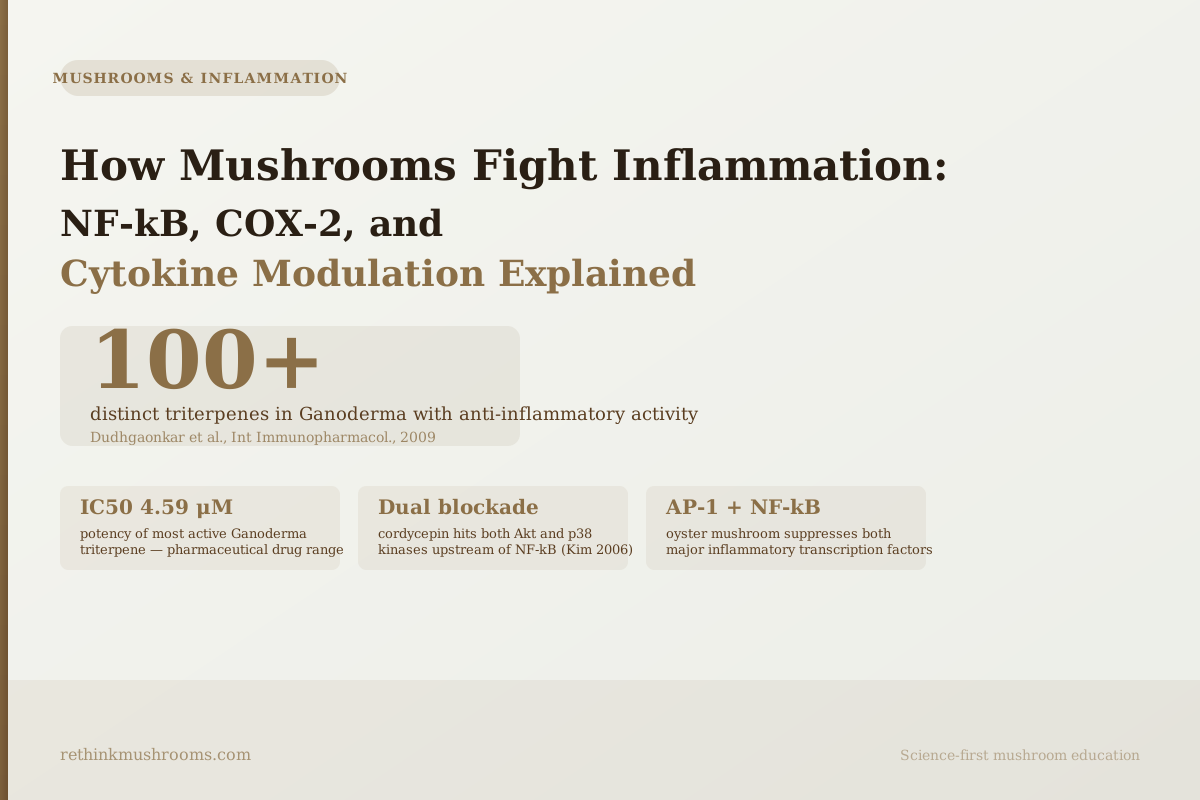
100+ distinct triterpenes in Ganoderma with anti-inflammatory activity
Ganoderma lucidum contains more than 100 structurally distinct triterpenes, each suppressing NF-kB through direct inhibition of the p65 phosphorylation step that unlocks the inflammatory cascade.
Dudhgaonkar et al., Int Immunopharmacol., 2009
IC50 4.59 μM
potency of the most active Ganoderma triterpene against NF-kB activation — in the pharmaceutical drug range (Dudhgaonkar 2009)
Dual blockade
cordycepin inhibits BOTH Akt and p38 kinases upstream of NF-kB — most anti-inflammatories hit only one target (Kim 2006)
AP-1 + NF-kB
oyster mushroom suppresses two major inflammatory transcription factors simultaneously, not just one (Jedinak 2011)
Dudhgaonkar et al., Int Immunopharmacol., 2009
 View as image ↗
Most anti-inflammatory supplement marketing describes the outcome (reduces inflammation) without explaining the mechanism. This article is for the reader who has encountered terms like NF-kB, COX-2, and cytokines and wants to understand exactly how mushroom compounds interact with them, at which step in the cascade, and what that means for downstream inflammatory output. For the broader overview of mushroom anti-inflammatory research, see How Mushrooms Fight Inflammation: NF-kB, COX-2, and Beyond.
The research answer, established across multiple peer-reviewed studies and synthesized in the Elsayed 2014 review of mushroom anti-inflammatory compounds, is that mushroom compounds operate at multiple points in the inflammatory signaling chain rather than at a single target.[1] Different compound classes, specifically triterpenes and polysaccharides, act through completely different mechanisms. And mushrooms hit targets that most pharmaceutical anti-inflammatories do not, including transcription factors upstream of COX-2 rather than the enzyme itself. That distinction has both mechanistic and practical implications.
Key Takeaways
- NF-kB is a protein that activates inside immune cells when inflammation is triggered; it travels to the cell nucleus and switches on genes including those that produce COX-2, iNOS, TNF-alpha, and IL-1beta
- Cordycepin (from Cordyceps) blocks NF-kB by inhibiting two upstream kinases simultaneously: Akt and p38 MAPK — this dual blockade is the mechanism template for how mushroom compounds suppress NF-kB (Kim 2006)
- Ganoderma triterpenes suppress NF-kB through direct inhibition of p65 phosphorylation, with IC50 values of 4.59 to 21.60 μM for the most potent compounds — concentrations comparable to pharmaceutical compounds (Dudhgaonkar 2009)
- COX-2 is the enzyme that produces prostaglandin E2, the short-range molecule responsible for pain, swelling, and heat; NSAIDs inhibit COX-2 directly, while mushroom triterpenes suppress the NF-kB transcription factor that produces COX-2 in the first place
- Oyster mushroom extract suppresses both NF-kB and AP-1, a second major inflammatory transcription factor; reducing AP-1 alongside NF-kB decreases production of PGE2, nitric oxide, TNF-alpha, and IL-1beta simultaneously (Jedinak 2011)
- Antrodia camphorata triterpenoids inhibit iNOS and COX-2 expression via NF-kB pathway suppression, establishing the downstream mechanism by which NF-kB inhibition translates to reduced nitric oxide and prostaglandin output (Hseu 2005)
The NF-kB Inflammatory Cascade: How It Works Step by Step
NF-kB stands for Nuclear Factor kappa B. The name refers to its function: it is a protein complex that activates in the nucleus of immune cells (like macrophages) in response to an inflammatory signal. Under normal conditions, NF-kB is held inactive in the cytoplasm (the fluid inside cells) by a protein called IkB, which binds to NF-kB and prevents it from entering the nucleus.
When an inflammatory trigger arrives (a bacterial toxin, a cytokine signal, or cellular damage), a chain of events begins:
- Inflammatory signal activates the IKK (IkB Kinase) complex.
- IKK phosphorylates IkB, which marks IkB for destruction.
- IkB is degraded, releasing NF-kB.
- Free NF-kB travels into the cell nucleus.
- In the nucleus, NF-kB binds to DNA and switches on inflammatory genes.
- Those genes produce COX-2, iNOS, TNF-alpha, and IL-1beta.
- COX-2 produces prostaglandin E2 (the molecule responsible for pain and swelling). iNOS produces nitric oxide (which amplifies local inflammation). TNF-alpha and IL-1beta are cytokines that broadcast the inflammatory signal to surrounding tissue.
This cascade is the central driver of acute inflammation. It is also the pathway that, when chronically activated, underlies inflammatory conditions from rheumatoid arthritis to inflammatory bowel disease to cardiovascular disease.
The key points in this cascade where mushroom compounds intervene are steps 1 and 2: upstream of NF-kB, before it ever reaches the nucleus.
How Cordycepin Blocks the Cascade: The Dual-Kinase Mechanism
Kim and colleagues in 2006 traced the cordycepin mechanism through the NF-kB pathway in detail using macrophage cell culture experiments.[2] Cordycepin is a compound from Cordyceps militaris (the cultivated form of the medicinal cordyceps species used in research).
When macrophages were stimulated with LPS (lipopolysaccharide, the bacterial toxin used experimentally to trigger inflammation) in the presence of cordycepin, NF-kB activation was significantly suppressed. Kim then identified exactly where in the cascade cordycepin was acting. The answer was at two upstream kinases: Akt and p38 MAPK.
Akt and p38 are signaling enzymes that sit upstream of the IKK complex. When an inflammatory signal arrives, both Akt and p38 contribute to IKK activation, which then phosphorylates IkB and releases NF-kB. Cordycepin inhibited both kinases simultaneously. By blocking the two upstream signals, it prevented IKK activation, which prevented IkB phosphorylation, which kept NF-kB inactive in the cytoplasm. The inflammatory gene expression downstream never happened.
This dual-kinase blockade is mechanistically notable because most pharmaceutical compounds hitting this pathway target a single kinase. Inhibiting both Akt and p38 simultaneously creates a more complete suppression of the cascade, and the two kinases regulate some non-overlapping inflammatory pathways, meaning the dual blockade reaches more of the inflammatory response.
The COX-2 Question: What It Is and Why Mushrooms Target It Differently
COX-2 (Cyclooxygenase-2) is an enzyme. It converts arachidonic acid into prostaglandins, specifically prostaglandin E2 (PGE2), which is the molecular signal responsible for the pain, heat, redness, and swelling of local inflammation. NSAIDs, including ibuprofen and naproxen, work by directly blocking the COX-2 active site, preventing it from producing PGE2 regardless of how much COX-2 protein is present.
Mushroom compounds, specifically triterpenes and polyphenols, work differently. Rather than blocking the COX-2 enzyme directly, they suppress the NF-kB transcription factor that switches on the COX-2 gene in the first place. The result, less COX-2 protein expressed, less PGE2 produced, is the same. The mechanism is different: inhibiting the factory that builds COX-2 rather than the assembled enzyme itself.
Hseu and colleagues in 2005 documented this pathway specifically for Antrodia camphorata, a medicinal mushroom used in Taiwanese traditional medicine.[5] Antrodia extract significantly reduced COX-2 and iNOS expression in macrophages, alongside reduction in the inflammatory cytokines TNF-alpha and IL-6. The mechanism was NF-kB pathway suppression: the extract blocked NF-kB activation, which caused the downstream genes (COX-2, iNOS) to remain inactive.
iNOS is the gene that produces nitric oxide synthase, the enzyme that generates nitric oxide in inflammatory conditions. While nitric oxide has signaling roles throughout the body, excessive production in inflamed tissue amplifies local damage and recruits additional immune cells. Suppressing iNOS alongside COX-2 via NF-kB inhibition captures both prostaglandin and nitric oxide pathways in one mechanism.
The practical difference between NSAIDs and mushroom compounds on COX-2 is evidence depth: NSAIDs have extensive human clinical trial data demonstrating efficacy and safety profiles (including risk of gastrointestinal damage from chronic use). Mushroom compound effects on COX-2 and NF-kB are well-characterized at the cell and molecular level, but the corresponding human clinical dose-response data is limited. Mechanism is established; human efficacy quantification is not.
The Ganoderma Triterpene Story: 100 Compounds, One Target
Dudhgaonkar and colleagues in 2009 investigated purified triterpenes from Ganoderma lucidum — reishi — across a panel of anti-inflammatory assays.[3] Their key finding: Ganoderma contains more than 100 structurally distinct triterpenes, and the most potent of these directly inhibit NF-kB by blocking p65 phosphorylation.
p65 is the specific subunit of the NF-kB complex that needs to be phosphorylated (chemically tagged) to activate gene transcription once NF-kB reaches the nucleus. Ganoderma triterpenes intervene at this point: they prevent the phosphorylation of p65, meaning NF-kB reaches the nucleus but cannot activate the inflammatory genes it would normally switch on.
The potency data is notable: the most active Ganoderma triterpenes showed IC50 values of 4.59 to 21.60 micromolar. IC50 is the concentration required to reduce the target activity by half. A lower IC50 means a more potent compound. Drug-range compounds often operate in the 1 to 100 micromolar range. Ganoderma's most active triterpenes sit at the lower end of that range.
The 100+ distinct triterpene finding also matters for understanding why reishi extract research shows variable results. The anti-inflammatory potency of a reishi product depends heavily on which triterpenes are concentrated during extraction, at what purity, and in what quantities. Products standardized only for total triterpene content may not capture the specific compounds with the strongest NF-kB inhibitory activity.
AP-1: The Second Inflammatory Switch Mushrooms Also Target
NF-kB gets most of the attention in discussions of inflammatory signaling, but it is not the only transcription factor that drives inflammation. AP-1 (Activator Protein-1) is a second major inflammatory transcription factor that activates many of the same inflammatory genes as NF-kB, through a parallel pathway.
Jedinak and colleagues in 2011 investigated oyster mushroom (Pleurotus ostreatus) extract and found it suppressed both NF-kB and AP-1 simultaneously in LPS-stimulated macrophages.[4] The downstream effects were measured as reduced production of PGE2 (via COX-2 suppression), nitric oxide (via iNOS suppression), TNF-alpha, and IL-1beta. All four outputs declined because both transcription factors were blocked.
This AP-1 suppression is important mechanistically because NF-kB and AP-1 can partially compensate for each other. A compound that blocks only NF-kB may see AP-1 maintain some inflammatory gene expression. A compound that blocks both closes both routes simultaneously, producing a more complete suppression of inflammatory output.
The Elsayed 2014 comprehensive review noted that this multi-target, multi-pathway action is a characteristic feature of mushroom anti-inflammatory compounds across species.[1] Unlike pharmaceutical drugs designed to hit single molecular targets, mushroom extracts typically carry multiple compound classes that engage different points in the inflammatory network. The result is simultaneous suppression of multiple inflammatory drivers rather than single-target inhibition.
What This Mechanism Evidence Means in Practice
The mechanistic picture established by these studies is coherent and specific: mushroom compounds can suppress NF-kB, block its ability to activate inflammatory genes, reduce COX-2 and iNOS expression, and lower production of TNF-alpha, IL-1beta, PGE2, and nitric oxide. The mechanisms are real, reproducible across multiple labs, and well-characterized at the molecular level.
The gap between this mechanistic evidence and clinical utility is the dose question. These cell culture experiments use concentrations that are calculated for the target cells in the dish. Achieving comparable concentrations in inflamed human tissue via oral supplementation depends on absorption, distribution, metabolism, and excretion rates that have not been established for most mushroom compounds at pharmaceutical precision.
The pillar cluster for this topic includes articles specifically on Triterpenes vs. Polysaccharides: Different Anti-Inflammatory Pathways and How Mushrooms Modulate Inflammatory Cytokines, which cover the complementary polysaccharide pathway and the specific cytokine-level evidence including the two human randomized controlled trials in the literature (Lima 2012 in elderly women, Dai 2015 in healthy young adults with shiitake).
The Bottom Line
Mushroom compounds suppress inflammation at the NF-kB level, upstream of COX-2 and other inflammatory effectors. Cordycepin (from Cordyceps) blocks the two kinases (Akt and p38) that release NF-kB from inhibition. Ganoderma triterpenes prevent p65 phosphorylation, blocking NF-kB activity even after it reaches the nucleus. Oyster mushroom compounds suppress both NF-kB and AP-1, the two major inflammatory transcription factors. All of this evidence comes from cell and biochemical studies. The mechanism is established. Human dose-response data at clinically relevant concentrations is limited.
Frequently Asked Questions
Sources & References
- 1RTHM-00590·Elsayed, Elsayed A et al. (2014). “Mushrooms: a potential natural source of anti-inflammatory compounds for medical applications..” Mediators of inflammation.Study breakdown →PubMed →↩
- 2RTHM-00103·Kim, Ho Gyoung et al. (2006). “Cordycepin inhibits lipopolysaccharide-induced inflammation by the suppression of NF-kappaB through Akt and p38 inhibition in RAW 264.7 macrophage cells..” European journal of pharmacology.Study breakdown →PubMed →↩
- 3RTHM-00152·Dudhgaonkar, Shailesh et al. (2009). “Suppression of the inflammatory response by triterpenes isolated from the mushroom Ganoderma lucidum..” International immunopharmacology.Study breakdown →PubMed →↩
- 4RTHM-00219·Jedinak, Andrej et al. (2011). “Anti-inflammatory activity of edible oyster mushroom is mediated through the inhibition of NF-κB and AP-1 signaling..” Nutrition journal.Study breakdown →PubMed →↩
- 5RTHM-00079·Hseu, You-Cheng et al. (2005). “Anti-inflammatory potential of Antrodia Camphorata through inhibition of iNOS, COX-2 and cytokines via the NF-kappaB pathway..” International immunopharmacology.Study breakdown →PubMed →↩