Mushrooms & Inflammation
5 Pleurotus samples tested
Across five Pleurotus samples, the extracts showed COX-2 and NF-κB inhibitory activity; P. ostreatus Florida — with the highest beta-glucan content (43.3% dry weight) — was the most active NF-κB inhibitor.
Stastny et al., Antioxidants, 2022
3 species, 3 targets
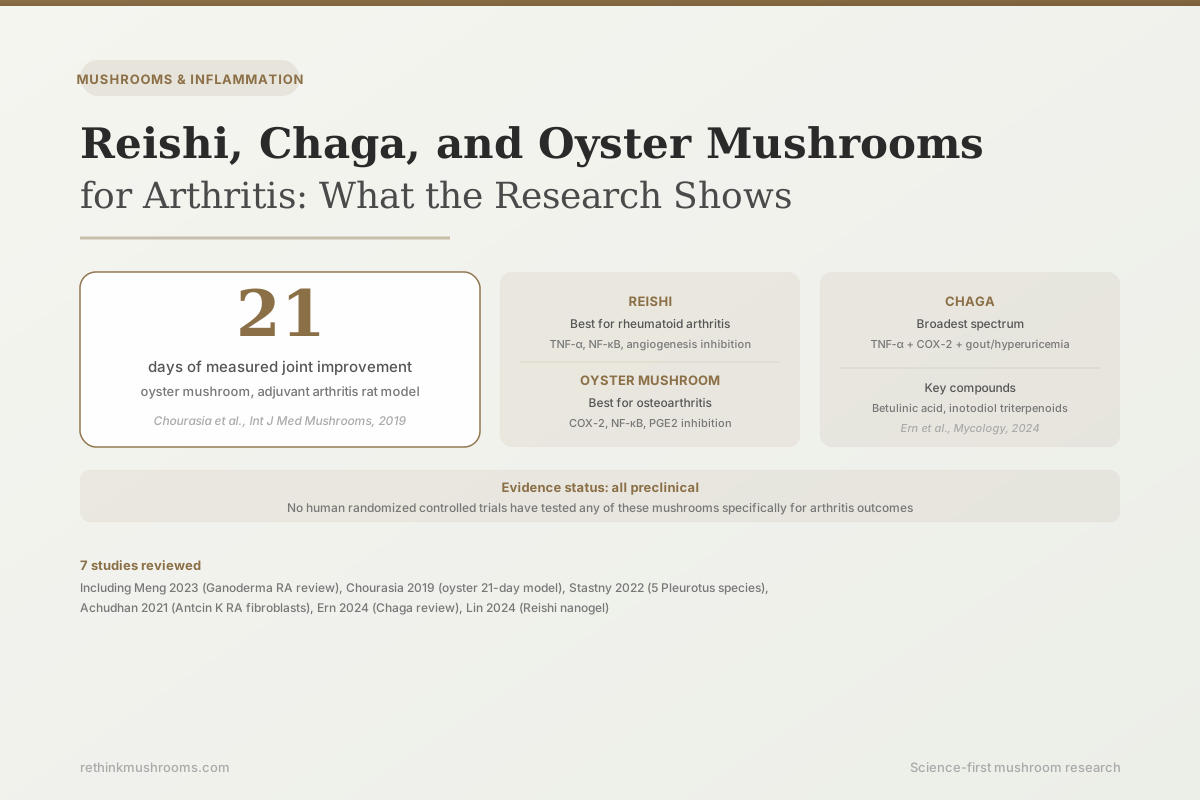
Reishi targets RA's immune cascade; Oyster targets OA's COX-2 pathway; Chaga provides broad-spectrum coverage including gout
21 days
Duration of functional joint improvement in the oyster mushroom arthritis rat model (Chourasia et al., 2019)
0 human RCTs
No randomized controlled trials have tested any of these mushrooms for arthritis outcomes in humans
Stastny et al., Antioxidants, 2022
 View as image ↗
Arthritis is not one disease. Rheumatoid arthritis is an autoimmune condition where the immune system attacks joint tissue, driving up levels of TNF-α, IL-1β, and IL-6 (the inflammatory alarm signals that degrade cartilage and bone). Osteoarthritis is mechanical degeneration: cartilage wears down over time, and the secondary inflammation is largely driven by COX-2 enzyme activity producing prostaglandins (the same molecules that ibuprofen blocks). The disease type changes which mushroom research is actually relevant.
Three species have the most preclinical data for arthritis: Reishi, Chaga, and Oyster mushroom. Each targets a different part of the inflammatory picture. This article maps those connections, covers what the studies actually found, and is honest about where the evidence ends. For the broader overview of how mushrooms modulate inflammation through NF-κB, COX-2, and TNF-α, see our pillar article on how mushrooms fight inflammation: NF-κB, COX-2, and beyond.
Key Takeaways
- Rheumatoid arthritis (RA) and osteoarthritis (OA) are different diseases with different inflammation drivers; mushroom species with the best RA evidence (Reishi) are not the same as those with the best OA evidence (Oyster)
- Reishi (Ganoderma lucidum) polysaccharides and triterpenes target the RA immune cascade at multiple points: TNF-α/cytokine production, T/B lymphocyte dysregulation, MMP-driven cartilage degradation, angiogenesis, and bone loss
- In a collagen-induced arthritis rat model, Ganoderma polysaccharide peptide (GLPP) significantly reduced joint swelling and arthritis severity scores via dual NF-κB and MAPK inhibition (Meng et al., 2023)
- Oyster mushroom (Pleurotus ostreatus) extract reduced paw swelling and joint diameter (both p<0.001) over 21 days in an adjuvant arthritis model, with measurable grip strength improvement. These are functional outcomes, not just biomarkers (Chourasia et al., 2019)
- Across five Pleurotus samples tested for anti-inflammatory activity, P. ostreatus Florida was the most active NF-κB inhibitor and had the highest beta-glucan content (43.3% dry weight); the extracts also showed COX-2 inhibitory activity (Stastny et al., 2022)
- No human randomized controlled trial has tested Reishi, Chaga, or Oyster mushroom specifically for arthritis; the full evidence base is in vitro and animal models
Why the RA vs. OA Distinction Changes Which Mushroom Is Relevant
The same term, "anti-inflammatory," covers very different biological targets depending on which form of arthritis is being addressed.
Rheumatoid arthritis is driven by immune dysregulation. The body produces autoreactive T and B cells that attack the joint lining, triggering the release of TNF-α, IL-1β, and IL-6 (inflammatory cytokines that signal the immune system to attack). These cytokines cause synovial fibroblasts, the cells lining the joint capsule, to proliferate and release MMPs (enzymes that digest the collagen matrix in cartilage). The inflamed joint also grows abnormal blood vessels, a process called angiogenesis, which feeds a destructive tissue called the pannus that progressively invades bone and cartilage. The treatment target in RA is the immune cascade itself.
Osteoarthritis is driven by mechanical wear. Cartilage degrades over years, and the resulting tissue damage triggers a secondary inflammatory response. COX-2, an enzyme also targeted by ibuprofen and naproxen, converts arachidonic acid into prostaglandins (molecules that sensitize pain receptors and maintain the swollen state). NF-κB is also active, but the initiating event is structural damage rather than immune attack.
Why this matters for mushrooms: Reishi's polysaccharide compounds directly target the T/B lymphocyte dysregulation and TNF-α production that characterize RA. Oyster mushroom's beta-glucan inhibits COX-2 and NF-κB, which are the relevant targets in OA. A compound that is excellent at suppressing the RA autoimmune cascade may offer little to OA inflammation driven by COX-2, and vice versa.
For a deep dive on mushrooms and RA specifically, see Mushrooms and Rheumatoid Arthritis: Immune-Modulating Approaches. For the OA case in detail, see Mushrooms for Osteoarthritis Pain.
Species · Target · Arthritis Type
Three Mushrooms, Three Inflammatory Targets
Arthritis is not one disease. Each species hits a different part of the inflammatory picture, which is why the best-evidenced mushroom depends on which form of arthritis you mean.
Reishi
Ganoderma lucidum
Molecular target
TNF-α / autoimmune cascade
Polysaccharides and triterpenes suppress cytokines and dual-inhibit NF-κB + MAPK signaling.
Best-fit arthritis
Rheumatoid arthritis
Anchor: GLPP cut arthritis scores in a collagen-induced arthritis rat model
Oyster
Pleurotus ostreatus
Molecular target
COX-2 / prostaglandin E2
Beta-glucan inhibits COX-2 (the NSAID target) and NF-κB; potency tracks beta-glucan content.
Best-fit arthritis
Osteoarthritis
Anchor: Extract reduced swelling, pain behavior, and improved grip over 21 days
Chaga
Inonotus obliquus
Molecular target
Broad: TNF-α, COX-2, xanthine oxidase
Triterpenoid acids also lower uric acid by inhibiting xanthine oxidase, the enzyme behind gout.
Best-fit arthritis
Gout / broad-spectrum
Anchor: Reviewed anti-inflammatory profile; no arthritis-specific trial yet
All evidence shown is preclinical (in vitro and animal models). No human randomized controlled trial has tested any of these species for arthritis outcomes.
Source: Meng et al. (2023); Chourasia et al. (2019); Stastny et al. (2022); Ern et al. (2024)
View as image ↗Reishi's Case for Rheumatoid Arthritis: Multiple Attack Points on the Cascade
Reishi (Ganoderma lucidum) has the most studied anti-RA mechanism profile of any mushroom. A comprehensive 2023 review in Molecules by Meng and colleagues catalogued the full anti-RA activity of Ganoderma lucidum polysaccharides (GLP).[1] The compound class works across several distinct steps in the RA disease progression.
GLP inhibits synovial fibroblast proliferation and migration, slowing the expansion of the destructive cell population that drives joint tissue destruction. It modulates T and B lymphocyte balance, reducing the autoimmune signaling that initiates the cascade. It suppresses MMP production, protecting the collagen matrix in cartilage from enzymatic digestion. It inhibits angiogenesis, cutting off the blood supply to the pannus. And it promotes osteoblast activity, the cells that rebuild bone, protecting bone integrity alongside cartilage.
Five distinct protective mechanisms from one compound class. No competitor review of mushrooms for arthritis has mapped GLP to all five stages simultaneously.
Animal model data backs the mechanism review. Also in 2023, Meng et al. tested GLPP (Ganoderma lucidum polysaccharide peptide, a related preparation) in a collagen-induced arthritis rat model, the standard preclinical model for RA research where injecting collagen triggers an autoimmune joint attack that resembles human RA pathology.[2] GLPP-treated animals showed significantly reduced arthritis severity scores, decreased joint swelling, and lower inflammatory cytokine levels compared to arthritic controls. The mechanism was simultaneous inhibition of both NF-κB (the master inflammation on-switch) and MAPK (a parallel inflammation amplification pathway) signaling.
Meng et al. (2023) · Phytomedicine
- Population
- Male Wistar rats with collagen-induced arthritis (the standard preclinical RA model)
- Intervention
- Oral GLPP at 100 or 200 mg/kg for 35 days
- Comparator
- Untreated arthritic controls
- Finding
- Reduced paw thickness and clinical arthritis scores with lower RA-related protein levels, via inactivation of NF-κB and MAPK signaling
preliminary Animal model only; no human dose established
Meng et al., Phytomedicine, 2023
The most recent Reishi joint data comes from Ratnaningtyas and colleagues in 2024, who developed a Reishi (Ganoderma lucidum) nanogel formulation and tested it in a complete Freund's adjuvant-induced rheumatoid arthritis rat model.[3] The nanogel showed anti-arthritic, anti-inflammatory, and antioxidative activity. The nanogel delivery format matters because polysaccharides from oral supplements face real bioavailability limitations in reaching joint tissue; the nanogel approach showed improved activity compared to crude extract.
A compound with the most mechanistically complete RA profile: Antcin K from Antrodia camphorata
Not Reishi itself, but a related Taiwanese medicinal mushroom, Antrodia camphorata, contains a triterpenoid called Antcin K that has been studied in human RA synovial fibroblast models across three sequential papers. Achudhan and colleagues (2021) showed Antcin K dose-dependently inhibited TNF-α, IL-1β, and IL-8 (three cytokines central to RA inflammation) in TNF-stimulated human RA synovial fibroblasts, and also suppressed both MMP-3 and MMP-13, the enzymes that cleave cartilage collagen.[4] Two 2022 follow-up papers from the same group showed Antcin K also blocked VCAM-1 expression (a surface protein that lets monocytes adhere to and infiltrate joint tissue)[8] and inhibited VEGF-driven angiogenesis (the blood vessel growth that sustains the pannus).[9] Together, the three papers document Antcin K acting across the cytokine, cell recruitment, and angiogenesis stages of the RA cascade. This is all in vitro, and Antrodia camphorata products are uncommon outside Taiwan, but the mechanistic completeness is notable.
For the detailed account of how triterpene compounds like these suppress TNF-α, see mushroom triterpenes and TNF-α suppression.
Oyster Mushroom for Osteoarthritis: COX-2 Inhibition With Functional Evidence
Oyster mushroom (Pleurotus ostreatus) has the most relevant mechanism profile for osteoarthritis, and it is the species with the most concrete functional outcome data in the arthritis literature.
Chourasia and colleagues (2019) tested Pleurotus ostreatus cv. Florida extract in rats with adjuvant-induced arthritis, the standard animal model for inflammatory joint disease, measuring outcomes over 21 days.[5] The extract-treated animals showed significant reductions (p<0.001) in paw volume (joint swelling) and joint diameter, normalized body weight, and reduced joint swelling on X-ray. They also showed improved gripping activity compared to the arthritic control group that received no treatment.
The gripping activity finding is worth emphasizing. Most arthritis research reports biomarker changes: cytokine levels, histology scores, radiographic assessments. Grip strength improvement is a functional outcome that connects the molecular changes to something resembling a real-world measure of joint use. Whether that translates to humans is a separate question, but the Chourasia data is not just biochemistry.
Chourasia et al. (2019) · International Journal of Medicinal Mushrooms
- Population
- Rats with complete Freund's adjuvant-induced arthritis
- Intervention
- Oral hydroethanolic P. ostreatus cv. Florida extract at 200 or 400 mg/kg
- Comparator
- Untreated arthritic controls; piroxicam (4 mg/kg) as reference drug
- Finding
- Significant reductions (p<0.001) in paw volume and joint diameter, improved grip strength, and reduced joint swelling on X-ray — functional joint outcomes, not just biomarkers
preliminary Animal model only; human dose not established
Chourasia et al., International Journal of Medicinal Mushrooms, 2019
The mechanism underlying those outcomes was examined by Stastny and colleagues in 2022, who compared five Pleurotus samples (P. flabellatus, P. pulmonarius, P. opuntiae, and two P. ostreatus strains, Sylvan Ivory and Florida) for antioxidant and anti-inflammatory activity, using an enzymatic COX-2/prostaglandin E2 (PGE2) assay and an NF-κB reporter assay in LPS-stimulated THP-1 cells (LPS is a bacterial toxin that triggers inflammation).[6] The extracts showed COX-2 inhibitory activity, and P. ostreatus Florida was the most active NF-κB inhibitor (72.2% of control) while also carrying the highest beta-glucan content, at 43.3% dry weight, suggesting the polysaccharide fraction drives the anti-inflammatory potency.
The COX-2 connection matters for OA context. COX-2 is the exact enzyme that ibuprofen, naproxen, and celecoxib block to reduce arthritis pain. When OA researchers talk about "anti-inflammatory" treatments, COX-2 inhibition is frequently what they mean. Oyster mushroom beta-glucan inhibiting this enzyme through a food-derived pathway is mechanistically parallel to what NSAIDs do, through a different molecular interaction. The Stastny 2022 finding suggests this is a broad genus property, with the effect varying in degree across the Pleurotus samples rather than in kind.
Chaga: Broad-Spectrum Anti-Inflammatory With a Distinct Gout Angle
Chaga (Inonotus obliquus) doesn't align as cleanly to either RA or OA as the other two species. Its anti-inflammatory profile is broader, covering multiple pathways simultaneously without strong mechanistic mapping to one arthritis subtype.
Ern and colleagues published a comprehensive review of Chaga's therapeutic properties in Mycology in 2024.[7] The anti-inflammatory mechanisms documented include TNF-α modulation (overlapping with Reishi's RA-relevant activity), COX-2 inhibition (overlapping with Oyster's OA-relevant pathway), and triterpenoid-mediated hyperuricemia reduction. Hyperuricemia is elevated uric acid in the blood. When uric acid crystals deposit in joints, the result is gout, a distinct form of inflammatory arthritis with intense acute flares. Neither Reishi nor Oyster mushroom has documented activity in this pathway. In hyperuricemic-mouse models, Chaga triterpenoid acids lower uric acid by inhibiting xanthine oxidase, the enzyme that generates uric acid (the same target as the gout drug allopurinol). That is a preclinical mechanism, but it is distinct from anything documented for the other two species.
The limitation the Ern 2024 review identifies is significant: most of Chaga's evidence is in vitro or rodent data. No arthritis-specific trial, animal or human, has been published specifically for Chaga.
Where Chaga fits in practice: as a general anti-inflammatory with preclinical evidence across both TNF-α and COX-2 pathways, and a unique position in gout-type arthritis, it is the most versatile of the three species. But versatility built on preclinical evidence is a weaker claim than the targeted animal model data that exists for Reishi in RA and Oyster in OA.
Ranking the Evidence: Which Species for Which Condition
The three species have distinct evidence profiles that correspond to specific disease mechanisms:
Reishi: best evidence for rheumatoid arthritis. Its polysaccharides and triterpenes target the RA immune cascade at multiple points: TNF-α and cytokine suppression, T/B lymphocyte regulation, MMP inhibition, angiogenesis inhibition, and bone protection. Two 2023 animal models support the mechanism review data.
Oyster mushroom: best evidence for osteoarthritis. The COX-2 inhibition mechanism maps directly to OA's primary inflammation driver. The Chourasia 2019 study provides functional outcome data (grip strength, swelling reduction) over 21 days. The Stastny 2022 finding establishes this is a stable property across the Pleurotus genus.
Chaga: broadest profile, strongest gout relevance. The dual TNF-α/COX-2 coverage means it is conceptually relevant to both RA and OA, but evidence is thinner and less condition-specific. The hyperuricemia activity is distinctive and unmatched by the other two.
None of these species has been tested in human arthritis trials. The rankings reflect preclinical evidence quality and mechanistic fit, not clinical efficacy.
- Cell / in vitro studiescompleted
Antcin K in human RA synovial fibroblasts; Stastny COX-2 and NF-κB assays across Pleurotus extracts
- Animal modelscurrent
Reishi GLPP and nanogel in RA rat models; oyster mushroom extract in an adjuvant arthritis rat model with functional outcomes
- Small human trialsmissing
No human trial has tested these species for arthritis outcomes
- Large randomized trialsmissing
None conducted
The evidence is mechanistically coherent and reaches functional outcomes in animals, but stops at the animal-model stage. The jump to human efficacy has not been made for any of the three species.
Meng et al. (2023); Chourasia et al. (2019); Stastny et al. (2022); Achudhan et al. (2021)
For a detailed species-specific comparison of Reishi and Chaga, including dosing considerations and form factors, see Reishi and Chaga for Joint Health. For the cytokine balance picture relevant to both RA and OA, see how mushrooms balance pro- and anti-inflammatory cytokines. The full arthritis overview across all mushroom species is in Mushrooms for Arthritis: Can They Reduce Joint Inflammation?.
What the Research Hasn't Established
The evidence gap is not subtle: every study in this article is either in vitro or animal model. No human randomized controlled trial has evaluated Reishi, Chaga, or Oyster mushroom as an arthritis treatment.
No human dose-response data exists. The Chourasia 2019 rat model used specific extract concentrations at specific doses. The Stastny 2022 paper correlated beta-glucan content with NF-κB inhibition potency. Neither provides a usable human dose. No clinical pharmacokinetic study has established what oral mushroom supplementation produces in joint-relevant tissue concentrations.
Bioavailability from food and standard supplements is poorly characterized. The Ratnaningtyas 2024 nanogel study was developed precisely because crude Reishi extract has limited bioavailability in vivo. Standard supplement forms have not been tested for joint tissue distribution.
RA has established treatments with decades of clinical evidence. Biological therapies targeting TNF-α (such as etanercept and adalimumab) and DMARDs (such as methotrexate) are the current clinical standard. The mushroom research is mechanistically coherent, but it is not an evidenced clinical alternative to these treatments at this stage. No interaction data exists between these mushrooms and the medications typically used to treat RA.
Safety
ModerateImmunomodulatory mushrooms may interact with RA medications
Concern
Reishi, Chaga, and other medicinal mushrooms modulate the immune system, and standard RA treatments (methotrexate and other DMARDs, plus TNF-α biologics such as etanercept and adalimumab) deliberately suppress it. No human interaction studies have been published for these combinations.
What the research says
Treat these mushrooms as unproven adjuncts, not replacements for prescribed therapy. Do not stop or reduce RA medication to try a mushroom supplement.
Particularly relevant for: Anyone taking DMARDs or biologic therapy for rheumatoid arthritis
What to do
Talk to your rheumatologist before adding any medicinal mushroom supplement. This article is educational and is not medical advice.
Meng et al. (2023); clinical-standard RA therapy references
The Bottom Line
Three mushrooms have meaningful preclinical data for arthritis, and they map to different disease mechanisms: Reishi's polysaccharide and triterpene compounds target the autoimmune cascade in RA; Oyster mushroom's beta-glucan inhibits COX-2 and NF-κB relevant to OA; Chaga provides broad-spectrum coverage with a unique gout angle. Animal model data for Reishi and Oyster mushroom is reasonably specific. No human clinical trial has tested any of the three specifically for arthritis, and dose-to-effect relationships in humans are not established.
Frequently Asked Questions
Sources & References
- 1RTHM-01750·Meng, Meng et al. (2023). “Potential Anti-Rheumatoid Arthritis Activities and Mechanisms of Ganoderma lucidum Polysaccharides..” Molecules (Basel.Study breakdown →PubMed →↩
- 2RTHM-01751·Meng, Meng et al. (2023). “Ganoderma lucidum polysaccharide peptide (GLPP) attenuates rheumatic arthritis in rats through inactivating NF-κB and MAPK signaling pathways..” Phytomedicine : international journal of phytotherapy and phytopharmacology.Study breakdown →PubMed →↩
- 3RTHM-01974·Ratnaningtyas, Nuniek Ina et al. (2024). “Lingzhi or Reishi Medicinal Mushroom Ganoderma lucidum (Agaricomycetes) Nanogel in a Complete Freund's Adjuvant-Induced Rheumatoid Arthritis Rat Model: Anti-Arthritic, Anti-Inflammatory, and Antioxidative Activity..” International journal of medicinal mushrooms.Study breakdown →PubMed →↩
- 4RTHM-00670·Achudhan, David et al. (2021). “Antcin K Inhibits TNF-α, IL-1β and IL-8 Expression in Synovial Fibroblasts and Ameliorates Cartilage Degradation: Implications for the Treatment of Rheumatoid Arthritis..” Frontiers in immunology.Study breakdown →PubMed →↩
- 5RTHM-01045·Chourasia, Ayushi et al. (2019). “Evaluation of Antiarthritic Effect of Culinary-Medicinal Oyster Mushroom Pleurotus ostreatus cv. Florida (Agaricomycetes) on Complete Freund's Adjuvant Induced Arthritis in Rats..” International journal of medicinal mushrooms.Study breakdown →PubMed →↩
- 6RTHM-01618·Stastny, Jan et al. (2022). “Antioxidant and Anti-Inflammatory Activity of Five Medicinal Mushrooms of the Genus Pleurotus..” Antioxidants (Basel.Study breakdown →PubMed →↩
- 7RTHM-01886·Ern, Phoebe Tee Yon et al. (2024). “Chaga Therapeutic Properties: What This 2024 Review Actually Shows.” Mycology.Study breakdown →PubMed →↩
- 8RTHM-00738·Achudhan, David et al. (2022). “Antcin K inhibits VCAM-1-dependent monocyte adhesion in human rheumatoid arthritis synovial fibroblasts..” Food & nutrition research.Study breakdown →PubMed →↩
- 9RTHM-00739·Achudhan, David et al. (2022). “Antcin K inhibits VEGF-dependent angiogenesis in human rheumatoid arthritis synovial fibroblasts..” Journal of food biochemistry.Study breakdown →PubMed →↩