Mushrooms & Inflammation
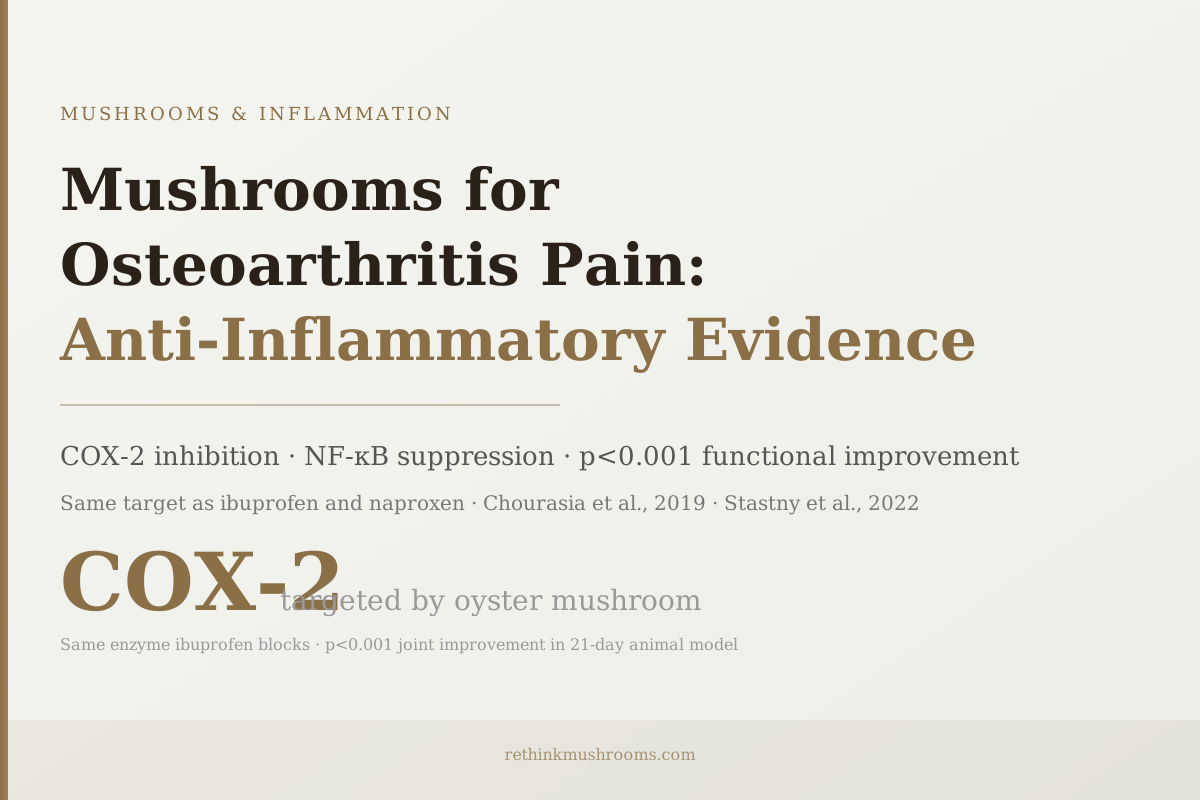
p<0.001 functional improvement
Chourasia et al. found oyster mushroom extract produced statistically significant decreases in paw volume, joint diameter, and pain behavior over 21 days in an arthritis animal model: functional outcomes, not just biomarker changes.
Chourasia et al., International Journal of Medicinal Mushrooms, 2019
COX-2
the enzyme oyster mushroom inhibits, the same target as ibuprofen and naproxen
NF-κB
the master inflammation switch oyster mushroom suppresses in all five Pleurotus species tested
43.3%
beta-glucan content (dry weight) of P. ostreatus Florida, associated with highest anti-inflammatory potency
Chourasia et al., International Journal of Medicinal Mushrooms, 2019
 View as image ↗
Most recommendations for "mushrooms for arthritis" treat rheumatoid arthritis and osteoarthritis as the same condition. They are not. Rheumatoid arthritis is an autoimmune disease where the immune system attacks joint tissue. Osteoarthritis is a degenerative joint disease driven by cartilage wear and the secondary inflammation that follows. Different diseases, different mechanisms, different mushrooms. This article focuses on osteoarthritis specifically, where oyster mushroom has the most mechanistically relevant preclinical data: COX-2 inhibition and NF-κB suppression in the same inflammation pathways that over-the-counter pain medications target. The evidence is preclinical, from animal models and cell studies. No human trials for mushrooms in OA exist yet. But the mechanistic overlap is specific enough to be worth understanding. This article is part of the broader guide to how mushrooms combat inflammation.
Key Takeaways
- Osteoarthritis (OA) is a degenerative disease driven by cartilage wear and COX-2-mediated secondary inflammation, not autoimmune activity; this makes oyster mushroom's COX-2 inhibition mechanistically well-matched to OA specifically
- Chourasia et al. (2019) found oyster mushroom extract produced significant (p<0.001) decreases in paw volume, joint diameter, and pain behavior over 21 days in an arthritis animal model; functional improvements, not just cytokine biomarkers[1]
- Stastny et al. (2022) tested five Pleurotus species and found all inhibited NF-κB and suppressed COX-2-driven prostaglandin E2 and nitric oxide production; P. ostreatus Florida had the highest activity (43.3% beta-glucan dry weight)[2]
- COX-2 is the enzyme that produces prostaglandins, the pain-signaling molecules that drive OA discomfort; NSAIDs (ibuprofen, naproxen) reduce pain by blocking COX-2; mushroom-derived beta-glucans and terpenoids inhibit the same enzyme
- Multiple fungal compounds target the OA inflammation pathway: beta-glucans suppress NF-κB, ergosterol reduces prostaglandin synthesis, and terpenoids inhibit histamine and cytokine production[3]
- The honest limitation: all existing mushroom and OA research is in cell cultures and animal models; no human clinical trials have tested mushrooms specifically for osteoarthritis outcomes
Osteoarthritis vs. Rheumatoid Arthritis: Why the Distinction Matters for Mushroom Selection
The difference between OA and RA is not just a matter of severity. They are different diseases operating through different biological mechanisms.
Osteoarthritis begins with the breakdown of cartilage, the smooth tissue that cushions joints. As cartilage wears away, the underlying bone is exposed, creating friction, pain, and swelling. The inflammation in OA is secondary to this mechanical damage: damaged cartilage cells release signals that trigger an inflammatory response, which in turn produces more enzymes that break down cartilage further. The primary mediators are prostaglandins, signaling molecules that activate pain receptors and promote swelling. The enzyme that produces them is COX-2.
Rheumatoid arthritis works differently. In RA, the immune system mistakenly identifies joint tissue as foreign and attacks it. The immune cells driving this attack release different mediators: tumor necrosis factor-alpha (TNF-α), interleukin-1β, and interleukin-6, cytokines that coordinate an autoimmune cascade. RA requires drugs that suppress immune activity. OA inflammation is prostaglandin-driven and responds to a different class of interventions.
This distinction matters enormously for mushroom selection. Reishi and Antrodia camphorata (Antcin K) have the most developed research for rheumatoid arthritis because their compounds target TNF-α and the autoimmune cascade. Oyster mushroom's research points in a different direction: COX-2 and NF-κB inhibition, which is specifically relevant to the prostaglandin-driven inflammation of OA.
For an overview of the broader arthritis landscape including both OA and RA, mushrooms for arthritis: can they reduce joint inflammation? covers both conditions. For the RA-specific evidence, mushrooms and rheumatoid arthritis: immune-modulating approaches goes into the Antcin K and Ganoderma RA research in depth.
Oyster Mushroom in an Arthritis Model: Functional Outcomes Over 21 Days
Chourasia and colleagues (2019) tested Pleurotus ostreatus extract in a standard arthritis animal model, specifically the Complete Freund's Adjuvant (CFA) model, which induces an inflammatory response in rats resembling the chronic joint inflammation and pain of arthritis.[1]
Over 21 days of treatment, the oyster mushroom extract group showed statistically significant (p<0.001) decreases in three functional measures: paw volume (swelling), joint diameter, and spontaneous pain behavior. Grip strength improved compared to arthritic controls that received no treatment.
The significance of functional outcomes rather than just biomarker changes deserves emphasis. Many anti-inflammatory studies measure cytokine levels or enzyme activity in isolated cells. Chourasia 2019 measured whether the animals could grip, whether their joints were physically less swollen, whether they showed less pain behavior. These are closer to the clinical question a person with OA would actually care about.
The model has limitations. CFA-induced arthritis in rats is a research tool, not a perfect replica of human OA. The inflammation in the CFA model is partially immune-mediated, which means the findings are not purely OA-relevant. But the functional improvement data, the dose-response, and the 21-day duration make this the most clinically informative preclinical data available for oyster mushroom and joint health.
The COX-2 Connection: Why This Mechanism Is Specifically Relevant to OA
The reason oyster mushroom's anti-inflammatory activity is particularly relevant to osteoarthritis comes down to one enzyme: COX-2.
COX-2, short for cyclooxygenase-2, is the enzyme responsible for producing prostaglandins, the signaling molecules that cause the pain, swelling, and stiffness characteristic of OA. When cartilage cells are damaged by mechanical stress, they release signals that upregulate COX-2. COX-2 then produces prostaglandins in the joint space. Those prostaglandins activate pain receptors, recruit inflammatory cells, and promote the release of more cartilage-degrading enzymes. This is the central loop of OA pain.
NSAIDs reduce OA pain by blocking COX-2. Ibuprofen, naproxen, and celecoxib are all COX-2 inhibitors. Their mechanism is the same as what the Stastny 2022 research demonstrated in oyster mushroom.
Stastny and colleagues tested extracts from five Pleurotus species in LPS-stimulated macrophages, cells primed to produce an inflammatory response.[2] All five species inhibited COX-2-mediated prostaglandin E2 production, one of the primary prostaglandins driving OA pain. All five also suppressed nitric oxide production, a secondary inflammatory mediator.
The species with the highest anti-inflammatory activity was P. ostreatus Florida, which also had the highest beta-glucan content at 43.3% of dry weight. The correlation between beta-glucan content and anti-inflammatory potency suggests beta-glucans are at least part of the active mechanism, though the relationship is not perfectly linear across all species tested.
The NF-κB finding in the same study adds another layer. NF-κB is a transcription factor, meaning it acts like a switch inside cells that turns on the genes responsible for producing inflammatory molecules including COX-2 itself. Oyster mushroom inhibited NF-κB in all five species tested. An NF-κB inhibitor works upstream of COX-2, potentially reducing not just one prostaglandin signal but the entire inflammatory gene activation cascade.
The Compounds Doing the Work: Beta-Glucans, Ergosterol, and Terpenoids
The anti-inflammatory activity of mushrooms is not produced by a single compound. Elsayed and colleagues' 2014 review mapped the anti-inflammatory compound landscape across fungal species, establishing which compound classes target which parts of the inflammation pathway.[3]
Beta-glucans, the structural polysaccharides in mushroom cell walls, suppress NF-κB and modulate the activity of macrophages and dendritic cells. Their anti-inflammatory effect comes through their interaction with Dectin-1 receptors on immune cells, which triggers signaling cascades that can reduce the expression of pro-inflammatory genes.
Ergosterol, the primary sterol in fungal membranes, reduces prostaglandin synthesis by inhibiting enzymes in the arachidonic acid pathway, the biochemical route that produces both prostaglandins and other inflammatory signaling molecules. Ergosterol is the precursor to ergocalciferol (vitamin D2) in UV-exposed mushrooms, but its anti-inflammatory activity is separate from any vitamin D effects.
Terpenoids found in mushrooms, including the ganoderic acids in Reishi and betulinic acid derivatives in Chaga, inhibit histamine release, cytokine production, and prostaglandin synthesis through several mechanisms. Oyster mushroom contains a different terpenoid profile than Reishi, but terpenoids as a class are broadly represented across edible mushroom species.
The practical implication: the anti-inflammatory activity of whole mushrooms is likely produced by multiple compounds acting in parallel on multiple points of the inflammation pathway, rather than a single mechanism. This is consistent with how culinary mushrooms as whole foods differ from isolated pharmaceutical compounds, and it makes the dose-response relationship more complex to characterize.
For a deeper analysis of how terpenoids versus polysaccharides hit different parts of the inflammation cascade, triterpenes vs. polysaccharides: different anti-inflammatory pathways covers the mechanistic comparison in detail.
The NSAID Parallel: Same Target, Different Source
NSAIDs are the standard OA pain medication for a reason: blocking COX-2 reliably reduces the prostaglandin-driven pain and swelling of OA. Approximately 30 million Americans take NSAIDs daily for chronic pain, including osteoarthritis. Long-term NSAID use carries meaningful risks: gastrointestinal bleeding, kidney stress, and cardiovascular effects with selective COX-2 inhibitors.
The mechanistic parallel between NSAID action and oyster mushroom's demonstrated COX-2 inhibition is worth stating directly. They work on the same enzyme. NSAIDs are pharmaceutical-grade COX-2 inhibitors developed through clinical trials demonstrating efficacy in human populations. Oyster mushroom's COX-2 inhibition is demonstrated in cell cultures and one animal model. These are not equivalent bodies of evidence, and the comparison is not a recommendation to replace NSAIDs with mushrooms.
But the parallel explains why the mushroom research is relevant to OA specifically, rather than to inflammation in general. Someone interested in whether dietary or supplemental choices could support their OA management will find the COX-2 connection more informative than a generic "mushrooms are anti-inflammatory" claim.
The distinction also suggests something about dose and context. NSAIDs require sustained therapeutic blood levels to maintain COX-2 inhibition. Mushroom compounds consumed as food or standard supplements do not achieve the same blood concentrations. Whether dietary levels of beta-glucans and ergosterol produce meaningful COX-2 inhibition in human joints is a question that has not been tested in clinical trials.
For the broader context on how mushrooms affect TNF-α, one of the central inflammatory signals relevant to joint conditions, mushrooms and TNF-alpha: reducing the master inflammatory signal covers the evidence in depth.
What the Evidence Can and Cannot Tell You
Three studies provide the evidentiary basis for mushrooms and osteoarthritis: Chourasia 2019 (functional outcomes in an arthritis animal model), Stastny 2022 (five-species mechanistic study), and Elsayed 2014 (compound-level framework). They establish a coherent mechanistic story and meaningful preclinical signals.
What they do not establish:
Effective dose in humans. Chourasia 2019 used oyster mushroom extract at a dose appropriate for a rat model. The equivalent human dose has not been determined. The beta-glucan content of commercial oyster mushroom supplements varies widely. What constitutes a pharmacologically relevant dose for COX-2 inhibition in humans is unknown.
Duration and sustained effects. The animal model ran 21 days. Long-term effects on joint function, cartilage integrity, or OA progression are not known.
Clinical outcomes in people with OA. Animal models and cell studies generate hypotheses. They do not confirm that the same effects occur in human cartilage, human synovial tissue, or in the presence of other medications. A randomized controlled trial in OA patients measuring pain, function, and joint biomarkers would be required to make that case.
Species equivalence. The Stastny 2022 study tested five Pleurotus species and found variation in potency within the same genus. Commercial "oyster mushroom supplements" vary enormously in which variety, growing conditions, extraction method, and beta-glucan content they contain.
The honest position: oyster mushroom is the most mechanistically plausible whole mushroom for osteoarthritis support based on its COX-2 and NF-κB inhibitory activity. The functional animal model data from Chourasia 2019 is more informative than biomarker-only studies. Human evidence does not yet exist. For a comparison between Reishi and Chaga's joint health evidence (which includes different mechanisms relevant to RA and hyperuricemia/gout), reishi and chaga for joint health: research review provides the species-by-species breakdown.
The Bottom Line
Osteoarthritis inflammation is driven primarily by COX-2 enzyme activity producing prostaglandins in damaged joint tissue. Oyster mushroom inhibits COX-2, prostaglandin E2 production, and NF-κB activation in five Pleurotus species tested (Stastny et al., 2022). Chourasia et al. (2019) demonstrated functional improvements in an arthritis animal model at p<0.001 over 21 days. The mechanistic overlap with NSAID action is specific and relevant to OA. Human clinical trials do not yet exist.
Frequently Asked Questions
Sources & References
- 1. Source details for this reference are not yet available.
- 2. Source details for this reference are not yet available.
- 3. Source details for this reference are not yet available.