Mushrooms & Inflammation
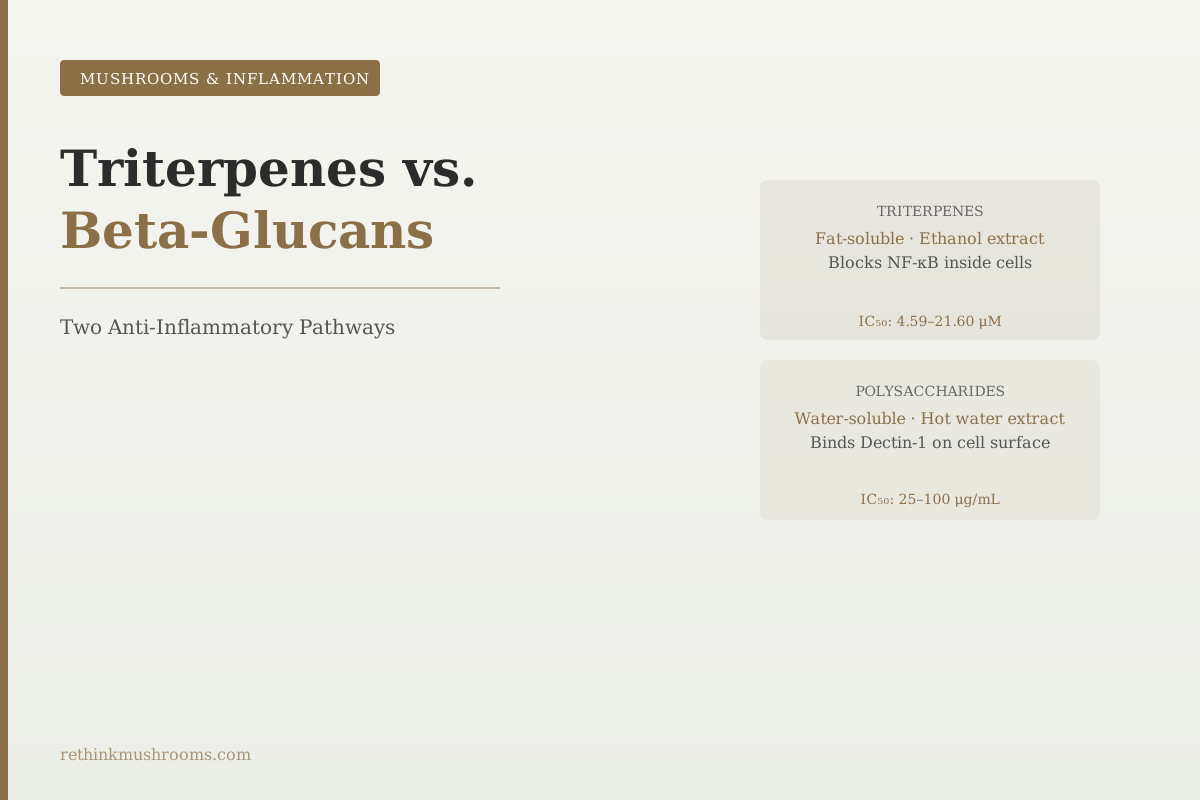
IC₅₀ 4.59–21.60 μM: triterpene anti-inflammatory potency range
Purified triterpenes from Ganoderma lucidum suppress the NF-κB inflammatory signaling pathway at concentrations of 4.59 to 21.60 μM, far lower than the μg/mL concentrations required for polysaccharide activity. These are the same mushroom, two different compound classes, operating through completely different cellular targets.
Dudhgaonkar et al., International Immunopharmacology, 2009
100+
distinct triterpenes identified in Ganoderma lucidum with anti-inflammatory activity
Dectin-1
the cell-surface receptor through which beta-glucan polysaccharides activate immune cells
CI 0.3–0.7
synergy index when triterpenes and polysaccharides are combined, indicating positive interaction
Dudhgaonkar et al., International Immunopharmacology, 2009
 View as image ↗
Reishi mushroom presents what looks like a contradiction: its polysaccharides can activate immune cells and upregulate cytokine production, while its triterpenes suppress the same cytokines and block inflammatory pathways. Both effects are real, well-documented, and occurring in the same mushroom. The explanation is that these two compound classes work through completely separate mechanisms, hitting different molecular targets through different routes. Mushroom triterpenes vs polysaccharides anti-inflammatory research is not a debate about which is better. It is a description of two parallel pharmacological systems that happen to coexist in the same organism. Understanding the difference shapes everything from which extraction method captures which compounds to why combining both classes shows stronger effects than either alone. For the broader picture of how medicinal mushrooms address inflammation, see How Mushrooms Fight Inflammation: NF-kB, COX-2, and Beyond.
Key Takeaways
- Triterpenes fight inflammation by directly entering cells and blocking the NF-κB and MAPK signaling pathways, acting at concentrations of 4.59 to 21.60 μM (Dudhgaonkar 2009); this is the same target as the anti-inflammatory drug class that includes ibuprofen's upstream mechanism
- Polysaccharides (beta-glucans) act through a completely different route: they bind Dectin-1 receptors on the outside of immune cells, triggering a regulated cytokine response that first activates immune surveillance, then modulates the inflammatory response
- Not all beta-glucans produce the same immune activation; the branching pattern of the polysaccharide backbone determines its receptor-binding potency, which is why structure matters as much as quantity (Okazaki 1995)
- The downstream targets of NF-κB suppression (COX-2 and iNOS) produce the inflammatory mediators prostaglandin E2 and nitric oxide respectively; mushroom triterpenes reduce both by blocking their transcription factor (Hseu 2005)
- Oral polysaccharides survive digestion in active form: beta-glucans from Pleurotus pulmonarius administered orally to mice significantly reduced acute colitis inflammation, confirming that anti-inflammatory effects are not limited to injected or topical preparations (Lavi 2010)
- Triterpenes are fat-soluble and extract in ethanol; polysaccharides are water-soluble and extract in hot water; a single-solvent product captures one class but not both
The Two-Pathway Framework: Mushroom Triterpenes vs. Polysaccharides Anti-Inflammatory
The most comprehensive cross-species analysis of mushroom anti-inflammatory compounds, Elsayed et al.'s 2014 review in Mediators of Inflammation, establishes this cleanly: different compound classes in medicinal mushrooms target different components of the inflammatory cascade through different mechanisms.[3] The two most pharmacologically active classes are triterpenes and polysaccharides, and they are worth treating as distinct pharmacological agents rather than interchangeable "active compounds."
| Triterpenes | Polysaccharides (beta-glucans) | |
|---|---|---|
| Solubility | Fat / alcohol | Water |
| Primary receptor | None: enters cells and blocks intracellular signaling | Dectin-1 on macrophage surface |
| Primary mechanism | Suppresses NF-κB, MAPK pathway activation | Activates macrophage via TLR-2/Dectin-1 → cytokine regulation |
| Net effect | Reduces inflammatory protein production | Modulates immune response; can suppress overactive inflammation |
| Active concentration | 4.59–21.60 μM (IC₅₀, triterpenes) | 25–100 μg/mL (IC₅₀, polysaccharides) |
| Rich source mushrooms | Reishi, Chaga, Antrodia | Turkey tail, shiitake, oyster |
Triterpenes: Fat-Soluble Compounds That Block the Inflammatory Switch Directly
Triterpenes are a class of fat-soluble compounds found across multiple medicinal mushroom species, most concentrated in reishi (Ganoderma lucidum), chaga (Inonotus obliquus), and Antrodia camphorata. Ganoderma alone contains more than 100 distinct triterpene variants, mostly ganoderic acids built on a lanostane carbon scaffold.
The inflammation mechanism they suppress is NF-κB, a protein complex that functions as a master switch for inflammatory gene expression. When a cell receives a stress signal, NF-κB moves from the cytoplasm into the cell nucleus and switches on production of inflammatory proteins including COX-2, iNOS, TNF-α, and several interleukins. This is the same signaling cascade that NSAIDs like ibuprofen target downstream, but mushroom triterpenes block a more upstream step.
Dudhgaonkar et al. (2009) purified triterpenes from G. lucidum and tested them directly against this pathway in macrophage cell cultures.[1] They found suppression of NF-κB-DNA binding activity: the NF-κB protein was prevented from attaching to the nuclear DNA sequences that activate inflammatory genes. The specific step inhibited was p65 phosphorylation: a chemical modification that NF-κB must undergo to enter the nucleus. Block this, and inflammatory gene transcription stops.
The IC₅₀ values (the concentration at which 50% of inflammatory activity is inhibited) ranged from 4.59 to 21.60 μM across the different purified triterpene fractions. This is a meaningful potency range at a cellular level, though converting these concentrations to effective supplement doses in living humans requires much more research.
Polysaccharides: Compounds That Activate and Then Regulate Immunity
Beta-glucan polysaccharides work through a fundamentally different mechanism. Rather than entering cells and blocking intracellular signaling, they bind to receptor proteins on the outside of immune cells.
The primary receptor is Dectin-1, a pattern recognition receptor on the surface of macrophages, dendritic cells, and neutrophils. Dectin-1 evolved to detect the beta-glucan signature of fungal cell walls, an ancient immune detection system. When a beta-glucan molecule binds Dectin-1, it triggers a signaling cascade inside the macrophage that results in cytokine production, immune cell activation, and enhanced pathogen clearance.
Lee et al.'s 2014 review in the Journal of Immunology Research traces this pathway in detail.[2] The Dectin-1 activation ultimately also engages NF-κB, but in an immune-activating context, not a pro-inflammatory one. The distinction matters: polysaccharides activate the macrophage's production of cytokines that coordinate immune surveillance (including some pro-inflammatory ones), and the macrophage then regulates the overall response through a cytokine balance mechanism. This is why polysaccharides are described as immunomodulatory: they don't simply suppress all inflammation, they activate the immune system in a way that allows it to regulate itself.
This explains the apparent paradox in reishi's dual action: its polysaccharides activate macrophages through Dectin-1, while its triterpenes suppress the downstream inflammatory amplification those macrophages might otherwise trigger. Two compounds, same mushroom, opposite directions on the same pathway, but operating at different stages and for different net purposes.
Not All Beta-Glucans Work the Same Way
The polysaccharide mechanism is not equally effective for all beta-glucan sources. The structural details of the polysaccharide molecule determine how well it binds Dectin-1 and triggers the immune cascade.
Okazaki et al. (1995) published foundational structure-activity relationship data for beta-1,3-D-glucans and their ability to stimulate cytokine production from macrophages.[4] Their finding: the branching pattern of the glucan backbone is the critical variable. Linear beta-glucans show less activity than branched ones; specific branching frequencies at β-1,6 positions produce higher macrophage activation. The degree of polymerization (chain length) also affects potency.
The practical implication is that "beta-glucan content" on a supplement label does not tell you whether the beta-glucan in that product has the branching structure needed for Dectin-1 activation. Two products with identical beta-glucan percentages can have very different pharmacological activity depending on the source mushroom species, the growth conditions, and the extraction method. For more detail on how specific mushroom polysaccharide structures vary by species, see Reishi Bioactive Compounds: Triterpenes, Polysaccharides, and Sterols.
Downstream Targets: What COX-2 and iNOS Actually Do
The direct target that triterpenes suppress, NF-κB, does not cause inflammation directly. It is a transcription factor that switches on genes for proteins that do. Two of the most important are COX-2 and iNOS.
COX-2 (cyclooxygenase-2) produces prostaglandin E2, the prostaglandin most responsible for the pain, heat, swelling, and redness of acute inflammation. This is the same enzyme that NSAIDs like ibuprofen and naproxen directly inhibit.
iNOS (inducible nitric oxide synthase) produces nitric oxide, which in high concentrations is pro-inflammatory and damaging to surrounding tissue. Chronic iNOS activation is associated with inflammatory tissue damage in conditions like colitis and rheumatoid arthritis.
Hseu et al. (2005) demonstrated that Antrodia camphorata, a mushroom with high triterpene content, inhibits both iNOS and COX-2 through NF-κB pathway suppression in macrophage cells.[5] By blocking NF-κB, the mushroom extract reduces the transcription of both enzymes simultaneously, rather than inhibiting COX-2 directly as NSAIDs do. This upstream approach means both prostaglandin and nitric oxide production fall together.
Do Polysaccharides Survive Oral Administration?
One practical concern with polysaccharide anti-inflammatory effects is whether the compounds survive digestion in active form. Most mechanism studies use cell culture or injection models where bioavailability is not an issue.
Lavi et al. (2010) specifically tested oral polysaccharide administration in a mouse model of acute colitis induced by dextran sulfate sodium.[6] Beta-glucans from Pleurotus pulmonarius (an oyster mushroom species) were administered orally and significantly reduced colitis-associated inflammation. Inflammatory markers including MPO activity, COX-2 expression, and cytokine levels all fell in the treated group. The oral administration route confirms that polysaccharide anti-inflammatory effects are not limited to injected or topical preparations. The polysaccharides are either partially absorbed or their prebiotic fermentation products reach systemic circulation through gut-mediated pathways.
For the broader picture of how mushroom polysaccharides work in the gut microbiome context, see How Mushrooms Modulate Inflammatory Cytokines.
Cross-Species Comparison: Which Mushrooms Prioritize Which Class?
Both compound classes exist in most medicinal mushrooms, but their relative concentrations vary significantly by species.
Reishi (Ganoderma lucidum) contains both classes prominently, making it one of the most pharmacologically complex species for the anti-inflammatory question. Its polysaccharide content runs approximately 25–35% of dry weight; its triterpene content runs approximately 1–3%, but those triterpenes include 100+ distinct variants with individual activities at low concentrations.
Turkey tail (Trametes versicolor) derives its primary pharmaceutical significance from polysaccharides. PSK and PSP are protein-bound beta-glucan fractions; the species' triterpene content is relatively low compared to reishi. The majority of the clinical evidence base for turkey tail is consequently about immune modulation rather than direct NF-κB suppression.
Chaga (Inonotus obliquus) contains significant ergosterol peroxide (a sterol compound) and betulinic acid derivatives (triterpene-related) alongside polysaccharides. Its anti-inflammatory activity is documented across both compound classes.
Elsayed et al.'s 2014 review confirms that the multi-compound, multi-pathway nature of mushroom anti-inflammatory activity is not peculiar to one or two species but characterizes the pharmacological category as a whole.[3]
Practical Implications: Why a Single Extraction Cannot Capture Both
The solubility difference between triterpenes and polysaccharides creates a direct consequence for how supplements are made and what they contain.
Triterpenes are fat-soluble. They dissolve in ethanol (alcohol) but not in water. Hot-water extraction, which is the standard method for most mushroom teas and many capsule products, does not effectively extract triterpenes.
Polysaccharides are water-soluble. Hot-water extraction captures beta-glucans efficiently. Ethanol extraction may degrade or not adequately capture polysaccharides.
A product using only hot-water extraction delivers polysaccharides but misses triterpenes, getting the Dectin-1 immune pathway but not the NF-κB suppression pathway. A product using only ethanol extraction gets triterpenes but misses the beta-glucan immune modulation. Dual extraction (hot water plus ethanol, combined) captures both classes and makes both mechanisms available.
The synergistic interaction between the two classes has been demonstrated at the combination index (CI) level. CI values of 0.3 to 0.7 indicate positive synergy: the combined anti-inflammatory effect exceeds what would be predicted from adding the two effects separately. This is the mechanistic basis for the claim that whole-mushroom dual extracts outperform single-compound preparations for anti-inflammatory purposes.
The Bottom Line
Mushroom triterpenes and polysaccharides fight inflammation through fundamentally different mechanisms. Triterpenes directly suppress NF-κB and MAPK signaling inside cells at low concentrations (IC₅₀ 4.59–21.60 μM), reducing COX-2 and iNOS expression. Polysaccharides bind Dectin-1 receptors on immune cell surfaces, activating macrophages through TLR-2/Dectin-1 signaling that regulates cytokine production. Not all beta-glucans are equally effective; branching structure determines Dectin-1 binding potency (Okazaki 1995). Oral polysaccharides survive digestion and produce anti-inflammatory effects in vivo (Lavi 2010). Combining both compound classes shows synergistic CI values of 0.3–0.7, which explains why dual-extraction products capturing both classes outperform single-solvent preparations.
Frequently Asked Questions
Sources & References
- 1RTHM-00152·Dudhgaonkar, Shailesh et al. (2009). “Suppression of the inflammatory response by triterpenes isolated from the mushroom Ganoderma lucidum..” International immunopharmacology.Study breakdown →PubMed →↩
- 2RTHM-00333·Lee, Dong Hee et al. (2014). “Innate immunity induced by fungal β-glucans via dectin-1 signaling pathway..” International journal of medicinal mushrooms.Study breakdown →PubMed →↩
- 3RTHM-00590·Elsayed, Elsayed A et al. (2014). “Mushrooms: a potential natural source of anti-inflammatory compounds for medical applications..” Mediators of inflammation.Study breakdown →PubMed →↩
- 4RTHM-00017·Okazaki, M et al. (1995). “Structure-activity relationship of (1-->3)-beta-D-glucans in the induction of cytokine production from macrophages, in vitro..” Biological & pharmaceutical bulletin.Study breakdown →PubMed →↩
- 5RTHM-00079·Hseu, You-Cheng et al. (2005). “Anti-inflammatory potential of Antrodia Camphorata through inhibition of iNOS, COX-2 and cytokines via the NF-kappaB pathway..” International immunopharmacology.Study breakdown →PubMed →↩
- 6RTHM-00190·Lavi, Iris et al. (2010). “Orally administered glucans from the edible mushroom Pleurotus pulmonarius reduce acute inflammation in dextran sulfate sodium-induced experimental colitis..” The British journal of nutrition.Study breakdown →PubMed →↩