Mushrooms & Inflammation
TNF-α + IL-6 + IL-1β
Multiple mushroom species suppress the three major pro-inflammatory cytokines in macrophage cell models; two human RCTs show measurable immune marker changes in living people.
Alhallaf & Perkins, Molecules, 2022; Dai et al., J Am Coll Nutr, 2015
Lima 2012 RCT
elderly women: Agaricus blazei significantly modulated inflammatory mediators in humans
Dai 2015 RCT
healthy adults: daily shiitake reduced CRP and improved immune cell profiles in 4 weeks
IL-10 upregulation
beta-glucan/Dectin-1 pathway also increases anti-inflammatory cytokines (Lee 2014)
Alhallaf & Perkins, Molecules, 2022; Dai et al., J Am Coll Nutr, 2015
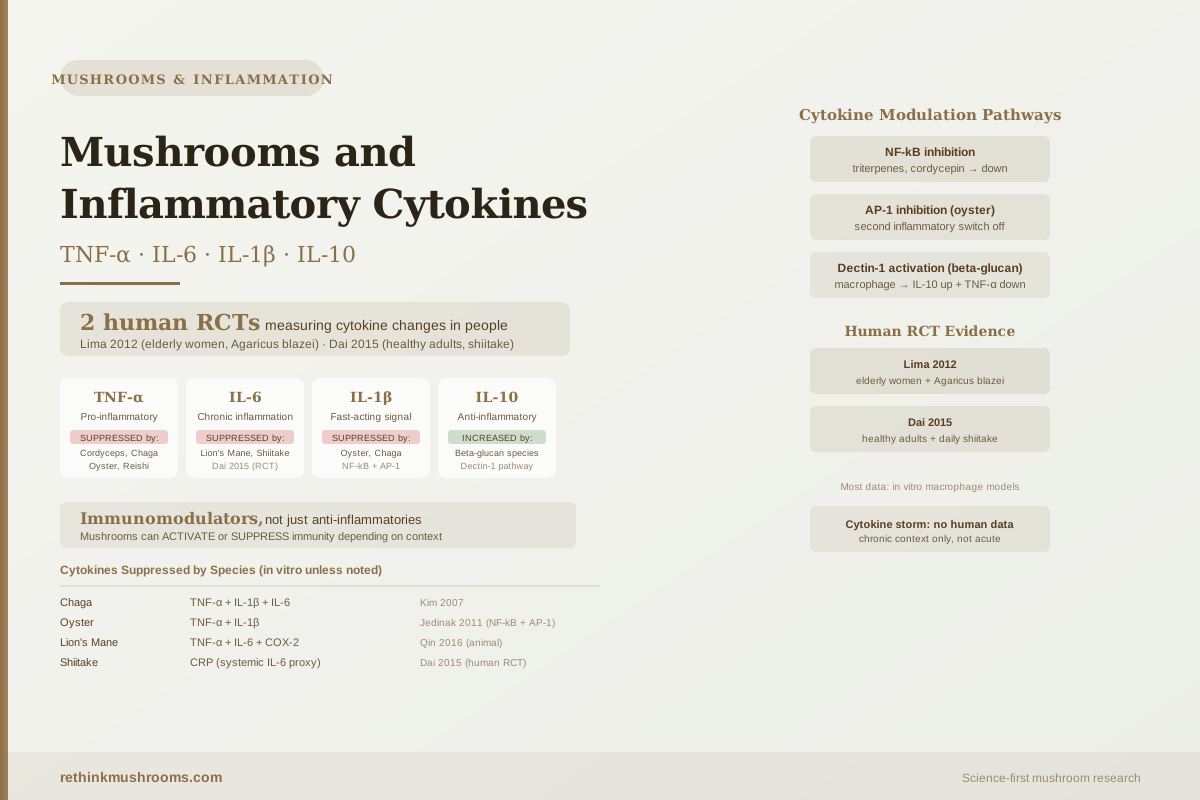 View as image ↗
When researchers measure how mushrooms affect inflammation in living systems, they rarely find a single cytokine going down. They find a pattern: pro-inflammatory signals like TNF-alpha, IL-6, and IL-1beta decrease, while anti-inflammatory regulators like IL-10 increase. This dual action is the clearest evidence that medicinal mushrooms function as immunomodulators — substances that balance immune activity — rather than simply acting as anti-inflammatory suppressants.
This article is part of the Mushrooms and Inflammation cluster. For the full pathway-level mechanisms including NF-kB, COX-2, and the two major compound classes, see How Mushrooms Fight Inflammation: NF-kB, COX-2, and Beyond.
Not medical advice. The research described here is preclinical and preliminary human data. Nothing in this article should be interpreted as guidance for treating, preventing, or managing any medical condition. Consult a qualified healthcare provider before using mushroom supplements, especially if you have an immune or inflammatory condition or take immunosuppressant medications.
Key Takeaways
- Medicinal mushrooms act as immunomodulators, both suppressing pro-inflammatory cytokines (TNF-alpha, IL-6, IL-1beta) and upregulating anti-inflammatory cytokines like IL-10
- Chaga (Inonotus obliquus) extracts inhibit LPS-induced TNF-alpha, IL-6, and IL-1beta production in RAW 264.7 macrophages, with effect varying by extraction method — ethanol/water and accelerated solvent extraction show the highest cytokine suppression (Alhallaf & Perkins, 2022)
- Oyster mushroom (Pleurotus ostreatus) inhibits TNF-alpha and IL-1beta production via dual suppression of NF-kB AND AP-1 — two separate transcription factors (Jedinak et al., 2011)
- Human RCT evidence is sparse but real: Lima 2012 (elderly women, Agaricus blazei) and Dai 2015 (healthy adults, shiitake) are the two most-cited RCTs showing human cytokine and immune marker changes
- The Dai 2015 shiitake RCT picture is more complex than commonly reported: CRP decreased (indicating lower systemic inflammation), but some cytokines including TNF-alpha and IL-1alpha actually increased — consistent with immunomodulation rather than simple suppression
- The IL-10 upregulation angle is almost entirely absent from consumer content: beta-glucan activation of Dectin-1 receptors triggers a cytokine response that includes both pro-inflammatory signals and the regulatory IL-10 (Lee et al., 2014)
- Cytokine storm evidence is preclinical only — no human trial has tested mushrooms as an intervention for cytokine dysregulation in acute illness
What Cytokines Are and Why They Matter Here
Cytokines are signaling proteins that immune cells use to communicate. When tissue is damaged or infected, cells release pro-inflammatory cytokines — particularly TNF-alpha (tumor necrosis factor alpha), IL-6 (interleukin-6), and IL-1beta — to recruit more immune cells and amplify the inflammatory response. This is useful in acute infections. In chronic conditions, the same signals become destructive when they're active without a real threat to respond to.
Anti-inflammatory cytokines like IL-10 work in the opposite direction — they dampen immune activity and are part of how the body ends an inflammatory episode. A healthy inflammatory response involves both types working in concert: pro-inflammatory cytokines activate, anti-inflammatory ones regulate, and the system returns to baseline.
Mushroom research measures cytokine changes as a proxy for anti-inflammatory or immunomodulatory activity. A meaningful result shows not just decreased TNF-alpha but an accompanying picture of how other cytokines shift.
TNF-Alpha: The Upstream Signal Most Mushrooms Target
TNF-alpha is the master pro-inflammatory cytokine — one of the first signals released when immune cells detect a threat, and the target of several major immunosuppressant drugs (the TNF inhibitor class used for rheumatoid arthritis and inflammatory bowel disease).
Multiple mushroom species suppress TNF-alpha production in macrophage cell models, typically by blocking the upstream NF-kB transcription factor that drives TNF-alpha gene expression.
Cordyceps: Kim and colleagues (2006) showed that cordycepin, the primary bioactive compound in Cordyceps, inhibits LPS-induced TNF-alpha production in RAW 264.7 macrophages through upstream blockade of both Akt and p38 MAPK — the kinases that activate NF-kB. Suppressing both kinases simultaneously means NF-kB cannot be activated even if one pathway is available.[1]
Chaga: Multiple Chaga (Inonotus obliquus) extracts inhibit LPS-induced TNF-alpha, IL-6, and IL-1beta production in RAW 264.7 macrophages. Alhallaf and Perkins (2022) systematically compared extraction methods and found that the inhibitory effect varies significantly depending on how the extract is prepared — ethanol/water and accelerated solvent extraction showed the highest cytokine suppression, while aqueous tea infusions showed more modest activity.[8] Earlier work by Kim and colleagues (2007) established that Chaga ethanol extract suppresses NF-kB activation through the PI3K/Akt/IkB pathway and JNK inhibition, providing the upstream mechanism for cytokine suppression.[5]
Oyster mushroom: Jedinak and colleagues (2011) found that oyster mushroom (Pleurotus ostreatus) extract reduced TNF-alpha and PGE2 in LPS-stimulated macrophages through a mechanism that targets both NF-kB and AP-1 — two distinct inflammatory transcription factors. Suppression of both pathways makes the oyster mushroom data unusual, since most mushroom studies demonstrate activity on only one.[2]
For context on these mechanisms in relation to each other, see Triterpenes vs. Polysaccharides: Different Anti-Inflammatory Pathways.
IL-6: The Chronic Inflammation Marker
IL-6 is elevated in virtually every major chronic inflammatory condition — rheumatoid arthritis, type 2 diabetes, cardiovascular disease, depression, and many cancers all show elevated baseline IL-6. It's also one of the better-measured markers in human clinical studies, which is why it appears in the few mushroom RCTs that exist.
Lion's Mane: Qin and colleagues (2016) tested H. erinaceus ethanol extract in a mouse model of ulcerative colitis, finding significant reductions in TNF-alpha, IL-1beta, and IL-6 in colon tissues (alongside oxidative stress markers).[6] This data is notable because it demonstrates anti-inflammatory activity in Lion's Mane that is separate from — and largely ignored by — the species' more prominent neurological profile. Lion's Mane research tends to focus on cognitive effects; the GI anti-inflammatory data is a parallel activity that most consumer content doesn't discuss.
Shiitake (human RCT): The Dai 2015 randomized dietary intervention enrolled healthy young adults who ate shiitake mushrooms (Lentinula edodes) daily for 4 weeks. At the end of the trial, participants showed measurably reduced C-reactive protein (CRP — the clinical proxy for systemic inflammation) alongside increased NK cell and T-cell activity.[4] Notably, IL-6 itself did not significantly change in this trial — the CRP reduction reflects systemic inflammatory tone rather than a direct IL-6 effect. This distinction matters for interpreting the result accurately.
IL-1β: Fast-Acting Inflammation Signal
IL-1beta operates on a shorter timescale than IL-6 — it is one of the first cytokines produced after tissue injury or infection, and it amplifies the inflammatory response rapidly. It also triggers fever, which is why IL-1beta blockers (like anakinra) are used in acute inflammatory conditions.
The oyster mushroom Jedinak 2011 data showed significant IL-1beta suppression alongside TNF-alpha reduction, with the dual NF-kB/AP-1 blockade providing the mechanism.[2]
The Alhallaf 2022 Chaga data similarly documented IL-1beta suppression alongside TNF-alpha and IL-6, making Chaga one of the few mushrooms with specific quantitative data across all three of the major pro-inflammatory cytokines in a single comparative study design.[8]
The Other Direction: Why Mushrooms Also Raise IL-10
Consumer content about mushroom anti-inflammatory properties almost always frames the story as: pro-inflammatory cytokines go down. What gets left out is the complementary signal: anti-inflammatory cytokines go up.
IL-10 is a regulatory cytokine that down-regulates the entire pro-inflammatory cascade. When immune cells produce IL-10, they signal the immune system to stop amplifying the response. IL-10 production is part of how inflammation resolves normally, and its absence or insufficiency is associated with chronic inflammatory conditions.
The mechanism for IL-10 upregulation in mushroom research runs through beta-glucan activation of Dectin-1 receptors. When beta-glucan binds to Dectin-1 on macrophages and dendritic cells, the resulting signaling cascade produces both pro-inflammatory cytokines (NF-kB-mediated TNF-alpha, IL-6) AND anti-inflammatory regulators (including IL-10).[7]
This dual response is exactly what "immunomodulation" means in practice. The net effect on inflammation depends on context: in an underactive immune system, the activation signal dominates and immunity is enhanced. In an overactive inflammatory state, the IL-10 regulatory signal provides a corrective counterweight. This context-dependence is why describing mushrooms as simply "anti-inflammatory" misses what the pharmacology actually shows.
The Human Evidence: What Lima 2012 and Dai 2015 Actually Measured
The majority of cytokine research on medicinal mushrooms is in vitro — macrophage cells in a dish stimulated with LPS to mimic bacterial infection. These studies establish mechanism but don't tell us what happens in a human body taking a supplement.
Two randomized controlled trials provide the closest available human evidence.
Lima 2012 tested Agaricus blazei Murrill extract in elderly women in a randomized clinical trial design.[3] Elderly populations are relevant because aging is associated with elevated baseline inflammatory cytokines (a state called inflammaging), making this population both higher-risk and potentially more responsive to cytokine-modulating interventions. The trial found significant modulation of inflammatory mediators — direct human cytokine measurement, not an in vitro proxy.
Lima et al. (2012) · Scandinavian Journal of Immunology
- Population
- Elderly women (randomized clinical trial design)
- Intervention
- Agaricus blazei Murrill extract (oral supplementation)
- Comparator
- Placebo or control group
- Finding
- Significant modulation of inflammatory mediators — direct human cytokine measurement in an aging population with elevated baseline inflammation
positive Notable for measuring cytokine changes directly in humans, not cell culture. Elderly population with elevated baseline inflammation (inflammaging) may be particularly responsive.
Lima et al., 2012, Scand J Immunol
Dai 2015 took a food-based approach: healthy young adults ate standardized amounts of shiitake mushrooms daily for four weeks in a randomized dietary intervention.[4] The outcomes included CRP, NK cell activity, and T-cell proliferation. CRP decreased and immune cell function improved — results applicable to a dietary recommendation context. The cytokine picture, however, was more complex: IL-6 and IL-1beta did not significantly change, while TNF-alpha and IL-1alpha levels actually increased. This is consistent with immunomodulation — not suppression across the board — where shiitake activated certain immune pathways while reducing systemic inflammatory tone (CRP).
Dai et al. (2015) · Journal of the American College of Nutrition
- Population
- 52 healthy adults aged 21–41 years
- Intervention
- 5g or 10g whole dried shiitake (Lentinula edodes) daily for 4 weeks
- Comparator
- Baseline (within-person comparison)
- Finding
- Reduced CRP and increased NK cell / T-cell activity. IL-6 and IL-1β unchanged; TNF-α and IL-1α increased — a mixed cytokine picture consistent with immune activation, not pure suppression.
mixed This is a food-based RCT using real dietary amounts, not concentrated extract — makes results applicable to regular mushroom consumption. The mixed cytokine profile shows immune activation alongside reduced systemic inflammation.
Dai et al., 2015, J Am Coll Nutr
These two RCTs don't establish a definitive clinical effect — both are limited in scale and neither was powered for a specific clinical outcome. But they do provide genuine human evidence that cytokine-level effects observed in cell studies translate, at some level, to measurable changes in living people.
- Cell culture (in vitro)completed
Strong mechanistic data: Cordyceps cordycepin (NF-kB via Akt/p38), Chaga (NF-kB via Akt/JNK; TNF-α/IL-6/IL-1β suppression), oyster mushroom (NF-kB + AP-1 dual inhibition), Lion's Mane (TNF-α/IL-6 in colitis model). Multiple species, multiple studies.
- Animal studiescompleted
Lion's Mane (Qin 2016, mouse colitis model: TNF-α and IL-6 reduced in colon tissue). Confirms cell study mechanisms in a living system.
- Human RCTs (small scale)current
Lima 2012 (elderly women, Agaricus blazei): significant cytokine modulation. Dai 2015 (52 healthy adults, shiitake 4 weeks): reduced CRP, immune cell improvements, but mixed cytokine picture. Both limited in scale.
- Large powered RCTs (n>200)missing
No large randomized controlled trials have tested any mushroom species for cytokine-specific endpoints in humans.
- Systematic review / meta-analysismissing
No meta-analysis exists for mushroom cytokine modulation in humans. Preclinical meta-analyses exist for specific compounds (e.g., Ganoderma triterpenes).
The mushroom cytokine field has solid mechanistic foundations in cell and animal studies, and two human RCTs confirming measurable immune changes. The gap between where the evidence stands (small trials) and definitive clinical guidance (large powered RCTs) remains significant.
Multiple studies as cited above
The Cytokine Storm Question: What the Evidence Actually Allows Us to Say
"Cytokine storm" became a widely searched term during the COVID-19 pandemic, when dysregulated inflammatory cytokine production was identified as a driver of severe outcomes. The question of whether mushrooms might help prevent or treat cytokine storm follows logically from the cytokine suppression data above.
The honest answer is that the evidence doesn't support that claim.
The cytokine storm in severe illness is an acute, systemic, and often catastrophic response involving rapid multi-cytokine dysregulation. The mushroom cytokine data exists in cell culture models and, in the human trials, in chronic low-grade inflammation contexts — elderly women and healthy young adults over weeks of regular mushroom consumption. These are fundamentally different situations from acute cytokine storm.
There are no controlled trials of any mushroom preparation as an intervention in cytokine storm, cytokine release syndrome, or acute inflammatory dysregulation in humans. The Lee 2014 Dectin-1 data showing both pro- and anti-inflammatory cytokine responses from beta-glucan activation[7] actually suggests that in a context where the immune system is already dangerously over-activated, activating macrophages further through beta-glucan stimulation could be counterproductive.
The cytokine data for mushrooms supports the claim that they modulate inflammatory signaling in chronic, low-grade contexts. It does not support claims about acute dysregulation in ill patients.
The Bottom Line
Medicinal mushrooms modulate inflammatory cytokines through two mechanisms: direct suppression of pro-inflammatory signals (TNF-alpha, IL-6, IL-1beta) via NF-kB and AP-1 pathway inhibition, and upregulation of the regulatory cytokine IL-10 through beta-glucan/Dectin-1 activation. The cytokine data is mostly in vitro, but two human RCTs (Lima 2012 for Agaricus blazei in elderly women; Dai 2015 for shiitake in healthy adults) demonstrate that these effects translate to measurable changes in human immune markers — though the Dai 2015 picture is mixed, with CRP decreasing while some pro-inflammatory cytokines increased, consistent with immunomodulation rather than simple suppression. Mushrooms function as immunomodulators — the direction of effect depends on context — not simply as cytokine suppressants.
Frequently Asked Questions
Sources & References
- 1RTHM-00103·Kim, Ho Gyoung et al. (2006). “Cordycepin inhibits lipopolysaccharide-induced inflammation by the suppression of NF-kappaB through Akt and p38 inhibition in RAW 264.7 macrophage cells..” European journal of pharmacology.Study breakdown →PubMed →↩
- 2RTHM-00219·Jedinak, Andrej et al. (2011). “Anti-inflammatory activity of edible oyster mushroom is mediated through the inhibition of NF-κB and AP-1 signaling..” Nutrition journal.Study breakdown →PubMed →↩
- 3RTHM-00254·Lima, C U J O et al. (2012). “Agaricus blazei Murrill and inflammatory mediators in elderly women: a randomized clinical trial..” Scandinavian journal of immunology.Study breakdown →PubMed →↩
- 4RTHM-00368·Dai, Xiaoshuang et al. (2015). “Consuming Lentinula edodes (Shiitake) Mushrooms Daily Improves Human Immunity: A Randomized Dietary Intervention in Healthy Young Adults..” Journal of the American College of Nutrition.Study breakdown →PubMed →↩
- 5RTHM-00117·Kim, Ho-Gyoung et al. (2007). “Ethanol extract of Inonotus obliquus inhibits lipopolysaccharide-induced inflammation in RAW 264.7 macrophage cells..” Journal of medicinal food.Study breakdown →PubMed →↩
- 6RTHM-00442·Qin, Mingming et al. (2016). “Anti-Inflammatory Effects of Ethanol Extract of Lion's Mane Medicinal Mushroom, Hericium erinaceus (Agaricomycetes), in Mice with Ulcerative Colitis..” International journal of medicinal mushrooms.Study breakdown →PubMed →↩
- 7RTHM-00333·Lee, Dong Hee et al. (2014). “Innate immunity induced by fungal β-glucans via dectin-1 signaling pathway..” International journal of medicinal mushrooms.Study breakdown →PubMed →↩
- 8. Source details for this reference are not yet available.