Mushrooms & Inflammation
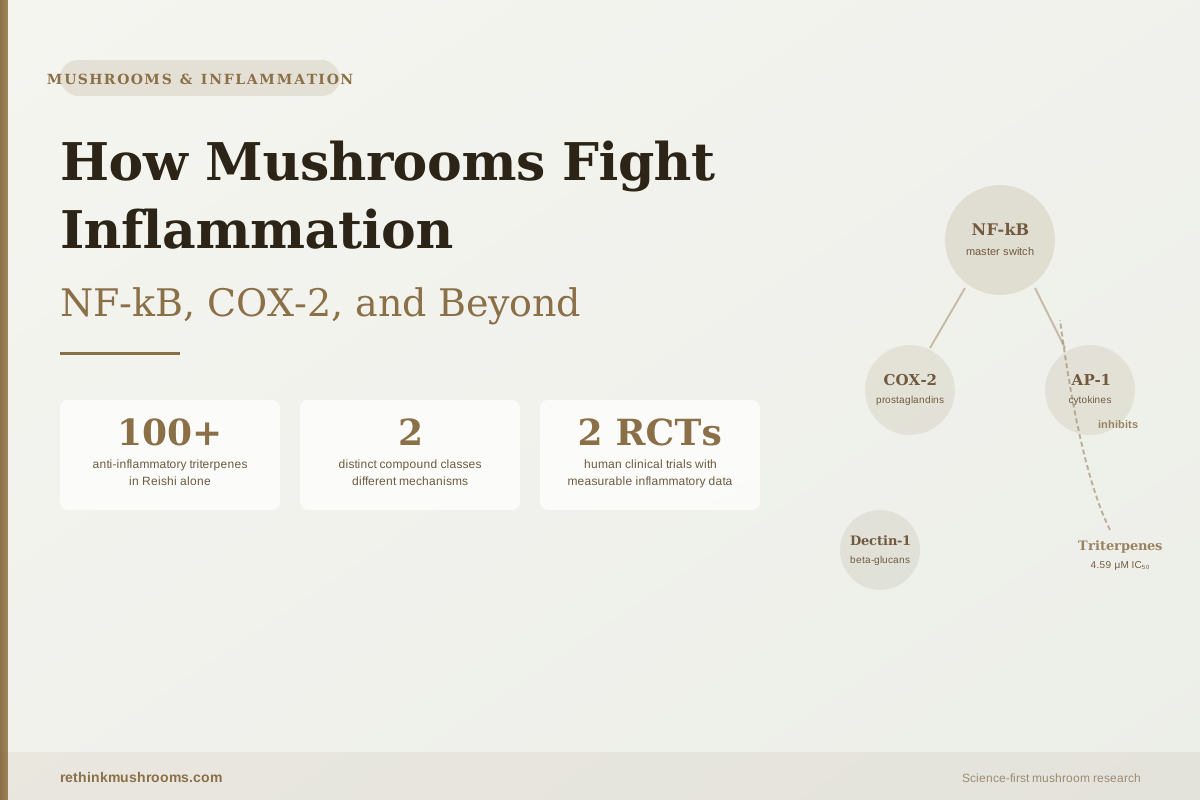
100+ anti-inflammatory triterpenes in a single mushroom species
A randomized trial found daily shiitake consumption for four weeks improved NK cell activity and reduced CRP in healthy adults, providing direct human evidence for mushroom immune modulation.
Dai et al., J Am Coll Nutr, 2015
2 Pathways
triterpenes and beta-glucan polysaccharides use completely different anti-inflammatory mechanisms
4.59 μM
lowest IC₅₀ potency measured for Reishi triterpenes blocking NF-kB activation
2 RCTs
human clinical trials testing mushroom compounds against measurable inflammatory markers
Dai et al., J Am Coll Nutr, 2015
 View as image ↗
In the same randomized study, volunteers eating shiitake daily for four weeks showed two changes at the same time. Their immune cells became more active, with NK cells and T-cells proliferating at higher rates. And their blood levels of CRP — a protein that rises during inflammation and falls when inflammation resolves — dropped. These are not contradictory findings. An immune system that is more capable overall is also better at regulating itself and shutting down unnecessary inflammatory activity.
That paradox is the key to understanding how mushrooms fight inflammation. Medicinal mushrooms are immunomodulators, not simple suppressors. A corticosteroid suppresses immune activity broadly. An NSAID blocks a specific enzyme to reduce inflammatory output. Mushroom compounds do something different: they engage the immune system's own regulatory machinery and adjust its output depending on context. To see how that works, you need to understand the two compound classes doing most of the work — and the very different molecular logic behind each of them.
Medicinal mushrooms fight inflammation primarily through two compound classes. Triterpenes (concentrated in Reishi and Chaga) directly suppress the NF-kB and MAPK signaling pathways. Beta-glucan polysaccharides bind Dectin-1 receptors on immune cells, triggering a regulated cytokine response that modulates both pro- and anti-inflammatory signals simultaneously. A 2014 cross-species review by Elsayed and colleagues mapped these compound classes — polysaccharides, triterpenes, phenolics, ergosterols, and fatty acids — to specific inflammatory pathways across dozens of mushroom species, establishing the multi-compound, multi-target nature of mushroom anti-inflammatory activity.[1]
Key Takeaways
- Reishi (Ganoderma lucidum) contains more than 100 distinct triterpenes with documented anti-inflammatory activity; the most potent show IC₅₀ values as low as 4.59 μM against NF-kB activation (Dudhgaonkar 2009)
- Cordycepin, the primary bioactive compound in Cordyceps, suppresses the inflammation master switch by blocking two upstream kinases simultaneously — both Akt and p38 MAPK — not just one (Kim 2006)
- Beta-glucan polysaccharides and triterpenes operate through completely different mechanisms: polysaccharides activate immune cells via the Dectin-1 receptor, while triterpenes directly suppress the inflammatory signaling cascade (Lee 2014, Dudhgaonkar 2009)
- Oyster mushroom suppresses both NF-kB and AP-1 — two separate inflammatory transcription factors — in the same preparation, covering more of the inflammation network than species that target only one (Jedinak 2011)
- Daily shiitake consumption for four weeks increased NK cell proliferation, improved T-cell activity, and reduced CRP levels in healthy young adults in a randomized dietary intervention (Dai 2015)
- Mushrooms are immunomodulators rather than pure anti-inflammatories — the same beta-glucan pathway that activates immune cells in one context can reduce chronic inflammatory marker levels in another
Two Compound Classes, Two Completely Different Mechanisms
The most common mistake in consumer content on mushrooms and inflammation is treating all species as interchangeable. Reishi's anti-inflammatory effects come primarily from its triterpene content. Shiitake's come primarily from its polysaccharides. Chaga hits both pathways. These are not minor variations on a shared mechanism. They are fundamentally different molecular strategies.
Elsayed and colleagues documented this in their 2014 review, cataloguing the compound diversity across species and mapping each class to distinct inflammatory targets.[1] The practical implication: an extract standardized for triterpene content and one standardized for beta-glucan content will behave differently in the body, even if both are described as "anti-inflammatory mushroom extracts."
The two main mechanisms deserve separate explanations. The triterpene pathway works by intercepting the cell's own inflammatory signaling. The polysaccharide pathway works by engaging receptor proteins on immune cells and then steering the immune response that follows. Both ultimately reduce inflammatory output, but through completely different routes.
For a detailed comparison of the two compound classes with potency data and evidence for synergistic effects, see Triterpenes vs. Polysaccharides: Different Anti-Inflammatory Pathways.
Two Compound Classes, One Endpoint
Opposite Molecular Logic, Same Result: Less Inflammation
Triterpenes and beta-glucans both lower inflammatory output, but they take opposite routes. Triterpenes suppress the NF-kB cascade directly. Beta-glucans activate immune cells first, then let the response self-regulate. Reading the two lanes side by side is the fastest way to see why "immunomodulator" fits mushrooms better than "anti-inflammatory."
Direct blockers intercept the cell’s own signal
Different compounds, one strategy — stop the cascade directly. Reishi triterpenes block NF-kB from binding DNA and phosphorylating p65; cordycepin (from Cordyceps) shuts down the upstream kinases Akt and p38 MAPK; oyster extract hits NF-kB plus a second switch, AP-1. All follow the "always down" logic of a classic anti-inflammatory.
Dudhgaonkar 2009 [3] (IC₅₀ 4.59–21.60 µM; >100 triterpenes) · Kim 2006 [2] (Akt + p38) · Jedinak 2011 [4] (NF-kB + AP-1) — all in vitro
Beta-glucans engage the immune system’s own controls
Concentrated in Shiitake, beta-1,3-glucans bind the Dectin-1 receptor and first activate immune cells. The sustained cytokine response that follows includes IL-10, an anti-inflammatory signal that guides the system back toward baseline — immunomodulation, not simple suppression.
Lee-Huang 2014 [5] (Dectin-1 / IL-10 signaling) · Dai 2015 [7] (shiitake RCT: ↓CRP, ↑NK/T-cell activity in healthy adults)
Every molecular step shown is established in cell studies. The only human evidence is two small randomized trials — Lima 2012 [6] (Agaricus blazei extract, elderly women) and Dai 2015 [7] (whole shiitake, healthy young adults) — in different species and populations. The dose-response relationship for these compounds in human tissue is not yet established.
Mechanism synthesis; arms from refs [2][3][4][5][7] (see references)
How Reishi's 100+ Triterpenes Shut Down the Master Inflammation Switch
Every cell has a protein that functions as a master switch for inflammation. When the cell detects a threat — bacteria, damaged tissue, a foreign molecule — this switch activates, moves into the cell nucleus, and turns on dozens of inflammation-related genes simultaneously. The genes it activates produce COX-2 (an enzyme that generates prostaglandins, which cause tissue swelling and pain), iNOS (which generates nitric oxide, another inflammatory signal), and cytokines like TNF-α and IL-1β that recruit more immune cells to the site. The switch is called NF-kB, short for nuclear factor kappa B.
Under normal circumstances, NF-kB activates briefly in response to a real threat, then shuts off as the threat resolves. In chronic inflammatory conditions, including arthritis, metabolic disease, and some cancers, the switch stays partly on. Low-level inflammatory output continues even without an active threat driving it.
Triterpenes from mushrooms interrupt this by targeting the molecules that activate NF-kB in the first place. Dudhgaonkar and colleagues tested purified triterpenes from Ganoderma lucidum (Reishi) in 2009 and found they suppressed NF-kB by doing two things: blocking the NF-kB protein from binding to DNA, and preventing phosphorylation (chemical activation) of p65, the specific component of the NF-kB complex that carries it into the nucleus.[3] In plain terms: the triterpenes stopped the switch from reaching the genes it was trying to turn on.
The potency data from that study is useful context. IC₅₀ values for Ganoderma triterpenes ranged from 4.59 to 21.60 μM. IC₅₀ is the concentration that reduces a given activity by 50 percent; lower values mean higher potency. The range indicates that different individual triterpenes within Reishi have different potency, with the most active ones effective at quite low concentrations in cell studies. Translating in vitro IC₅₀ values to effective human doses requires pharmacokinetic data that doesn't yet exist for most of these compounds.
Dudhgaonkar's group also identified more than 100 distinct triterpenes in Ganoderma lucidum with individual anti-inflammatory activities.[3] This is significant and rarely mentioned in consumer content: Reishi's triterpene fraction isn't a single compound. It's a library of structurally related molecules, each with slightly different potency and molecular target preferences. The complexity of that library is one reason researchers think whole-mushroom extracts may perform differently from isolated purified compounds.
Cordycepin Targets Two Switches Before NF-kB Even Activates
While Dudhgaonkar's work focused on blocking NF-kB after it had already been released, a 2006 study by Kim and colleagues showed that cordycepin — the primary anti-inflammatory compound in Cordyceps — works further upstream.[2]
To understand the difference, consider how NF-kB gets activated in the first place. In a resting cell, NF-kB is held in the cytoplasm (the cell's main body) by a protein called IkB, which acts as a kind of leash. When an inflammatory signal arrives, two enzyme proteins — Akt and p38 MAPK — become active. These enzymes chemically modify IkB in a way that releases the NF-kB, freeing it to travel to the nucleus. Think of it as a two-key system: both enzyme proteins have to activate before the inflammatory program proceeds.
Cordycepin blocks both keys. Kim's team exposed macrophages (a type of immune cell) to LPS, a bacterial component routinely used in laboratory settings to trigger an artificial inflammatory response, then tested whether cordycepin affected the inflammatory output. They found it suppressed NF-kB activation by inhibiting both Akt and p38 MAPK activity simultaneously.[2] The downstream result was reduced TNF-α, IL-6, and nitric oxide production.
The dual-kinase blockade is mechanistically notable. Most pharmaceutical NF-kB inhibitors target a single point in the cascade. Blocking two upstream enzymes creates a more complete interruption and reduces the probability that the inflammatory signal finds an alternative activation route. This is theoretical at the cell level; whether the dual-kinase mechanism confers any practical advantage in human tissue at achievable concentrations is unknown.
The "Beyond" Part: Oyster Mushroom Targets a Second Inflammatory Switch
NF-kB gets most of the attention in mushroom anti-inflammatory research, but it is not the only protein that controls the expression of inflammation genes. AP-1 (activator protein-1) is a second major inflammatory transcription factor — a protein that, when active, binds to DNA and turns on inflammation-related genes. In many inflammatory contexts, NF-kB and AP-1 work in parallel, reinforcing each other's effects.
Consumer content about mushrooms and inflammation almost universally focuses on NF-kB alone. The "beyond" in this article's title refers to AP-1, which Jedinak and colleagues specifically measured in a 2011 study on Pleurotus ostreatus (oyster mushroom) extract.[4]
Jedinak's team applied oyster mushroom extract to LPS-stimulated macrophages and measured four inflammatory markers: prostaglandin E2 (PGE2, generated by COX-2 and involved in fever and tissue swelling), nitric oxide, TNF-α, and IL-1β. The extract suppressed all four. When they examined the mechanism, they found simultaneous suppression of both NF-kB and AP-1 signaling.[4]
Why does covering both transcription factors matter? Because NF-kB and AP-1 have overlapping but non-identical sets of target genes. Some inflammation genes respond to NF-kB binding. Others respond to AP-1. Some respond to both. An agent that suppresses only NF-kB will leave the AP-1-controlled targets untouched. Oyster mushroom extract, in this cell study, hit both networks simultaneously.
This is an in vitro finding from macrophage cells in a laboratory dish. The mechanism is established at the cellular level. Whether it functions in human tissue at concentrations achievable through oral consumption remains untested.
How Beta-Glucan Polysaccharides Work: Activation First, Regulation Second
Here is the finding that surprises most people who have read standard consumer content on mushrooms and inflammation: beta-glucan polysaccharides do not start by suppressing inflammation. They start by activating immune cells. The anti-inflammatory regulation comes second.
This mechanism was laid out in a 2014 review by Lee-Huang and colleagues on Dectin-1 signaling, the receptor pathway that beta-glucans use to engage the immune system.[5]
Dectin-1 is a detection receptor on the surface of macrophages, dendritic cells, and other immune cells. Its biological purpose is to recognize the cell wall components of fungi — specifically beta-1,3-glucan structures that are characteristic of fungal organisms. When beta-glucan polysaccharides from mushrooms encounter a Dectin-1 receptor, the immune cell activates. It begins producing cytokines (the chemical messengers that coordinate immune responses) and ramps up its defensive activity.
At first glance, this sounds like inflammation promotion, not suppression. And in the short term, immune activation does include some pro-inflammatory signaling. But the sustained cytokine response triggered by Dectin-1 activation includes regulatory signals — including IL-10, an anti-inflammatory cytokine that helps the immune system self-regulate and return to baseline activity.[5]
This regulatory follow-through is the core of what makes mushroom polysaccharides immunomodulatory rather than simply anti-inflammatory. The beta-glucan pathway doesn't override the inflammatory response directly. It engages the immune system's own regulatory machinery and guides the outcome. The immune system does the work. This explains the apparent paradox in the Dai 2015 study: eating shiitake daily increased immune cell activity (the activation phase) while simultaneously reducing CRP levels (the regulatory outcome from that activation).
For a detailed mechanistic comparison of how beta-glucan potency varies with molecular structure, see Triterpenes vs. Polysaccharides: Different Anti-Inflammatory Pathways.
Two Human Clinical Trials That Confirm Something Real Is Happening
Every mechanism described above was established in cell studies. Cell studies are essential — they identify which compounds work, through which pathways, at what concentrations. But they cannot establish that those mechanisms produce meaningful effects when a person actually consumes a mushroom product. That bridge requires human data. There are two relevant trials.
Lima and colleagues conducted a randomized clinical trial in 2012 testing Agaricus blazei Murrill extract in elderly women.[6] The trial measured inflammatory mediators directly in blood samples, finding that the Agaricus blazei extract significantly modulated those markers in the treatment group compared to placebo. This established the first controlled human evidence that a mushroom compound produced measurable changes in inflammatory mediators in living people.
The second trial, from Dai and colleagues in 2015, tested a more familiar mushroom in a different population: shiitake (Lentinula edodes) in healthy young adults.[7] Participants in the dietary intervention ate shiitake mushrooms daily for four weeks. Blood measurements taken at the start, midpoint, and end of the intervention showed three changes: increased NK cell proliferation, increased T-cell activity, and reduced CRP levels. The NK cell and T-cell findings represent the immune activation effect of beta-glucan-driven Dectin-1 signaling. The reduced CRP represents the downstream regulatory outcome.
Both trials have limitations that matter for interpretation. Lima 2012 tested an extract in elderly women; Dai 2015 tested a whole food in healthy young adults. Neither trial used a preparation that would be commercially standardized. Neither identified which specific compounds drove the effects. Neither tested a population with an active inflammatory condition where clinical benefit would be most meaningful. And both trials were small enough that replication would strengthen confidence in the findings.
What the two trials together establish is that measurable inflammatory marker changes in humans are achievable from mushroom consumption under controlled conditions. They don't resolve questions about optimal dose, preparation, or which populations benefit most.
For the specific cytokine data from these studies alongside in vitro evidence, see How Mushrooms Modulate Inflammatory Cytokines. For CRP specifically and what the evidence says about chronic inflammation markers, see Mushrooms and C-Reactive Protein: Can Fungi Lower Chronic Inflammation Markers?.
Why "Immunomodulator" Is More Accurate Than "Anti-Inflammatory"
The research literature uses the term "immunomodulator" for medicinal mushrooms more often than "anti-inflammatory," and the distinction is meaningful rather than just semantic.
An anti-inflammatory agent suppresses immune activity. Ibuprofen blocks the COX-2 enzyme directly, reducing prostaglandin production. Corticosteroids broadly suppress immune cell function. The direction is always the same: down.
An immunomodulator adjusts immune activity relative to the current state of the immune system. If the immune system is underactive — as in someone recovering from illness or dealing with immune suppression — an immunomodulatory agent may increase immune cell activity and cytokine production. If the immune system is overactive — producing chronic low-grade inflammatory output — the same agent may reduce those markers. The compound is doing the same thing (engaging the regulatory machinery) in both cases. What changes is the starting state of the system it is engaging.
This explains several otherwise puzzling features of the mushroom research data. It explains why the same shiitake intervention can show both increased immune cell proliferation and decreased CRP. It explains why mushroom extracts appear in both cancer immunology research (where immune activation is the goal) and chronic disease research (where inflammatory marker reduction is the goal). And it sets accurate expectations: a mushroom compound is not a substitute for an NSAID's direct prostaglandin suppression, but it is also not doing something narrower or weaker. It is doing something categorically different.
For an explanation of how these same mechanisms apply in the context of autoimmune inflammatory disease, see Mushrooms and Rheumatoid Arthritis: Immune-Modulating Approaches.
What the Current Evidence Cannot Answer
The mechanistic picture — how mushroom compounds interact with NF-kB, AP-1, Dectin-1, Akt, p38 MAPK, and the downstream cytokine cascade — is well-mapped in cell and animal research. What the evidence does not resolve is the set of practical questions that matter most for human use.
Human dosing data is essentially absent. The two RCTs used specific preparations at specific quantities, but neither was designed as a dose-finding study. The in vitro IC₅₀ values for triterpenes (4.59-21.60 μM for Reishi) describe potency in a controlled cell environment. What concentration those triterpenes reach in human tissue after oral consumption, metabolism by gut bacteria, and absorption through the intestinal wall is not established by the existing research.
Preparation method varies considerably across commercially available products. Hot water extraction favors polysaccharide yield. Alcohol extraction favors triterpene yield. Many products use neither or both. An extract described as "Reishi extract" may contain very different levels of active compounds depending on how it was produced, from which part of the mushroom, and at what stage of the mushroom's growth.
Bioavailability of polysaccharides after oral consumption has been studied in animal models of intestinal inflammation, with evidence that some beta-glucans survive digestion and exert local effects in the gut. Systemic bioavailability, and the question of whether orally consumed polysaccharides produce the same Dectin-1 activation that has been documented in cell studies, has not been systematically resolved in humans.
None of this invalidates the mechanistic research. It means the mechanistic research tells us what mushroom compounds can do in controlled laboratory conditions, and what they have done in two small human trials. It does not fully answer what a specific commercial product at a specific serving size will do in a specific person with a specific inflammatory condition.
The Full Picture Across Species and Compounds
This article covers the shared mechanisms underlying the entire cluster. The sibling articles go deeper on specific aspects:
-
Mushroom Anti-Inflammatory Mechanisms: A Comprehensive Guide covers each major species individually — Reishi, Chaga, Lion's Mane, Oyster, Cordyceps, and Shiitake — with compound-level data showing which specific molecule in each species carries the anti-inflammatory evidence
-
Triterpenes vs. Polysaccharides: Different Anti-Inflammatory Pathways goes deep on the compound class comparison, including the IC₅₀ potency differential between the two classes and evidence that combining both shows synergistic activity
-
How Mushrooms Modulate Inflammatory Cytokines is organized by specific cytokine — TNF-α, IL-6, IL-1β, IL-10 — showing which species affect which signals and what the RCT data shows
-
How Mushrooms Fight Inflammation: NF-kB, COX-2, and Cytokine Modulation Explained is written for readers who want the step-by-step molecular pathway explanation, including how the NF-kB cascade leads to COX-2 gene expression and how mushroom compounds interrupt that sequence at each step
For a species-specific look at how the Dectin-1 pathway functions with Maitake's most studied compounds, see Grifola frondosa D-Fraction and MD-Fraction: Understanding Maitake's Key Extracts.
The Bottom Line
Medicinal mushrooms fight inflammation through two structurally distinct compound classes operating on different molecular targets. Triterpenes, most concentrated in Reishi, directly suppress the NF-kB and MAPK signaling cascades that activate inflammation genes; Dudhgaonkar et al. (2009) found IC₅₀ values as low as 4.59 μM and identified more than 100 distinct anti-inflammatory triterpenes in Ganoderma lucidum alone. Beta-glucan polysaccharides bind the Dectin-1 receptor on immune cells, first activating them and then guiding their cytokine output toward regulation — an immunomodulatory sequence rather than simple suppression. Two human RCTs provide direct evidence that these mechanisms translate beyond the laboratory: Lima et al. (2012) found cytokine modulation in elderly women consuming Agaricus blazei extract, and Dai et al. (2015) found reduced CRP and improved NK cell activity in healthy adults eating daily shiitake for four weeks. The honest picture is that the mechanistic evidence from cell studies is strong and internally consistent, human clinical evidence is limited to two small trials using different species and populations, and the dose-response relationship for most mushroom preparations in human tissue remains unestablished.
Frequently Asked Questions
Sources & References
- 1RTHM-00590·Elsayed, Elsayed A et al. (2014). “Mushrooms: a potential natural source of anti-inflammatory compounds for medical applications..” Mediators of inflammation.Study breakdown →PubMed →↩
- 2RTHM-00103·Kim, Ho Gyoung et al. (2006). “Cordycepin inhibits lipopolysaccharide-induced inflammation by the suppression of NF-kappaB through Akt and p38 inhibition in RAW 264.7 macrophage cells..” European journal of pharmacology.Study breakdown →PubMed →↩
- 3RTHM-00152·Dudhgaonkar, Shailesh et al. (2009). “Suppression of the inflammatory response by triterpenes isolated from the mushroom Ganoderma lucidum..” International immunopharmacology.Study breakdown →PubMed →↩
- 4RTHM-00219·Jedinak, Andrej et al. (2011). “Anti-inflammatory activity of edible oyster mushroom is mediated through the inhibition of NF-κB and AP-1 signaling..” Nutrition journal.Study breakdown →PubMed →↩
- 5RTHM-00333·Lee, Dong Hee et al. (2014). “Innate immunity induced by fungal β-glucans via dectin-1 signaling pathway..” International journal of medicinal mushrooms.Study breakdown →PubMed →↩
- 6RTHM-00254·Lima, C U J O et al. (2012). “Agaricus blazei Murrill and inflammatory mediators in elderly women: a randomized clinical trial..” Scandinavian journal of immunology.Study breakdown →PubMed →↩
- 7RTHM-00368·Dai, Xiaoshuang et al. (2015). “Consuming Lentinula edodes (Shiitake) Mushrooms Daily Improves Human Immunity: A Randomized Dietary Intervention in Healthy Young Adults..” Journal of the American College of Nutrition.Study breakdown →PubMed →↩