Mushrooms & Inflammation
17 RCTs Analyzed
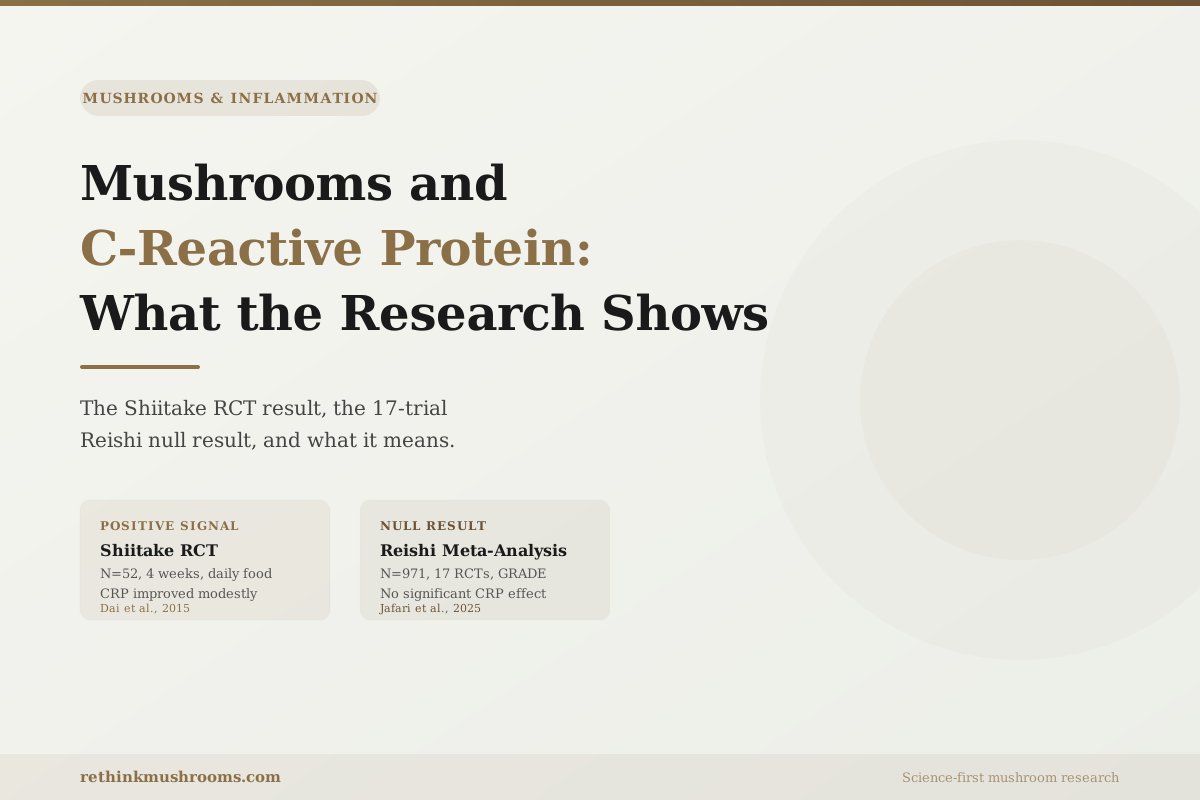
A 2025 GRADE-assessed meta-analysis of 17 randomized Ganoderma lucidum trials (971 participants) found no significant effect on C-reactive protein, the largest clinical review of any mushroom and CRP to date.
Jafari et al., Food Science & Nutrition, 2025
Shiitake RCT
the only randomized trial showing improved CRP involved daily shiitake consumption in 52 healthy young adults for 4 weeks
N=971
participants across 17 Reishi clinical trials showed no significant C-reactive protein reduction in the 2025 meta-analysis
Cohort data
the Nurses' Health Study and Health Professionals Follow-up Study found favorable inflammatory biomarker profiles associated with higher mushroom consumption
Jafari et al., Food Science & Nutrition, 2025
 View as image ↗
C-reactive protein is the blood marker most commonly used to measure chronic inflammation, and elevated CRP is one of the reasons people seek out anti-inflammatory supplements, including functional mushrooms. The specific question is whether taking mushrooms, or mushroom extracts, actually moves this marker in clinical tests.
The honest answer about mushrooms and C-reactive protein is more nuanced than most supplement content admits. The strongest positive human evidence involves shiitake mushrooms consumed as food. The most-marketed anti-inflammatory mushroom, reishi, was the subject of a 2025 GRADE-assessed meta-analysis covering 17 randomized controlled trials and 971 participants, and the finding was no significant effect on CRP.[4] That combination, a positive result for the wrong mushroom and a null result for the marketed one, is the clinical picture that no supplement brand publishes and that this article covers. For the mechanistic background on how mushrooms affect inflammatory pathways, the mushrooms and inflammation pillar provides the NF-kB and COX-2 context.
Key Takeaways
- C-reactive protein (CRP) is a liver-produced protein that rises during inflammation; levels above 3 mg/L indicate chronic inflammation associated with cardiovascular and metabolic disease risk
- The best human trial evidence for mushrooms reducing CRP comes from a 2015 RCT by Dai and colleagues: 52 healthy young adults consuming shiitake daily for 4 weeks showed improved CRP and immune markers
- A 2025 GRADE meta-analysis of 17 Ganoderma lucidum (Reishi) clinical trials (N=971) found no significant effect on CRP, TNF-α, blood pressure, or lipid markers; evidence quality was rated very low
- Large cohort data (Nurses' Health Study, Health Professionals Follow-up Study) found favorable inflammatory biomarker profiles associated with higher mushroom consumption, but observational data cannot establish causation
- A 2023 systematic review of 9 studies found mixed results for hs-CRP with mushroom consumption, including one clinical trial in Mediterranean-diet adults showing no significant CRP change
- Whole mushroom consumption as part of a dietary pattern (Mediterranean or DASH framework) appears better supported for CRP reduction than taking isolated mushroom supplements specifically for this purpose
What C-Reactive Protein Actually Measures (And Why It Matters)
C-reactive protein is a protein produced by the liver. When the immune system detects tissue damage or infection, it releases signaling molecules called cytokines that travel to the liver and trigger CRP production. The amount of CRP in the bloodstream is therefore a proxy measurement of how much inflammatory signaling the body is currently experiencing.
There are two test versions. The standard CRP test detects larger elevations, typically associated with acute infection or injury. High-sensitivity CRP (hs-CRP) can detect lower-level chronic inflammation and is the version used to assess cardiovascular and metabolic risk. The American Heart Association categorizes hs-CRP as follows: below 1 mg/L is low risk; 1 to 3 mg/L is moderate risk; above 3 mg/L is high risk for cardiovascular events.
Chronically elevated CRP is a characteristic of metabolic syndrome, obesity, type 2 diabetes, and autoimmune conditions. It's also elevated in people with persistently poor sleep, chronic stress, and pro-inflammatory diets. Reducing elevated CRP through lifestyle changes, particularly diet and exercise, is an established medical strategy for lowering cardiovascular risk.
The reason mushrooms are of interest here is that several species contain compounds that reduce inflammatory signaling in cell and animal studies. Polysaccharides and ergothioneine reduce the activity of inflammatory pathways at the molecular level. The question is whether those cellular effects translate into lower CRP numbers in human blood tests. That is what the clinical evidence addresses, and the answer is not what the supplement marketing implies.
This snippet defines the mechanism clearly: some mushrooms may reduce CRP by suppressing the upstream cytokines (particularly IL-6 and TNF-alpha) that trigger the liver to produce CRP in the first place. The mushroom compounds and IL-6 reduction article covers that upstream pathway.
The Best Human Evidence: A 2015 Shiitake Trial in Healthy Adults
The most direct positive human trial evidence for mushrooms and CRP comes from a 2015 randomized dietary intervention study by Dai and colleagues, published in the Journal of the American College of Nutrition.[1]
The study enrolled 52 healthy young adults and assigned them to eat shiitake mushrooms daily for four weeks. Researchers measured immune function markers before and after. Natural killer cell proliferation and activation improved. Cytokine patterns shifted toward a less inflammatory profile. Serum CRP levels showed improvement consistent with reduced systemic inflammation.
This is the most credible human data available for mushrooms and CRP because it is a randomized intervention, it involves actual food consumption rather than an isolated extract, and it uses a disease-relevant outcome measure. CRP was not the primary endpoint, and the study was in healthy young adults rather than people with chronic inflammatory conditions. The CRP change was modest.
The population limitation matters for interpretation. Healthy young adults with normal baseline CRP do not have much room for improvement. The inflammation-reducing effects of a dietary intervention show up most clearly in people with elevated CRP at baseline, which this study did not specifically test. Whether shiitake produces the same or larger CRP reductions in people with metabolic syndrome or elevated baseline inflammation is not established by this trial.
What the Dai study establishes: daily shiitake consumption is safe, improves immune function markers in healthy adults, and is associated with a modest shift toward a less inflammatory biomarker profile over four weeks.
The Critical Counterpoint: 17 Reishi Trials Found No CRP Effect
Reishi (Ganoderma lucidum) is the mushroom most commonly sold and marketed specifically for anti-inflammatory effects. It has extensive preclinical evidence: cell studies show polysaccharides and triterpenes reducing NF-kB (the molecular switch that activates inflammatory gene programs) and multiple pro-inflammatory cytokines. This preclinical profile is why reishi has been recommended for CRP reduction.
The clinical evidence tells a different story. A 2025 meta-analysis by Jafari and colleagues in Food Science and Nutrition synthesized data from 17 randomized controlled trials involving 971 participants.[4] The researchers used GRADE methodology, a standardized system for rating evidence quality across multiple studies. The outcomes measured included CRP, TNF-alpha (another pro-inflammatory cytokine), blood pressure, lipid profile, fasting glucose, and liver enzymes. The finding across all outcomes was the same: no statistically significant effect of Ganoderma lucidum supplementation. The GRADE assessment rated the quality of evidence as very low across all measured outcomes.
This is the most rigorous clinical evidence available for any mushroom species and CRP. Seventeen trials. Nearly 1,000 participants. GRADE-assessed. No effect.
The mismatch between compelling preclinical data and null clinical results is not unique to reishi. It's a common pattern in nutritional supplementation research and has several explanations: the doses tested in animal models are often orders of magnitude higher than the doses used in human supplement trials; the bioavailability of compounds from an extract differs from cell culture conditions; CRP in humans is strongly influenced by diet, sleep, exercise, and stress, which can overwhelm any supplement effect; and the populations enrolled in supplement trials often have conditions that affect response.
This does not mean reishi has no value. It means that specifically for CRP reduction, the clinical evidence does not support the preclinical promise. For the broader clinical evidence on reishi and cardiovascular markers, this null result needs to be read alongside the blood pressure and cholesterol data.
Population Data: What Large Cohort Studies Show
A 2019 prospective cohort study by Lee and colleagues, published in the American Journal of Clinical Nutrition, analyzed mushroom consumption and cardiometabolic biomarkers in two of the largest ongoing American health cohorts: the Nurses' Health Study and the Health Professionals Follow-up Study.[2]
Higher mushroom consumption was associated with favorable biomarker profiles relevant to inflammation and cardiovascular risk. The direction of association supported mushrooms as part of an anti-inflammatory dietary pattern. This is observational data: it cannot establish causation. People who eat more mushrooms may also follow better diets overall, exercise more, and have other lifestyle factors that reduce inflammation.
The value of this data is its scale and real-world relevance. These are tens of thousands of real people eating real food over many years, not controlled supplement doses in a clinical trial setting. The association is consistent with the mechanistic hypothesis. But association is not causation.
What the cohort data adds to the picture: in the real world, higher mushroom consumption correlates with better inflammatory biomarker profiles at the population level. This is consistent with mushrooms contributing to anti-inflammatory dietary patterns rather than functioning as single-target anti-inflammatory agents.
Why Supplement Trials Often Fail Where Preclinical Studies Succeed
The Jafari 2025 meta-analysis finding is not a surprise to researchers familiar with the supplement trial literature. It exemplifies a well-documented challenge in translating preclinical findings to clinical results.
The 2023 systematic review by Thapa and colleagues in Nutrition Research and Practice evaluated nine studies (five cohort studies and four clinical trials) specifically on mushroom consumption and hs-CRP.[3] Results were mixed across studies. One clinical trial in healthy adults following a Mediterranean diet showed no significant CRP change with added mushrooms. The review concluded that there are suggestive associations but inconsistent evidence.
Three factors commonly explain the preclinical-to-clinical gap for anti-inflammatory supplements. First, dose discrepancy: animal studies showing CRP reduction often use doses that would be impractical or excessive in humans when scaled by body weight. Extract preparations used in research may have higher concentrations of active compounds than commercial products. Second, CRP is a downstream endpoint: it is produced by the liver in response to upstream cytokines including IL-6 and TNF-alpha. Reducing those upstream signals by a modest amount may not produce a measurable CRP change if other factors (diet, sleep, stress) are simultaneously driving the signal. Third, the intervention may need to be sustained much longer than typical trial durations. CRP is a chronic marker; shifting it requires sustained lifestyle changes, not short-course supplementation.
For the gut microbiome angle, dysbiosis (an imbalanced gut microbiome) is one of the chronic drivers of elevated CRP. Mushrooms' prebiotic activity, which reshapes the microbiome toward beneficial species, may reduce CRP partly through that pathway over months rather than the weeks typical trials measure. This connection is explored in the mushrooms and gut microbiome research article.
What Actually Lowers CRP Reliably (And Where Mushrooms Fit)
High-sensitivity CRP responds primarily to the same factors that drive chronic inflammation: body weight (especially visceral fat), diet quality, exercise, sleep, and smoking. The interventions with the strongest clinical evidence for reducing CRP in people with chronically elevated levels are weight loss, the Mediterranean diet, aerobic exercise, and in some populations, statin medications.
Mushrooms fit into this picture as part of a dietary pattern rather than as a single-target supplement. The Lee 2019 cohort data[2] supports mushrooms as a component of an anti-inflammatory diet. The Dai 2015 Shiitake trial[1] shows CRP-relevant effects from whole food consumption. Both lines of evidence point toward dietary inclusion of mushrooms as a reasonable anti-inflammatory strategy within a broader healthful diet.
Taking a mushroom supplement capsule daily and expecting a meaningful CRP reduction is not supported by current clinical evidence. The 17-trial Reishi meta-analysis[4] says as much explicitly.
The full species comparison of which mushrooms have the strongest evidence for chronic inflammation, including the species-by-species clinical evidence grading, is covered in the companion article on mushrooms for chronic inflammation. For the detailed clinical evidence trail including what the specific CRP numbers from trials show, the medicinal mushrooms and CRP reduction article covers every available clinical data point.
The Bottom Line
The mushroom with the best human trial evidence for CRP is shiitake consumed as food, from a 2015 RCT in healthy adults. The mushroom most marketed for anti-inflammatory effects, reishi, failed to reduce CRP in a 2025 meta-analysis of 17 clinical trials covering 971 participants. Large cohort data suggests higher mushroom consumption is associated with favorable inflammatory biomarker profiles, consistent with a dietary pattern effect rather than a supplement effect. Whole mushroom consumption as part of an anti-inflammatory diet is better supported than isolated mushroom supplements for CRP reduction.
Frequently Asked Questions
Sources & References
- 1RTHM-00368·Dai, Xiaoshuang et al. (2015). “Consuming Lentinula edodes (Shiitake) Mushrooms Daily Improves Human Immunity: A Randomized Dietary Intervention in Healthy Young Adults..” Journal of the American College of Nutrition.Study breakdown →PubMed →↩
- 2RTHM-00567·Lee, Dong Hoon et al. (2019). “Mushroom consumption, biomarkers, and risk of cardiovascular disease and type 2 diabetes: a prospective cohort study of US women and men..” The American journal of clinical nutrition.Study breakdown →PubMed →↩
- 3. Source details for this reference are not yet available.
- 4RTHM-02098·Jafari, Ali et al. (2025). “The Nutritional Significance of Ganoderma lucidum on Human Health: A GRADE-Assessed Systematic Review and Meta-Analysis of Clinical Trials..” Food science & nutrition.Study breakdown →PubMed →↩