Mushrooms & Inflammation
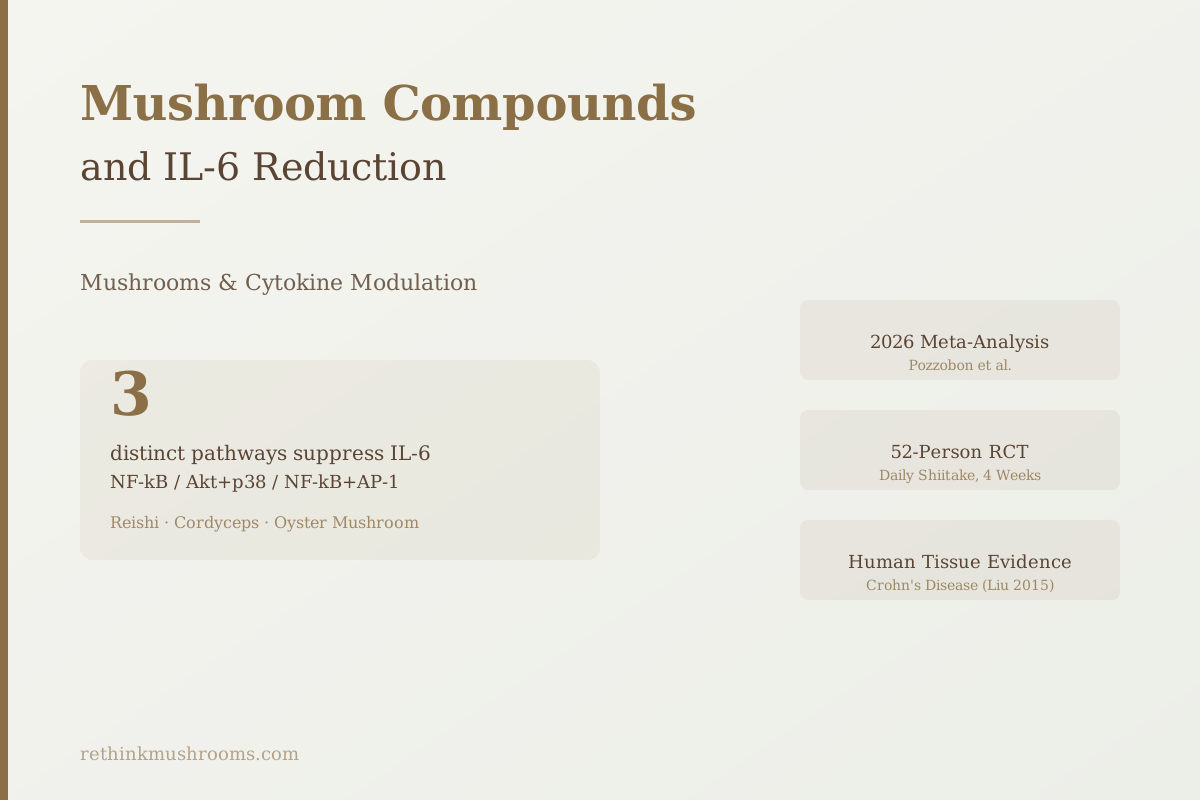
2026 meta-analysis
A systematic review and meta-analysis confirmed that Ganoderma lucidum triterpenes suppress IL-6 and other inflammatory cytokines, representing the most comprehensive synthesis of reishi's anti-inflammatory evidence to date.
Pozzobon et al., Pharmaceuticals (Basel), 2026
3 pathways
distinct signaling routes through which mushroom compounds suppress IL-6 production
52 adults
in the 4-week shiitake dietary trial measuring immune cytokine response (Dai 2015)
2 tissues
IL-6 suppression documented in macrophage cell models and human Crohn's disease tissue
Pozzobon et al., Pharmaceuticals (Basel), 2026
 View as image ↗
IL-6 (interleukin-6) is among the most frequently cited markers of chronic inflammation. Elevated in type 2 diabetes, cardiovascular disease, and autoimmune conditions, it has become a target for both pharmaceutical intervention and research into dietary compounds that might modulate it. Mushroom compounds, particularly from reishi, cordyceps, and oyster mushroom, have shown the capacity to reduce IL-6 in laboratory models through at least three mechanistically distinct pathways, a finding that goes beyond the generic "anti-inflammatory" framing that fills most supplement content.
The research here spans macrophage cell culture, mouse models, human tissue samples from Crohn's disease patients, and a 4-week randomized dietary trial in healthy adults. The evidence is not uniform, and the gap between cell culture and clinical outcomes is real. Understanding what mushroom compounds actually do to IL-6 production, at what biological level, and through which mechanisms is where this article starts. For the broader framework on how mushrooms interact with the NF-kB pathway that controls IL-6 production, see how mushrooms fight inflammation: NF-kB, COX-2, and beyond.
Mechanism · Three Routes to Lower IL-6
Same Destination, Different Entry Points
Each compound class reduces IL-6, but enters the inflammatory signaling chain at a different point. The differences are mechanistic, not marketing.
Reishi triterpenes
Ganoderma lucidum
Direct at NF-κB
Triterpenes act on the NF-κB transcription switch itself, the master control for IL-6 gene expression.
Cordycepin
Cordyceps
Upstream at Akt / p38
Blocks the Akt and p38 kinases that sit above NF-κB, dampening the signal before it reaches the switch.
Oyster mushroom extract
Pleurotus ostreatus
Dual: NF-κB + AP-1
Blocks NF-κB and the independent AP-1 factor at once, closing two separate routes to IL-6 production.
Reduced IL-6 production
Lower output of the cytokine that drives chronic inflammation when it fails to switch off
All routes are shown in preclinical (cell and animal) models. The step to clinical benefit from oral supplementation is not yet established.
Source: Dudhgaonkar et al. (2009); Kim et al. (2006); Jedinak et al. (2011)
View as image ↗Key Takeaways
- IL-6 is a dual-function cytokine: protective in acute infection, damaging when chronically elevated in metabolic syndrome, cardiovascular disease, and autoimmune conditions
- Reishi (Ganoderma lucidum) triterpenes suppressed IL-6 secretion from LPS-stimulated macrophages and in endotoxemic mice (Dudhgaonkar 2009); a 2026 systematic review and meta-analysis confirmed this anti-inflammatory activity across preclinical models
- Ganoderma triterpenoids downregulated NF-kB signaling and showed anti-inflammatory effects in human Crohn's disease tissue samples, making this one of the few human-relevant data points for mushroom compounds and IL-6 (Liu 2015)
- Cordycepin (from Cordyceps) suppressed the LPS-driven inflammatory cascade by inhibiting Akt and p38 kinases upstream of NF-kB, a mechanistic route distinct from the direct NF-kB blockade used by reishi triterpenes
- Oyster mushroom extract simultaneously blocked both NF-kB and AP-1 transcription factors, reducing IL-6 alongside TNF-alpha and other pro-inflammatory cytokines (Jedinak 2011)
- A 4-week shiitake dietary intervention in 52 healthy adults improved immune cell activation and cytokine response markers, representing the strongest human dietary trial in this evidence base (Dai 2015)
IL-6: The Cytokine That Helps in Acute Infection and Harms When It Won't Turn Off
IL-6 is a signaling protein produced by macrophages, T cells, endothelial cells, and other immune cells in response to infection, injury, or inflammatory stimulation.
When an infection begins, IL-6 serves several protective functions. It triggers fever, raising body temperature to slow pathogen replication. It signals the liver to produce acute phase proteins that are part of the body's first-line defense response. It recruits additional immune cells to the site of infection. In this context, IL-6 is part of a coordinated response that resolves an acute threat.
The problem arises when IL-6 production does not return to baseline after the threat is resolved, or when chronic low-grade inflammation keeps IL-6 persistently elevated. Chronically elevated IL-6 is associated with insulin resistance, endothelial dysfunction in blood vessels, muscle wasting in aging, and the maintenance of autoimmune inflammation. In conditions like type 2 diabetes, cardiovascular disease, and rheumatoid arthritis, IL-6 is consistently elevated and its suppression is a documented therapeutic target.
This dual character of IL-6, essential in acute responses and harmful when persistent, is why the evidence on mushroom compounds and IL-6 reduction matters specifically. Suppressing IL-6 in a context of chronic overproduction is different from suppressing it during an acute infection, and the studies in this cluster address the former. For the broader question of how mushrooms navigate this pro-versus-anti-inflammatory balance, see how mushrooms balance pro- and anti-inflammatory cytokines.
Reishi Triterpenes and IL-6: From In Vitro Evidence to a 2026 Meta-Analysis
The most studied mushroom compounds for IL-6 suppression are the triterpenes from Ganoderma lucidum (reishi). These are steroid-like secondary metabolites distinct from the polysaccharides (such as beta-glucans) that drive reishi's immune-stimulating properties.
Dudhgaonkar and colleagues published the foundational cellular and animal study in 2009. They applied triterpene extracts from Ganoderma lucidum to macrophages that had been stimulated with lipopolysaccharide (LPS), a component of bacterial cell walls that reliably triggers an inflammatory cytokine response. The result was marked suppression of both TNF-alpha and IL-6 secretion from these immune cells.[1]
The same study then moved to animal models. Endotoxemic mice, the term for mice given LPS to trigger systemic inflammation, also showed suppression of TNF-alpha and IL-6 following reishi triterpene administration.[1] This step from cell culture to live animal models is important because it demonstrates the suppressive effect occurs in a more complex biological system, not only in isolated cells.
The 2026 Pozzobon systematic review and meta-analysis of preclinical evidence placed this finding within the broader landscape of Ganoderma lucidum triterpene anti-inflammatory research. Screening more than 3,000 records against a pre-registered PROSPERO protocol, it included 23 non-clinical studies and pooled their in vitro data. The meta-analysis reported a statistically significant reduction in IL-6 (standardized mean difference -3.51, 95% CI -4.73 to -2.29), acting primarily through downregulation of MAPK and TLR-4/NF-kB signaling, and represents the highest-evidence summary of this evidence base currently available.[2]
Pozzobon et al. (2026) · Pharmaceuticals (Basel)
- Population
- 23 non-clinical in vitro and in vivo studies (macrophages, human PBMCs, mouse/rat/chicken models); >3,000 records screened
- Intervention
- Ganoderma lucidum triterpene extracts or isolated compounds
- Comparator
- Unstimulated or vehicle-treated controls within each included study
- Finding
- Meta-analysis of in vitro data found a significant IL-6 reduction (SMD -3.51, 95% CI -4.73 to -2.29), driven by MAPK and TLR-4/NF-kB downregulation.
preliminary Strongest available synthesis, but strictly preclinical: no clinical trials, bioavailability, or long-term toxicity data were available to include.
Pozzobon et al., Pharmaceuticals (Basel), 2026 (PROSPERO CRD42024510982)
The honest limitation: this is preclinical evidence (cells and animals), not clinical trials in humans. The question of whether oral reishi supplementation achieves tissue concentrations sufficient to suppress IL-6 in the same way as direct triterpene application in cell culture remains incompletely answered. For a deeper look at how triterpenes and polysaccharides differ as anti-inflammatory agents, see triterpenes vs. polysaccharides: different anti-inflammatory pathways. For the companion article on how reishi triterpenes specifically target TNF-alpha, see mushroom triterpenes and TNF-alpha suppression.
The Crohn's Disease Data: How Ganoderma Triterpenoids Acted on Human Tissue
Liu and colleagues published a 2015 study in Inflammatory Bowel Diseases that moved the evidence from cell culture and animal models closer to human relevance. They examined the effects of Ganoderma lucidum triterpenoids on NF-kB signaling in tissue samples from patients with Crohn's disease.
NF-kB (nuclear factor kappa B) is the molecular switch that controls the production of inflammatory cytokines including IL-6. When NF-kB is activated in immune cells, it triggers a cascade that results in IL-6 transcription and release. Blocking NF-kB activation is the primary mechanism by which most mushroom compounds reduce IL-6.
The Liu 2015 Crohn's study found that Ganoderma triterpenoids downregulated NF-kB signaling in the human Crohn's disease tissue samples, with corresponding anti-inflammatory effects.[3]
What makes this significant is the biological material: not a macrophage cell line in a dish, but actual diseased human tissue from patients with a chronic inflammatory bowel condition. IL-6 is persistently elevated in active Crohn's disease, and demonstrating that a mushroom-derived compound can modulate NF-kB activity in this tissue is a more clinically relevant finding than macrophage data alone.
The caveat is equally important: this was a cohort study on human tissue samples, not a randomized trial of Ganoderma supplementation in Crohn's disease patients. Showing that a compound acts on tissue in an ex vivo model is not the same as showing it produces clinical benefit when taken orally. The NF-kB pathway and its central role in mushroom anti-inflammatory activity is covered in depth in how mushrooms fight inflammation: NF-kB, COX-2, and beyond.
Cordycepin's Distinct Route: Same Destination, Different Signaling Chain
Cordycepin is a bioactive compound found in Cordyceps mushrooms with a structure similar to adenosine, one of the body's own cellular signaling molecules. It suppresses IL-6 production, but through a mechanistic route that differs from the reishi triterpene pathway.
Kim and colleagues demonstrated this in a 2006 study. Cordycepin inhibited LPS-induced inflammation in RAW 264.7 macrophage cells by suppressing NF-kB activation, but the mechanism was not a direct block of NF-kB itself. Instead, cordycepin inhibited two proteins that sit upstream of NF-kB in the inflammatory signaling chain: Akt (a kinase involved in cell survival and growth signaling) and p38 (a stress-activated kinase that responds to inflammatory signals).[4]
This distinction matters for a few reasons. First, Akt and p38 are regulatory targets in their own right, with roles in pathways beyond NF-kB. Inhibiting them upstream has broader effects on inflammatory signaling than blocking NF-kB alone. Second, it demonstrates that different mushroom compounds reduce IL-6 through different molecular entry points, which may have implications for the types of inflammatory conditions each is most relevant to.
Reishi triterpenes appear to act more directly on NF-kB and its target genes. Cordycepin reaches the same destination by dampening the kinase activity that activates NF-kB in the first place. Both reduce IL-6, but through different parts of the same signaling chain.
Oyster Mushroom's Double Block: NF-kB and AP-1 Together
Jedinak and colleagues published a 2011 study on oyster mushroom (Pleurotus ostreatus) that identified a broader cytokine-suppressing effect than reishi or cordyceps research had described individually.
The study found that oyster mushroom extract inhibited not only NF-kB but also AP-1 (activator protein-1) in macrophages. AP-1 is an independent transcription factor, a protein complex that binds to DNA and switches on inflammatory gene expression, with its own role in controlling inflammatory cytokine production separate from NF-kB. The result of simultaneously blocking both was a reduction in TNF-alpha, IL-6, and other pro-inflammatory cytokines.[5]
When only NF-kB is blocked, AP-1 can still drive some IL-6 production. Blocking both suppresses production through two independent transcriptional routes simultaneously. This may produce broader or more complete suppression than blocking either transcription factor alone.
The oyster mushroom data is notable for another reason: Pleurotus ostreatus is a common edible mushroom, not a specialized medicinal species requiring extraction and supplementation. This finding extends the cytokine-modulating evidence beyond reishi to a mushroom many people eat as food. Whether dietary intake of oyster mushroom produces concentrations sufficient for the NF-kB and AP-1 effects observed in this cell study is not established.
This is also a useful point of comparison against the reishi data. The anti-inflammatory effects of mushroom compounds are not limited to the most exotic species. The ergothioneine compound found across multiple mushroom species, including oyster mushroom, also has a separate anti-inflammatory profile: see ergothioneine and inflammation: anti-inflammatory research.
What 4 Weeks of Daily Shiitake Did in a Human Trial
Most of the evidence reviewed so far is preclinical: cells and animals. The closest thing to clinical human evidence in this cluster is the 2015 dietary intervention trial by Dai and colleagues, which used shiitake mushrooms as a whole-food dietary exposure.
Fifty-two healthy young adults were randomized to consume shiitake mushrooms daily for 4 weeks. Researchers measured changes in immune cell proliferation, activation markers, and cytokine production before and after the intervention.[6]
The intervention produced improvements in immune cell markers: higher proliferation and activation of immune cells, changes in cytokine production patterns consistent with a more regulated immune response. The shiitake group showed immune changes that suggest meaningful dietary immunomodulation over the 4-week period.
Several important caveats apply. This was a trial in healthy young adults, not in patients with elevated baseline IL-6 from a chronic disease condition. Healthy adults tend to have IL-6 levels already in a normal range, which makes measuring suppression difficult: you cannot easily reduce what isn't elevated. The trial measured immune cell markers and general cytokine patterns rather than specific IL-6 serum levels as a primary endpoint.
What the Dai 2015 trial demonstrates is that regular shiitake consumption in humans produces measurable changes in immune cell function and cytokine regulation. It's the most relevant human dietary evidence in this cluster, even if it doesn't directly answer the question of whether mushrooms suppress chronically elevated IL-6 in diseased populations.
The evidence needed to answer that question would be trials in populations with elevated baseline IL-6: people with metabolic syndrome, rheumatoid arthritis, or other conditions where IL-6 reduction is clinically meaningful. Those trials exist in limited form for some mushroom compounds, but are not represented in the study set examined here.
For the question of how mushroom compounds might theoretically be relevant in extreme inflammatory states like cytokine storm, the framework is covered in the cytokine storm: can mushrooms help modulate immune overreaction?. For the companion article on TNF-alpha, see mushrooms and TNF-alpha: reducing the master inflammatory signal. Reishi's anti-inflammatory properties in neurological contexts are examined in reishi and neuroinflammation-driven depression: microglial research.
- Cell & Lab Studiescompleted
IL-6 suppression in LPS-stimulated macrophages for reishi triterpenes, cordycepin, and oyster mushroom (Dudhgaonkar 2009; Kim 2006; Jedinak 2011); NF-kB downregulation in human Crohn's tissue (Liu 2015)
- Animal Studiescompleted
TNF-alpha and IL-6 suppression in endotoxemic mice given reishi triterpenes (Dudhgaonkar 2009)
- Small Human Trialscurrent
4-week shiitake dietary trial in 52 healthy adults (Dai 2015) - measured immune-cell activation and cytokine patterns, not IL-6 in a disease population
- Meta-Analysiscurrent
2026 systematic review + meta-analysis of 23 preclinical studies pooled a significant IL-6 reduction (SMD -3.51), but strictly non-clinical (Pozzobon 2026)
- Large Clinical Trial in Elevated-IL-6 Patientsmissing
No trial has tested whether oral mushroom supplementation lowers chronically elevated IL-6 in metabolic, cardiovascular, or autoimmune disease
The evidence is mechanistically deep in cells and animals and has one preclinical meta-analysis, but the clinical step - lowering elevated IL-6 in a diseased population via oral supplements - has not been taken.
Dudhgaonkar 2009; Kim 2006; Jedinak 2011; Liu 2015; Dai 2015; Pozzobon 2026
Safety
ModerateIL-6 is not a switch to flip off at home
Concern
IL-6 is protective during acute infection. Deliberately suppressing immune signaling with concentrated supplements - especially alongside immunosuppressant or biologic medication for an autoimmune condition - could have consequences that this preclinical evidence base does not address.
What the research says
The studies here are cell, animal, and healthy-adult dietary research, not treatment trials. None establish a safe or effective supplement dose for lowering elevated IL-6 in a disease.
Particularly relevant for: People with autoimmune conditions, those on immunomodulating drugs, and anyone considering high-dose extracts
What to do
Treat this as mechanism-of-interest research, not medical advice. Discuss any mushroom supplement with a clinician before use if you have a chronic inflammatory condition or take immune-affecting medication.
Evidence base limitations across Dudhgaonkar 2009, Liu 2015, Dai 2015, Pozzobon 2026
The Bottom Line
The evidence for mushroom compounds and IL-6 reduction spans multiple biological levels and multiple species. Reishi triterpenes suppress IL-6 in macrophage models and in animal models of endotoxemia, with a 2026 meta-analysis confirming this anti-inflammatory activity. Ganoderma triterpenoids have shown NF-kB suppression in human Crohn's disease tissue, representing the closest the evidence gets to clinical human data. Cordycepin from cordyceps suppresses IL-6 through a distinct upstream pathway involving Akt and p38 kinases. Oyster mushroom blocks two independent transcription factors that control IL-6 production. The Dai 2015 shiitake RCT provides the only whole-food human dietary evidence. The common limitation across the evidence base is the gap between in vitro concentrations and those achievable with oral supplementation, and the absence of clinical trials in populations with chronically elevated IL-6.
Frequently Asked Questions
Sources & References
- 1RTHM-00152·Dudhgaonkar, Shailesh et al. (2009). “Suppression of the inflammatory response by triterpenes isolated from the mushroom Ganoderma lucidum..” International immunopharmacology.Study breakdown →PubMed →↩
- 2RTHM-02241·Pozzobon, Rafaela Guedes et al. (2026). “Anti-Inflammatory Potential of Ganoderma lucidum Triterpenes: A Systematic Review and Meta-Analysis of Preclinical Evidence..” Pharmaceuticals (Basel.Study breakdown →PubMed →↩
- 3RTHM-00719·Liu, Changda et al. (2015). “Anti-inflammatory Effects of Ganoderma lucidum Triterpenoid in Human Crohn's Disease Associated with Downregulation of NF-κB Signaling..” Inflammatory bowel diseases.Study breakdown →PubMed →↩
- 4RTHM-00103·Kim, Ho Gyoung et al. (2006). “Cordycepin inhibits lipopolysaccharide-induced inflammation by the suppression of NF-kappaB through Akt and p38 inhibition in RAW 264.7 macrophage cells..” European journal of pharmacology.Study breakdown →PubMed →↩
- 5RTHM-00219·Jedinak, Andrej et al. (2011). “Anti-inflammatory activity of edible oyster mushroom is mediated through the inhibition of NF-κB and AP-1 signaling..” Nutrition journal.Study breakdown →PubMed →↩
- 6RTHM-00368·Dai, Xiaoshuang et al. (2015). “Consuming Lentinula edodes (Shiitake) Mushrooms Daily Improves Human Immunity: A Randomized Dietary Intervention in Healthy Young Adults..” Journal of the American College of Nutrition.Study breakdown →PubMed →↩