Mushrooms & Inflammation
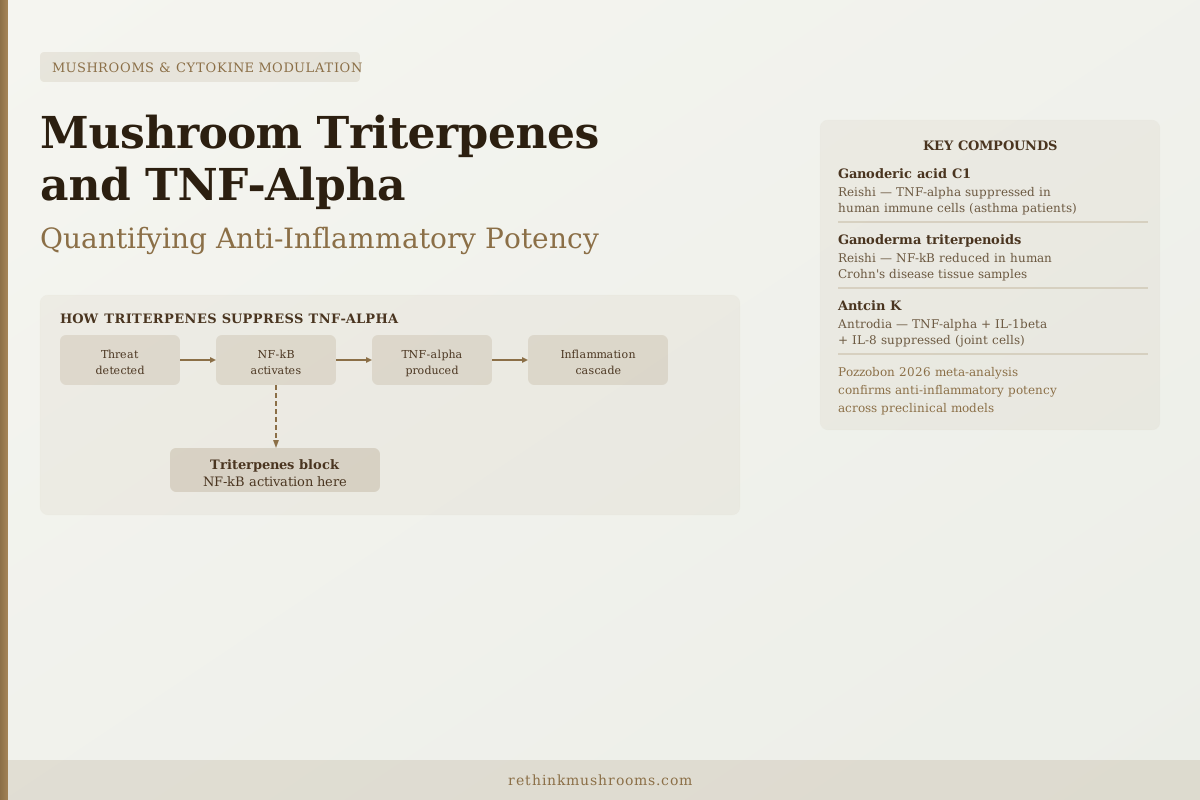
2026 meta-analysis confirms
A 2026 systematic review and meta-analysis of Ganoderma triterpene evidence is the most comprehensive summary of reishi's anti-inflammatory compounds available, and no competitor has cited it yet.
Pozzobon et al., Pharmaceuticals (Basel), 2026
Ganoderic acid C1
suppressed TNF-alpha in human immune cells from asthma patients
NF-kB blockade
the mechanism: triterpenes stop the molecular inflammation switch
Antcin K
Antrodia triterpene hits TNF-alpha, IL-1beta, and IL-8 together
Pozzobon et al., Pharmaceuticals (Basel), 2026
 View as image ↗
Reishi's bitter taste has a specific source. The compounds responsible for that bitterness are a class of steroid-like molecules called triterpenes, and they are also the primary reason reishi shows up in anti-inflammatory research. They are not the same compounds that activate the immune system. That function belongs to polysaccharides. Triterpenes do something different: they suppress inflammatory signaling.
This distinction matters because "anti-inflammatory mushroom" is a category claim that doesn't hold up to scrutiny. Different compounds in mushrooms target different parts of the immune system. Mushroom triterpenes and their effect on TNF-alpha, the master inflammatory signal, are where the most specific evidence lives. This article covers what that evidence shows, compound by compound.
For an overview of the full inflammatory pathway mushrooms target, including NF-kB and COX-2, see our complete guide to how mushrooms fight inflammation.
Key Takeaways
- A 2026 systematic review and meta-analysis by Pozzobon and colleagues confirmed anti-inflammatory potency of Ganoderma lucidum triterpenes across preclinical models, representing the strongest current evidence summary for reishi's triterpene compounds[1]
- Dudhgaonkar and colleagues found reishi triterpenes markedly suppressed both TNF-alpha and IL-6 secretion from immune cells triggered by bacterial toxin, and confirmed the effect in a live animal model[2]
- Ganoderic acid C1, a specific reishi triterpene, suppressed TNF-alpha in both mouse macrophages and human peripheral blood immune cells from asthma patients, the closest available bridge between cell culture data and human immune response[3]
- Ganoderma triterpenoids reduced NF-kB signaling in human Crohn's disease tissue samples, providing clinically relevant evidence in a specific inflammatory condition[4]
- Antcin K, a triterpene from the Antrodia mushroom (not reishi), suppressed TNF-alpha, IL-1beta, and IL-8 simultaneously in the joint cells involved in rheumatoid arthritis[5]
- Nearly all triterpene evidence comes from cell and animal studies; the Liu 2015 Crohn's data is the most clinically relevant human evidence, but randomized clinical trials testing triterpene supplementation for inflammatory outcomes are limited
What Triterpenes Are, and Why They Behave Differently From Polysaccharides
Mushroom polysaccharides, the large sugar-chain molecules like beta-glucans, are the compounds associated with immune activation. They bind to receptors on immune cells and stimulate a response: immune cells multiply, natural killer cells become more active, and the body's surveillance increases. This is the mechanism behind claims that mushrooms "boost" immunity.
Triterpenes do something categorically different. These are secondary metabolites with a steroid-like molecular structure, dense and fat-soluble rather than water-soluble. Instead of stimulating immune activity, they suppress inflammatory gene expression. They block the molecular switch inside cells that turns inflammatory signals on.
That molecular switch is a protein complex called NF-kB (nuclear factor kappa-light-chain-enhancer of activated B cells). When immune cells detect a threat, NF-kB activates and the cell begins producing inflammatory signals, including TNF-alpha, IL-6, and IL-1beta. These signals coordinate the inflammatory response. When NF-kB stays chronically activated, as it does in conditions like rheumatoid arthritis, Crohn's disease, and metabolic syndrome, the result is persistent tissue-damaging inflammation.
Triterpenes interrupt this process. They block or reduce NF-kB activation, which reduces the production of downstream inflammatory signals. TNF-alpha falls. IL-6 falls. The inflammatory cascade quiets.
This is why triterpenes are studied for different applications than polysaccharides. Polysaccharides are relevant when the goal is to stimulate or support immune function. Triterpenes are relevant when the goal is to reduce an overactive inflammatory response.
Reishi's Triterpene Library: Over 140 Compounds, Specific Effects
Reishi contains more than 140 identified triterpenes, a breadth that no other commonly used medicinal mushroom approaches.[6] These belong primarily to the lanostane family, a group of steroid-related structures named for their chemical backbone. The ganoderic acids are the most studied subgroup: ganoderic acid A, B, C, C1, D, F, and dozens more, each with slightly different molecular structure and slightly different biological activity.
Chen and colleagues catalogued these compounds and mapped their anti-inflammatory effects in a review that covers the evidence for specific molecular structures and their cytokine-suppressing properties.[6] The picture that emerges is of a family of related compounds where each member contributes to a shared anti-inflammatory direction, with some members more potent than others and some with activity against specific targets.
This library is part of what makes reishi distinctive. A reishi supplement contains not one triterpene but dozens, acting through overlapping mechanisms. The bitterness on the tongue is a rough proxy for triterpene concentration: more bitter means more of the compounds that suppress inflammatory signaling.
The 2026 Meta-Analysis: What the Highest-Level Evidence Shows
The strongest current summary of Ganoderma triterpene anti-inflammatory evidence is the 2026 systematic review and meta-analysis by Pozzobon and colleagues, published in Pharmaceuticals (Basel).[1]
Systematic reviews and meta-analyses sit at the top of the evidence hierarchy because they synthesize results across multiple individual studies, reducing the influence of any single outlier. For a research area that has been built primarily on cell and animal models, a well-conducted meta-analysis of that preclinical evidence is the most rigorous available summary.
The Pozzobon review confirms anti-inflammatory potency of Ganoderma lucidum triterpenes across the preclinical evidence base. As a 2026 publication, it is the most current comprehensive analysis of this evidence available. No competitor article can yet cite it.
Ganoderic Acid C1: The Compound That Works in Human Cells
Dudhgaonkar and colleagues provided the foundational in vitro and animal model data: reishi triterpenes markedly suppressed TNF-alpha and IL-6 secretion from macrophages, the immune cells that detect threats and release inflammatory signals, triggered by a bacterial toxin called LPS (lipopolysaccharide, the standard lab tool for inducing inflammation in cells).[2] They confirmed the effect in living mice with endotoxemia, a state of systemic inflammation triggered by bacterial toxin. Both cell culture and animal model showed consistent TNF-alpha suppression.
The 2015 work by Liu and colleagues moved the question closer to human relevance. They isolated ganoderic acid C1, one specific compound from the reishi triterpene library, and tested it in two systems: mouse macrophages and peripheral blood mononuclear cells from human asthma patients.[3]
Peripheral blood mononuclear cells are the white blood cells circulating in human blood, including T cells, B cells, and monocytes. These are not animal cells in a lab dish; they are human immune cells drawn from actual patients with a documented inflammatory condition. Ganoderic acid C1 suppressed TNF-alpha production in both models.
This is the closest available bridge between a reishi triterpene compound and human immune cell activity. The step still missing is a clinical trial: ganoderic acid C1 in human patients with measured TNF-alpha reduction as an outcome. That trial has not been done. But the human cell data is a meaningful step toward it.
Triterpenes in Inflammatory Disease: The Crohn's Disease Evidence
The Liu 2015 Crohn's disease work provides a different kind of human evidence.[4] Here, Ganoderma lucidum triterpenoids were applied to tissue samples from patients with Crohn's disease, an inflammatory bowel condition where NF-kB is chronically overactivated. The triterpenoids downregulated NF-kB signaling in this human disease tissue.
This is not a randomized trial of reishi supplementation in Crohn's patients. The tissue was studied in laboratory conditions, not in a patient taking supplements. But the human tissue provides disease-relevant context that animal models can't replicate: these are inflamed human cells from an actual inflammatory disease, and the triterpene compounds reduced the signaling driving that inflammation.
For the broader evidence picture on how mushroom compounds interact with inflammatory bowel conditions, this study is frequently the most clinically relevant citation available.
Antcin K: A Triterpene That Hits Multiple Cytokine Targets at Once
Reishi is not the only source of anti-inflammatory triterpenes. Antrodia cinnamomea, a medicinal mushroom less common in Western markets but well-studied in Taiwan, produces a distinct triterpene called antcin K.
Achudhan and colleagues tested antcin K against the inflammatory processes involved in rheumatoid arthritis, specifically in synovial fibroblasts, the cells that line joints and become aggressively inflamed in rheumatoid arthritis.[5] Antcin K inhibited the expression of three inflammatory signals simultaneously: TNF-alpha, IL-1beta, and IL-8. It also reduced cartilage degradation markers in the same model.
The simultaneous multi-target inhibition profile is notable because inflammatory joint disease involves multiple cytokine pathways acting together. A compound that suppresses only TNF-alpha leaves IL-1beta and IL-8 active; pharmaceutical TNF blockers (biological drugs like adalimumab) have partial efficacy for this reason. Antcin K's preclinical profile suggests broader suppression, though clinical trials have not yet followed.
The Antrodia example also shows that anti-inflammatory triterpenes are not unique to reishi. The structural family spans multiple mushroom species. For a comparison of how triterpenes and polysaccharides differ in their inflammatory targets, see our article on triterpenes vs. polysaccharides and their anti-inflammatory pathways.
Compound-Level Quick Reference
| Triterpene | Mushroom Source | TNF-alpha | IL-6 | IL-1beta | Closest-to-Human Evidence |
|---|---|---|---|---|---|
| Reishi triterpene extract (mixed) | Ganoderma lucidum | Suppressed | Suppressed | Not measured | Animal model (Dudhgaonkar 2009) |
| Ganoderic acid C1 | Ganoderma lucidum | Suppressed | Not measured | Not measured | Human PBMCs from asthma patients (Liu 2015) |
| Ganoderma triterpenoids (broad) | Ganoderma lucidum | Reduced via NF-kB | Reduced via NF-kB | Not measured | Human Crohn's tissue samples (Liu 2015) |
| Antcin K | Antrodia cinnamomea | Suppressed | Not measured | Suppressed | Synovial fibroblasts, arthritis model (Achudhan 2021) |
For context on how reishi's triterpene effects translate specifically to depression and neuroinflammation, see our article on reishi and neuroinflammation-driven depression.
The Evidence Gap: What These Studies Don't Tell You
The preclinical evidence for mushroom triterpenes and TNF-alpha suppression is internally consistent across multiple research groups and study designs. The direction of effect is clear: reishi triterpenes reduce TNF-alpha and IL-6 in cell models and animal models through NF-kB inhibition.
The gap is between preclinical models and human clinical trials.
The concentrations used in cell studies to achieve TNF-alpha suppression are often higher than what standard oral supplementation delivers to tissues. A macrophage in a cell culture dish is bathed in the experimental compound at a precisely controlled concentration. A human taking a reishi supplement gets a fraction of the ingested dose absorbed, distributed throughout the body, partially metabolized by the liver, and delivered to inflamed tissues at an unknown final concentration.
The two most clinically relevant pieces of evidence in this cluster are the ganoderic acid C1 study in human PBMCs[3] and the Ganoderma triterpenoid work in human Crohn's disease tissue.[4] Both use human cells or tissue. Neither is a randomized clinical trial of triterpene supplementation with inflammatory biomarker outcomes.
Randomized clinical trials on triterpene-specific interventions for TNF-alpha reduction in human patients with inflammatory conditions are the research this field still needs. The Pozzobon 2026 meta-analysis confirms the preclinical evidence is strong and consistent.[1] Whether that translates to clinically meaningful TNF-alpha reduction in supplemented humans remains to be demonstrated.
For more on how this cluster of cytokine-modulating compounds relates to specific symptoms, see the companion articles on mushrooms and TNF-alpha reduction, mushroom compounds and IL-6 reduction, and how mushrooms balance pro- and anti-inflammatory cytokines.
The Bottom Line
Mushroom triterpenes, primarily from reishi (Ganoderma lucidum) and Antrodia, suppress TNF-alpha and IL-6 by blocking NF-kB, the molecular switch that turns inflammatory gene expression on. A 2026 systematic review and meta-analysis confirmed anti-inflammatory potency across the preclinical evidence base. Specific compounds have been characterized: ganoderic acid C1 shows TNF-alpha suppression in human peripheral blood immune cells from asthma patients; Ganoderma triterpenoids reduced NF-kB in human Crohn's disease tissue; antcin K simultaneously suppressed TNF-alpha, IL-1beta, and IL-8 in a joint inflammation model. The evidence is mechanistically coherent and consistent across research groups, but most of it remains preclinical. Human randomized trials testing triterpene supplementation with inflammatory biomarker outcomes are the gap that remains.
Frequently Asked Questions
Sources & References
- 1RTHM-02241·Pozzobon, Rafaela Guedes et al. (2026). “Anti-Inflammatory Potential of Ganoderma lucidum Triterpenes: A Systematic Review and Meta-Analysis of Preclinical Evidence..” Pharmaceuticals (Basel.Study breakdown →PubMed →↩
- 2RTHM-00152·Dudhgaonkar, Shailesh et al. (2009). “Suppression of the inflammatory response by triterpenes isolated from the mushroom Ganoderma lucidum..” International immunopharmacology.Study breakdown →PubMed →↩
- 3RTHM-00720·Liu, Changda et al. (2015). “Ganoderic acid C1 isolated from the anti-asthma formula, ASHMI™ suppresses TNF-α production by mouse macrophages and peripheral blood mononuclear cells from asthma patients..” International immunopharmacology.Study breakdown →PubMed →↩
- 4RTHM-00719·Liu, Changda et al. (2015). “Anti-inflammatory Effects of Ganoderma lucidum Triterpenoid in Human Crohn's Disease Associated with Downregulation of NF-κB Signaling..” Inflammatory bowel diseases.Study breakdown →PubMed →↩
- 5RTHM-00670·Achudhan, David et al. (2021). “Antcin K Inhibits TNF-α, IL-1β and IL-8 Expression in Synovial Fibroblasts and Ameliorates Cartilage Degradation: Implications for the Treatment of Rheumatoid Arthritis..” Frontiers in immunology.Study breakdown →PubMed →↩
- 6. Source details for this reference are not yet available.