Mushrooms & Inflammation
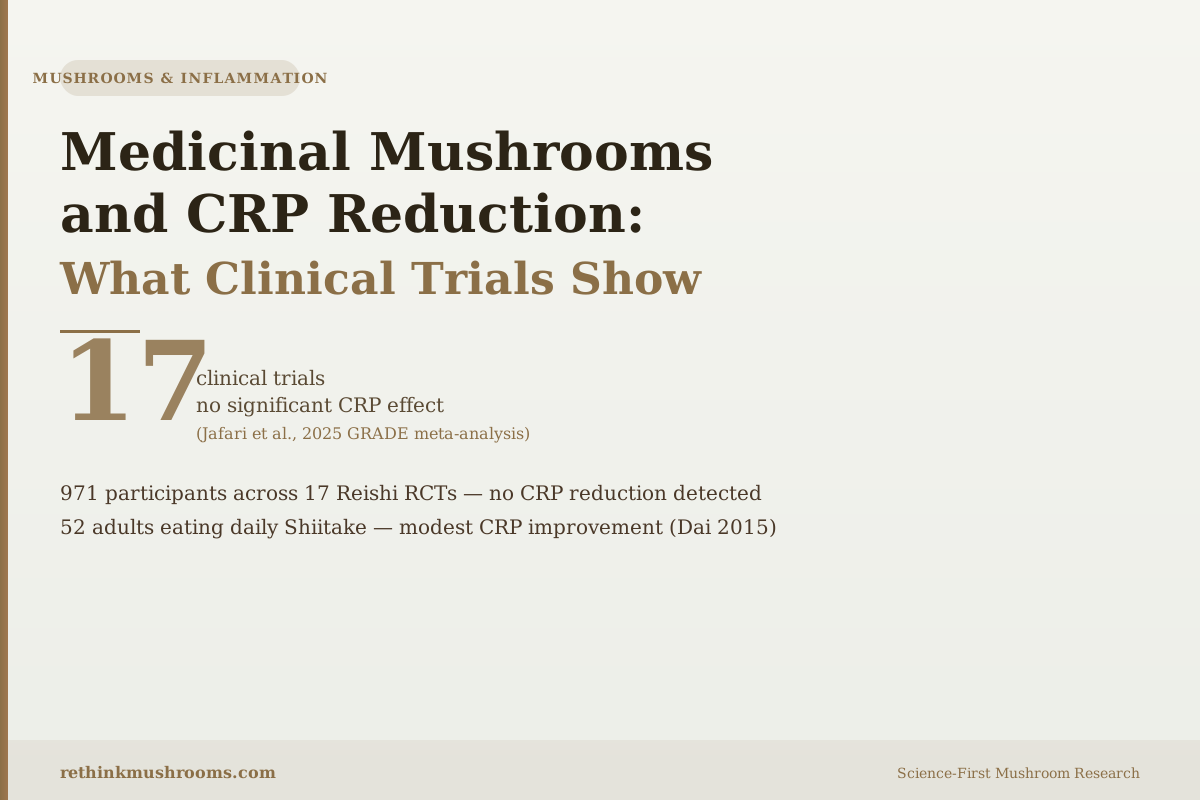
17 RCTs, no CRP effect
A 2025 GRADE meta-analysis of 17 randomized trials with 971 participants found Ganoderma lucidum supplementation had no significant effect on CRP or other inflammatory markers.
Jafari et al., Food Science & Nutrition, 2025
1 RCT
showing CRP improvement, with daily Shiitake food consumption (Dai et al., 2015)
971 patients
in the Reishi meta-analysis with consistently null CRP findings
Very low
GRADE evidence quality rating for all Reishi inflammatory outcomes (Jafari 2025)
Jafari et al., Food Science & Nutrition, 2025
 View as image ↗
The supplement marketing narrative says medicinal mushrooms lower CRP. The clinical evidence says: it depends entirely on which mushroom, which form, and which evidence you look at. The most popular mushroom marketed specifically for inflammation is Reishi. The most rigorous clinical evidence for Reishi comes from a 2025 GRADE-assessed meta-analysis of 17 randomized controlled trials with 971 participants, and the finding is unambiguous: Ganoderma lucidum supplementation had no significant effect on CRP, TNF-alpha, or any other inflammatory marker measured.[6]
Meanwhile, the mushroom with the best human evidence for modestly reducing CRP is Shiitake. Not as a supplement. As food. The strongest single study used whole Shiitake mushrooms consumed daily as part of a normal diet.[1]
This article covers the full clinical picture of medicinal mushrooms and CRP reduction: what the evidence actually shows, where the null results are, and why the gap between compelling preclinical data and clinical trial performance is larger than most health content acknowledges. For the mechanistic basis of how mushrooms interact with inflammatory pathways, see how mushrooms fight inflammation.
Key Takeaways
- CRP above 3 mg/L on a high-sensitivity test indicates elevated chronic inflammation risk; levels above 10 mg/L typically indicate acute infection or injury (American Heart Association thresholds)
- The only human RCT demonstrating CRP improvement from a single mushroom species used daily Shiitake consumption in 52 healthy young adults over 4 weeks (Dai et al., J Am Coll Nutr, 2015)
- A 2025 GRADE meta-analysis of 17 RCTs with 971 participants found Ganoderma lucidum (Reishi) supplementation had no significant effect on CRP, TNF-alpha, or other inflammatory markers (Jafari et al., Food Sci Nutr, 2025)
- GRADE evidence quality for all Reishi inflammatory outcomes was rated "very low," meaning the clinical evidence base is insufficient to support clinical recommendations
- A 2023 systematic review of 22 articles rated the evidence on mushroom consumption and hs-CRP as limited and inconsistent: a suggestive signal in experimental studies, but largely null observational data (Uffelman et al., Nutrients, 2023)
- The largest prospective cohort data (110,000+ adults in the Nurses' Health Study and Health Professionals Follow-up Study) found no association between mushroom consumption and plasma inflammation biomarkers, or with cardiovascular disease and type 2 diabetes risk (Lee et al., Am J Clin Nutr, 2019)
CRP: What It Measures and Why It's Hard to Move
C-reactive protein (CRP) is a protein produced by the liver in response to inflammation signals. When cells are damaged, infected, or stressed, they release signaling molecules (primarily interleukin-6, or IL-6) that travel to the liver and trigger CRP production. CRP is released into the bloodstream within hours. A blood test measures how much is present.
Two testing standards exist. Standard CRP tests detect levels above about 5 mg/L and are used for acute infections and inflammatory conditions. High-sensitivity CRP (hs-CRP) tests detect smaller amounts and are used for chronic, low-grade inflammation assessment.
The American Heart Association uses hs-CRP thresholds for cardiovascular risk: below 1 mg/L is low risk, 1-3 mg/L is average risk, and above 3 mg/L is high risk. Levels above 10 mg/L usually indicate acute infection or injury rather than chronic low-grade inflammation.
Chronic low-grade CRP elevation (the 2-5 mg/L range that reflects ongoing systemic inflammation from metabolic syndrome, poor diet, stress, or gut dysbiosis) is the target that most people taking "anti-inflammatory" supplements are trying to address. It is also a notoriously difficult biomarker to move with isolated supplements.
The reason: CRP is downstream of IL-6, which is downstream of NF-kappaB signaling, which is downstream of multiple triggering factors including body composition, sleep, exercise, diet quality, and gut microbiome health. Reducing CRP requires addressing its upstream drivers. A supplement that inhibits NF-kappaB in a test tube faces a long and complex pathway before that effect translates to measurable CRP changes in a person who hasn't changed their diet, sleep, or exercise patterns. For how IL-6 specifically connects to mushroom compounds, see mushroom compounds and IL-6 reduction.
The Best Human Evidence: Shiitake, Not the Most Popular Supplement
The single most directly relevant clinical trial in the mushroom-and-CRP literature is not about Reishi, Turkey Tail, or Lion's Mane. It is about Shiitake mushrooms eaten as food.
Dai and colleagues, publishing in the Journal of the American College of Nutrition in 2015, enrolled 52 healthy young adults in a randomized dietary intervention.[1] Participants consumed one serving of dried Shiitake mushrooms daily for four weeks. The outcomes included immune cell markers and inflammatory markers.
The findings: daily Shiitake consumption increased proliferation and activation of gamma-delta T cells (60% more) and NK-T cells (roughly two-fold more), shifted the cytokine pattern toward a less inflammatory profile, and produced a CRP reduction consistent with lower inflammation. These are immune benefits from food-level mushroom consumption, not from a concentrated supplement extract.
Relevant caveats: participants were healthy young adults without baseline chronic inflammation. The absolute magnitude of CRP change was modest. And this was a single trial with 52 participants. It cannot establish what the effect would be in older adults, in people with elevated baseline CRP, or in people with chronic inflammatory conditions.
What the Dai 2015 trial does establish is that daily Shiitake consumption, at dietary doses, produced measurable anti-inflammatory changes in a randomized human trial. That is a more robust level of evidence for the CRP outcome than exists for any mushroom supplement studied in a comparable trial.
The Most Rigorous Finding: Reishi Failed in 17 Clinical Trials
Ganoderma lucidum, sold as Reishi, has one of the most compelling anti-inflammatory profiles in mushroom preclinical research. Its triterpenoids and polysaccharides have demonstrated NF-kappaB inhibition, TNF-alpha suppression, and anti-inflammatory cytokine modulation in cell culture and animal models. Reviews covering its pharmacological profile have documented this evidence base consistently.[3][4]
The 2025 GRADE meta-analysis by Jafari and colleagues, published in Food Science and Nutrition, synthesized the human clinical trial evidence specifically.[6]
The scope: 17 randomized controlled trials, 971 participants total (daily doses ranging from 200 to 11,200 mg over 1 to 24 weeks), assessing Ganoderma lucidum supplementation against placebo or control conditions. The outcomes analyzed included inflammatory markers (CRP, TNF-alpha), blood pressure, lipid profile (LDL, HDL, total cholesterol, triglycerides), fasting glucose, and liver enzymes.
The finding for every inflammatory and cardiometabolic marker relevant to this article: no statistically significant effect. The pooled analysis detected no effect on inflammatory markers, blood pressure, fasting glucose, lipid profile, or liver enzymes. (The meta-analysis did report small changes in a handful of other indices, such as BMI in specific subgroups, but nothing that supports an anti-inflammatory or CRP-lowering claim.)
The GRADE quality assessment rated the evidence for all outcomes as "very low." This rating reflects concerns about risk of bias in the individual trials, inconsistency between trial results, and imprecision in the pooled estimates. Very low GRADE quality means the evidence cannot support clinical recommendations.
Jafari et al. (2025) · Food Science & Nutrition
- Population
- 971 participants across 17 RCTs (healthy, at-risk, and chronic-disease adults)
- Intervention
- Ganoderma lucidum (Reishi) supplementation, 200–11,200 mg/day for 1–24 weeks
- Comparator
- Placebo or control
- Finding
- No significant effect on inflammatory markers (CRP, TNF-alpha), blood pressure, fasting glucose, lipid profile, or liver enzymes. GRADE certainty rated very low across all outcomes.
null Preclinical anti-inflammatory activity did not translate to measurable human CRP reduction.
Jafari et al. (2025), Food Science & Nutrition [ref 6]
To be clear about what this means: the meta-analysis did not establish that Reishi harms people or that it cannot work. It established that the existing human trial data is insufficient to conclude that Reishi supplementation reduces CRP or other inflammatory markers. The preclinical evidence remains; the human trial evidence does not support it.
This finding matters specifically because Reishi is marketed to consumers as an anti-inflammatory supplement more aggressively than almost any other mushroom. People taking Reishi specifically hoping to lower CRP are doing so without human trial support.
Fact Check
Myth vs. evidence
The claim
“Reishi supplements lower CRP and calm chronic inflammation.”
Preclinical NF-kappaB and TNF-alpha data plus supplement marketing
What research shows
UnsupportedIn the pooled human trial data (17 RCTs, 971 participants), Reishi supplementation produced no significant change in CRP or other inflammatory markers.
The compounds are genuinely active in cell and animal models, but that activity has not shown up as measurable CRP reduction in randomized human trials, and the overall evidence certainty is rated very low.
Jafari et al. (2025), Food Science & Nutrition [ref 6]
For how mushroom triterpenes (including Reishi's ganoderic acids) interact with inflammatory pathways at the molecular level, see mushroom triterpenes and TNF-alpha suppression.
Mixed Results: What the Systematic Review Picture Shows
The 2023 systematic review by Uffelman and colleagues, published in Nutrients, assessed 22 articles (11 experimental and 11 observational) on mushroom consumption and cardiometabolic risk factors, including inflammatory biomarkers.[5]
The assessment: limited evidence from the experimental (interventional) studies suggested mushroom consumption may lower blood triglycerides and hs-CRP, but the review rated the hs-CRP evidence as insufficient and inconsistent overall. The observational evidence was largely null, with several cohort analyses finding no association between mushroom consumption and inflammatory or cardiometabolic biomarkers. The majority of the included studies were rated "poor" quality on the NHLBI study-quality assessment tool.
The interpretation challenge: the studies differ by species (Shiitake vs. generic mushroom consumption), form (whole food vs. supplement), population (healthy vs. metabolic syndrome), duration, and outcome measurement. No unified conclusion can be drawn. Different mushrooms, in different forms, may have different effects in different populations.
The Lee 2019 cohort study adds the longest time horizon and largest sample size to the picture, and its result is a cautionary one.[2] Following 67,139 women in the Nurses' Health Study and 43,541 men in the Health Professionals Follow-up Study across more than two million person-years, the investigators found no association between mushroom consumption and plasma biomarkers of lipids, insulin, or inflammation, and no association with the risk of cardiovascular disease or type 2 diabetes. This is the largest and longest human dataset on the question, and at the population level it does not show that eating more mushrooms lowers inflammation.
The Human Evidence, Mapped
Every Human Study on Mushrooms and CRP, by Form and Verdict
The one positive result is a small food-based trial. The larger dataset and the supplement meta-analysis are both null, and the systematic review calls the evidence insufficient. Form and sample size, not the headline, tell the story.
Daily Shiitake eaten as food; modest CRP drop in an already-low-risk group.
Largest, longest dataset; no link to inflammation biomarkers or CVD/T2D risk.
A suggestive experimental signal, but hs-CRP evidence rated insufficient overall.
Reishi supplementation; no effect on inflammatory markers, GRADE very low.
Read down the verdict column: one small positive food trial, one large null cohort, one “insufficient” review, and a null supplement meta-analysis. That is the entire human case, and it does not support a reliable CRP-lowering claim for mushroom supplements.
Sources: Dai et al. (2015) [ref 1]; Lee et al. (2019) [ref 2]; Uffelman et al. (2023) [ref 5]; Jafari et al. (2025) [ref 6].
Why Preclinical Evidence Doesn't Always Translate to Clinical Results
The gap between compelling lab evidence and null clinical trials is common in nutrition research and is not specific to mushrooms. Three mechanisms explain most of it.
First, laboratory doses are not supplement doses. Cell culture and animal studies frequently use concentrations of bioactive compounds that are many times higher than what any commercially available supplement delivers per dose. A mushroom polysaccharide that suppresses NF-kappaB at 200 micrograms per milliliter in a cell dish may not reach relevant tissue concentrations at a 500mg supplement capsule dose.
Second, standardization varies enormously. Studies reporting anti-inflammatory effects in lab settings often use purified fractions with documented compound concentrations. Consumer supplements vary widely in beta-glucan content, extraction method, and bioactive compound density. A product labeled "Reishi extract" may contain anywhere from trace amounts to significant concentrations of the triterpenoids responsible for preclinical anti-inflammatory activity.
Third, CRP is a downstream biomarker. Moving it in a meaningful and sustained direction requires changing multiple upstream factors simultaneously. The NF-kappaB inhibition that Reishi demonstrates in preclinical settings is one input into a much larger and more complex inflammatory network. Isolated supplementation without dietary, exercise, or other lifestyle changes faces a high bar for producing detectable CRP shifts.
- Cell studiescompleted
Reishi triterpenoids and polysaccharides inhibit NF-kappaB and TNF-alpha in vitro
- Animal modelscompleted
Anti-inflammatory effects shown in rodent models
- Small human RCTcompleted
Dai 2015: daily Shiitake food (n=52) reduced CRP in healthy young adults
- Large dedicated CRP RCTmissing
No large, adequately powered trial in people with elevated baseline CRP
- Meta-analysiscompleted
Jafari 2025: 17 Reishi RCTs (n=971) found no CRP effect; GRADE very low
The evidence pyramid is populated but points the wrong way for supplements: strong preclinical signals, one small positive food RCT, no large dedicated CRP trial, and a meta-analysis showing no effect for Reishi supplementation at very low certainty.
Dai et al. (2015) [ref 1]; Jafari et al. (2025) [ref 6]
For context on how mushrooms interact with the gut microbiome (itself a key driver of systemic inflammation), see how mushrooms change your gut microbiome. For how beta-glucans may produce longer-lasting immune effects through epigenetic reprogramming, see how beta-glucans epigenetically reprogram immune cells.
Whole Mushrooms vs. Supplements: What the Evidence Suggests About Form
It is tempting to conclude that whole dietary mushrooms outperform isolated supplements for inflammation, but the human evidence does not cleanly support even that. What can be said with confidence is narrower: the isolated-supplement evidence is actively negative (Reishi failed across 17 RCTs in Jafari 2025), while the whole-food evidence is mixed rather than reliably positive.
The whole-food picture holds one small positive RCT (Dai 2015, Shiitake eaten as food), one large null cohort (Lee 2019, dietary mushroom intake), and a systematic review (Uffelman 2023) that rated the hs-CRP evidence insufficient. So the honest statement is that the only randomized human trial to show a CRP reduction happened to use food rather than a supplement, but that is a single small trial, not an established pattern.
One hypothesis for why food might matter more than an extract: whole mushrooms contain fiber (including prebiotic beta-glucans), ergosterol (a vitamin D precursor), a full array of polysaccharides, proteins, and minor bioactive compounds. They may influence CRP partly by feeding beneficial gut bacteria (reducing the dysbiosis component of chronic inflammation), partly by providing vitamin D precursors, and partly through polysaccharide anti-inflammatory activity, inputs no single extracted compound delivers together. But as the Lee cohort shows, delivering them through ordinary diet has not reliably moved inflammation markers at the population level either.
The broader lesson from Uffelman 2023 is methodological: most of the human studies on mushrooms and cardiometabolic markers were rated poor quality, which is a large part of why no confident conclusion, positive or negative, can yet be drawn about mushrooms and CRP specifically.
For readers with elevated CRP looking to understand all the mushroom-inflammation mechanisms: see mushrooms for chronic inflammation: cross-species research and mushrooms and C-reactive protein: can fungi lower chronic inflammation markers.
Safety
LowElevated CRP is a medical finding, not a supplement problem
Concern
A persistently elevated hs-CRP (above 3 mg/L) can reflect cardiovascular risk, metabolic disease, or an undiagnosed infection or inflammatory condition, and no mushroom supplement has been shown to reliably lower it.
What the research says
Treat an elevated CRP as a prompt to look upstream, at diet, body composition, sleep, activity, and any underlying condition, with a clinician, rather than something a supplement is expected to fix.
Particularly relevant for: Anyone with a known-elevated hs-CRP or a chronic inflammatory or cardiovascular condition
What to do
Discuss elevated CRP results and any supplement use with a qualified healthcare professional. This article is educational and is not medical advice.
American Heart Association hs-CRP risk thresholds; Jafari et al. (2025) [ref 6]
The Bottom Line
The clinical evidence for medicinal mushrooms reducing CRP is more mixed and honest than most health content acknowledges. The most rigorous evidence (Jafari 2025 meta-analysis, 17 RCTs, 971 participants) found that Reishi supplementation had no significant CRP effect, with very low GRADE quality across all inflammatory outcomes. The best positive human evidence is a single Shiitake food RCT (Dai 2015) showing modest CRP improvement in healthy adults. The largest dietary cohort (Lee 2019, 110,000+ adults) found no association between mushroom consumption and inflammation biomarkers, and a 2023 systematic review (Uffelman) rated the hs-CRP evidence insufficient. The gap between compelling preclinical evidence and null clinical trials reflects dose, standardization, and the complexity of moving a downstream inflammation biomarker with isolated supplementation.
Frequently Asked Questions
Sources & References
- 1RTHM-00368·Dai, Xiaoshuang et al. (2015). “Consuming Lentinula edodes (Shiitake) Mushrooms Daily Improves Human Immunity: A Randomized Dietary Intervention in Healthy Young Adults..” Journal of the American College of Nutrition.Study breakdown →PubMed →↩
- 2RTHM-00567·Lee, Dong Hoon et al. (2019). “Mushroom consumption, biomarkers, and risk of cardiovascular disease and type 2 diabetes: a prospective cohort study of US women and men..” The American journal of clinical nutrition.Study breakdown →PubMed →↩
- 3RTHM-01321·Ahmad, Rizwan et al. (2021). “Ganoderma lucidum (Reishi) an edible mushroom; a comprehensive and critical review of its nutritional, cosmeceutical, mycochemical, pharmacological, clinical, and toxicological properties..” Phytotherapy research : PTR.Study breakdown →PubMed →↩
- 4RTHM-01332·Chan, Sze Wa et al. (2021). “The beneficial effects of Ganoderma lucidum on cardiovascular and metabolic disease risk..” Pharmaceutical biology.Study breakdown →PubMed →↩
- 5RTHM-01810·Uffelman, Cassi N et al. (2023). “An Assessment of Mushroom Consumption on Cardiometabolic Disease Risk Factors and Morbidities in Humans: A Systematic Review..” Nutrients.Study breakdown →PubMed →↩
- 6RTHM-02098·Jafari, Ali et al. (2025). “The Nutritional Significance of Ganoderma lucidum on Human Health: A GRADE-Assessed Systematic Review and Meta-Analysis of Clinical Trials..” Food science & nutrition.Study breakdown →PubMed →↩