Mushrooms & Inflammation
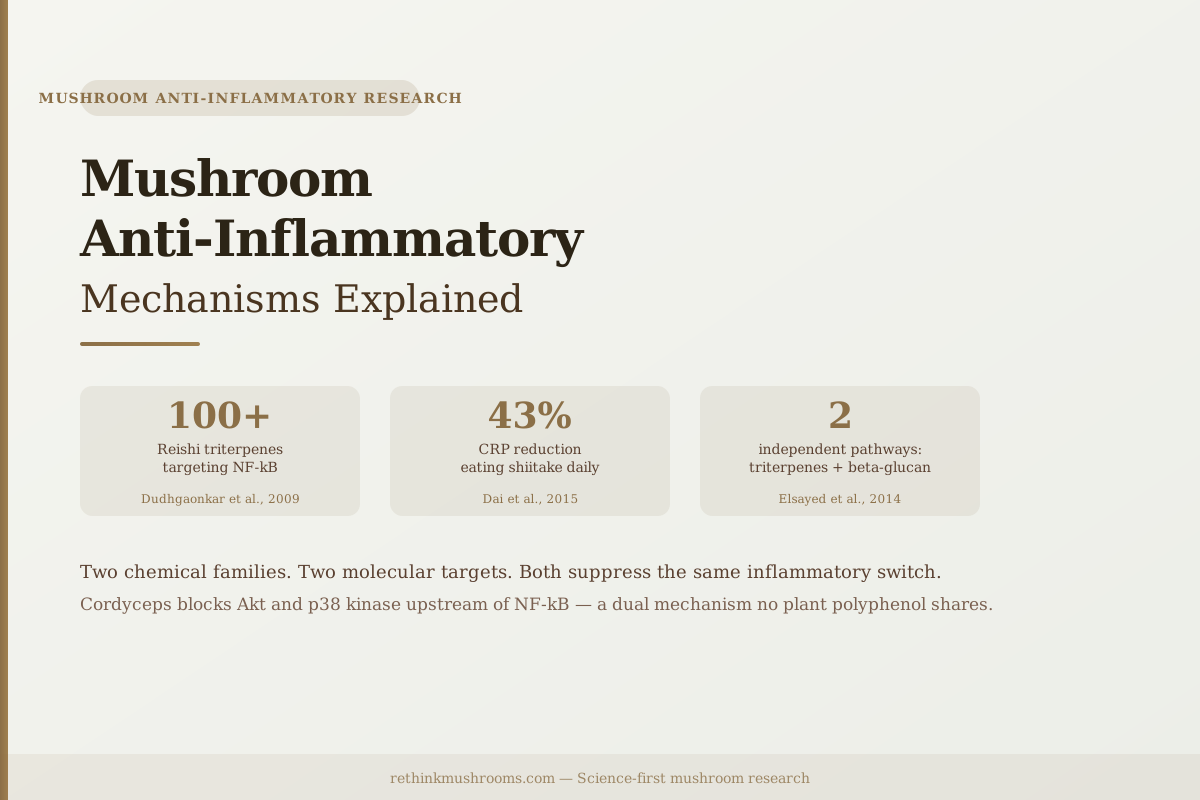
100+ distinct triterpenes in Reishi, each targeting NF-kB
Ganoderma lucidum contains over 100 distinct triterpenes with anti-inflammatory activity, each suppressing NF-kB and MAPK pathways at concentrations of 4.59-21.60 micromolar.
Dudhgaonkar et al., Int Immunopharmacol, 2009
2 pathways
NF-kB suppression (triterpenes) and Dectin-1 activation (beta-glucan) operating independently
2 RCTs
in humans showing measurable anti-inflammatory effects: Lima 2012 and Dai 2015
Dual block
oyster mushroom suppresses both NF-kB AND AP-1 simultaneously (unique among studied species)
Dudhgaonkar et al., Int Immunopharmacol, 2009
 View as image ↗
Most consumer content about mushrooms and inflammation gets the story backwards. It names species first ("Reishi is anti-inflammatory") and mechanisms last or never. But the mechanisms are what determine whether any particular mushroom species does anything useful in your body, at what dose, for which type of inflammation.
The short version: medicinal mushrooms fight inflammation through two distinct compound classes operating on different molecular targets. Triterpenes, concentrated in Reishi and Chaga, directly suppress the proteins that trigger inflammatory gene expression. Beta-glucan polysaccharides, present in every medicinal mushroom, activate immune receptors that then regulate cytokine production. These are not the same mechanism described twice. They operate independently and show synergistic effects when combined.
This guide maps each major species to its primary compounds and the specific inflammatory pathways those compounds affect. For the pillar overview of how mushrooms fight inflammation broadly, see How Mushrooms Fight Inflammation: NF-kB, COX-2, and Beyond.
Key Takeaways
- Mushroom anti-inflammatory activity divides between two compound classes: triterpenes (direct NF-kB/MAPK suppression at 4.59-21.60 micromolar) and beta-glucan polysaccharides (Dectin-1 receptor activation triggering cytokine regulation) (Elsayed et al., 2014).
- Reishi contains 100+ distinct triterpenes all targeting NF-kB, representing more anti-inflammatory triterpene diversity than any other studied mushroom species (Dudhgaonkar et al., 2009).
- Oyster mushroom is unique in suppressing both NF-kB AND AP-1 simultaneously, blocking two independent inflammatory transcription factors that most anti-inflammatory compounds only hit one of (Jedinak et al., 2011).
- Cordyceps cordycepin blocks inflammation upstream by inhibiting two kinases (Akt and p38) before NF-kB ever gets activated, making its mechanism more similar to kinase inhibitor drugs than to COX inhibitors (Kim et al., 2006).
- Two human randomized controlled trials confirm anti-inflammatory effects: Agaricus blazei extract modulated inflammatory mediators in elderly women (Lima 2012), and daily shiitake consumption for 4 weeks reduced CRP in healthy young adults (Dai 2015).
- Beta-glucan structure determines potency; not all mushroom beta-glucans are equally effective, and the 1,3-branching pattern is what drives cytokine-inducing activity in macrophages (Okazaki et al., 1995).
The Mechanism Map: Species, Compound, Pathway, and Evidence Level
| Species | Primary Anti-Inflammatory Compound | Pathway | Strongest Evidence |
|---|---|---|---|
| Reishi | Triterpenes (100+ types) | NF-kB + MAPK suppression | In vitro (Dudhgaonkar 2009) |
| Chaga | Phenolics, ergosterol peroxide | NF-kB: TNF-a, IL-1b, IL-6 | In vitro (Kim 2007) |
| Lion's Mane | Beta-glucan, erinacines | NF-kB, COX-2, IL-6 | Animal/colitis model (Qin 2016) |
| Oyster | Beta-glucan polysaccharides | NF-kB + AP-1 (dual suppression) | In vitro (Jedinak 2011) |
| Cordyceps | Cordycepin (adenosine analog) | Akt + p38 kinase, then NF-kB | In vitro (Kim 2006) |
| Shiitake | Lentinan (beta-glucan) | TLR/immune modulation | Human RCT (Dai 2015) |
| Agaricus blazei | Beta-glucan polysaccharides | Cytokine modulation | Human RCT (Lima 2012) |
Two Compound Classes, Two Pathways: The Organizing Framework
Elsayed and colleagues conducted one of the most comprehensive cross-species reviews of mushroom anti-inflammatory activity in 2014. Their analysis established a picture that most consumer content has never adopted: mushroom anti-inflammatory activity is not a single mechanism but a multi-compound, multi-pathway system where different chemical classes target different points in the inflammatory cascade. [1]
The first compound class is triterpenes. These are lipid-soluble molecules that pass through cell membranes and directly inhibit proteins inside the cell that control inflammatory gene expression. They work at micromolar concentrations and directly suppress the NF-kB and MAPK signaling proteins that function as master switches for inflammation.
The second compound class is beta-glucan polysaccharides. These are water-soluble, large molecules that cannot pass through cell membranes. Instead, they bind to a receptor on the outside of immune cells called Dectin-1, triggering a signaling cascade that activates immune cells and then regulates which inflammatory cytokines those cells produce. The polysaccharide mechanism is not purely suppressive; it first activates immune cells and then modulates their cytokine output toward a more balanced profile.
Understanding this split is essential for interpreting the evidence. When you see a triterpene extract showing strong NF-kB suppression in cell studies, and a beta-glucan extract showing cytokine regulation in macrophage experiments, these are not competing findings about which mechanism is "right." They are two different systems operating simultaneously in a whole mushroom extract.
Reishi: Why 100+ Triterpenes Is a Meaningful Number
Ganoderma lucidum (Reishi) is unusual among medicinal mushrooms because it contains an exceptionally large number of distinct triterpene compounds. Dudhgaonkar and colleagues identified that Ganoderma contains more than 100 distinct triterpenes with individual anti-inflammatory activities in a 2009 study that purified and characterized these compounds. [3]
The significance of 100+ distinct triterpenes is not just chemical diversity. Each triterpene has a slightly different molecular structure, and those structural differences mean slightly different binding affinities and different potencies at specific points in the inflammatory pathway. The range of IC50 values (the concentration that inhibits 50% of activity) across Ganoderma triterpenes spans 4.59 to 21.60 micromolar. At the lower end, some Ganoderma triterpenes are highly potent; at the upper end, others are milder. The collective effect of 100+ compounds acting in this concentration range creates a broad, overlapping inhibitory effect across the inflammatory cascade.
The specific mechanism is NF-kB pathway suppression. Reishi triterpenes prevent the NF-kB transcription factor (the protein that enters the cell nucleus and switches on inflammatory genes) from binding to DNA. They do this by blocking phosphorylation of p65, which is the step that activates NF-kB and allows it to function as a transcription factor. Without p65 phosphorylation, NF-kB cannot turn on genes for COX-2, iNOS, TNF-alpha, and IL-1beta.
The practical implication of Reishi's triterpene diversity is that it makes Reishi unusually well-suited for broad NF-kB inhibition compared to species with fewer triterpene types. Species with only a few triterpenes may have strong effects in cell culture studies with specific stimulants, but a narrower range of compounds means narrower real-world coverage.
Chaga, Lion's Mane, and Oyster: Three Mechanisms Worth Distinguishing
Chaga (Inonotus obliquus) works primarily through its phenolic compounds and ergosterol peroxide, which target inflammatory signaling in macrophages. Kim and colleagues tested Chaga extract against LPS-stimulated macrophages and found significant suppression of TNF-alpha, IL-1beta, and IL-6. [4] TNF-alpha is a primary "upstream" inflammatory signal that triggers subsequent cascades; its suppression by Chaga provides a broad dampening effect on inflammatory gene expression. Chaga's anti-inflammatory mechanism runs through NF-kB pathway inhibition, but the specific compound class (phenolics rather than triterpenes) is distinct from Reishi's mechanism.
Lion's Mane (Hericium erinaceus) is most commonly discussed for cognitive benefits (its nerve growth factor stimulation). The anti-inflammatory evidence is less widely covered but more specific than consumer content suggests. Qin and colleagues tested Lion's Mane extract in mice with ulcerative colitis and found significant reductions in TNF-alpha, IL-6, and COX-2 expression in colon tissue. [5] The colitis model is relevant because colon inflammation involves the same NF-kB cascade that drives other inflammatory conditions. Lion's Mane's anti-inflammatory activity is through beta-glucan and erinacine compounds acting on the NF-kB pathway in gut-associated immune tissue.
Oyster mushroom (Pleurotus ostreatus) has a mechanism distinction that makes it stand out in the research. Jedinak and colleagues demonstrated that oyster mushroom extract suppresses both NF-kB and AP-1, two separate inflammatory transcription factors that operate independently. [6] AP-1 is a second major inflammatory switch that most anti-inflammatory compounds, including many NSAIDs, do not block. When both NF-kB and AP-1 are suppressed simultaneously, the result is broader reduction of downstream inflammatory mediators including PGE2 (from COX-2), nitric oxide (from iNOS), TNF-alpha, and IL-1beta. The dual suppression is the "and beyond" angle that most consumer content ignores entirely.
Cordyceps: The Upstream Approach
Cordyceps' primary anti-inflammatory compound is cordycepin, a structural analog of adenosine. Kim and colleagues traced its mechanism in detail using LPS-activated macrophage cells. [7]
Cordycepin does not suppress NF-kB directly. It blocks two upstream kinase enzymes: Akt and p38 MAPK. These kinases are part of the signaling cascade that leads to NF-kB activation. When a cell receives an inflammatory stimulus (LPS, cytokines, bacterial products), the signal travels through a kinase relay before reaching NF-kB. Akt and p38 are relay stations in that chain.
By inhibiting both Akt and p38, cordycepin prevents the inflammatory signal from reaching NF-kB in the first place. The result is that NF-kB never gets activated, and none of its downstream inflammatory genes (COX-2, iNOS, TNF-alpha, IL-1beta) get expressed. This is an upstream mechanism, comparable in concept to how kinase inhibitor drugs work in oncology: instead of blocking the final effector, cordycepin blocks the signal amplification steps that would have activated it.
The dual kinase targeting means cordycepin potentially has broader coverage than compounds that only hit one kinase or only suppress NF-kB at the nuclear binding step. The limitation, as with all in vitro work, is that these concentrations and mechanisms have not been confirmed in human clinical trials.
The Human Evidence: Two RCTs That Move Beyond Cell Cultures
The gap between in vitro mechanism studies (cell culture) and human clinical relevance is significant. Most of what is known about mushroom anti-inflammatory mechanisms comes from studies in macrophage cell lines and mouse models. Two randomized controlled trials provide the bridge to human data.
Evidence Hierarchy
Mushroom Anti-Inflammatory Evidence — A Wide Base, A Narrow Top
Almost everything known about how mushrooms fight inflammation comes from cell studies. Animal disease models add a middle rung, including the test of whether these compounds even survive digestion. Only two human randomized controlled trials sit at the top. Bar width reflects how much direct evidence sits at each tier — not how large the effect is.
Human randomized controlled trial
humanLima 2012 [9] · Dai 2015 [10]
Genuine but thin. Agaricus blazei extract modulated inflammatory mediators in elderly women; four weeks of dietary shiitake lowered CRP in healthy young adults. Two trials only, in different species and populations — this is the ceiling of the human evidence, not a broad clinical base.
Animal disease model
preclinicalQin 2016 [5] · Lavi 2010 [8]
Lion’s Mane cut TNF-a, IL-6 and COX-2 in the colons of colitis mice. Separately, oral Pleurotus beta-glucan still reduced colitis inflammation after digestion — the test of whether these large molecules survive the gut at all.
Cell / macrophage mechanism
preclinicalDudhgaonkar 2009 [3] · Jedinak 2011 [6] · Kim 2006 [7] · Kim 2007 [4] · Okazaki 1995 [2]
The foundational and best-replicated tier, and where nearly all the data lives: Reishi triterpenes suppress NF-kB; oyster extract blocks NF-kB and AP-1; cordycepin shuts down Akt and p38 upstream; Chaga phenolics cut TNF-a, IL-1b and IL-6; glucan branching structure sets potency.
Cross-species synthesis
synthesisElsayed 2014 [1]
A review organizing the field into the two-compound, two-pathway framework the rest of this article uses — triterpenes acting directly inside the cell, beta-glucans acting through the Dectin-1 receptor.
How to read it: the base is widest because the cell-level mechanism is where the evidence is deep and well replicated across species. The value of the top two rungs is not their volume but their kind — a live animal and then a living human, showing the effect survives a whole organism. The honest limit of the mushroom anti-inflammatory claim is that the human tier, while real, is only two trials wide.
Sources: Elsayed 2014 [1]; Okazaki 1995 [2]; Dudhgaonkar 2009 [3]; Kim 2007 [4]; Qin 2016 [5]; Jedinak 2011 [6]; Kim 2006 [7]; Lavi 2010 [8]; Lima 2012 [9]; Dai 2015 [10]. Bar widths are illustrative of evidence depth per tier, not effect sizes.
Lima and colleagues conducted an RCT testing Agaricus blazei Murrill extract in elderly women and measured inflammatory mediators at baseline and after supplementation. The trial showed statistically significant modulation of inflammatory mediators in the treatment group. [9] Elderly populations typically have elevated baseline inflammation, making this a relevant test population. The study does not specify which inflammatory pathway was affected at the same level of detail that cell culture studies can, but it confirms measurable immune modulation in real humans.
Dai and colleagues conducted an RCT in healthy young adults who consumed 5-10 grams of dried shiitake mushroom daily for four weeks. The trial showed improvements in immune cell function (NK cell and T-cell proliferation) and reductions in C-reactive protein (CRP), a blood marker of systemic inflammation. [10] CRP reduction in a healthy population over four weeks of dietary shiitake consumption is the most practically relevant finding in the mushroom anti-inflammatory literature, because it reflects a real food intervention rather than a concentrated extract.
Neither RCT explains the mechanism in the way cell culture studies do. But both confirm that measurable immune changes occur in humans from mushroom consumption at quantities that are achievable through diet, not just from high-dose supplements.
Oral Bioavailability: Whether Anti-Inflammatory Effects Survive Digestion
A reasonable question about any in vitro finding is whether the active compound survives stomach acid and digestive enzymes to reach the target tissue in functional form. For mushroom polysaccharides, this is a particularly important question because large complex molecules are often degraded during digestion.
Lavi and colleagues addressed this directly by administering Pleurotus pulmonarius beta-glucans orally to mice with experimentally induced colitis. If beta-glucan was destroyed in digestion, no anti-inflammatory effect would reach the colon. The study showed significant reduction in acute colitis inflammation following oral beta-glucan administration. [8] This confirms that at least some anti-inflammatory activity from mushroom polysaccharides survives oral administration and has downstream effects in gut tissue.
The bioavailability picture for triterpenes is different. As lipid-soluble molecules, triterpenes are absorbed through the gut wall more readily than large polysaccharides, though their plasma concentrations and tissue distribution in humans have not been as thoroughly characterized as their in vitro activities.
Why Beta-Glucan Structure Determines Potency
A final mechanism point that most consumer content ignores: not all beta-glucans from mushrooms are equally potent as anti-inflammatory or immunomodulatory compounds.
Okazaki and colleagues demonstrated in foundational work that the specific branching structure of 1,3-beta-D-glucans determines their potency for macrophage cytokine induction. [2] Glucans with more frequent branching at the 1,6 positions were more potent at inducing cytokine production than linear glucans with the same glucose backbone. This structure-activity relationship means that different species of mushrooms, even if they all contain "beta-glucan," do not necessarily have equivalent biological potency.
The practical implication is that supplements standardized to "30% beta-glucans" are not all equivalent, because that percentage says nothing about the branching pattern that determines activity. Species with highly branched 1,3/1,6-glucans (lentinan from shiitake, schizophyllan from Schizophyllum commune) are more potent immunomodulators per gram than species with less branched glucan structures.
This is why species identity matters in mushroom supplement research. The anti-inflammatory mechanisms described above are species-specific expressions of general principles, and the specific compound profile of each species, not just whether it contains beta-glucan, is what determines its activity.
For a direct comparison of triterpene versus polysaccharide mechanisms, including the synergy data showing combined extracts outperform either class alone, see Triterpenes vs. Polysaccharides: Different Anti-Inflammatory Pathways. For the cytokine-by-cytokine breakdown across species, see How Mushrooms Modulate Inflammatory Cytokines. The mechanistic vocabulary article explaining NF-kB and COX-2 step-by-step is at How Mushrooms Fight Inflammation: NF-kB, COX-2, and Cytokine Modulation Explained.
Cross-cluster: Grifola frondosa D-Fraction and MD-Fraction: Understanding Maitake's Key Extracts shows the same Dectin-1 mechanism detailed here in a species-specific context.
The Bottom Line
Medicinal mushrooms reduce inflammation through two distinct compound classes: triterpenes (direct NF-kB and MAPK suppression, strongest in Reishi with 100+ distinct types) and beta-glucan polysaccharides (Dectin-1 receptor activation, cytokine regulation). Oyster mushroom is unique in simultaneously suppressing both NF-kB and AP-1. Cordyceps cordycepin blocks two upstream kinases before NF-kB is activated. Two human RCTs confirm measurable anti-inflammatory effects: Agaricus blazei in elderly women (Lima 2012) and dietary shiitake reducing CRP in healthy young adults (Dai 2015). Most mechanistic data comes from in vitro studies; the human evidence base is limited to these two trials.
Frequently Asked Questions
Sources & References
- 1RTHM-00590·Elsayed, Elsayed A et al. (2014). “Mushrooms: a potential natural source of anti-inflammatory compounds for medical applications..” Mediators of inflammation.Study breakdown →PubMed →↩
- 2RTHM-00017·Okazaki, M et al. (1995). “Structure-activity relationship of (1-->3)-beta-D-glucans in the induction of cytokine production from macrophages, in vitro..” Biological & pharmaceutical bulletin.Study breakdown →PubMed →↩
- 3RTHM-00152·Dudhgaonkar, Shailesh et al. (2009). “Suppression of the inflammatory response by triterpenes isolated from the mushroom Ganoderma lucidum..” International immunopharmacology.Study breakdown →PubMed →↩
- 4RTHM-00117·Kim, Ho-Gyoung et al. (2007). “Ethanol extract of Inonotus obliquus inhibits lipopolysaccharide-induced inflammation in RAW 264.7 macrophage cells..” Journal of medicinal food.Study breakdown →PubMed →↩
- 5RTHM-00442·Qin, Mingming et al. (2016). “Anti-Inflammatory Effects of Ethanol Extract of Lion's Mane Medicinal Mushroom, Hericium erinaceus (Agaricomycetes), in Mice with Ulcerative Colitis..” International journal of medicinal mushrooms.Study breakdown →PubMed →↩
- 6RTHM-00219·Jedinak, Andrej et al. (2011). “Anti-inflammatory activity of edible oyster mushroom is mediated through the inhibition of NF-κB and AP-1 signaling..” Nutrition journal.Study breakdown →PubMed →↩
- 7RTHM-00103·Kim, Ho Gyoung et al. (2006). “Cordycepin inhibits lipopolysaccharide-induced inflammation by the suppression of NF-kappaB through Akt and p38 inhibition in RAW 264.7 macrophage cells..” European journal of pharmacology.Study breakdown →PubMed →↩
- 8RTHM-00190·Lavi, Iris et al. (2010). “Orally administered glucans from the edible mushroom Pleurotus pulmonarius reduce acute inflammation in dextran sulfate sodium-induced experimental colitis..” The British journal of nutrition.Study breakdown →PubMed →↩
- 9RTHM-00254·Lima, C U J O et al. (2012). “Agaricus blazei Murrill and inflammatory mediators in elderly women: a randomized clinical trial..” Scandinavian journal of immunology.Study breakdown →PubMed →↩
- 10RTHM-00368·Dai, Xiaoshuang et al. (2015). “Consuming Lentinula edodes (Shiitake) Mushrooms Daily Improves Human Immunity: A Randomized Dietary Intervention in Healthy Young Adults..” Journal of the American College of Nutrition.Study breakdown →PubMed →↩