Mushrooms & Inflammation
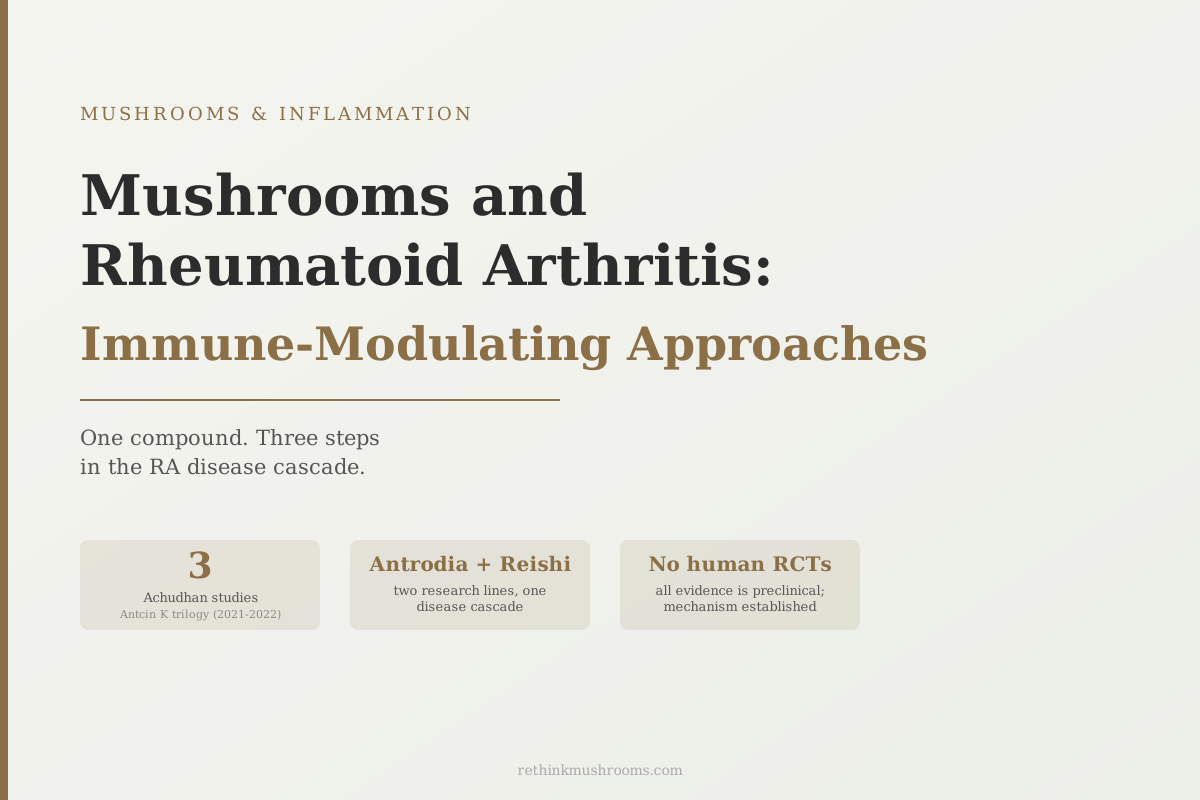
3 connected studies
Achudhan and colleagues published three papers (2021 and 2022) showing that Antcin K, a compound from the Taiwanese medicinal mushroom Antrodia camphorata, targets three distinct steps in the rheumatoid arthritis disease cascade: cytokine production, inflammatory cell recruitment into joints, and the new blood vessel formation that feeds joint-destroying tissue.
Achudhan et al., Frontiers in Immunology, 2021; Food & Nutrition Research, 2022; Journal of Food Biochemistry, 2022
TNF-α, IL-1β, IL-8
the three inflammatory signals Antcin K inhibited in human RA synovial fibroblasts; also reduced MMP-3 and MMP-13, the cartilage-degrading enzymes (Achudhan et al., 2021)
Multi-target reishi
Ganoderma lucidum polysaccharides inhibit synovial cell proliferation, modulate immune cell balance, and protect bone-forming cells; reviewed in Meng et al., Molecules, 2023
No human RCTs yet
all RA-relevant mushroom research to date is in cell cultures or animal models; clinical translation remains unproven
Achudhan et al., Frontiers in Immunology, 2021; Food & Nutrition Research, 2022; Journal of Food Biochemistry, 2022
 View as image ↗
Rheumatoid arthritis is not a wear-and-tear problem. It's an immune system error: the body's defenses mistake joint tissue for a foreign threat and attack it, flooding the joint with inflammatory signals that slowly destroy cartilage, bone, and surrounding tissue. The question of whether mushrooms can help with RA is really asking whether any mushroom compounds can interrupt that immune attack, not just reduce generic inflammation.
The research on mushrooms and rheumatoid arthritis is narrow but unusually specific. Two research lines, one focused on Antrodia camphorata and another on Ganoderma lucidum (reishi), have produced preclinical studies targeting the exact molecular steps that drive RA joint destruction. This article covers what those studies show, what the evidence trail looks like, and what the research cannot yet establish.
For the broader framework of how mushrooms modulate inflammatory pathways, including NF-kB and COX-2, see the foundational guide at How Mushrooms Fight Inflammation: NF-kB, COX-2, and Beyond.
Key Takeaways
- Antcin K, a triterpenoid from Antrodia camphorata, dose-dependently inhibited TNF-alpha, IL-1beta, and IL-8 in human RA synovial fibroblasts (the cells lining the inflamed joint), while also reducing MMP-3 and MMP-13, the enzymes that digest cartilage collagen (Achudhan et al., Front Immunol, 2021)
- A 2022 follow-up found Antcin K blocked VCAM-1 expression in RA synovial tissue, preventing monocytes (circulating inflammatory cells) from adhering to and entering the joint, stopping the inflammatory amplification cycle (Achudhan et al., Food Nutr Res, 2022)
- A second 2022 paper completed the trilogy: Antcin K inhibited VEGF secretion and new blood vessel formation in RA synovial tissue, targeting the angiogenesis that supplies pannus with the blood it needs to grow and invade cartilage (Achudhan et al., J Food Biochem, 2022)
- Ganoderma lucidum polysaccharides (GLP) have a multi-target anti-RA profile reviewed in 2023: inhibiting synovial fibroblast proliferation, modulating T and B lymphocyte balance, blocking angiogenesis, reducing MMP production, and promoting osteoblast activity that protects bone (Meng et al., Molecules, 2023)
- In a collagen-induced arthritis rat model, Ganoderma lucidum polysaccharide peptide (GLPP) significantly reduced joint swelling, inflammatory cytokines, and joint destruction scores via dual inhibition of NF-kB and MAPK signaling (Meng et al., 2023)
- A 2024 Reishi nanogel formulation delivered anti-arthritic, anti-inflammatory, and antioxidative effects in a rat arthritis model, with improved bioavailability compared to crude extract (Lin et al., Int J Med Mushrooms, 2024)
Why Rheumatoid Arthritis Needs a Different Approach Than Other Joint Conditions
The distinction between rheumatoid arthritis and osteoarthritis matters for mushroom research because the two diseases work through completely different biological processes.
Osteoarthritis begins with mechanical damage. Cartilage wears down over decades, and the secondary inflammation that follows involves mainly COX-2 enzyme activity and prostaglandin release. Compounds that inhibit COX-2 (like the beta-glucans in oyster mushroom) are pharmacologically relevant to that process.
Rheumatoid arthritis starts with an immune system failure. Specialized immune cells called T lymphocytes mistakenly recognize proteins in joint tissue as foreign. They activate the inflammatory response, which floods the joint with cytokines: primarily TNF-alpha, IL-1beta, and IL-6. These protein signals recruit more immune cells, activate the synovial fibroblasts that line the joint cavity, and trigger a cascade that slowly eats the joint from the inside.
The joint lining cells (synovial fibroblasts) become abnormally activated. They proliferate, produce enzymes called matrix metalloproteinases (MMPs) that digest cartilage collagen, secrete more inflammatory signals, and express surface molecules (VCAM-1) that attract even more inflammatory cells from circulation. Over time, this inflamed tissue forms a structure called pannus: a mass of abnormally growing tissue that invades and destroys cartilage and bone.
Pannus requires a blood supply to grow. The joint tissue secretes VEGF, a growth factor that signals the body to build new blood vessels into the inflamed area. This angiogenesis feeds the pannus and sustains the destruction.
Modern RA drugs target specific points in this cascade. TNF inhibitors (adalimumab, etanercept) block the cytokine TNF-alpha. IL-6 inhibitors (tocilizumab) block another central signal. JAK inhibitors block intracellular signaling downstream of multiple cytokines. The research on mushrooms and RA is asking whether natural compounds can do something similar, and where they fit in that cascade.
For context on how mushrooms modulate TNF-alpha specifically, see Mushrooms and TNF-Alpha: Reducing the Master Inflammatory Signal.
Antcin K: One Compound, Three Steps in the RA Disease Cascade
The most mechanistically complete mushroom research for RA comes not from reishi but from Antrodia camphorata, a fungus that grows exclusively on the inner heartwood of Taiwanese camphor trees. Its primary bioactive triterpenoids include a compound called Antcin K.
Achudhan and colleagues built a trilogy of papers on Antcin K and RA between 2021 and 2022, each targeting a different stage of the disease process.
The 2021 study: Stopping the cytokine fire and the cartilage enzymes.
Achudhan's team exposed human RA synovial fibroblasts (cells taken from people with active RA) to TNF-alpha, which mimics the inflammatory environment inside an RA joint.[1] Antcin K suppressed the production of TNF-alpha, IL-1beta, and IL-8 in a dose-dependent way: higher concentrations produced greater suppression. The inhibition was not uniform across all inflammatory signals; it was targeted to the cytokines most central to the RA cascade.
Beyond the inflammatory signals, Antcin K also reduced MMP-3 and MMP-13 production. These are enzymes that digest collagen, the structural protein that gives cartilage its architecture. By reducing both the inflammatory signals and the cartilage-degrading enzymes, Antcin K was acting on both the upstream trigger and the downstream destruction.
The first 2022 study: Blocking inflammatory cells from entering the joint.
In RA, circulating monocytes are recruited into the joint by inflammatory signals. To enter, they must adhere to the blood vessel walls in the joint tissue. VCAM-1 is an adhesion molecule expressed on those vessel walls that allows monocytes to grab on and migrate into the inflamed tissue.[2]
The second Achudhan paper showed that Antcin K suppressed VCAM-1 expression in RA synovial fibroblasts, reducing the ability of monocytes to adhere. This is a mechanistically distinct action from the first study: rather than stopping the inflammatory signals already present, this paper showed Antcin K could help prevent the amplification cycle where circulating immune cells are continuously recruited into the joint.
The second 2022 study: Cutting off the blood supply to pannus.
The third paper in the series addressed angiogenesis. VEGF (vascular endothelial growth factor) is the molecular trigger that tells the body to grow new blood vessels into the joint. In RA, this blood supply is what allows pannus tissue to expand and invade cartilage.[3]
Achudhan showed Antcin K inhibited VEGF secretion in RA synovial tissue and suppressed the downstream angiogenic process. By targeting VEGF, Antcin K was acting on a different mechanism from either of the previous two studies: not the cytokine storm, not the monocyte recruitment, but the vascular supply that sustains the tissue doing the damage.
Taken together, the trilogy maps Antcin K through the disease progression from initial cytokine production to immune cell infiltration to the angiogenesis that sustains pannus. No other mushroom compound has been characterized through this complete a picture of RA pathogenesis in published research.
For more on the mechanism by which triterpenes target inflammatory pathways, see Mushroom Triterpenes and TNF-Alpha Suppression: Quantifying Anti-Inflammatory Potency.
Reishi's Polysaccharides: A Multi-Target Approach From a Different Species
Ganoderma lucidum (reishi) research approaches RA from a different angle than the Antcin K work. Rather than a single highly characterized compound, the reishi RA evidence centers on its polysaccharide fraction, which appears to act on multiple points in the immune cascade simultaneously.
Meng and colleagues (2023) published a comprehensive review of Ganoderma lucidum polysaccharides (GLP) for RA, synthesizing the available mechanistic evidence.[4] The mechanisms they identified are notably broad:
GLP inhibit the proliferation and migration of RA synovial fibroblasts, the cells that form pannus. They modulate the balance between different types of T and B lymphocytes, which are the immune cells whose dysfunction drives RA in the first place. They inhibit angiogenesis through mechanisms partly distinct from those studied with Antcin K. They reduce MMP production, protecting the cartilage collagen matrix. And they promote osteoblast activity, which protects bone by supporting the cells that build new bone tissue to counteract the destruction from osteoclasts.
That last mechanism is uncommon in the mushroom RA literature. Most anti-inflammatory compounds target the destructive side of the equation. The Meng review suggests GLP may also support the constructive side.
A companion animal study in 2023 tested Ganoderma lucidum polysaccharide peptide (GLPP) in collagen-induced arthritis rats, a standard preclinical model for RA.[5] GLPP significantly reduced arthritis severity scores, joint swelling, and inflammatory cytokine levels compared to controls. The mechanism was dual: GLPP inhibited both NF-kB and MAPK signaling. NF-kB is the master transcription factor that turns on inflammatory gene programs. MAPK is a signal relay pathway that amplifies inflammatory signals downstream. Blocking both simultaneously is more effective than either alone because the pathways can partially compensate for each other.
The most recent reishi RA data comes from Lin and colleagues (2024), who tested a nanogel formulation of reishi extract in a complete Freund's adjuvant rat arthritis model.[6] The nanogel showed anti-arthritic, anti-inflammatory, and antioxidative effects in the model. Importantly, the nanogel formulation improved bioavailability compared to crude reishi extract. This matters because a key limitation of the preclinical reishi literature has been uncertainty about how much of the active polysaccharides and triterpenes actually reach joint tissue at supplement doses. The nanogel work is not a clinical study, but it represents active research into the delivery problem.
What These Studies Cannot Tell Us
The mechanistic picture from the Antcin K trilogy and the reishi research is unusually detailed for the mushroom literature. Antcin K has been characterized through three distinct RA pathways in human cell models. Reishi polysaccharides have been characterized through multiple mechanisms and validated in rat models with animal-level evidence.
That depth makes the remaining gap clearer, not smaller.
All of these studies are in vitro (cell cultures) or in animal models. Antcin K has not been tested in human RA patients. Ganoderma polysaccharides have not been evaluated in a randomized controlled trial for RA. The jump from cell culture data and rat arthritis scores to a human disease outcome involves questions those studies cannot answer: how much of the compound reaches an inflamed human joint after oral ingestion, at what dose, over what duration.
The dose question is particularly open. None of the in vitro studies establish the concentrations needed in human joint tissue to produce the effects they observed in cell culture. The rat model studies used specific dosing in animals, but allometric conversion to human doses is imprecise, and the bioavailability of polysaccharides from supplements varies substantially with extraction method and processing.
There is also a drug interaction consideration specific to RA. People with active RA are often taking medications specifically designed to suppress the immune cascade that mushrooms may also be modulating. Biologics that block TNF-alpha (adalimumab, etanercept) work through the same molecular target that Antcin K inhibits in vitro. Whether using an immunomodulatory mushroom alongside a biologic TNF inhibitor would produce additive benefit, work against the drug, or have no interaction at supplement doses is not characterized by any existing study.
This consideration doesn't apply to everyone with arthritis. But for people on DMARDs or biologic therapies, the immune-modulating activity that makes reishi and Antrodia compounds scientifically interesting is also the mechanism that creates the most relevant pharmacological question.
For the complete picture of how medicinal mushrooms interact with immunosuppressant medications, see Mushrooms and Immunosuppressants: Safety Considerations.
For context on how RA fits within the broader landscape of mushrooms and autoimmune conditions, see Mushrooms and Autoimmune Disease.
For an overview of both RA and OA across mushroom species, see Mushrooms for Arthritis: Can They Reduce Joint Inflammation? and the species comparison at Mushrooms for Arthritis: Reishi, Chaga, and Oyster Mushroom Joint Research.
The Bottom Line
The preclinical research on mushrooms and rheumatoid arthritis is mechanistically specific in a way that general anti-inflammatory mushroom literature rarely is. The Achudhan trilogy on Antcin K characterizes a single compound through three distinct steps in the RA disease cascade. Reishi polysaccharide research adds a multi-target parallel with animal model validation. No human trials exist for either compound in RA. The drug interaction question for people on biologics or DMARDs is real and uncharacterized.
Frequently Asked Questions
Sources & References
- 1. Source details for this reference are not yet available.
- 2. Source details for this reference are not yet available.
- 3. Source details for this reference are not yet available.
- 4. Source details for this reference are not yet available.
- 5. Source details for this reference are not yet available.
- 6. Source details for this reference are not yet available.