Mushrooms & Inflammation
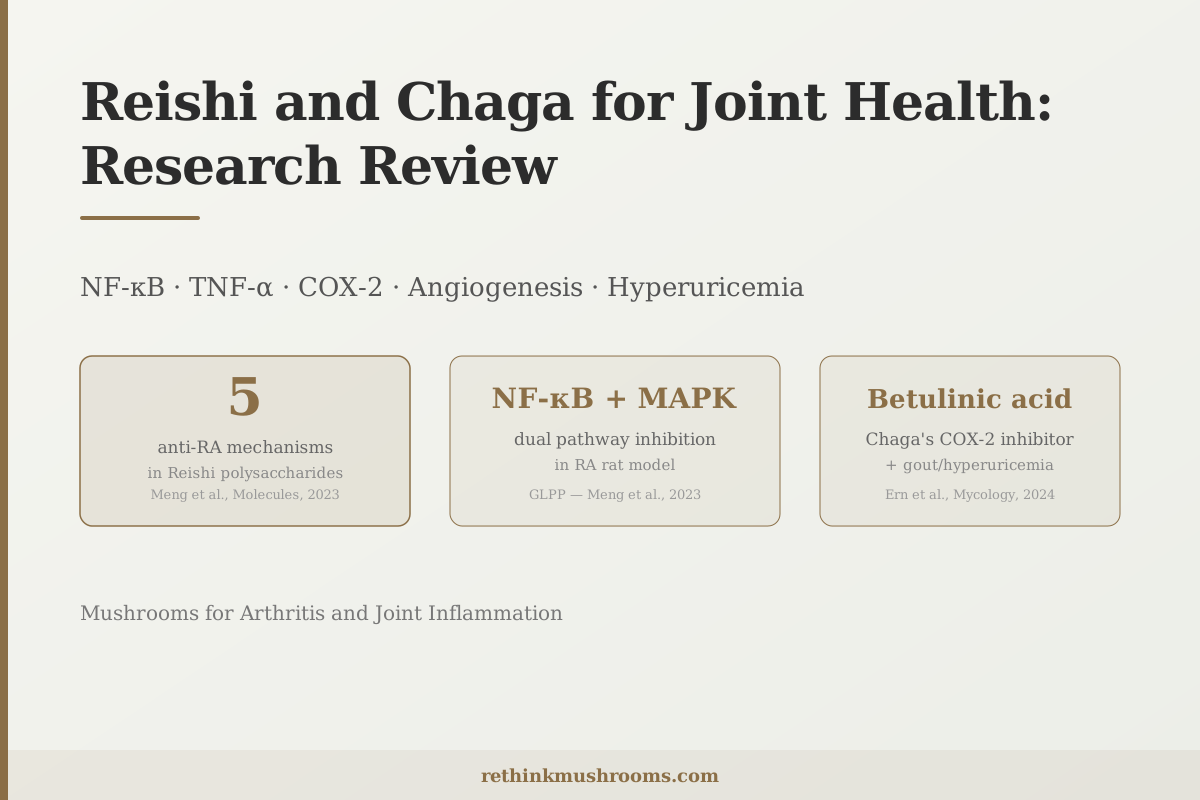
5 anti-RA mechanisms in Reishi polysaccharides
Meng et al. (2023) identified five distinct mechanisms by which Reishi polysaccharides counter rheumatoid arthritis: inhibiting synovial cell growth, modulating immune cell balance, blocking new blood vessel formation, reducing cartilage-degrading enzymes, and protecting bone-forming cells.
Meng et al., Molecules, 2023
NF-κB + MAPK
two inflammation control pathways blocked by Reishi polysaccharide peptide in collagen-induced arthritis animal models
Betulinic acid
Chaga's primary anti-inflammatory compound, with COX-2 inhibition and hyperuricemia (gout) reduction in research models
No human RCTs
neither Reishi nor Chaga has completed a randomized controlled trial specifically for arthritis
Meng et al., Molecules, 2023
 View as image ↗
Reishi and Chaga both appear in supplement marketing as general anti-inflammatory agents. The research behind them tells a more specific story. Reishi has the most developed preclinical evidence for rheumatoid arthritis, with multiple studies showing its polysaccharides and compounds interfere with the specific immune mechanisms that drive RA joint destruction. Chaga has a broader anti-inflammatory compound profile and an angle no competitor covers: laboratory evidence for reducing the elevated uric acid that causes gout attacks.
Neither has completed a human clinical trial specifically for any joint condition. That matters, and this article does not paper over it. What the preclinical evidence shows — in cell culture and animal models — is that both mushrooms have plausible mechanisms, and that their mechanisms are different enough that understanding which you're dealing with informs the research context. This article covers the reishi chaga joint health research with the specificity that separates what the studies actually show from what the supplement marketing says. For the broader framework, see how mushrooms fight inflammation: NF-κB, COX-2, and beyond.
Key Takeaways
- Reishi polysaccharides have been shown in multiple preclinical studies to target the specific immune mechanisms driving rheumatoid arthritis: NF-κB inhibition, T and B cell modulation, angiogenesis blockade, and reduction of cartilage-degrading enzymes[1]
- Meng et al. (2023) showed Reishi polysaccharide peptide (GLPP) significantly reduced arthritis severity in collagen-induced arthritis rats by simultaneously blocking two inflammation signaling pathways: NF-κB and MAPK[2]
- Lin et al. (2024) demonstrated that a Reishi nanogel formulation produced anti-arthritic, anti-inflammatory, and antioxidant effects in a rat arthritis model, with the nanogel delivery improving bioavailability over crude extract[3]
- Chaga's anti-inflammatory compounds include betulinic acid and inotodiol (triterpenoids from birch tree sterols concentrated in Chaga's outer layer) that inhibit TNF-α production and COX-2 enzyme activity[4]
- Chaga has documented activity in laboratory models for hyperuricemia (elevated blood uric acid) — the mechanism underlying gout; this distinguishes Chaga from Reishi in the joint health context[4]
- Neither Reishi nor Chaga has been tested in randomized controlled trials specifically for arthritis outcomes; all human-relevant evidence remains preclinical (in vitro and animal model studies)
Reishi vs. Chaga for Joint Health: Key Comparison
| Feature | Reishi (Ganoderma lucidum) | Chaga (Inonotus obliquus) |
|---|---|---|
| Primary bioactives | Polysaccharides (GLP, GLPP), ganoderic acid triterpenes | Betulinic acid, inotodiol, polysaccharides |
| Key anti-inflammatory targets | NF-κB, MAPK, TNF-α, angiogenesis, MMP enzymes | TNF-α, COX-2, uric acid (gout) |
| Best arthritis type match | Rheumatoid arthritis (autoimmune, TNF-α driven) | General inflammation; gout-related joint disease |
| Strongest evidence source | Multiple in vitro + 2 animal models (2023-2024) | 2024 comprehensive review; no arthritis-specific animal models |
| Human trial evidence | No arthritis RCTs | No arthritis RCTs |
| Notable limitation | All RA evidence preclinical | Most evidence from review-level only |
For more on how mushroom compounds target different inflammation pathways, see triterpenes vs. polysaccharides: different anti-inflammatory pathways.
Reishi's Mechanistic Case for Rheumatoid Arthritis
Rheumatoid arthritis is not simply inflammation — it is an autoimmune condition in which the immune system attacks the joint's inner lining. The cells lining the joint (synovial fibroblasts) become abnormally aggressive. They proliferate, invade cartilage and bone, and release enzymes that physically break down joint tissue. Inflammatory signals, particularly TNF-α, IL-1β, and IL-6, drive this process.
Meng and colleagues (2023) reviewed what is known about how Ganoderma lucidum polysaccharides (GLP) interact with this disease process.[1] Their review identified five specific mechanisms:
1. Inhibiting synovial fibroblast proliferation and migration. GLP slowed the growth and movement of the aggressive joint-lining cells that drive RA cartilage invasion. Unchecked, these cells form pannus — the inflammatory tissue mass that physically erodes joint surfaces.
2. Modulating T and B lymphocyte balance. RA involves dysregulated immune cell populations. GLP appeared to normalize the ratio of inflammatory T helper cells (Th17) versus regulatory T cells (Treg), and reduce overactive B cell antibody production that contributes to joint attack.
3. Blocking angiogenesis. Pannus growth requires a blood supply. GLP reduced the formation of new blood vessels into joint tissue, limiting the inflammatory tissue's ability to expand. This is a different mechanism from simply reducing cytokines — it limits the physical infrastructure of joint destruction.
4. Reducing matrix metalloproteinases (MMPs). These are enzymes (specifically MMP-3 and MMP-13) that break down the protein framework of cartilage, including collagen. Reducing MMP activity means less physical cartilage destruction, not just less inflammation signaling.
5. Protecting osteoblasts. Osteoblasts are the cells that build bone. RA causes bone loss adjacent to affected joints partly by suppressing osteoblast activity. GLP appeared to support osteoblast function, which would protect bone density near joints.
This five-mechanism profile distinguishes Reishi from simple anti-inflammatory supplements. It is not just reducing pain signals — the research suggests potential to interfere with the disease process at multiple steps. For the TNF-α mechanism in detail, see mushrooms and TNF-alpha: reducing the master inflammatory signal.
Reishi in Animal Models: What the Joint Research Shows
Mechanism reviews establish plausibility. Animal models test whether the mechanism translates to actual disease outcomes.
Meng and colleagues' separate 2023 study tested a specific Reishi compound — polysaccharide peptide (GLPP) — in rats with collagen-induced arthritis, the standard animal model for RA research.[2] GLPP treatment significantly reduced joint swelling, inflammatory cytokine levels, and joint destruction scores compared to untreated arthritic rats. The mechanism was simultaneous blockade of two inflammatory signaling pathways: NF-κB (the master switch for inflammation, which activates dozens of inflammatory genes when turned on) and MAPK (a second inflammation control pathway that amplifies inflammatory cell responses). Blocking both pathways together produced stronger effects than either would alone.
Lin and colleagues (2024) added the most recent Reishi arthritis data with a novel delivery angle.[3] They formulated Reishi extract as a nanogel — a gel matrix with nanoparticle-sized drug carriers — and tested it in rats with complete Freund's adjuvant-induced arthritis. The nanogel formulation produced anti-arthritic, anti-inflammatory, and antioxidant effects. Importantly, the nanogel improved bioavailability compared to crude Reishi extract. This addresses one of Reishi's practical limitations: polysaccharides from oral supplements often have low and variable absorption.
The Lin 2024 study is notable not because nanogel Reishi is commercially available — it is not — but because it demonstrates that researchers are actively working to improve Reishi delivery for therapeutic applications. It reflects the field's view that the mechanism is real enough to invest in improving the delivery system.
Both studies are animal models. The mechanism likely exists; whether it translates to clinically meaningful joint outcomes in humans requires human trials, which have not been conducted.
Chaga's Anti-Inflammatory Profile: More Than Free-Radical Marketing
Chaga mushroom (Inonotus obliquus) is heavily marketed as an antioxidant. The research reveals a more specific anti-inflammatory profile than antioxidant capacity tests capture.
Ern and colleagues (2024) conducted a comprehensive review of Chaga's therapeutic properties, synthesizing the available evidence on its anti-inflammatory activity.[4] Two compound classes stand out in the joint health context.
Betulinic acid and inotodiol are triterpenoids — fat-soluble compounds Chaga concentrates from the birch trees it grows on, specifically from birch bark's betulin content. These compounds inhibit TNF-α production and COX-2 enzyme activity. COX-2 is the enzyme responsible for producing prostaglandins, which are key mediators of inflammatory pain and swelling. This is the same enzyme targeted by ibuprofen and naproxen. The COX-2 inhibition mechanism positions Chaga's triterpenoids in the same mechanistic territory as common anti-inflammatory drugs, though the potency comparison in humans has not been established.
Chaga polysaccharides add to this through toll-like receptor activation and cytokine modulation, broadly similar to other medicinal mushroom polysaccharides.
The overall picture from Ern 2024: Chaga has a genuine anti-inflammatory compound portfolio, the mechanisms are plausible and specific, but the arthritis-specific evidence is primarily from compound-level in vitro work rather than arthritis model animal studies. There is no Chaga equivalent of the Meng 2023 collagen-induced arthritis experiment.
The Gout Angle: Chaga and Hyperuricemia
One aspect of Chaga's joint health profile that no competitor covers: its research on hyperuricemia — the elevated blood uric acid concentration that causes gout.
Gout occurs when uric acid crystals deposit in joints (particularly the big toe and ankles), causing intense inflammatory pain attacks. It is technically a form of arthritis, driven by uric acid rather than autoimmune attack or cartilage wear. The triterpenoids in Chaga have shown activity in laboratory models for reducing uric acid elevation, according to Ern et al. (2024).[4]
This is a different mechanism from Reishi's RA activity and from Chaga's COX-2 inhibition. Uric acid reduction involves blocking the enzyme that makes uric acid in the body (xanthine oxidase) — the same mechanism as allopurinol, the primary gout medication. Some Chaga compounds appear to inhibit this enzyme in laboratory settings, which would reduce uric acid production at the source.
For gout specifically, Chaga is the more directly relevant mushroom of the two. Reishi's RA mechanisms do not speak to uric acid or gout. This is the clearest practical differentiation between the two species for joint health purposes.
When the Evidence Runs Out: The Human Trial Gap
Both Reishi and Chaga have preclinical evidence for anti-inflammatory activity relevant to joint health. Neither has been tested in a randomized controlled trial specifically for arthritis outcomes in humans.
This is not a minor caveat. Animal models of arthritis reproduce some features of human RA or OA but not all. The collagen-induced arthritis model used in the GLPP and Reishi nanogel studies is a useful screen, but many compounds that reduce inflammation in CIA rats do not produce the same effects in human RA patients. The mechanisms are suggestive, not predictive.
For people already taking disease-modifying drugs for RA (such as methotrexate) or biologics (such as TNF-α inhibitors like adalimumab), there is an additional consideration: mushroom compounds that activate immune cells could theoretically interact with immunosuppressive therapy. This is a theoretical concern based on mechanism, not documented human drug-interaction evidence, but it is the right question to raise with a prescriber.
For more on what the broader cluster of arthritis-relevant mushroom research shows across species, see mushrooms for arthritis: can they reduce joint inflammation, mushrooms and rheumatoid arthritis: immune-modulating approaches, mushrooms for osteoarthritis pain: anti-inflammatory evidence, and the full species comparison at mushrooms for arthritis: Reishi, Chaga, and Oyster Mushroom joint research.
The Bottom Line
Reishi has the most developed preclinical evidence for rheumatoid arthritis, with multiple mechanisms documented in cell culture (synovial fibroblast inhibition, angiogenesis, MMP reduction) and animal model validation of NF-κB and MAPK inhibition. Chaga offers a broader compound profile with COX-2 inhibition and a unique hyperuricemia angle relevant to gout. Neither has been tested in a human arthritis RCT. The evidence is preclinical; mechanisms are plausible and specific, but clinical efficacy in humans remains unestablished.
Frequently Asked Questions
Sources & References
- 1. Source details for this reference are not yet available.
- 2. Source details for this reference are not yet available.
- 3. Source details for this reference are not yet available.
- 4. Source details for this reference are not yet available.