Enoki Mushroom Antioxidant Activity & Free Radical Research
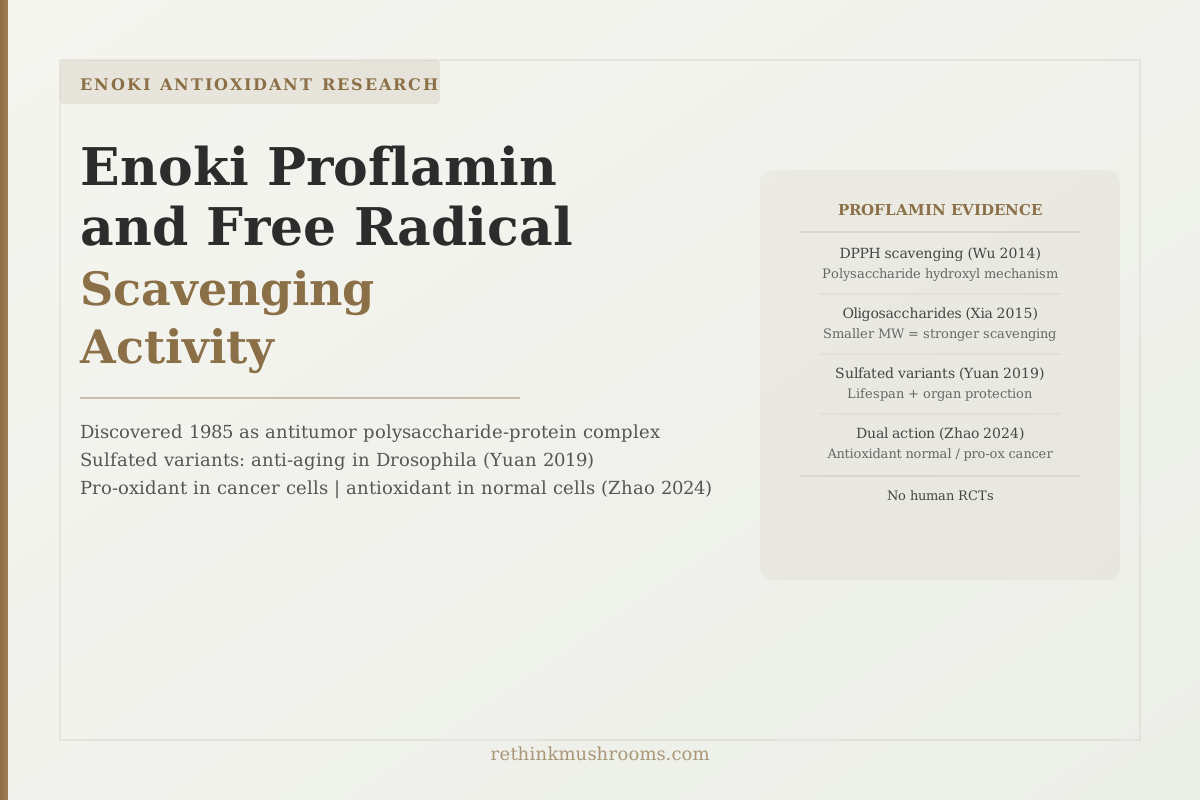
Dual action: proflamin polysaccharides scavenge free radicals in normal cells and induce selective oxidative stress in cancer cells (Zhao et al., 2024)
Zhao et al. (2024) found that F. velutipes polysaccharide induced mitochondrial apoptosis selectively in A549 lung adenocarcinoma cells while protecting normal cells from oxidative damage, demonstrating the context-dependent pro-oxidant/antioxidant duality of enoki's polysaccharide complex.
Zhao et al., Scientific Reports, 2024
1985
year proflamin was first isolated from F. velutipes and described as an antitumor polysaccharide-protein complex (Yoshida et al.)
Sulfated
polysaccharide fractions from F. velutipes extended Drosophila lifespan and protected liver and kidney from oxidative damage (Yuan et al., 2019)
PI3K/AKT
pathway activated by brown-strain enoki extract to reduce cisplatin-induced kidney oxidative injury in mice (Chou et al., 2023)
Zhao et al., Scientific Reports, 2024
 View as image ↗
Proflamin is one of enoki mushroom's least-known bioactive compounds in consumer health media and one of the more scientifically interesting. Discovered in 1985, it is an acidic heteropolysaccharide-protein complex with documented antitumor activity. Forty years of subsequent research have also developed evidence for its polysaccharide component's antioxidant and free radical scavenging properties, including a 2024 finding that inverts the conventional antioxidant story: enoki polysaccharides do not just protect cells from oxidative damage; they can selectively induce oxidative damage in cancer cells while leaving normal cells protected. This article covers what proflamin is, how its polysaccharide component scavenges free radicals, and what the most recent research found about its context-dependent pro-oxidant activity. For the broader overview of enoki's biology, see What Is Enoki Mushroom? The Tiny Mushroom with Big Research.
Key Takeaways
- Proflamin is an acidic heteropolysaccharide-protein complex from Flammulina velutipes, first isolated and described by Yoshida et al. in 1985; it was initially characterized for antitumor activity before subsequent research documented its antioxidant properties
- Wu et al. (2014) isolated an F. velutipes polysaccharide fraction (FVP) showing strong DPPH and hydroxyl radical scavenging activity in vitro alongside macrophage-stimulating immunomodulatory effects, suggesting antioxidant and immune pathways are linked in enoki's polysaccharide fraction
- Xia (2015) found that oligosaccharide fractions from F. velutipes show concentration-dependent DPPH and superoxide radical scavenging, with smaller molecular weight fractions producing higher antioxidant potency, providing structure-activity insight
- Yuan et al. (2019) documented that sulfated F. velutipes polysaccharides extended lifespan in Drosophila, protected liver and kidney from oxidative damage, and demonstrated DPPH scavenging alongside elevated SOD and reduced MDA markers
- Zhao et al. (2024) found that F. velutipes polysaccharide selectively induced mitochondrial oxidative stress in A549 lung cancer cells while protecting normal cells, demonstrating context-dependent dual activity rather than uniform antioxidant behavior
- No human clinical trial has tested proflamin or enoki polysaccharides specifically for antioxidant or free radical outcomes; all evidence is preclinical
What Is Proflamin?
Proflamin is an acidic heteropolysaccharide-protein complex isolated from the fruiting bodies of Flammulina velutipes. The term "heteropolysaccharide" means its polysaccharide component contains multiple different sugar units (rather than a simple repeating polymer of one sugar type), and the "acidic" designation refers to the presence of uronic acid residues that give the complex a negative charge at physiological pH. This complex has both a polysaccharide backbone and protein components, making it structurally distinct from the simpler polysaccharide compounds studied in most mushroom research.
Yoshida et al. (1985) first described proflamin as an antitumor agent in the Japanese Cancer Research Journal.[1] The 1985 paper documented the preparation, physicochemical properties, and antitumor activity of the compound. Its antitumor activity predates by a decade the research on FIP-fve protein, enoki's other main immunomodulatory compound. The 1985 proflamin discovery was part of the broader Japanese medicinal mushroom research effort that also produced the Nagano epidemiological cancer observation and the early polysaccharide anti-cancer studies.
Proflamin's antioxidant properties are a secondary research thread that developed from the broader investigation into what enoki's polysaccharide complex does biochemically. The polysaccharide backbone of proflamin, like other mushroom polysaccharides, contains hydroxyl groups that can neutralize reactive oxygen species through hydrogen donation. This is the fundamental chemistry behind polysaccharide-mediated antioxidant activity across many plant and fungal sources.
For how proflamin fits within enoki's full compound profile alongside FIP-fve protein and beta-glucan polysaccharides, see Enoki Bioactive Compounds: Flammulin, Proflamin, and Polysaccharides.
How Polysaccharide Hydroxyl Groups Scavenge Free Radicals
Free radical scavenging works through a chemical process called hydrogen atom transfer. Free radicals, which are molecules with unpaired electrons, are highly reactive and cause cellular damage by stealing electrons from nearby molecules, including DNA, proteins, and lipid membranes. Antioxidants terminate this chain reaction by donating a hydrogen atom (proton plus electron) to the radical, neutralizing it without becoming reactive themselves.
Polysaccharides with multiple hydroxyl (-OH) groups along their backbone can donate hydrogen atoms to radicals, and mushroom polysaccharides with more hydroxyl groups tend to show stronger antioxidant capacity in standard assays like DPPH (a purple radical that decolorizes when neutralized) and hydroxyl radical scavenging tests.
Wu et al. (2014) isolated an F. velutipes polysaccharide fraction and documented its radical scavenging activity directly.[2] The polysaccharide showed strong DPPH and hydroxyl radical scavenging capacity in vitro, with activity increasing proportionally with concentration, which is the dose-response pattern expected from a true antioxidant mechanism. Separately, the same polysaccharide fraction stimulated macrophage activity in cell culture. This coupling of antioxidant and immunomodulatory activity in the same polysaccharide fraction suggests the two properties may share molecular features, though they operate through different mechanisms.
The Tang et al. (2016) comprehensive review of F. velutipes biological activities situates proflamin's antioxidant activity within the broader context of enoki's compound classes, noting that the polysaccharide fraction contributes to antioxidant activity alongside the phenolic and ergothioneine fractions.[3]
Oligosaccharide Fractions: Structure and Scavenging Potency
Xia (2015) took a more structurally precise approach to the F. velutipes antioxidant question by examining oligosaccharide fractions derived from the polysaccharides rather than the intact high-molecular-weight polysaccharides themselves.[4] Oligosaccharides are shorter carbohydrate chains produced by partial enzymatic or chemical degradation of intact polysaccharides.
The Xia study found that oligosaccharide fractions from F. velutipes showed concentration-dependent DPPH and superoxide radical scavenging activity, with an important structural finding: smaller molecular weight fractions produced higher antioxidant potency than larger fractions. This structure-activity relationship suggests that the scavenging activity depends partly on the accessibility of hydroxyl groups and the ability of shorter chains to interact with radicals more efficiently than larger, more folded polymer structures.
The implication for supplement and extract research is that processing methods that partially hydrolyze (break down) enoki polysaccharides into oligosaccharides might increase their antioxidant potency compared to intact high-molecular-weight preparations. Whether this matters for food-form enoki is an open question, since the enzymatic environment of digestion naturally produces oligosaccharide fragments from polysaccharide precursors.
Sulfated Polysaccharides: Anti-Aging and Organ Protection
Yuan et al. (2019) examined a specific structural variant of F. velutipes polysaccharides: the sulfated form, which has sulfate groups chemically attached to the polysaccharide backbone.[5] Sulfation increases a polysaccharide's negative charge and its water solubility and is associated with enhanced biological activity in many polysaccharide contexts.
The Yuan study tested sulfated F. velutipes polysaccharides in a Drosophila (fruit fly) aging model. Drosophila is a standard lifespan research model because it reproduces quickly, has many genes analogous to human biology, and responds to interventions in ways that correlate with mammalian aging research. The sulfated enoki polysaccharides extended median lifespan in Drosophila compared to controls. In parallel antioxidant assays, they demonstrated DPPH scavenging capacity, elevated SOD (superoxide dismutase, an endogenous antioxidant enzyme) activity, and reduced MDA (malondialdehyde, a lipid peroxidation marker indicating oxidative damage). In mouse models, the sulfated polysaccharides protected liver and kidney from oxidative damage.
This study is the most direct evidence for a connection between enoki polysaccharide antioxidant activity and organ-level protective outcomes. The Drosophila lifespan extension is intriguing, though the biological mechanisms in insects have limited direct translation to human aging. The liver and kidney protection data in mice is more directly relevant to organ-level oxidative stress, a known feature of aging and metabolic disease.
For the broader enoki antioxidant activity research including DPPH benchmarks, see Enoki and Antioxidant Activity: Free Radical Research.
Brown Strain Enoki and Kidney Protection
Chou et al. (2023) investigated a specific application: whether brown-strain Flammulina velutipes extract could reduce cisplatin-induced kidney injury in mice.[6] Cisplatin is a widely used chemotherapy drug that causes acute kidney injury as a serious side effect, through a mechanism that involves oxidative stress: cisplatin generates reactive oxygen species in renal tubular cells, initiating cell death.
The brown-strain F. velutipes water extract significantly reduced markers of kidney oxidative damage in cisplatin-treated mice. The mechanism was PI3K/AKT pathway activation. The PI3K/AKT signaling pathway (phosphoinositide 3-kinase/protein kinase B) promotes cell survival and is suppressed by cisplatin-induced oxidative stress. The enoki extract activated this pathway in kidney cells, counteracting the oxidative injury and reducing the loss of kidney function.
Two aspects of this study are worth noting. First, it used the brown strain rather than the standard white cultivar, and the brief's competitive analysis notes that brown and yellow enoki strains have measurably different antioxidant profiles from white enoki. Most consumers encounter only white enoki. Second, this represents a potential adjunct therapy context, protecting against medication-induced oxidative damage, which is distinct from general antioxidant supplementation.
The Dual Nature: Pro-Oxidant in Cancer Cells, Antioxidant in Normal Cells
The most counterintuitive finding in the enoki polysaccharide antioxidant literature comes from Zhao et al. (2024).[7]
The study tested F. velutipes polysaccharide on A549 cells, a human lung adenocarcinoma cell line. Rather than showing antioxidant protection of cancer cells, the polysaccharide induced mitochondrial apoptosis through elevated intracellular oxidative stress. Cancer cells depend on elevated antioxidant capacity (called "redox adaptation") to survive the heightened metabolic stress of their accelerated growth. Compounds that overwhelm this redox adaptation and push cancer cells into pro-oxidant states can trigger their cell death. The F. velutipes polysaccharide appears to achieve this in A549 cells while protecting normal cells from oxidative damage.
This dual context-dependent activity is not without precedent in natural compound pharmacology. Some compounds can act as antioxidants at low concentrations or in normal cell environments and as pro-oxidants at higher concentrations or in metabolically abnormal cells. The cancer cell's elevated baseline oxidative stress makes it vulnerable to additional pro-oxidant pressure that normal cells can tolerate.
The practical interpretation: enoki polysaccharides are not simply antioxidant compounds that "protect" cells indiscriminately. They interact with cellular redox state in context-dependent ways, which may be why the same polysaccharide fraction can reduce oxidative damage in normal tissue (Yuan 2019) while inducing it in cancer cells (Zhao 2024). This dual activity is biologically plausible but remains to be confirmed in any human study or clinical context.
Why Proflamin-Specific Antioxidant Data Is Difficult to Interpret
The antioxidant data reviewed above comes from polysaccharide fractions of F. velutipes rather than from proflamin specifically. Proflamin, as originally described, is a complex of polysaccharide and protein together. The polysaccharide research that has built up since 1985 has mostly used isolated polysaccharide fractions that may or may not correspond to the polysaccharide component of the intact proflamin complex.
This is an important distinction that no competitor article addresses, because most consumer content does not attempt the level of chemical specificity required to identify it. The antioxidant activity documented in Wu 2014, Xia 2015, Yuan 2019, and Zhao 2024 is attributable to F. velutipes polysaccharide fractions. Whether the intact proflamin heteropolysaccharide-protein complex produces the same or enhanced antioxidant activity compared to its isolated polysaccharide component is not documented in the available research. The protein component of proflamin could in theory either enhance or modulate the polysaccharide's antioxidant behavior, depending on how it affects the accessibility of hydroxyl groups.
No human clinical trial has specifically tested proflamin's antioxidant effects. The evidence chain runs from 1985 antitumor characterization through in vitro polysaccharide antioxidant assays to animal organ protection studies, without a human intervention trial connecting dietary enoki consumption to measurable antioxidant outcomes.
For how enoki's antioxidant profile compares to other culinary mushrooms, see Enoki vs. Other Culinary Mushrooms: Antioxidant Comparison. For the phenolic compound layer of enoki's antioxidant profile, see Enoki Phenolic Compounds and Oxidative Stress Protection.
The Bottom Line
Proflamin is an acidic heteropolysaccharide-protein complex from Flammulina velutipes, first described in 1985 for antitumor activity. Its polysaccharide component shows free radical scavenging via hydroxyl group donation (Wu et al., 2014), with smaller oligosaccharide fractions showing higher potency (Xia 2015). Sulfated variants extend Drosophila lifespan and protect organs from oxidative damage (Yuan et al., 2019). Zhao et al. (2024) found context-dependent dual activity: antioxidant in normal cells, pro-oxidant selectively in cancer cells. No human RCTs exist for proflamin-specific antioxidant or free radical outcomes.
Frequently Asked Questions
Sources & References
- 1. Source details for this reference are not yet available.
- 2RTHM-00656·Wu, Ming et al. (2014). “Antioxidant and immunomodulatory activities of a polysaccharide from Flammulina velutipes..” Journal of traditional Chinese medicine = Chung i tsa chih ying wen pan.Study breakdown →PubMed →↩
- 3RTHM-00831·Tang, Calyn et al. (2016). “Golden Needle Mushroom: A Culinary Medicine with Evidenced-Based Biological Activities and Health Promoting Properties..” Frontiers in pharmacology.Study breakdown →PubMed →↩
- 4RTHM-00746·Xia, Zhenqiang (2015). “Preparation of the oligosaccharides derived from Flammulina velutipes and their antioxidant activities..” Carbohydrate polymers.Study breakdown →PubMed →↩
- 5RTHM-01150·Yuan, Fangfang et al. (2019). “Characterization, Antioxidant, Anti-Aging and Organ Protective Effects of Sulfated Polysaccharides from Flammulina velutipes..” Molecules (Basel.Study breakdown →PubMed →↩
- 6RTHM-01678·Chou, Ya-Ni et al. (2023). “Water Extract from Brown Strain of Flammulina velutipes Alleviates Cisplatin-Induced Acute Kidney Injury by Attenuating Oxidative Stress, Inflammation, and Autophagy via PI3K/AKT Pathway Regulation..” International journal of molecular sciences.Study breakdown →PubMed →↩
- 7RTHM-02038·Zhao, Fei et al. (2024). “Effect of Flammulina velutipes polysaccharide on mitochondrial apoptosis in lung adenocarcinoma A549 cells..” Scientific reports.Study breakdown →PubMed →↩