Enoki (Flammulina velutipes)
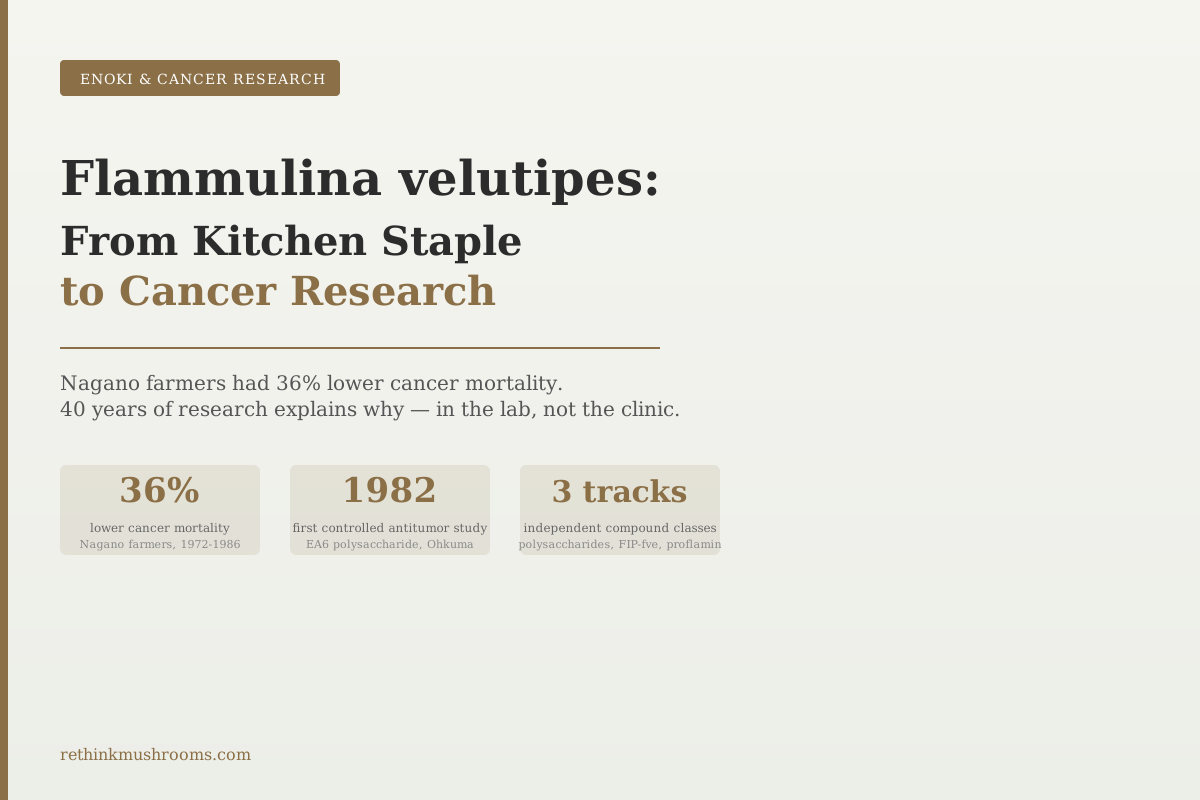
36% lower
Enoki mushroom farmers in Nagano prefecture had cancer death rates approximately 36% lower than the general Japanese population, a 1989 population survey that launched four decades of mechanistic research.
Ikekawa, Nagano Prefectural Research Institute of Rural Industry, 1989
1982
year of first controlled antitumor study on Flammulina velutipes (Ohkuma)
3 tracks
independent anticancer compound classes: polysaccharides, FIP-fve, proflamin/sterols
2024
year of most recent mechanism study: mitochondrial apoptosis in lung cancer cells (Zhao)
Ikekawa, Nagano Prefectural Research Institute of Rural Industry, 1989
 View as image ↗
In 1989, researcher Tetsuro Ikekawa published a population survey from Nagano prefecture in Japan's central highlands, an area where commercial enoki mushroom cultivation had been a major industry for generations. Male enoki farmers showed cancer death rates of approximately 97 per 100,000 population, compared to 160 per 100,000 in the general Japanese male population during the same period. That 36% difference launched one of the most sustained research programs in medicinal mushroom science. The question it raised was simple: what compounds in Flammulina velutipes cancer research consistently reveals might explain such an observation?
This is a cluster article in the Enoki series. For the full overview of Flammulina velutipes including its nutritional profile, compound classes, and clinical evidence, see What Is Enoki Mushroom? The Tiny Mushroom with Big Research.
Four decades of laboratory investigation identified three independent research tracks, each involving different chemical compounds and different mechanisms. None of them has yet produced a human cancer treatment trial. All of them explain, at the cellular level, biological activities that could plausibly underlie the Nagano observation.
Key Takeaways
- A 1989 Nagano prefecture population survey found male enoki farmers had cancer death rates of approximately 97 vs 160 per 100,000 compared to the general Japanese male population, a 36% difference that prompted sustained laboratory investigation.
- The earliest controlled antitumor study (Ohkuma et al., 1982) found that beta-1,3-glucan polysaccharide EA6 from Flammulina velutipes augmented the anti-tumor effect of cryosurgery in sarcoma-bearing mice.
- FIP-fve, the fungal immunomodulatory protein unique to enoki, interrupts lung cancer cell migration and proliferation in cell culture via MAP2K3/p38 MAPK signaling (Chang 2013, Gu 2022).
- A 2024 study in Scientific Reports found that acidic polysaccharide FVP-S1 induced mitochondrial apoptosis in lung adenocarcinoma A549 cells, decreasing membrane potential and increasing Caspase-3 and Caspase-9 expression (Zhao et al.).
- Proflamin, a glycoprotein enzyme from enoki mycelium discovered in 1985, significantly prolonged lifespan in mice bearing B-16 melanoma and adenocarcinoma 755 (Ikekawa et al.).
- All cancer research on Flammulina velutipes is preclinical (animal or cell culture). No human cancer treatment trials have been conducted.
The Nagano Observation: Farmers Who Ate Enoki Had Roughly 36% Less Cancer
Nagano prefecture is a mountainous inland region northwest of Tokyo. By the mid-20th century, it had become the center of commercial enoki mushroom cultivation in Japan. Enoki growers in the region consumed the mushrooms regularly, both as part of local cuisine and as a byproduct of daily cultivation work.
Tetsuro Ikekawa's 1989 survey, conducted through the Nagano Prefectural Research Institute of Rural Industry, compared cancer mortality across occupational groups within the prefecture over the period 1972-1986. The finding that male enoki farmers had death rates from cancer approximately 36% below the general male population generated significant scientific attention.
The survey was epidemiological: it observed a pattern in a defined population over time. It did not demonstrate causation, did not control for every confounding variable (diet beyond enoki, lifestyle factors, other exposures), and did not claim that enoki consumption caused the lower cancer rates. What it did was establish a correlation robust enough to motivate systematic laboratory investigation.
That investigation began in earnest with the characterization of the mushroom's chemical compounds. The comprehensive 2016 review by Tang and colleagues in Frontiers in Pharmacology catalogued the full bioactive compound landscape: polysaccharides, the immunomodulatory protein FIP-fve, the antitumor glycoprotein proflamin, sterols, sesquiterpenes, and additional protein fractions.[1]
The research that followed organized into three largely independent tracks.
Track 1: Polysaccharides and the Mitochondrial Apoptosis Discovery
The first track concerned the polysaccharides, which are complex carbohydrate structures that constitute the most studied compound class in medicinal mushroom research.
Ohkuma and colleagues published the first controlled antitumor study on Flammulina velutipes in 1982 in the Journal of Pharmacobio-Dynamics, testing a protein-bound polysaccharide called EA6, which is a beta-1,3-glucan fraction isolated from the fruiting body.[2] In mice bearing sarcoma 180 tumors, EA6 administered at 10 mg/kg augmented the anti-tumor effect of cryosurgery (freeze destruction of tumor tissue), which on its own produced only weak tumor control. The combination of cryosurgery plus EA6 significantly extended lifespan compared to cryosurgery alone. This was an early demonstration that an enoki polysaccharide could modify the immune environment around tumors to support a treatment effect.
Fifteen years later, Leung and colleagues published a more refined characterization of the immunomodulatory polysaccharide fraction in Immunopharmacology, demonstrating that Flammulina velutipes polysaccharide (FVP) preparations triggered significant proliferation of splenic lymphocytes and augmented macrophage phagocytosis when administered to mice.[4] Lymphocyte proliferation and macrophage activation are components of the immune response that targets cancer cells. The finding helped establish that FVP compounds were acting through immune stimulation, not direct toxicity to tumor cells.
The NK cell finding added specificity. Jia and colleagues' 2017 study in the International Journal of Medicinal Mushrooms isolated a specific polysaccharide fraction called FVPA1 and showed it significantly enhanced natural killer (NK) cell activity against K562 leukemia cells in culture.[10] NK cells are lymphocytes specifically tasked with identifying and killing cancer cells and virus-infected cells without prior sensitization. The identification of a specific polysaccharide fraction responsible for NK cell activation gave the immune-mechanism hypothesis a molecular anchor.
The most mechanistically detailed polysaccharide-cancer study came in 2024. Zhao and colleagues published in Scientific Reports a comparison of two polysaccharide fractions, FVP-S1 and FVP-C, against lung adenocarcinoma A549 cells, one of the most-studied human lung cancer cell lines in laboratory research.[13] FVP-S1, an acidic polysaccharide built from glucuronic acid, xylose, and glucose, showed the strongest effect. It inhibited A549 cell proliferation and migration, and the mechanism was characterized as mitochondrial apoptosis: the cells' mitochondria lost their normal electrical charge (membrane potential), and the cells activated the caspase cascade (specifically Caspase-3 and Caspase-9), which is the molecular pathway of programmed cell death.
In plain terms: a specific enoki polysaccharide triggered lung cancer cells to destroy themselves from the inside, via the cell death pathway that the cells themselves are programmed to execute when they receive the right signal. The fact that cancer cells often suppress this pathway is one reason tumors grow uncontrolled; FVP-S1 appeared to overcome that suppression.
No competitor article has reported this Zhao 2024 finding. It represents the most specific mechanistic description of an enoki polysaccharide's cancer cell effects in the published literature. Whether a compound active in cell culture translates to a clinically relevant effect in people requires animal studies, dose-escalation research, and ultimately clinical trials, none of which have been completed for FVP-S1.
For more on how beta-glucan polysaccharides activate immune cells across multiple mushroom species, see How 1,3/1,6 Beta-Glucans Activate Your Immune System.
Track 2: FIP-fve, the Protein That Stops Cancer Cells from Moving
The second research track concerns FIP-fve, the fungal immunomodulatory protein unique to Flammulina velutipes. It was discovered and fully sequenced in 1995 by Ko and colleagues at the National Health Research Institute in Taiwan, and the full research arc on this compound extends from 1995 through 2022.
Within this article's scope, the most directly relevant finding came from Chang and colleagues' 2013 study published in the Journal of Agricultural and Food Chemistry.[8] Their target was lung cancer cell migration. Metastasis (the spread of cancer to other organs) depends on cancer cells' ability to migrate from the primary tumor through surrounding tissue and into the bloodstream. Compounds that interrupt migration are studied as potential anti-metastatic agents, a research category distinct from direct tumor killing.
FIP-fve dose-dependently interrupted the migration and proliferation of lung cancer cells in culture. The compound induced cell cycle arrest, stopping cancer cells from replicating, and activated apoptosis mechanisms. Chang's group concluded FIP-fve has potential as an anti-metastatic agent based on these cell-level findings.
The immune adjuvant angle was established earlier. Ding and colleagues published in Immunology in 2009 showing that co-administering FIP-fve alongside a tumor-associated antigen (a piece of tumor protein that the immune system can recognize) significantly enhanced anti-tumor immune responses in mice compared to the antigen alone.[5] This positions FIP-fve not only as a direct anti-tumor compound but as a potential immune adjuvant: something that amplifies the immune response to cancer antigens, including potentially tumor antigens presented by cancer immunotherapy approaches.
The mechanism was refined in 2022. Gu and colleagues used proteomics (large-scale protein analysis) to identify the specific signaling proteins that FIP-fve activates inside T cells.[11] They found that FIP-fve activates the MAP2K3/p38 alpha MAPK14 signaling pathway as the primary upstream mechanism for T-cell stimulation and IL-2 (a key immune signaling molecule) release. When they blocked MAP2K3 with a specific inhibitor (gossypetin) or blocked p38 alpha with another inhibitor (losmapimod), both the cell proliferation and the IL-2 release that FIP-fve normally produced were attenuated. This is mechanistic confirmation at the molecular level: specific proteins in the FIP-fve signaling cascade were identified and validated.
For detailed coverage of FIP-fve's structure, discovery, and signaling cascade, see Enoki and Flammulin: A Unique Immunomodulatory Protein.
Track 3: Proflamin and Sterols
The third track involves two compound classes that are structurally and functionally distinct from both polysaccharides and FIP-fve.
Proflamin is a glycoprotein enzyme fraction isolated from Flammulina velutipes mycelium (the root-like growth that produces the fruiting bodies). Ikekawa and colleagues published the discovery paper in the Japanese Journal of Cancer Research in 1985, testing proflamin against mice bearing B-16 melanoma and adenocarcinoma 755, two standard cancer models of the era.[3] Proflamin significantly prolonged the lifespan of tumor-bearing mice compared to controls. The study also characterized proflamin's physicochemical properties and confirmed its antitumor activity was distinct from the polysaccharide fraction, meaning the mushroom carries antitumor activity through at least two independent chemical pathways.
The sterols represent the fourth compound class. Mushroom sterols are fat-soluble compounds structurally related to cholesterol. Yi and colleagues published a 2013 study in the International Journal of Pharmaceutics characterizing novel sterols isolated from Flammulina velutipes and testing them against cancer cell lines.[7] The sterols showed strong cytotoxic effects against U251 glioma (a brain tumor cell line) and HeLa cervical cancer cells at 72 hours of exposure. The study also developed a micellar nanoformulation that significantly improved the oral bioavailability of these sterols, a practical pharmaceutical development step. The nanoformulation finding matters because enoki sterols are fat-soluble and would otherwise be poorly absorbed from an oral supplement.
Oral bioavailability of enoki bioactive compounds more broadly was demonstrated by Chang and colleagues in 2010, who showed in animal models that oral administration of FVE, an enoki protein-polysaccharide complex, activated both innate and adaptive immune arms and produced significant anti-tumor activity against hepatocellular carcinoma (liver cancer) in mice.[6] This is relevant context because many compounds active in injected or intravenous administration fail to survive digestion intact. The FVE oral data suggests at least some bioactive compounds from enoki retain activity after passing through the gastrointestinal tract.
The Stipe Finding: Even the Discarded Stems Carry Bioactives
Commercial enoki cultivation produces substantial waste in the form of stipes, the firm base sections of the mushroom clusters that are cut off and typically discarded before packaging. Chen and colleagues published a 2023 study in Anticancer Research testing extracts from these discarded stipes against multiple cancer cell lines.[12]
The stipe extracts showed potent antioxidant activity and anticancer properties across multiple cancer cell lines tested. Ethanolic extracts showed higher polysaccharide content, total phenolic content, and antioxidant capacity than water-based extracts. The finding that the discarded portion of commercial enoki carries anticancer bioactives is relevant to both the agricultural waste context (stipes are a potential source of bioactive extract at scale) and to understanding which preparation methods capture the active fractions.
What the Evidence Actually Proves (And What It Doesn't)
The research trail from Nagano 1989 to Zhao 2024 is a coherent scientific narrative: an epidemiological observation prompted compound isolation, which generated mechanism studies, which identified specific molecular targets. The research is extensive by medicinal mushroom standards. But it has not advanced to human cancer treatment trials.
All cancer research on Flammulina velutipes is preclinical. The polysaccharide, FIP-fve, and proflamin findings are from cell culture and animal models. The Nagano population data is correlational. Between cell culture activity and a cancer treatment effect in humans lie pharmacokinetic studies (what happens to the compound in the human body), dose-finding trials, and randomized controlled clinical trials measuring patient outcomes.
None of these have been conducted for enoki's anticancer compounds. The research establishes that biologically plausible mechanisms exist and that compounds from this mushroom are active against cancer cells in controlled laboratory conditions. It does not establish that consuming enoki mushrooms treats or prevents cancer in humans.
The Nagano epidemiology is an observation from a specific population in a specific historical period, with multiple uncontrolled variables. It is the hook that motivated the research, not evidence for a clinical intervention. For context on what population-level mushroom consumption data actually shows across multiple species and larger datasets, see Daily Mushroom Consumption and Cancer Risk Reduction.
Enoki's culinary identity as a mild, umami-rich mushroom suitable for soups, hot pots, and stir-fries, documented in food chemistry research by Phat and colleagues in 2016, is entirely compatible with its medicinal compound profile.[9] One of the features that makes enoki research practically interesting is that this is an ordinary food mushroom with a rich research record, not an exotic medicinal specimen sold only as a supplement.
The Bottom Line
Flammulina velutipes has been studied for anticancer properties continuously since 1982, motivated by a 1989 Japanese population survey showing enoki farmers had approximately 36% lower cancer mortality than the general population. Three independent compound classes carry documented anti-tumor activity in laboratory research: polysaccharides (including FVP-S1, which induces mitochondrial apoptosis in lung cancer cells via Caspase-3/Caspase-9 activation), the immunomodulatory protein FIP-fve (which interrupts lung cancer cell migration and acts as an immune adjuvant), and proflamin (which extended lifespan in tumor-bearing mice in 1985 animal models). All evidence is preclinical. No human cancer treatment trials have been conducted for any enoki anticancer compound.
Frequently Asked Questions
Sources & References
- 1RTHM-00831·Tang, Calyn et al. (2016). “Golden Needle Mushroom: A Culinary Medicine with Evidenced-Based Biological Activities and Health Promoting Properties..” Frontiers in pharmacology.Study breakdown →PubMed →↩
- 2RTHM-00008·Ohkuma, T et al. (1982). “Augmentation of antitumor activity by combined cryo-destruction of sarcoma 180 and protein-bound polysaccharide, EA6, isolated from Flammulina velutipes (Curt. ex Fr.) Sing. in ICR mice..” Journal of pharmacobio-dynamics.Study breakdown →PubMed →↩
- 3RTHM-00016·Ikekawa, T et al. (1985). “Proflamin, a new antitumor agent: preparation, physicochemical properties and antitumor activity..” Japanese journal of cancer research : Gann.Study breakdown →PubMed →↩
- 4RTHM-00053·Leung, M Y et al. (1997). “The isolation and characterization of an immunomodulatory and anti-tumor polysaccharide preparation from Flammulina velutipes..” Immunopharmacology.Study breakdown →PubMed →↩
- 5RTHM-00290·Ding, Ying et al. (2009). “Coadministration of the fungal immunomodulatory protein FIP-Fve and a tumour-associated antigen enhanced antitumour immunity..” Immunology.Study breakdown →PubMed →↩
- 6RTHM-00328·Chang, Hui-Hsin et al. (2010). “Oral administration of an Enoki mushroom protein FVE activates innate and adaptive immunity and induces anti-tumor activity against murine hepatocellular carcinoma..” International immunopharmacology.Study breakdown →PubMed →↩
- 7RTHM-00571·Yi, Chengxue et al. (2013). “Cytotoxic effect of novel Flammulina velutipes sterols and its oral bioavailability via mixed micellar nanoformulation..” International journal of pharmaceutics.Study breakdown →PubMed →↩
- 8RTHM-00513·Chang, Yu-Chi et al. (2013). “Interruption of lung cancer cell migration and proliferation by fungal immunomodulatory protein FIP-fve from Flammulina velutipes..” Journal of agricultural and food chemistry.Study breakdown →PubMed →↩
- 9RTHM-00441·Phat, Chanvorleak et al. (2016). “Evaluation of umami taste in mushroom extracts by chemical analysis, sensory evaluation, and an electronic tongue system..” Food chemistry.Study breakdown →PubMed →↩
- 10RTHM-00879·Jia, Wei et al. (2017). “Structural Characteristics of the Novel Polysaccharide FVPA1 from Winter Culinary-Medicinal Mushroom, Flammulina velutipes (Agaricomycetes), Capable of Enhancing Natural Killer Cell Activity against K562 Tumor Cells..” International journal of medicinal mushrooms.Study breakdown →PubMed →↩
- 11RTHM-01528·Gu, Kefei et al. (2022). “FIP-fve Stimulates Cell Proliferation and Enhances IL-2 Release by Activating MAP2K3/p38α (MAPK14) Signaling Pathway in Jurkat E6-1 Cells..” Frontiers in nutrition.Study breakdown →PubMed →↩
- 12RTHM-01671·Chen, Chien-Chin et al. (2023). “In Vitro Assessment of the Antioxidant and Anticancer Properties of Flammulina velutipes Stipe Extracts..” Anticancer research.Study breakdown →PubMed →↩
- 13RTHM-02038·Zhao, Fei et al. (2024). “Effect of Flammulina velutipes polysaccharide on mitochondrial apoptosis in lung adenocarcinoma A549 cells..” Scientific reports.Study breakdown →PubMed →↩