Enoki (Flammulina velutipes)
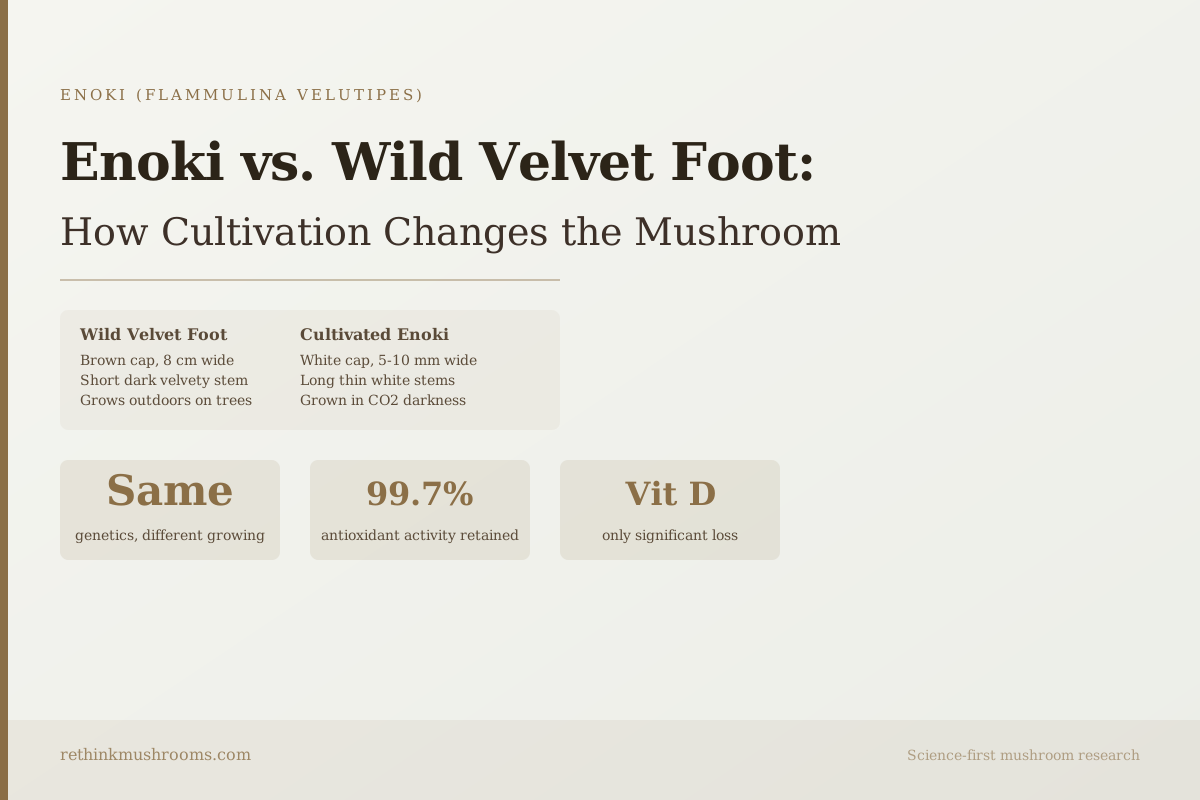
99.7% antioxidant activity
Hamster studies used the cultivated (supermarket) form of enoki and still recorded 99.7% DPPH antioxidant activity, confirming the indoor-grown version retains its bioactive profile.
Yeh et al., BioMed Research International, 2014
Same species
wild velvet foot and supermarket enoki are Flammulina velutipes
CO₂ + dark
the two conditions that create the white bundled form
Vitamin D
the one bioactive that drops significantly with indoor cultivation
Yeh et al., BioMed Research International, 2014
 View as image ↗
The enoki mushroom sold at grocery stores is unrecognizable beside the species it comes from. One is a pale, thin-stemmed bundle, almost white, with tiny round caps smaller than a fingernail. The other is a broad-capped, tawny brown mushroom growing on the base of dead trees in autumn forests. They are genetically identical.
Understanding what cultivation changes in Flammulina velutipes matters for two reasons. First, almost all the biomedical research on this mushroom was conducted using the cultivated form. If cultivation removed the bioactive compounds, the research would not apply to what people consume. Second, the visual difference is so dramatic that people routinely question whether both forms are even the same species. The answer, and what accounts for the difference, is covered here.
For the full research background on Flammulina velutipes as a medicinal mushroom species, see What Is Enoki Mushroom? The Tiny Mushroom with Big Research.
Key Takeaways
- Wild and cultivated enoki are the same species (Flammulina velutipes); the visual difference is caused entirely by growing conditions, not genetics
- Cultivated enoki has significantly lower Vitamin D2 content than outdoor-grown forms due to absence of UV exposure (Phillips et al., 2011)
- Kanno et al. (2020) measured moderate beta-glucan content in enoki consistent with other culinary-medicinal species, applicable to both forms
- Yeh et al. (2014) conducted antioxidant and lipid-lowering research using the cultivated (supermarket) form, confirming its research credentials
- Chen et al. (2023) found the stipe (stem) of cultivated enoki, the part most often discarded, showed potent antioxidant and anticancer activity across multiple cancer cell lines
- Phat et al. (2016) measured enoki's umami compound profile and found a distinct flavor signature distinct from shiitake despite lower overall umami intensity
The Same Species, Two Completely Different Mushrooms: Why This Happens
Wild Flammulina velutipes is a cold-weather mushroom. It fruits in late autumn and winter on the stumps and roots of elm, willow, hackberry, and other broadleaf trees across East Asia, Europe, and North America. The wild form is vernacularly called velvet foot or velvet shank in English, named for the dark, fine-haired texture of its lower stem. Its cap can reach 8 centimeters in diameter. The stem is short, usually 2 to 5 centimeters. The coloration ranges from tawny orange to dark brown.
None of that describes what is sold in supermarkets.
Cultivated enoki is produced under conditions specifically designed to produce a different-looking mushroom. The process uses enclosed cylindrical containers where mushrooms grow in near-total darkness, typically at temperatures around 5 to 8°C, with elevated carbon dioxide concentrations up to several percent of the ambient air. Under these conditions, the mushroom biology responds in a predictable way: cap development is suppressed, and the stem elongates toward light sources. The result is thin, white, elongated stems with minimal caps, growing in dense clusters.
Both responses are physiological, not genetic. Researchers studying F. velutipes cultivation have documented that the same genetic strain responds to CO₂ and darkness by suppressing cap expansion and extending stem length. Bring the cultivated strain outdoors in normal air, expose it to light, and it develops a brown cap. The genetics do not change. The growing environment does.
Tang et al.'s 2016 comprehensive review of F. velutipes biology confirms that the bioactive compound profile, including FIP-fve protein, proflamin glycoprotein, and polysaccharide fractions, is present in both the wild and cultivated forms of the species.[1]
What Actually Changes Between Wild and Cultivated Enoki
| Feature | Wild Velvet Foot | Cultivated Enoki |
|---|---|---|
| Cap color | Tawny to dark brown | White to cream |
| Cap diameter | Up to 8 cm | 5-10 mm |
| Stem length | 2-5 cm | 10-15 cm |
| Stem texture | Dark, velvety lower half | Smooth, white throughout |
| Growing conditions | Outdoor trees, autumn/winter | CO₂-enriched darkness, cold |
| Vitamin D2 content | Higher (UV exposure) | Lower (no UV) |
| Beta-glucan content | ~20.1% dw (fruiting body) | ~15.8% dw (fruiting body) |
| Flavor | Stronger, nuttier | Mild, delicate, fruity |
| FIP-fve / polysaccharides / proflamin | Present | Present |
The beta-glucan percentages come from a 2023 comparative study by Rezaeian et al. published in Food Research International, which examined both wild and commercial F. velutipes strains. Rezaeian's team found that the two forms had similar total beta-glucan content (22-23% by dry weight when including mycelium) but different structural architecture: commercial strain beta-glucans showed better water solubility, while wild strain fruiting bodies had a modestly higher percentage of beta-glucan in the fruiting body specifically.
The key message from the table: the visual features change entirely. The bioactive compounds do not.
What Cultivation Preserves: The Bioactive Research Still Applies
The concern underlying the wild vs. cultivated question is practical: if cultivation strips the medicinal compounds from the mushroom, then decades of F. velutipes research would not apply to the white-bundled version in grocery stores.
This concern does not hold up.
Yeh et al. (2014) conducted antioxidant and lipid-lowering research using the cultivated form of enoki, the same version available in supermarkets. The study found 99.7% DPPH antioxidant activity and significant reductions in triglycerides, total cholesterol, and LDL in hamsters.[4] This result in the cultivated form directly addresses the question: the indoor-grown mushroom retains the antioxidant and lipid-modifying activity documented in the literature.
The polysaccharide research similarly uses commercially available material. Kanno et al. (2020) quantified beta-glucan content across culinary-medicinal mushrooms including enoki and found moderate beta-glucan content consistent with other edible species.[3] Polysaccharide extraction studies routinely use the cultivated form because it is standardized and reproducible, unlike wild harvest.
Tang et al.'s (2016) systematic review of F. velutipes bioactives covers both wild and cultivated material and documents the same compound classes across both, without noting cultivation as a limiting factor for bioactive presence.[1]
The cultivated form's bioactive credentials are not compromised by indoor growing. What changes are specific physical characteristics and, as discussed below, vitamin D content.
For the detailed evidence on how these preserved compounds work, see Enoki Bioactive Compounds: Flammulin, Proflamin, and Polysaccharides.
Enoki also contains ergothioneine, an unusual antioxidant amino acid found almost exclusively in fungi that is absorbed via a dedicated transporter protein in humans. Ergothioneine: The Most Selective Antioxidant in Your Body covers this compound and why both wild and cultivated mushrooms are its primary dietary source.
The One Real Loss: Why Indoor-Grown Enoki Has Less Vitamin D
Vitamin D2 in mushrooms comes from ergosterol, a compound in fungal cell membranes that converts to vitamin D2 when exposed to ultraviolet light. This is the same mechanism that produces vitamin D in human skin when exposed to sunlight.
Cultivated enoki grows in darkness with no UV exposure. This means ergosterol does not convert to vitamin D2 during growth. The mushroom contains ergosterol (the precursor), but little to no vitamin D2.
Phillips et al. (2011) measured vitamin D content and sterol composition across 10 mushroom species purchased from US retail, including enoki. They found enoki contained measurable ergosterol but at lower vitamin D2 concentrations than outdoor-grown varieties.[2] This gap is not unique to enoki. Any indoor-cultivated mushroom grown without UV exposure will show similar vitamin D2 deficits compared to wild or UV-treated commercial products.
One practical consequence: enoki sold in standard grocery stores should not be counted on as a meaningful vitamin D2 source. Sun-exposed mushrooms (some commercial producers expose cultivated mushrooms to UV light after harvest) or outdoor-grown wild mushrooms can provide significant vitamin D2. The white, CO₂-grown supermarket bundle does not reliably do so.
This is the most practically significant difference between the two forms for anyone thinking about nutritional content.
The ergosterol precursor is still present in cultivated enoki, meaning that exposing stored enoki to UV light (including summer sunlight through a window) for 15 to 30 minutes can increase vitamin D2 content. The vitamin D loss is a consequence of growing conditions, not a permanent feature of the species.
Beta-Glucan in Wild vs. Cultivated Enoki: Same Amount, Different Architecture
The Rezaeian et al. (2023, Food Research International) comparative study produced an unexpected finding. Wild and commercial F. velutipes strains had similar total beta-glucan content at the species level (22-23% by dry weight including mycelium), but the structure of those beta-glucans differed in a way that affected solubility.
The commercial strain's beta-glucans showed better water solubility than the wild strain. Solubility matters for bioactivity: beta-glucans need to dissolve in gastrointestinal fluid to be recognized by immune receptors (particularly Dectin-1 on macrophages) and to enter systemic circulation. More soluble beta-glucans may be more bioavailable, though this has not been directly tested for F. velutipes specifically.
The wild fruiting body had modestly higher beta-glucan concentration in the fruiting body tissue (around 20.1% dw versus 15.8% dw in the commercial form's fruiting body, with the difference made up in mycelium). But the commercial form's structural advantage in solubility potentially offsets the quantitative difference.
Kanno et al. (2020) measured total beta-glucan content across species using a novel artificial recognition protein and found enoki's content was moderate relative to oyster and shiitake mushrooms in the analysis.[3] This positions cultivated enoki as a meaningful but not exceptional source of beta-glucans by dry weight.
For the broader mechanism of how beta-1,3/1,6-glucans activate immune cells through Dectin-1 and toll-like receptor pathways, see How 1,3/1,6 Beta-Glucans Activate Your Immune System.
The Discarded Stems: Why Cultivation Waste Still Has Bioactives
During commercial cultivation, F. velutipes grows in cylindrical containers with the stem bases embedded in substrate. After harvest, the lower stem sections attached to the substrate base are cut off and discarded as waste. These are the stipes, and they represent a significant fraction of the total mushroom material produced by commercial cultivation.
Chen et al. (2023) tested extracts from F. velutipes stipes specifically, asking whether this discarded material retained biological activity. The findings were clear: ethanolic stipe extracts showed potent antioxidant activity and anticancer properties against multiple cancer cell lines in vitro. Ethanolic extracts had higher polysaccharide content, total phenolic content, and antioxidant capacity than water extracts of the same material.[5]
Two things are notable about this finding. First, the stem discarded in commercial cultivation retains the same compound classes found in the edible cap and stem portion. The bioactives are distributed throughout the mushroom body, not concentrated only in the parts consumed. Second, the extraction method matters: ethanolic extraction (alcohol-based) pulled more bioactives from the stipe than hot water extraction.
This has practical implications for whole-mushroom product sourcing. The stem sections typically trimmed in commercial harvest retain a significant fraction of the mushroom's total phenolic and antioxidant content, meaning waste-stream stipe material may warrant attention in standardized extract production.
Flavor: How Cultivation Changes the Taste Profile
Wild F. velutipes has a stronger, nuttier flavor than cultivated enoki. The Maillard reaction between sugars and amino acids when cooking (the source of complex savory depth in browned mushrooms) produces more aromatic compounds in the wild form's thicker tissue and more concentrated sugars.
Cultivated enoki has a mild, slightly fruity flavor with gentle umami character. Phat et al. (2016) measured umami-active compounds (free glutamate, IMP, GMP, and other 5'-nucleotides) across several mushroom species and found enoki had a distinct flavor profile with lower overall umami intensity than shiitake, but a clear contribution from glutamate and nucleotide balance.[6]
The delicate flavor of the cultivated form is, counterintuitively, an advantage in cooking. Enoki's mild taste does not compete with broth or sauce flavors, making it suitable as a texture element in soups, hot pot, and noodle dishes where a stronger mushroom flavor would be intrusive. The wild form's more assertive taste suits preparations where the mushroom itself is a primary flavor.
For culinary applications, recipes, and how enoki is used across Asian cuisines, see Enoki in Asian Cuisine: Culinary Uses and Recipes.
What This Means for Someone Buying Enoki at the Store
The short answer: the white-bundled enoki in any Asian grocery store or supermarket is the cultivated form of Flammulina velutipes, and the biomedical research on this species applies to it.
Three things change with indoor cultivation:
- Appearance changes entirely. The same genetics produce a completely different-looking mushroom under CO₂ and darkness.
- Vitamin D2 drops significantly due to absent UV exposure. Cultivated enoki should not be considered a vitamin D source.
- Beta-glucan structure differs from wild forms, with commercial beta-glucans showing better water solubility in at least one comparative study.
Three things that do not change:
- Bioactive compound classes. FIP-fve protein, proflamin, polysaccharides, and sterols are present in both forms.
- Antioxidant activity. Yeh et al.'s 99.7% DPPH result came from the cultivated form.[4]
- Research applicability. The decades of preclinical research on F. velutipes immunomodulation, lipid lowering, and anticancer mechanisms used the cultivated form and applies directly to what is commercially available.
The "brown enoki is healthier" question that sometimes appears online reflects a real difference in vitamin D content. Whether the modest beta-glucan structural differences between wild and commercial strains translate to meaningful bioactivity differences in humans is not established. The research base on both forms supports the same general compound profile with one clear exception: vitamin D.
The Bottom Line
Wild velvet foot and cultivated enoki are the same species, Flammulina velutipes, differentiated entirely by growing conditions. CO₂ enrichment and darkness suppress cap development and drive stem elongation in cultivation, producing the white bundled form sold in grocery stores. The core bioactive compound classes (FIP-fve, proflamin, polysaccharides, sterols) are preserved in the cultivated form, and antioxidant and lipid research conducted using cultivated enoki confirms its bioactive credentials. The principal loss is vitamin D2, which drops significantly without UV exposure during growth. Beta-glucan structural differences between wild and commercial strains may affect solubility but have not been evaluated in human bioavailability studies.
Frequently Asked Questions
Sources & References
- 1RTHM-00831·Tang, Calyn et al. (2016). “Golden Needle Mushroom: A Culinary Medicine with Evidenced-Based Biological Activities and Health Promoting Properties..” Frontiers in pharmacology.Study breakdown →PubMed →↩
- 2RTHM-00230·Phillips, Katherine M et al. (2011). “Vitamin D and sterol composition of 10 types of mushrooms from retail suppliers in the United States..” Journal of agricultural and food chemistry.Study breakdown →PubMed →↩
- 3RTHM-00625·Kanno, Takashi et al. (2020). “Quantification of β-Glucan from Culinary-Medicinal Mushrooms Using Novel Artificial β-Glucan Recognition Protein..” International journal of medicinal mushrooms.Study breakdown →PubMed →↩
- 4RTHM-00663·Yeh, Ming-Yei et al. (2014). “Hypolipidemic and antioxidant activity of enoki mushrooms (Flammulina velutipes)..” BioMed research international.Study breakdown →PubMed →↩
- 5RTHM-01671·Chen, Chien-Chin et al. (2023). “In Vitro Assessment of the Antioxidant and Anticancer Properties of Flammulina velutipes Stipe Extracts..” Anticancer research.Study breakdown →PubMed →↩
- 6RTHM-00441·Phat, Chanvorleak et al. (2016). “Evaluation of umami taste in mushroom extracts by chemical analysis, sensory evaluation, and an electronic tongue system..” Food chemistry.Study breakdown →PubMed →↩