Enoki Culinary Guide
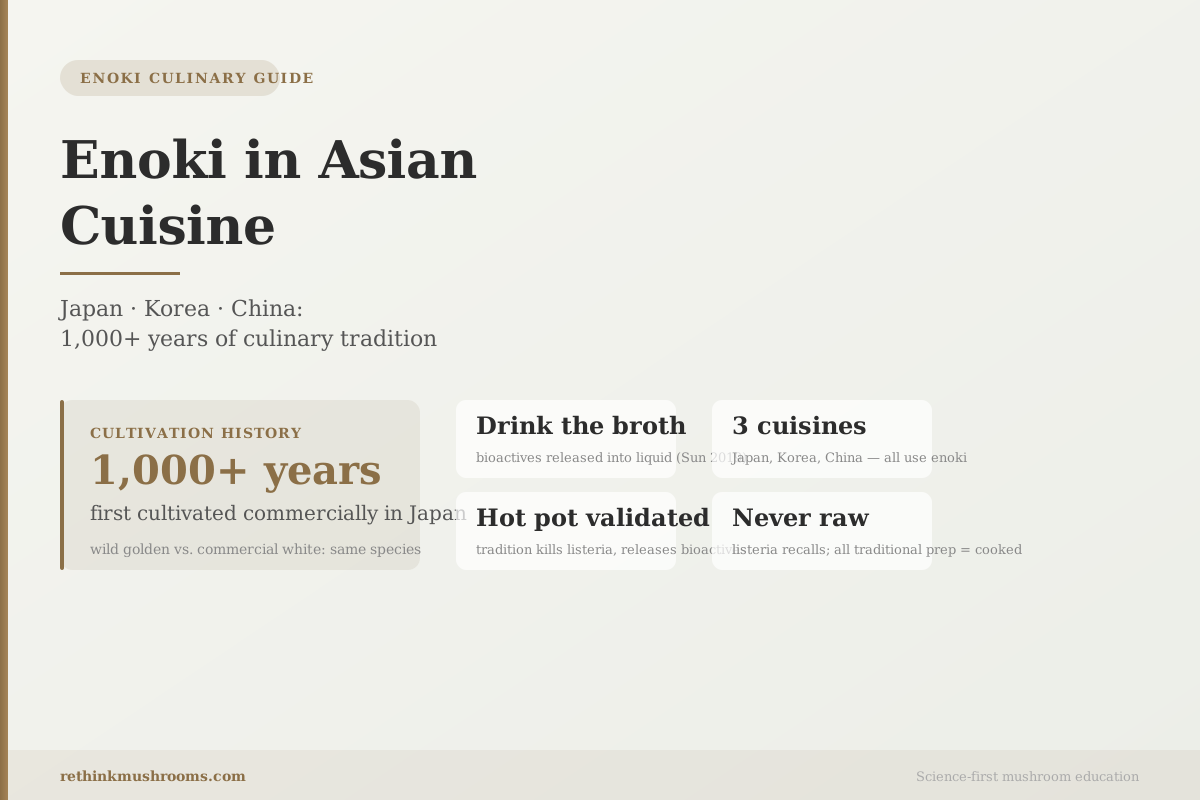
1,000+ years of cultivation
Enoki mushrooms appear in Japanese, Korean, and Chinese cooking in dozens of preparations. Their mild umami flavor and crunchy texture are best preserved in quick-cook applications like hot pot, miso soup, and stir-fries.
Tang et al., 2016
Two forms
commercial enoki (white, elongated) and wild velvet foot (golden, shorter cap) look completely different because cultivation conditions change the appearance
Broth matters
Sun et al. (2019) found that simmering mushrooms releases water-soluble bioactive compounds and flavor into the liquid; drinking the broth captures these
Cook always
raw enoki carries confirmed listeria risk from multiple food safety recalls; all traditional Asian preparations involve cooking, which eliminates this risk
Tang et al., 2016
 View as image ↗
The enoki mushroom sold in most grocery stores, a bundle of white slender stems topped with tiny pale caps, looks almost nothing like the wild mushroom from which it descended. The commercial form grows indoors in high-carbon-dioxide environments with minimal light, conditions that produce the long, ghostly white appearance associated with the name. The wild version, known as velvet foot, grows on dead trees in autumn and has golden-orange caps over shorter stems. They are the same species (Flammulina velutipes), shaped by radically different growing conditions into two distinct-looking foods.
Both forms have been consumed in East Asia for over a thousand years. Enoki appears in Japanese, Korean, and Chinese cooking traditions under different names and in different preparations, but almost always in hot, liquid-based dishes: hot pots, soups, broths, and quick stir-fries. This culinary preference is not coincidental. The traditional preparation methods that have defined how enoki is eaten across these cultures also happen to be the preparation methods that address the primary food safety concern with enoki and release its bioactive compounds into the cooking liquid.
For a full overview of the species, its research history, and what distinguishes it from other culinary mushrooms, what is enoki mushroom provides the foundation.
Key Takeaways
- Enoki mushrooms have been cultivated in East Asia for over a thousand years; the white elongated commercial form familiar in Western grocery stores is a product of 20th-century indoor cultivation techniques developed in Japan
- Commercial enoki (white, elongated) and wild velvet foot (golden, short-capped) are the same species but look completely different because indoor cultivation in low light and high CO2 suppresses pigmentation and elongates the stems
- Tang et al. (2016) reviewed enoki's history as a culinary medicine across East Asian food traditions, confirming that hot pot and soup preparations are the dominant traditional uses and naturally deliver the heat required for safety
- Sun et al. (2019) found that domestic cooking methods significantly affect nutrient, phytochemical, and flavor content in mushroom soup, with simmering releasing water-soluble bioactive compounds into the broth
- Enoki appears in Japanese cooking (sukiyaki, shabu-shabu, nabemono, miso soup), Korean cooking (beoseot-jeon, bibimbap, japchae), and Chinese cooking (hot pot, steamed fish topping, stir-fries) with consistently quick cook times
- Raw enoki should never be eaten as a garnish or in cold applications; food safety recalls in the US, UK, and Canada for listeria contamination cover raw enoki specifically; all traditional Asian preparations involve cooking that eliminates this risk
Wild vs. Commercial Enoki: Two Mushrooms From One Species
Understanding the appearance difference between wild and commercial enoki matters for anyone trying to identify enoki in Asian grocery stores, farmers markets, or restaurant dishes.
Wild enoki, called "velvet foot" in English, grows in tight clusters on dead elm, willow, and hackberry trees from late autumn through early spring. The caps are golden to reddish-brown, convex when young and flattening with age, typically 2 to 8 centimeters wide. The stems are covered in fine brown-black velvet (the velvet foot name), and the whole mushroom has the look of a small woodland mushroom. In Japan, where wild harvesting has occurred for centuries, it is found near water in cold weather.
Commercial enoki is the same species grown under controlled indoor conditions. Japanese cultivators developed techniques to grow enoki in bottles or tubes with elevated carbon dioxide levels, low light, and temperatures around 8 to 14 degrees Celsius. This environment drives the mushroom to grow tall and reach for light that is not coming, producing the elongated white stems (some reaching 15 centimeters) topped with tiny whitish caps less than a centimeter wide. The forced growth in low-light conditions suppresses the production of pigments that would otherwise make the caps golden, resulting in the characteristic pale white appearance of the commercial product.
The taste is similar between wild and commercial forms, though wild velvet foot is described as more robust in flavor with a slightly firmer texture. Commercial enoki has a milder, more delicate umami with a pronounced crunch that makes it ideal for hot pot, where it cooks in seconds and adds texture contrast rather than flavor intensity.
Flavor and Texture: What Enoki Brings to a Dish
Enoki has a lighter flavor profile than most other culinary mushrooms. Shiitake brings earthy depth and a meaty texture. Oyster mushrooms have a subtle seafood note and tender flesh. King oyster (trumpet) mushrooms are dense and rich. Enoki sits at the other end of the spectrum: mild, slightly nutty, with a gentle umami that does not compete with other ingredients.
The defining characteristic is texture. Raw enoki is notably crunchy, with a light snap when bitten. This texture persists through brief cooking: in a hot pot, enoki needs only 30 to 60 seconds in simmering broth to become slightly softened while retaining its characteristic resistance. This is why enoki is added near the end of hot pot meals rather than at the start. Longer cooking (more than 2 to 3 minutes in broth) produces a progressively more tender, eventually slightly silky texture.
The flavor and texture profile makes enoki particularly suited to applications where it adds textural interest to a dish rather than flavor depth: as a topping, a finishing addition to soup, or a quick-cook element in stir-fries. It does not stand up well to slow cooking or high-heat sustained contact, where it would lose its defining texture.
Enoki in Japanese Cooking
Japan has the longest documented history of commercial enoki cultivation, and the mushroom appears across a wide range of Japanese dish types.
Nabemono (hot pot): Enoki is a standard ingredient in Japanese one-pot dishes cooked at the table in shared broth. Sukiyaki (a sweet soy-based broth with thinly sliced beef and vegetables) and shabu-shabu (lighter dashi or water broth with beef or pork) both traditionally include enoki as one of several mushroom types. The broth in nabemono is not discarded; it concentrates the flavors and bioactive compounds released from all the ingredients as they cook, and finishing the meal by drinking the remaining broth is standard practice in Japanese food culture.
Miso soup: Enoki added to miso soup is a common domestic preparation, particularly in cold-season cooking. The mushroom is added after the miso paste is dissolved (to avoid overcooking) and served immediately. The brief cooking in hot dashi broth is sufficient to fully cook the enoki while preserving its texture.
Noodle soups: Enoki appears in various Japanese noodle soups, added as a topping after the broth and noodles are assembled. In restaurant presentations, it is sometimes served as a raw bundle on the side to be added by the diner, but this practice carries the listeria risk and the traditional preparation involves brief contact with hot broth.
Grilled preparations: Foil-wrapped enoki with butter and soy sauce, cooked over a grill until the stems soften, is a popular home and restaurant preparation. This method concentrates the flavor and produces a different texture than the liquid-based preparations.
Enoki in Korean Cooking
Korean cuisine uses enoki in several traditional preparations, often combined with other vegetables and a sesame-forward seasoning profile.
Beoseot-jeon (mushroom pancakes): Enoki is one of several mushrooms used in pan-fried mushroom pancakes, bound with egg and a light coating of flour. The pancakes are cooked in oil until golden, producing a crispy exterior with tender mushroom interior. Enoki's neutral flavor works well in combination with shiitake or oyster mushroom in mixed mushroom versions.
Bibimbap: Enoki appears as one of the namul (seasoned vegetable) components in bibimbap, blanched briefly and seasoned with sesame oil, salt, and sometimes garlic. The blanching step is brief (30 to 60 seconds in boiling water) and produces a soft but still slightly textured component that contrasts with the firmer vegetables in the bowl.
Japchae (glass noodle stir-fry): Enoki is sometimes included alongside glass noodles, spinach, carrot, and beef in japchae, stir-fried briefly over high heat. The quick stir-fry time is appropriate for enoki's texture and heat requirements.
Enoki muchim (seasoned enoki): A simple preparation in which blanched enoki is seasoned with soy sauce, sesame oil, garlic, and green onion. The seasoning is applied after cooking and cooling, making this a room-temperature side dish. The blanching step ensures the enoki is fully cooked.
Enoki in Chinese Cooking
In China, enoki is most commonly called jīn zhēn gū (golden needle mushroom) or jīn gū (golden mushroom), and it appears in both everyday cooking and in more formal restaurant preparations.
Hot pot: Enoki is a universal hot pot ingredient across Chinese regional styles. Whether in Sichuan mala (numbing-spicy) broth, Cantonese clear bone broth, or tomato-based broths, enoki is added to the communal pot and cooked briefly before eating. The individual dipping sauces (sesame paste, fermented tofu, soy with chili) do not affect the cooking; the enoki itself is always cooked in the hot broth.
Steamed fish topping: Whole steamed fish, a common preparation across southern Chinese cooking, is often topped with a combination of ginger, scallion, and enoki mushrooms. The mushrooms are placed on top of the fish before steaming and cook through the same steam process that cooks the fish. The preparation takes approximately 8 to 12 minutes total, more than sufficient to reach safe temperatures throughout.
Stir-fries: Enoki appears in Chinese stir-fries, typically in vegetable combinations rather than as the primary ingredient, added near the end of cooking for 30 to 60 seconds of contact with high heat. The stir-fry temperatures (well above 100 degrees Celsius in the wok) cook the enoki rapidly.
Broth-simmered dishes: Enoki added to chicken broth, tofu soup, or egg-drop soup is a common everyday preparation. The mushroom is added to already-hot liquid and served within minutes.
Why Soup and Hot Pot Validate the Tradition: What the Research Shows
Tang and colleagues (2016) reviewed the traditional use and bioactive properties of enoki as a culinary medicine, noting that hot pot and soup preparations in Chinese and Japanese traditions naturally achieve the cooking temperatures required for food safety while simultaneously releasing the water-soluble bioactive compounds (polysaccharides, proteins, ergothioneine) from the mushroom into the broth.[1] Drinking the broth from these preparations is standard culinary practice in East Asian cooking, which means the bioactives released from enoki during cooking are typically consumed rather than discarded.
Sun and colleagues (2019) studied how domestic cooking methods affect the nutrient, phytochemical, and flavor content of mushroom soup specifically.[2] The study found that simmering released water-soluble compounds into the broth in measurable quantities. For enoki specifically, this means the traditional practice of consuming the soup broth (rather than just the mushroom solids) captures the compounds released during cooking.
The convergence is worth noting: the traditional East Asian culinary preference for enoki in hot, liquid-based dishes is validated by two independent lines of evidence. From a food safety perspective, the hot liquid achieves temperatures that eliminate listeria risk. From a nutritional perspective, the hot liquid extracts water-soluble bioactive compounds that would otherwise remain partially trapped in the mushroom cell walls.
The Safety Rule Every Enoki Preparation Must Follow
Multiple food safety authorities in the United States, United Kingdom, and Canada have issued recalls and warnings for raw enoki mushrooms contaminated with listeria monocytogenes. These recalls have covered multiple brands and multiple years, and in some cases contaminated raw enoki was linked to confirmed human illness.
Listeria monocytogenes is heat-sensitive. Thorough cooking at temperatures above 70 degrees Celsius eliminates the bacteria. Every traditional East Asian preparation covered in this article involves cooking enoki to well above this temperature.
The safety rule is simple and non-negotiable: never eat enoki raw. Do not use raw enoki as a cold salad ingredient or as an uncooked garnish. Do not add raw enoki to cold noodle dishes. Do not eat it from the package without cooking. The mushroom needs to be cooked before eating, every time.
This rule is compatible with the entire traditional culinary repertoire for enoki. None of the traditional preparations described above use raw enoki. The food that has been used safely in East Asian kitchens for centuries has always been cooked enoki.
For the detailed safety and recall context, see how to safely prepare enoki and raw vs. cooked enoki: why you should never eat them raw. For the nutritional breakdown of what enoki delivers per 100g, see enoki nutritional profile: low calorie, high value.
The Bottom Line
Enoki mushrooms have been cultivated and eaten in East Asia for over a thousand years, appearing in Japanese, Korean, and Chinese cooking primarily in hot, liquid-based preparations including hot pots, soups, and stir-fries. The commercial white enoki and wild golden velvet foot are the same species shaped by different growing conditions. Traditional preparation methods naturally achieve the temperatures required to eliminate listeria risk while releasing water-soluble bioactive compounds into the broth. Raw enoki should never be consumed due to confirmed food safety recalls.
Frequently Asked Questions
Sources & References
- 1RTHM-00831·Tang, Calyn et al. (2016). “Golden Needle Mushroom: A Culinary Medicine with Evidenced-Based Biological Activities and Health Promoting Properties..” Frontiers in pharmacology.Study breakdown →PubMed →↩
- 2RTHM-00589·Sun, Yujing et al. (2019). “Domestic cooking methods affect nutrient, phytochemicals, and flavor content in mushroom soup..” Food science & nutrition.Study breakdown →PubMed →↩