Enoki Safety, Nutrition & Culinary Use
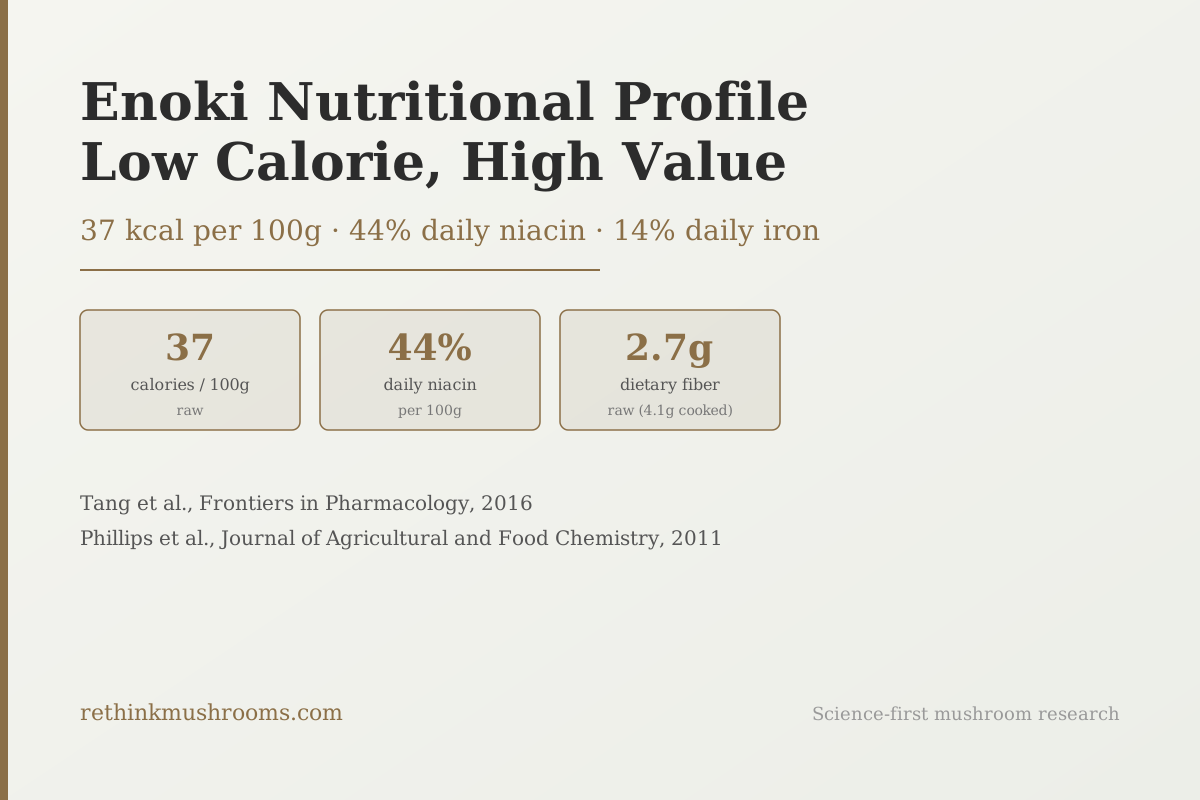
37 kcal per 100g
Enoki mushrooms pack 44% of your daily niacin into a 37-calorie serving, plus a bioactive compound profile that research shows extends well beyond the nutrition label.
Tang et al., Frontiers in Pharmacology, 2016
2.7g
fiber per 100g raw
44% DV
niacin per serving
0.29g
fat per 100g — nearly zero
Tang et al., Frontiers in Pharmacology, 2016
 View as image ↗
Enoki mushrooms are one of the lowest-calorie foods in any grocery produce section — 37 calories per 100g, less than most vegetables — yet they carry a nutritional profile that punches well above that number. At 44% of your daily niacin and 14% of your daily iron per 100g, the standard macros already tell a better story than most people expect. But a 2016 comprehensive review by Tang and colleagues found that enoki also contains bioactive polysaccharides, ergothioneine, flammulin, and mycosterol with measurable biological properties documented in laboratory and animal models.[1] The full picture includes one meaningful caveat that nutrition sites consistently miss.
For an overview of enoki mushroom research and biology, see what is enoki mushroom — the tiny mushroom with big research.
Key Takeaways
- Enoki provides 37 calories, 2.66g protein, and 2.7g fiber per 100g raw — strong micronutrient density for a food in that calorie range
- Niacin is the standout: 44% of the daily value per 100g, higher than most common whole foods at this calorie level
- Commercial enoki grown indoors in the dark has very low vitamin D — Phillips et al. (2011) confirmed this across 10 retail mushroom varieties; UV-treated enoki is the exception, not the rule
- Cooking increases measured total dietary fiber from 2.7g to roughly 4.1g per 100g, because heat reduces chitin content from about 7.7% to 2.7%, freeing other fiber fractions
- Tang et al. (2016) documented enoki's polysaccharide, ergothioneine, and flammulin content — compounds showing antifungal, antitumor, and antioxidant properties in preclinical studies
- When enoki is boiled in soup, water-soluble nutrients migrate into the broth — Sun et al. (2019) found drinking mushroom broth is the best way to capture nutrients that leach out during cooking
What the Numbers Actually Show: Enoki Mushroom Nutrition Per 100g
USDA FoodData Central provides the baseline for raw enoki (Flammulina velutipes, NDB #11260).
| Nutrient | Amount | % Daily Value |
|---|---|---|
| Calories | 37 kcal | — |
| Protein | 2.66g | 5% |
| Carbohydrates | 7.81g | — |
| — Dietary Fiber | 2.7g | 10% |
| — Sugars | 0.22g | — |
| Fat | 0.29g | 0% |
| Niacin (B3) | 6.9mg | 44% |
| Pantothenic Acid (B5) | 1.35mg | 27% |
| Folate (B9) | 48mcg | 12% |
| Riboflavin (B2) | 0.17mg | 13% |
| Potassium | 359mg | 8% |
| Phosphorus | 105mg | 15% |
| Iron | 1.11mg | 14% |
| Copper | 0.11mg | 12% |
Source: USDA FoodData Central
The niacin number stands out immediately. At 44% of the daily value per 100g, enoki delivers more niacin per calorie than chicken breast, pork loin, or peanuts — all foods commonly cited as top niacin sources. Pantothenic acid at 27% DV is similarly high relative to the calorie cost.
Protein at 2.66g per 100g is meaningful for a low-calorie food. Spinach provides about 2.9g protein per 100g at 23 calories — enoki is broadly comparable on protein density, with a different micronutrient profile.
Fat content is essentially zero at 0.29g, mostly polyunsaturated. Enoki is not a meaningful fat source.
Tang et al. reviewed the full bioactive compound profile in detail, covering polysaccharide content, mycosterol content, and what each compound class does in laboratory and animal models.[1] The USDA table captures standard macros and micronutrients, but doesn't capture compounds like flammulin, proflamin, or ergothioneine — which require direct analytical chemistry to measure, not a database lookup. For a deeper look at those specific compounds, see enoki bioactive compounds: flammulin, proflamin, and polysaccharides.
The Vitamin D Disappointment: Why Dark-Grown Enoki Scores Near Zero
This is the nutritional finding that nutrition sites consistently skip: commercial enoki mushrooms have almost no vitamin D.
Phillips et al. (2011) measured vitamin D and sterol composition across 10 types of mushrooms purchased from retail suppliers across the United States.[2] Enoki ranked among the lowest. The explanation is structural: commercial enoki is grown in cold, dark indoor facilities in elongated tubes that produce the characteristic pale white appearance. No light means no photosynthetic conversion of ergosterol into vitamin D2.
This matters because enoki is sometimes grouped with shiitake or maitake in content about "mushrooms as vitamin D sources," and that grouping is misleading. Shiitake and maitake grown under UV light or direct sunlight can contain substantial vitamin D2. Standard commercial enoki does not.
Phillips et al. also found that enoki contains ergosterol — the precursor compound that converts to vitamin D2 when exposed to ultraviolet light.[2] The raw material is there. The light exposure just hasn't happened.
UV-treated enoki does exist. Some producers expose packaged enoki to ultraviolet light before sealing, triggering ergosterol conversion. If the package lists vitamin D on the nutrition facts panel or specifically says "UV-treated," that's a different product. Most enoki in Asian grocery stores and mainstream supermarkets is not UV-treated, and the label won't volunteer this.
The practical point: don't buy enoki expecting vitamin D. If vitamin D from mushrooms is the goal, look for UV-treated maitake, portobello grown gill-side up, or any mushroom variety that shows vitamin D content on the label.
Cooking Enoki Increases Fiber: The Chitin Explanation
Most people assume cooking reduces a vegetable's nutritional value. With enoki's fiber content, the measured result goes the other direction — and the reason involves mushroom cell wall structure.
Raw enoki contains about 2.7g of dietary fiber per 100g. Cooked enoki comes in at approximately 4.1g of dietary fiber per 100g cooked. That is a 52% increase in measured fiber content from cooking.
The mechanism is chitin — the structural polymer that forms mushroom cell walls. Raw enoki has roughly 7.7% chitin content by dry weight. After cooking, that figure drops to around 2.7%. Heat breaks down chitin, which does two things simultaneously: it releases other fiber compounds that were bound within the cell wall matrix, and it improves the overall digestibility of the mushroom tissue.
This means cooking enoki is nutritionally beneficial on fiber alone, separate from the food safety argument. Tang et al. confirmed that the dietary fiber composition and polysaccharide profile of enoki are substantially influenced by preparation and processing methods.[1] The same cell wall breakdown that releases dietary fiber appears to increase the bioavailability of beta-glucans — the immunologically active polysaccharides that are central to enoki's functional food case.
The safety reasons for always cooking enoki are covered in detail in raw vs. cooked enoki: why you should never eat them raw. The nutritional reasons are a separate, reinforcing argument.
Beyond the Macros: What Research Found in Enoki's Bioactive Compounds
Tang et al. conducted the most comprehensive review of enoki's biological activities and bioactive compounds published to date, covering polysaccharides, lectins, ergothioneine, mycosterol, and additional compounds identified across decades of research.[1]
The polysaccharide content is the most researched area. Enoki polysaccharides — particularly beta-glucans — showed immunomodulatory activity in laboratory and animal models, meaning they interacted with immune system signaling pathways in ways that researchers could measure and quantify. The review also documented flammulin, a ribosome-inactivating protein found in enoki with antifungal and antitumor activity in cell line studies, and proflamin, a lectin studied for its effects on cancer cell proliferation in vitro.
Ergothioneine deserves specific attention. It is an amino acid derivative with strong antioxidant properties that humans cannot synthesize — we can only obtain it from dietary sources. Mushrooms are among the richest known dietary sources of ergothioneine, and enoki contains a notable amount. Tang et al. documented ergothioneine in enoki alongside evidence for its antioxidant properties, which operate through different pathways than vitamins C or E.[1] This means ergothioneine adds antioxidant capacity that isn't already covered by conventional dietary antioxidants.
Animal study evidence provides another data point. Yeh et al. (2014) fed enoki extract to rats over a defined study period and measured significant reductions in total cholesterol, LDL cholesterol, and triglycerides, alongside measurable increases in antioxidant enzyme activity in liver tissue.[3] These are preclinical results from a rat model and cannot be directly extrapolated to humans eating enoki in normal amounts. But they provide mechanistic support connecting enoki's polysaccharide and mycosterol content to effects worth studying at the human level.
Two limitations apply across this research. First, the work is largely preclinical — cell lines, animal models, and in vitro experiments. Human clinical trials are sparse. Second, research often uses concentrated extracts at doses far above what a normal serving of enoki would deliver. The research supports taking enoki's nutritional profile seriously. It does not support treating enoki as a functional medicine or supplement.
For readers interested in how different cooking methods interact with enoki's antioxidant compound content, how cooking methods affect enoki's antioxidant capacity covers that research in detail.
Boiling Enoki Releases Nutrients into the Broth — Drink It
Sun et al. (2019) studied how domestic cooking methods — boiling, stir-frying, and steaming — affect nutrient, phytochemical, and flavor content in mushroom-based soups.[4] The finding most relevant to how enoki is typically eaten: boiling releases a significant fraction of water-soluble nutrients from the mushroom tissue into the cooking liquid.
This is directly relevant to the most common Asian preparations of enoki — hot pots, Japanese nabe, Korean shabu-shabu, and miso-based soups. When enoki simmers in broth, B vitamins and water-soluble polysaccharides leach out of the mushroom tissue into the liquid. Discard the broth and those nutrients go with it. Drink the broth — as is conventional in Japanese and Korean cooking — and you recover them.
Sun et al. also found that stir-frying preserved certain phytochemicals better than boiling, because less cooking liquid means less opportunity for water-soluble compounds to leach out.[4] For enoki specifically, this makes quick stir-frying (2-3 minutes over medium-high heat) a good method for retaining heat-stable phytochemicals while still reaching the cooking temperatures required for safety. The practical preparation details are covered in how to safely prepare enoki.
Enoki vs. Other Mushrooms: Nutritional Comparison
Per 100g raw, based on USDA FoodData Central, with ergothioneine relative content from Tang et al. (2016):[1]
| Nutrient | Enoki | Shiitake | Oyster | Button |
|---|---|---|---|---|
| Calories | 37 kcal | 34 kcal | 33 kcal | 22 kcal |
| Protein | 2.66g | 2.24g | 3.31g | 3.09g |
| Fiber | 2.7g | 2.5g | 2.3g | 1.0g |
| Niacin | 44% DV | 26% DV | 28% DV | 23% DV |
| Pantothenic Acid | 27% DV | 52% DV | 18% DV | 19% DV |
| Folate | 12% DV | 10% DV | 4% DV | 4% DV |
| Iron | 14% DV | 6% DV | 10% DV | 2% DV |
| Vitamin D | Very low | Variable* | Low | Low |
| Ergothioneine | Notable | High | Moderate | Low |
*Shiitake vitamin D varies substantially depending on UV light exposure during or after cultivation.
Enoki's clear category win is niacin — 44% DV per 100g outperforms all three common alternatives by a wide margin. Iron at 14% DV also stands out, significantly higher than button mushrooms at 2% DV or shiitake at 6% DV. Enoki underperforms on pantothenic acid versus shiitake (27% vs. 52% DV) and on protein versus oyster mushrooms (2.66g vs. 3.31g).
The vitamin D row shows the key limitation. Shiitake varies widely because many producers use UV light exposure, while enoki's commercial cultivation conditions make UV treatment rare. Calorie-for-calorie, enoki's overall micronutrient density is competitive with the field — the vitamin D gap is the main nutritional shortcoming worth flagging.
The Bottom Line
Enoki mushrooms are genuinely both low calorie and high value: 37 calories per 100g with standout B-vitamin density (44% daily niacin) and a research-documented bioactive compound profile that includes ergothioneine, beta-glucan polysaccharides, and flammulin studied across multiple laboratory models. The main nutritional caveat is vitamin D — commercial enoki grown indoors in the dark has essentially none, and this distinction matters for consumers who buy mushrooms as a vitamin D source. Cooking enoki increases accessible dietary fiber by roughly 52% through chitin breakdown and is both a food safety requirement and a nutritional benefit.
Frequently Asked Questions
Sources & References
- 1RTHM-00831·Tang, Calyn et al. (2016). “Golden Needle Mushroom: A Culinary Medicine with Evidenced-Based Biological Activities and Health Promoting Properties..” Frontiers in pharmacology.Study breakdown →PubMed →↩
- 2RTHM-00230·Phillips, Katherine M et al. (2011). “Vitamin D and sterol composition of 10 types of mushrooms from retail suppliers in the United States..” Journal of agricultural and food chemistry.Study breakdown →PubMed →↩
- 3RTHM-00663·Yeh, Ming-Yei et al. (2014). “Hypolipidemic and antioxidant activity of enoki mushrooms (Flammulina velutipes)..” BioMed research international.Study breakdown →PubMed →↩
- 4RTHM-00589·Sun, Yujing et al. (2019). “Domestic cooking methods affect nutrient, phytochemicals, and flavor content in mushroom soup..” Food science & nutrition.Study breakdown →PubMed →↩