Enoki Safety
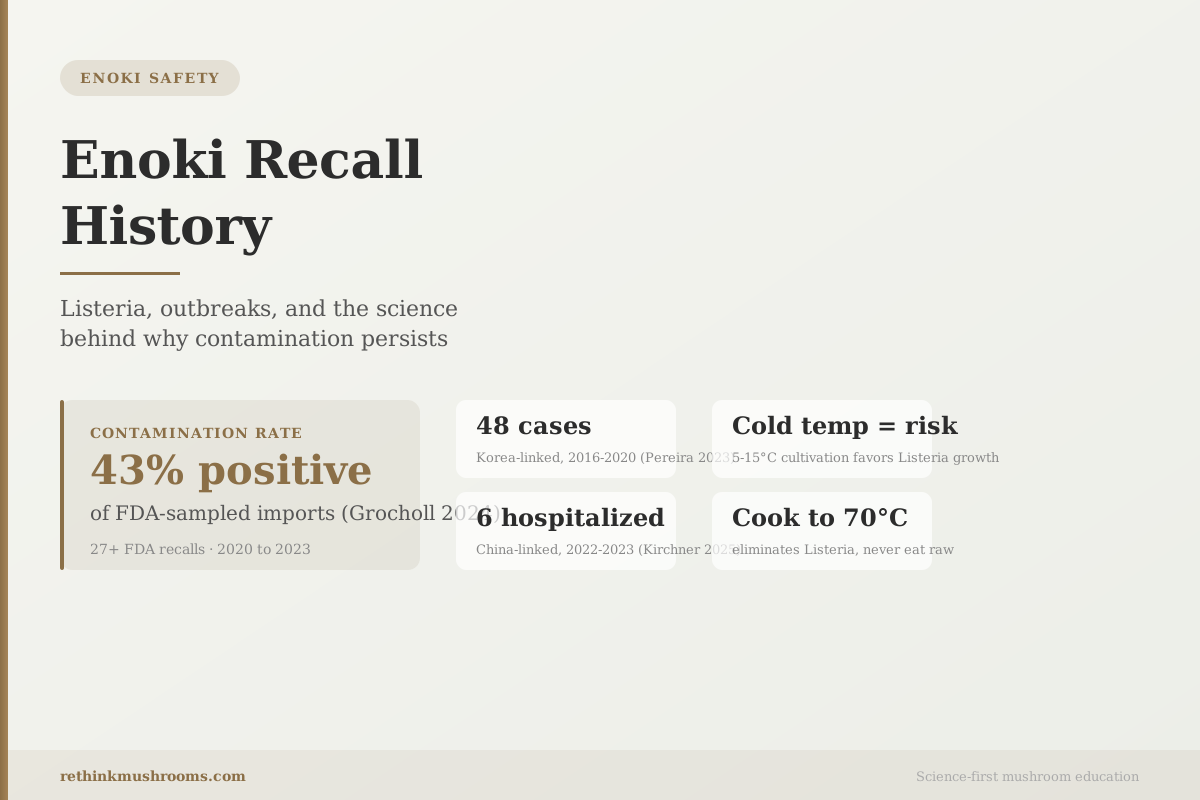
43% of imports tested positive
Grocholl et al. (2024) found that 43% of FDA-sampled imported enoki mushrooms tested positive for Listeria monocytogenes, the highest contamination rate documented for any single mushroom species.
Grocholl et al., 2024
48 cases (2016-2020)
Pereira et al. (2023) documented 48 US and Canadian listeriosis cases traced by whole-genome sequencing to one South Korean enoki facility
6 cases (2022-2023)
Kirchner et al. (2025) documented a China-linked outbreak of 6 cases, all hospitalized, caught via retail sample testing rather than illness reports
Cook to 70°C
thorough cooking to 70°C (158°F) for 2 or more minutes eliminates listeria risk; raw enoki should never be eaten
Grocholl et al., 2024
 View as image ↗
Between 2016 and 2023, public health investigators in the United States and Canada documented two separate multinational outbreak investigations linked to raw enoki mushrooms, accounting for at least 54 confirmed cases of listeriosis. During the same period, the US Food and Drug Administration initiated at least 27 recalls of enoki mushroom products due to Listeria monocytogenes contamination. These numbers place enoki in a category by itself among commercially sold mushrooms for documented listeria risk.
What distinguishes the enoki recall record from other food safety incidents is that it is not random or unpredictable. The peer-reviewed science published between 2023 and 2025 explains why enoki is unusually susceptible to listeria contamination and why the contamination persists despite regulatory pressure. This is a supply chain and cultivation science problem, not a random occurrence.
For context on how enoki is grown and why its cold, moist cultivation conditions create this vulnerability, what is enoki mushroom provides the species overview. For guidance on how to safely prepare enoki, see how to safely prepare enoki. For the broader safety argument — including why washing doesn't help and how cooking improves enoki nutritionally — see raw vs. cooked enoki: why you should never eat them raw and enoki nutritional profile: low calorie, high value.
Key Takeaways
- At least 27 FDA recalls of enoki mushrooms for Listeria monocytogenes contamination occurred between March 2020 and October 2023, involving products from South Korea, China, and Taiwan, with additional recalls continuing through 2024 (Viazis et al. 2025)
- Pereira et al. (2023) documented 48 confirmed listeriosis cases in the US and Canada (2016-2020) linked by whole-genome sequencing to a single South Korean facility
- Kirchner et al. (2025) documented a 2022-2023 China-linked outbreak of 6 confirmed cases, all hospitalized; the outbreak was identified through retail sample testing, not illness surveillance
- Grocholl et al. (2024) found that 43% of FDA-sampled imported enoki mushrooms tested positive for Listeria monocytogenes; the cold, moist cultivation conditions (5-15°C) that enoki requires are the same conditions that favor Listeria growth and survival
- Fay et al. (2023) modeling found that pre-chopped enoki distributes contamination more broadly than whole stems; Fay et al. (2023) kinetic studies found that dried/dehydrated enoki retains viable Listeria during long-term storage
- Thorough cooking to 70°C (158°F) for 2 or more minutes eliminates Listeria monocytogenes; raw enoki should never be consumed
The First Documented Multinational Outbreak: South Korea, 2016-2020
The scale of the first confirmed outbreak became clear only in retrospect, pieced together from illness records that had accumulated over four years before investigators connected them.
Pereira and colleagues (2023) published the investigation findings for a multinational outbreak of listeriosis linked to enoki mushrooms imported from the Republic of Korea, spanning 2016 to 2020.[1] The final case count was 48 illnesses: 36 in the United States and 12 in Canada. The investigation used whole-genome sequencing, a molecular typing method that can distinguish between different strains of the same bacterial species based on their precise genetic sequence, allowing epidemiologists to determine that illnesses separated by years and geography came from a genetically identical source.
The whole-genome sequencing evidence traced the outbreak to a single production facility in South Korea. The facility was identified through the genomic link between the Listeria strains isolated from ill patients and strains found in environmental samples and product samples. This level of traceability is only possible with modern genomic surveillance; the same outbreak would have been invisible to investigators using the laboratory methods available 20 years earlier.
The case count of 48 represents only confirmed, laboratory-diagnosed listeriosis cases. Listeria monocytogenes infection is a serious illness typically requiring hospitalization, but it exists on a spectrum. Milder infections may not be diagnosed, or may be attributed to other causes. The 48 confirmed cases are the floor, not the ceiling, of the actual human health impact over those four years.
The 2022-2023 China-Linked Outbreak: A Different Detection Method
The second documented outbreak differed from the first in how it was identified, and the difference matters for understanding how the recall system works.
Kirchner and colleagues (2025) published the investigation of a binational outbreak of listeriosis linked to enoki mushrooms imported from China, occurring in 2022-2023.[2] Six confirmed cases were identified in the United States and Canada. All six individuals were hospitalized.
The critical difference in this outbreak: it was identified through retail sample testing rather than illness reports. FDA collected enoki mushroom samples from retail outlets as part of routine import surveillance, found Listeria monocytogenes contamination, and whole-genome sequencing matched the contamination strains to the listeriosis cases under investigation. The investigation worked backward from a product finding to the human cases, rather than forward from illness clusters to a source.
This surveillance success demonstrates that FDA's import sampling program is capable of detecting contaminated product before the full disease burden accumulates. It also reveals a limitation: if retail sampling had not been initiated, those six cases would likely have been attributed to unknown sources, and the China-linked supply chain would have continued producing contaminated product without an identified connection to human illness. The Korea outbreak accumulated 48 cases over four years before it was resolved. The China outbreak was shorter because detection was faster.
Why 27 Recalls Is a Systemic Signal, Not Isolated Incidents
The volume of FDA recalls is the most direct indicator of how widespread the contamination problem is across the enoki supply chain. The FDA's own published overview of the enoki listeriosis investigations counted 27 recalls between March 2020 and October 2023, with additional recalls continuing through 2024, spanning products from multiple producers in South Korea, China, and Taiwan, distributed under multiple brand names to grocery retailers across the United States.[6]
This pattern does not describe contamination at one facility. It describes contamination as a recurring feature of enoki production at scale across the primary export countries. Different producers, different brands, multiple years, three countries: the common thread is the product and the production method, not a single bad actor.
The pattern also reveals a detection and recall dynamic: FDA can only initiate recalls for contamination it detects through testing. If a contaminated lot reaches consumers before sampling detects it, the recall prevents further exposure but does not help people who already ate the product. For the 48-case Korea outbreak, the contamination circulated for four years before the supply chain connection was established and the source identified.
Two Outbreaks, One Systemic Pattern
How Enoki Listeria Outbreaks Were Found — and Why Detection Speed Decided the Toll
The two published enoki listeriosis investigations differ less in the hazard than in the detection method. Korea's outbreak surfaced from illness clusters after four years; China's was caught when FDA retail sampling found the bacterium and traced it backward. Both sit on top of the same systemic driver.
Detected the slow way — from illness clusters
36 US · 12 Canada · one facility
Whole-genome sequencing tied 48 confirmed cases (36 US, 12 Canada) to a single South Korean manufacturer. Because the signal came from scattered human illnesses, the contamination circulated for roughly four years before investigators connected the cases and identified the source.
Pereira 2023 [1] · Viazis 2025 [6]
Detected the fast way — from retail sampling
all 6 hospitalized · sample-initiated
A sample-initiated retrospective investigation ran the logic in reverse: FDA import surveillance found Listeria in retail product first, then genomic matching linked it to the human cases. Six confirmed cases, all hospitalized — but the shorter case count reflects faster detection, not a milder hazard.
Kirchner 2025 [2] · Viazis 2025 [6]
The lower case count in the China outbreak reflects faster detection, not a less dangerous product. Both outbreaks trace to the same cultivation-and-cold-chain vulnerability, and the only reliable consumer control is thorough cooking. This is a food-safety map, not a risk-ranking of the two source countries.
Outbreak synthesis; figures from refs [1][2][3][6] (see references)
Why Enoki Is Uniquely Vulnerable: The Cultivation Science
The scientific explanation for why enoki has a higher listeria contamination rate than other mushrooms comes from the specific conditions required for its cultivation.
Grocholl and colleagues (2024) investigated Listeria monocytogenes contamination across the enoki cultivation process and found that the bacterium can enter at any stage, from substrate preparation through harvest, and grows to concentrations of approximately 10 to the third power (1,000) colony-forming units per gram under cultivation conditions.[3] The study found that 43% of FDA-sampled imported enoki mushrooms tested positive, making enoki one of the highest-contamination-rate produce items the FDA monitors.
The mechanism is tied directly to enoki's cold-temperature cultivation requirements. Enoki fruits optimally at 5 to 15 degrees Celsius, a temperature range that is also the optimal growth range for Listeria monocytogenes. Unlike many other food pathogens that prefer body temperature (37°C) and grow slowly in refrigeration, Listeria is cold-tolerant. It thrives in the same conditions that make enoki productive.
The problem compounds at the storage and distribution stage. After harvest, fresh enoki is stored and shipped under refrigeration to maintain freshness. These refrigerated conditions, which consumers and retailers correctly assume make food safer, actually support continued Listeria growth on the mushroom surface. The contamination that enters during cultivation does not die in the cold chain. It persists and in some conditions continues to grow.
Grocholl's analysis found that contamination could enter through the cultivation substrate, through water used during cultivation, through the facility environment, or through contact with contaminated equipment. These multiple entry points make it difficult to eliminate contamination through any single control measure; the entire cultivation environment would need to be managed.
The Pre-Chopping Risk and Why Dried Enoki Is Not Automatically Safe
Two additional studies from 2023 by Fay and colleagues extended the listeria analysis to specific food handling situations.
The first study modeled the fate of Listeria monocytogenes on fresh whole versus chopped enoki mushrooms.[4] Chopping or cutting raw enoki before cooking spreads contamination from the mushroom surface across the cutting board, knife, hands, and any surfaces or foods the contaminated hands and utensils subsequently contact. For whole raw enoki, the contamination is localized to the product. For pre-chopped raw enoki, the contamination is distributed across a kitchen work surface. The practical implication: if you are handling raw enoki before cooking, do not chop it and then proceed to prepare other ready-to-eat foods (salads, fruits, cooked proteins) without thoroughly cleaning the cutting surface and washing your hands. Better practice: add whole enoki directly to hot cooking liquid without pre-chopping on a surface shared with other foods.
The second study examined whether dried or dehydrated enoki mushrooms carry a lower listeria risk than fresh enoki.[5] The answer is no. Fay's kinetic analysis found that Listeria monocytogenes survives on dehydrated enoki mushrooms during long-term storage. Drying reduces the moisture that Listeria needs to grow, but viable bacteria persist on the dehydrated mushroom surface and can remain infectious for extended storage periods.
The practical implication: dried enoki mushroom products are not inherently safe to consume without cooking. The same rule that applies to fresh enoki applies to dried: cook thoroughly before eating.
Who Is at Greatest Risk
Listeria monocytogenes infection (listeriosis) affects different people differently. Most healthy adults who ingest small amounts of Listeria do not develop severe illness. The serious cases and deaths associated with listeria outbreaks are concentrated in specific high-risk groups.
Pregnancy: Pregnant people are approximately 10 times more likely to develop severe listeriosis than healthy non-pregnant adults. Listeria can cross the placenta and infect the fetus, causing miscarriage, stillbirth, premature birth, or severe illness in the newborn.
Adults 65 and older: Age-related changes in immune function increase susceptibility to Listeria, and the clinical course tends to be more severe. Hospitalization rates are high in this group.
Immunocompromised individuals: This includes people on immunosuppressive medications (including those used for organ transplants and autoimmune conditions), people receiving chemotherapy, people with HIV/AIDS, and people with blood cancers. For severely immunocompromised patients, even a small Listeria exposure can cause life-threatening illness.
People with liver disease and diabetes: Liver disease impairs immune clearance of bacterial infections. People with diabetes have increased susceptibility to several foodborne pathogens, including Listeria.
For people in these groups, the risk associated with consuming raw or undercooked enoki is significantly elevated. Thoroughly cooked enoki (with the cooking verified, not assumed) is the only form these individuals should consume.
The Practical Safety Guidance
The research translates to a small set of concrete actions.
Always cook enoki before eating. There is no safe preparation of raw enoki. The contamination rate (43% of imports tested) makes raw enoki a high-risk food for listeria exposure. The traditional East Asian preparations, all of which involve cooking, are the correct approach.
Verify the cooking is thorough. Adding enoki to a broth that is actively boiling or simmering, and cooking for at least 1 to 2 minutes, achieves temperatures that kill Listeria. Adding enoki to warm (but not hot) liquid and serving immediately does not.
Handle raw enoki carefully before cooking. Do not pre-chop raw enoki on surfaces shared with ready-to-eat foods. If you handle raw enoki, wash your hands before touching other foods. Cook whole stems by dropping them directly into hot liquid.
Do not assume dried enoki is safe without cooking. Dried enoki retains viable Listeria. Cooking dried enoki in hot liquid is the same requirement as fresh enoki.
High-risk individuals should be particularly careful. Pregnant people, adults over 65, immunocompromised people, and people with liver disease or diabetes should apply these precautions strictly and may want to avoid enoki entirely if they cannot verify thorough cooking.
The Bottom Line
The enoki mushroom recall record represents a documented, peer-reviewed food safety pattern, not isolated incidents. Two multinational outbreak investigations identified 54 confirmed listeriosis cases linked to enoki from South Korea and China (2016-2023). Grocholl et al. (2024) found 43% of FDA-sampled imported enoki positive for Listeria, explained by the cold-temperature cultivation conditions that simultaneously favor enoki growth and Listeria survival. Dried enoki is not inherently safe. Thorough cooking to 70°C eliminates the risk, and no traditional Asian enoki preparation uses raw enoki.
Frequently Asked Questions
Sources & References
- 1RTHM-01763·Pereira, Evelyn et al. (2023). “Multinational Outbreak of Listeria monocytogenes Infections Linked to Enoki Mushrooms Imported from the Republic of Korea 2016-2020..” Journal of food protection.Study breakdown →PubMed →↩
- 2RTHM-02108·Kirchner, Margaret et al. (2025). “A Binational Sample-Initiated Retrospective Outbreak Investigation of Listeria monocytogenes Infections in the United States and Canada Linked to Enoki Mushrooms Imported from China 2022-2023..” Journal of food protection.Study breakdown →PubMed →↩
- 3RTHM-01895·Grocholl, John et al. (2024). “Listeria monocytogenes Contamination Leads to Survival and Growth During Enoki Mushroom Cultivation..” Journal of food protection.Study breakdown →PubMed →↩
- 4RTHM-01692·Fay, Megan L et al. (2023). “Modeling the Fate of Listeria monocytogenes and Salmonella enterica on Fresh Whole and Chopped Wood Ear and Enoki Mushrooms..” Journal of food protection.Study breakdown →PubMed →↩
- 5RTHM-01691·Fay, Megan L et al. (2023). “Survival kinetics of Listeria monocytogenes and Salmonella enterica on dehydrated enoki and wood ear mushrooms during long-term storage..” Food microbiology.Study breakdown →PubMed →↩
- 6RTHM-02279·Viazis, Stelios et al. (2025). “An Overview of Listeriosis Outbreak Investigations in the United States Linked to Imported Enoki Mushrooms and Associated Regulatory Activities, Research, and Food Safety Knowledge Gaps..” Comprehensive reviews in food science and food safety.Study breakdown →PubMed →↩