Enoki Safety, Nutrition & Culinary Use
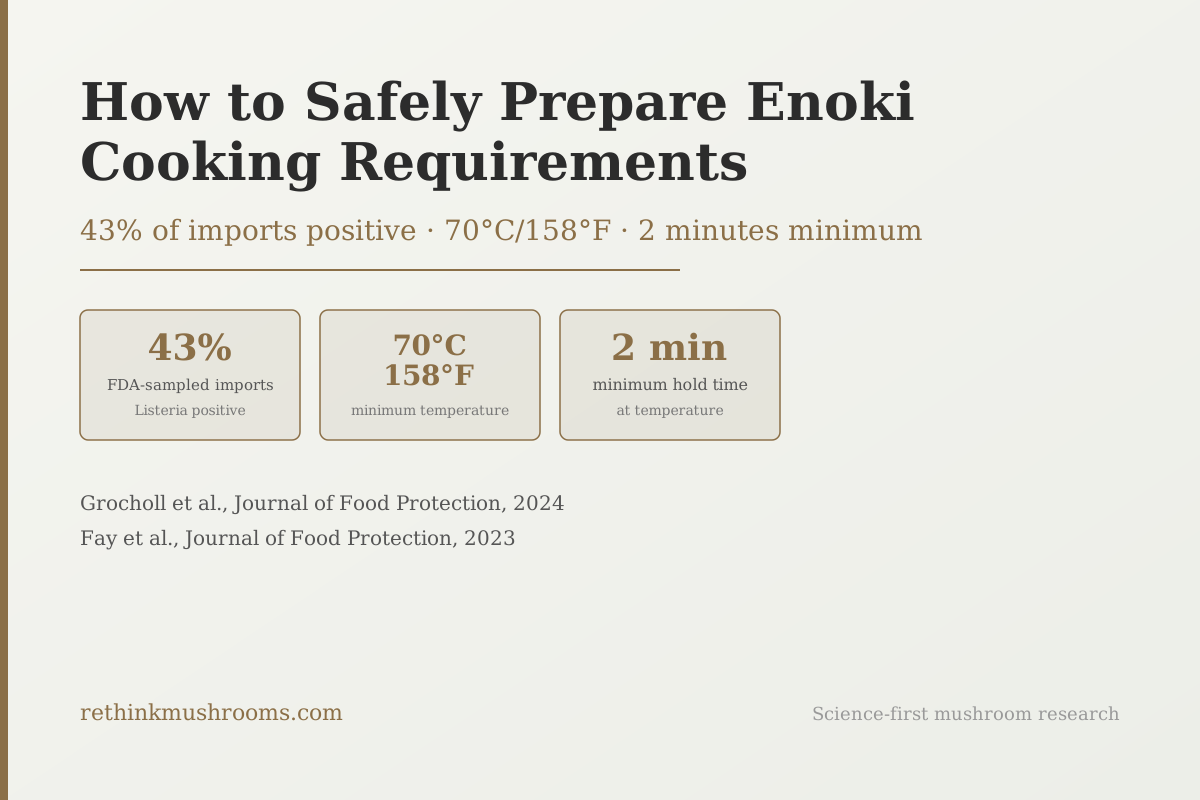
43% of FDA-sampled imports
Grocholl et al. (2024) found Listeria monocytogenes in 43% of FDA-sampled imported enoki — and the contamination grows inside the mushroom tissue, so washing alone cannot remove it.
Grocholl et al., Journal of Food Protection, 2024
70°C / 158°F
minimum internal temperature
2 min
minimum cooking time at temperature
Don't pre-chop
cutting raw enoki accelerates Listeria growth
Grocholl et al., Journal of Food Protection, 2024
 View as image ↗
The critical question about preparing enoki mushrooms is not how to cut them or which cooking method tastes best — it is whether they reach the temperature required to eliminate Listeria monocytogenes. Grocholl et al. (2024) found that 43% of FDA-sampled imported enoki tested positive for Listeria, and that contamination introduced at any point during cultivation grows to roughly 1,000 colony-forming units per gram (10³ cfu/g) by harvest time.[1] Washing does not remove this contamination because Listeria grows within the mushroom tissue itself, not just on the surface. Cooking to 70°C/158°F for a minimum of 2 minutes eliminates it.
This article covers the science behind that requirement and translates it into specific preparation steps. For the full story on why raw enoki carries this risk, see raw vs. cooked enoki: why you should never eat them raw. For the overview of enoki research and biology, see what is enoki mushroom — the tiny mushroom with big research.
Key Takeaways
- 43% of FDA-sampled imported enoki tested positive for Listeria monocytogenes — Grocholl et al. (2024) found contamination at any stage of cultivation survives to harvest and grows during refrigerated storage
- Washing enoki does not reduce Listeria risk because the bacteria live within the mushroom tissue, not only on the surface
- Safe minimum cooking temperature is 70°C/158°F held for at least 2 minutes; most standard cooking methods — stir-frying, boiling, hot pot — reliably achieve this
- Fay et al. (2023) found that chopping or damaging raw enoki accelerates Listeria growth significantly — don't pre-cut raw enoki, chop only after cooking
- Even packaged enoki from established brands has been recalled — Kirchner et al. (2025) documented a 2022-2023 outbreak linked to a recognized importer
- When boiling enoki in soup, Sun et al. (2019) found water-soluble nutrients migrate into the broth — drink the soup to capture them
Why Washing Enoki Doesn't Make It Safe
Most food safety guidance focuses on washing produce. For enoki, washing is effectively useless against Listeria.
Grocholl et al. (2024) investigated how Listeria monocytogenes contaminates enoki during cultivation.[1] They found that Listeria introduced at any stage — inoculation of growing medium, scraping, pinning, or collaring — survived and grew through the full cultivation cycle, reaching approximately 10³ cfu/g at harvest. The bacteria don't sit on the mushroom's surface waiting to be rinsed off. They establish within the tissue as the mushroom grows.
The same study found that refrigerated storage after harvest did not reduce Listeria counts. Counts increased during cold storage. This is counter to the intuition that refrigeration slows pathogen growth, and it reflects a specific property of Listeria monocytogenes: it is one of the few foodborne pathogens that continues to grow at refrigerator temperatures (4°C/39°F). Keeping enoki in the refrigerator maintains freshness and is still the right storage choice — but it does not make raw enoki safer over time.
This is why the 43% contamination rate from FDA sampling matters so much for consumers. It is not a rate for poorly handled enoki — it is a baseline contamination rate from imports sampled through standard retail channels. Cooking is the only effective intervention.
The Five Steps for Safe Enoki Preparation
Translating the research into a preparation protocol:
1. Keep refrigerated until ready to use. Do not store raw enoki at room temperature. Listeria grows faster at warmer temperatures, and room-temperature storage reduces your preparation window.
2. Keep in original packaging until use. Packaging integrity limits exposure to additional contamination sources and maintains moisture levels appropriate for the mushroom.
3. Trim 1-2 inches from the base root cluster. The base is a dense, tangled cluster attached to the growing medium. Trimming removes this cluster entirely. Rinse the trimmed enoki briefly under cold running water — do not soak.
4. Do not pre-chop raw enoki. If the recipe requires chopped enoki, cut after cooking. Fay et al. (2023) modeled how Listeria and Salmonella behave on whole vs. chopped enoki and found that cell damage from cutting dramatically accelerates Listeria growth on damaged tissue.[2] Pre-chopping raw enoki before cooking creates more surface area for contamination to proliferate in the time between cutting and cooking.
5. Cook to 70°C/158°F for at least 2 minutes before eating. This is the temperature and time combination specified in Canadian food safety guidance and consistent with Cornell University's food science recommendations. Most standard cooking methods achieve this with minimal effort — the specifics are in the section below.
How to Cook Enoki Safely: Methods and Timing
Different cooking methods reach the required temperature at different speeds. Here are reliable approaches ranked from fastest to slowest:
Stir-fry: Medium-high to high heat, 2-3 minutes. Enoki in a hot wok or pan reaches temperature quickly. The thin strands heat through faster than denser vegetables. Watch for the moment the enoki softens slightly and becomes translucent — that visual change indicates the tissue has reached cooking temperature. Add enoki last in multi-ingredient stir-fries, since it cooks faster than most vegetables.
Soup or hot pot: Add enoki to actively boiling or simmering broth in the last 2-3 minutes of cooking time. The enoki should be fully submerged and the broth should return to a boil after adding them. If you add enoki to a pot that's just barely simmering, extend cooking time to ensure the internal temperature is reached.
Boiling: 2+ minutes in boiling water (100°C/212°F). This is more than adequate — boiling water far exceeds the required 70°C/158°F threshold. Boiling tends to make enoki soft and slightly slippery, which works well for soups and noodle dishes but is less appealing in dishes where some texture is desired.
Baking or roasting: 190°C/375°F, 8-10 minutes. Enoki roasted in a single layer on a sheet pan develops concentrated flavor and slight crispness at the tips. This method completely eliminates the Listeria risk and produces a different culinary result from the more common soup/stir-fry applications.
Steaming: 5-7 minutes over boiling water. Steaming reaches adequate temperatures but is less common for enoki because the result is soft and neutral. Used in some Japanese preparations where enoki is steamed with dashi or other flavoring agents.
What is not safe: Any application that adds raw enoki to a dish without heat, or where heat is decorative rather than functional. This includes raw enoki as a salad ingredient, raw enoki as a cold garnish, and enoki added to a dish after cooking is complete. It also includes briefly dipping enoki in warm (not hot) liquid — the temperature must reach 70°C/158°F throughout the mushroom, not just at the surface.
Don't Pre-Chop Raw Enoki: The Research Behind This Rule
The Fay et al. (2023) modeling study specifically examined what happens to Listeria growth rates on whole versus chopped or damaged enoki mushrooms.[2] Chopped and physically damaged enoki showed significantly faster Listeria growth than whole mushrooms under identical storage conditions. The mechanism is cell damage: when mushroom cells are physically disrupted by cutting, nutrients previously contained within the cell walls become available at the surface, accelerating bacterial growth.
The practical implication is straightforward: prep raw enoki minimally. Trim the base, rinse, separate strands if needed — but do not slice, chop, or otherwise damage the mushroom flesh before cooking. If chopped enoki is required for a recipe, apply the knife after the mushroom has been cooked and the Listeria eliminated.
This matters for meal prep habits specifically. Cutting enoki on Sunday and storing it in the refrigerator for use during the week multiplies the contamination risk at exactly the point where refrigeration provides less protection than expected. Prep raw enoki immediately before cooking, not in advance.
Brand Familiarity Doesn't Protect You
Kirchner et al. (2025) investigated a 2022-2023 US-Canada outbreak of Listeria infections linked to enoki mushrooms imported from China, distributed by Utopia Foods.[4] Six people became ill; all six were hospitalized. The critical methodological point in this investigation: the outbreak was identified through retail sampling, not illness reports. FDA surveillance found contaminated product on store shelves before the illness cluster had grown large enough to be detected through normal reporting channels.
This demonstrates two things. First, even established importers with recognized brands in mainstream retail channels can distribute contaminated enoki. Kirchner et al. note that this was a sample-initiated investigation, meaning FDA's proactive retail surveillance caught the problem that standard disease surveillance alone might have missed.[4] Second, the contamination was present in commercially packaged product — not visibly damaged, not obviously compromised.
Buying enoki from a brand you've purchased before, from a retailer you trust, provides no meaningful protection against Listeria contamination. The contamination risk is systemic across imported enoki supply chains, not specific to particular brands or retail environments. Cooking is the protection; brand selection is not.
The second Fay et al. (2023) study adds a related point: Listeria and Salmonella survive long-term on dehydrated enoki during storage as well.[3] Dried or dehydrated enoki is not inherently safe. The same cooking temperature requirement applies to dehydrated enoki that has been rehydrated before eating.
The Broth Bonus: Nutritional Reason to Drink Enoki Soup
Enoki is most commonly eaten in soup, broth, and hot pot applications across Japanese, Korean, and Chinese cooking. Sun et al. (2019) studied how domestic cooking methods affect the nutrient profile of mushroom soups and found that boiling releases a significant fraction of water-soluble nutrients from mushroom tissue into the cooking liquid.[5]
B vitamins — the nutrient category where enoki is strongest, including niacin at 44% of the daily value per 100g raw — are water-soluble. When enoki simmers in broth, a portion of those B vitamins moves from the mushroom tissue into the liquid. If you discard the broth, you discard those nutrients. Drinking the broth recovers them.
This isn't unique to enoki — the same principle applies to any water-soluble vitamin in any vegetable. But for enoki specifically, where the most valuable micronutrients are B vitamins, it reinforces the traditional practice in East Asian cooking of finishing soup broth completely. The hot pot ritual of drinking the remaining broth isn't just cultural convention — it captures the nutritional value that leached out during cooking.
For enoki used in stir-fry or baking applications where there's no significant cooking liquid, this consideration doesn't apply.
The full nutritional profile of enoki — including what cooking does to its fiber content and how it compares to other mushrooms — is covered in enoki nutritional profile: low calorie, high value.
How to Store Enoki: Raw and Cooked
Raw enoki: Keep in original packaging in the refrigerator. Use within 7-14 days of purchase. Inspect before use — discard if slimy, discolored, or off-smelling. As Grocholl et al. (2024) demonstrated, refrigeration does not eliminate Listeria from enoki that is already contaminated, so storage time does not improve safety — cook within a reasonable window.[1]
Cooked enoki: Once cooked to the required temperature, Listeria has been eliminated. Store cooked enoki in a sealed container in the refrigerator and consume within 3-5 days. Reheat cooked enoki briefly before eating — it does not need to be recooked to full temperature again, since the contamination risk was addressed during the initial cooking.
What not to do: Do not store trimmed, separated, or pre-chopped raw enoki. Prepare raw enoki immediately before cooking. Do not leave raw enoki at room temperature for extended periods. Do not rewash enoki that has been sitting in the refrigerator for days hoping this improves safety.
Who Needs to Be Most Careful
The Listeria risk from raw enoki falls unequally across populations. Pregnant women, adults over 65, and people with weakened immune systems (including those undergoing chemotherapy, taking immunosuppressant medications, or living with HIV) face substantially higher risk of serious illness from Listeria infection compared to healthy adults.
For these groups, raw enoki is not an acceptable risk at any level. All enoki should be fully cooked before consumption. The cooking temperature requirement — 70°C/158°F for at least 2 minutes — eliminates the risk for everyone, regardless of immune status.
For healthy adults, raw enoki is inadvisable rather than categorically forbidden, but the 43% contamination rate from FDA sampling makes the risk meaningful even for low-risk individuals. The cooking requirement isn't excessive caution — it's a response to a documented and ongoing supply chain contamination problem that spans multiple countries and years of recalls.
Individuals who grow their own enoki at home avoid the commercial supply chain contamination risk entirely. Homegrown enoki that has never been exposed to contaminated growing medium from industrial cultivation is a different risk profile. For anyone interested in home cultivation as a path to safer enoki, how to grow mushrooms at home covers the basics.
The Bottom Line
Safely preparing enoki mushrooms requires cooking to 70°C/158°F for at least 2 minutes — washing is ineffective because Listeria monocytogenes grows within the mushroom tissue during cultivation, not just on the surface. Grocholl et al. (2024) found 43% of FDA-sampled imported enoki positive for Listeria, with counts that increase during refrigerated storage. Standard cooking methods — stir-frying, boiling, hot pot, baking — reliably achieve the required temperature. The single most important prep rule beyond cooking temperature: don't pre-chop raw enoki before cooking, as Fay et al. (2023) found that cell damage from cutting significantly accelerates Listeria growth.
Frequently Asked Questions
Sources & References
- 1RTHM-01895·Grocholl, John et al. (2024). “Listeria monocytogenes Contamination Leads to Survival and Growth During Enoki Mushroom Cultivation..” Journal of food protection.Study breakdown →PubMed →↩
- 2RTHM-01692·Fay, Megan L et al. (2023). “Modeling the Fate of Listeria monocytogenes and Salmonella enterica on Fresh Whole and Chopped Wood Ear and Enoki Mushrooms..” Journal of food protection.Study breakdown →PubMed →↩
- 3RTHM-01691·Fay, Megan L et al. (2023). “Survival kinetics of Listeria monocytogenes and Salmonella enterica on dehydrated enoki and wood ear mushrooms during long-term storage..” Food microbiology.Study breakdown →PubMed →↩
- 4RTHM-02108·Kirchner, Margaret et al. (2025). “A Binational Sample-Initiated Retrospective Outbreak Investigation of Listeria monocytogenes Infections in the United States and Canada Linked to Enoki Mushrooms Imported from China 2022-2023..” Journal of food protection.Study breakdown →PubMed →↩
- 5RTHM-00589·Sun, Yujing et al. (2019). “Domestic cooking methods affect nutrient, phytochemicals, and flavor content in mushroom soup..” Food science & nutrition.Study breakdown →PubMed →↩