Growing Mushrooms at Home
3 decisions that shape your medicinal mushroom harvest
The species you choose, the substrate you use, and where that substrate comes from all directly affect the bioactive compounds in your finished mushrooms — a connection that most beginner guides never cover.
Kała et al., Molecules, 2025; Ab Rhaman et al., Journal of Fungi, 2021; Tsiantas et al., Molecules, 2021
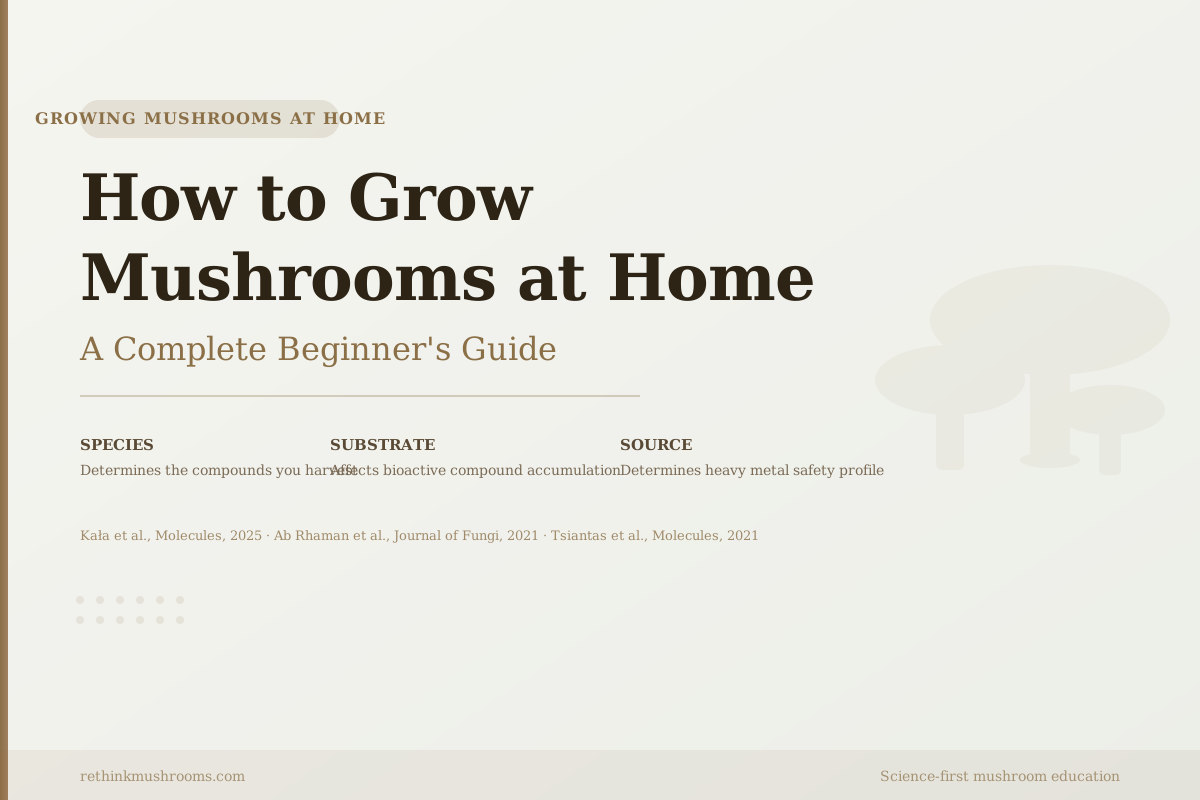
Species = Compounds
Ergothioneine and lovastatin concentrations vary significantly across mushroom species (Tsiantas 2021)
Substrate = Potency
Substrate composition directly affects hericenone accumulation in Lion's Mane fruiting bodies (Kała 2025)
Source = Safety
Mushrooms pull heavy metals from contaminated substrate into the fruiting body (Ab Rhaman 2021)
Kała et al., Molecules, 2025; Ab Rhaman et al., Journal of Fungi, 2021; Tsiantas et al., Molecules, 2021
 View as image ↗
Most beginner guides treat growing mushrooms at home as a food project. You follow the steps, keep things humid, wait a week or two, and get mushrooms. That works. But if you are growing medicinal species like Lion's Mane, oyster, or shiitake, there is a more important question underneath: what compounds actually end up in your harvest?
Learning how to grow mushrooms at home is genuinely beginner-friendly. You need three things: spawn (the living mushroom culture that colonizes your substrate), a substrate matched to your species (the organic growing medium), and a way to manage temperature and humidity during fruiting. Oyster mushrooms, the easiest starting species, can produce their first flush in as little as seven to fourteen days under proper conditions. The equipment list is shorter and cheaper than most people expect.
This guide covers everything you need to start: species selection, substrate science, equipment, the four-stage grow cycle, and how kits compare to building your own setup. It also covers the piece that competitors never mention. A 2025 study published in Molecules found that the substrate you use for Lion's Mane directly affects how much of its key brain-supportive compounds accumulate in the fruiting body.[1] If you are growing Lion's Mane for its compounds, substrate selection is not just a practical question. It is a health question.
Key Takeaways
- Oyster mushrooms are the easiest beginner species, typically producing a first flush within 7-14 days after initiating fruiting conditions.
- The substrate you use for Lion's Mane directly affects hericenone accumulation in the fruiting body — hericenones are the compounds most studied for Lion's Mane's brain-supportive effects — according to Kała et al. (2025, Molecules).
- Mushrooms draw heavy metals from their growing substrate and concentrate them in the edible fruiting body; contaminated substrate poses a genuine safety risk regardless of how well the grow goes otherwise (Ab Rhaman et al., 2021, Journal of Fungi).
- Concentrations of ergothioneine (a potent antioxidant) and lovastatin vary significantly across species, which means species selection directly affects which compounds you are growing for (Tsiantas et al., 2021, Molecules).
- A complete beginner setup requires spawn, substrate, a fruiting chamber (DIY option: about $10-15), and a hygrometer; total first-grow cost is typically $50-80.
- Lion's Mane, oyster, and shiitake are the three most beginner-accessible medicinal species, each with distinct compound profiles and different substrate requirements.
The Species You Grow Determines the Compounds You Eat
The most fundamental question in home mushroom growing is not "how do I set up my fruiting chamber?" It is "what am I actually trying to grow, and why?"
Different mushroom species produce meaningfully different compounds. A 2021 analysis published in Molecules by Tsiantas and colleagues measured concentrations of two bioactive compounds across multiple mushroom species and found significant variation between them.[3] One of those compounds is ergothioneine, a potent antioxidant that the body concentrates in tissues exposed to high oxidative stress. The other is lovastatin, which has cholesterol-modulating properties. The study found that which species you grow directly determines what concentrations of these compounds you end up with.
Lion's Mane (Hericium erinaceus) is the species most studied for cognitive and neurological effects. It produces hericenones in the fruiting body and erinacines in the mycelium. Neither compound is found at meaningful concentrations in oyster or shiitake. If brain health is your motivation for growing mushrooms, Lion's Mane is the species to grow.
Oyster mushrooms (Pleurotus ostreatus and related species) are high in ergothioneine and beta-glucans, a class of polysaccharides studied for immune support. They are also the most beginner-friendly species by a significant margin. Choosing oyster mushrooms is not settling for a second-best option. It is choosing a species with a well-documented bioactive profile and the fastest, most reliable path to a first successful harvest.
Shiitake (Lentinula edodes) contains lentinan, a beta-glucan with a substantial clinical research history, along with AHCC (active hexose correlated compound). Shiitake takes longer to fruit than oyster and requires hardwood substrate, but it remains accessible to beginners willing to manage a slightly longer grow cycle.
The compound profiles of these species are meaningfully different, which means choosing a species based on health goals is a legitimate framework, not overthinking a food project. The guide How to Grow Mushrooms at Home: A Health-Focused Beginner's Guide covers the species-by-compound angle in detail for growers who are motivated primarily by health outcomes.
Why Substrate Quality Is the Factor Every Guide Misses
Most beginner guides mention substrate as a purely practical topic: use straw for oyster mushrooms, hardwood for Lion's Mane, supplemented sawdust for shiitake. What they do not cover is why substrate quality matters beyond yield.
A 2025 study by Kała and colleagues, published in Molecules, examined how plant-based substrate composition affects the accumulation of bioactive compounds in Lion's Mane fruiting bodies.[1] The finding was direct: substrate composition shapes the medicinal quality of the mushroom, not just its yield. Hericenones, the compounds at the center of Lion's Mane's brain-support research profile, do not accumulate at the same levels regardless of what you feed your mycelium. The substrate you choose is a determinant of the end product.
This has a practical implication for home growers. Sourcing substrate from a reputable supplier who uses certified, well-characterized materials gives your Lion's Mane mycelium conditions that support compound accumulation. Buying cheap bulk substrate from an unknown source means growing in conditions with no guarantee of compound optimization.
The safety dimension is a separate issue, but equally important. A 2021 study by Ab Rhaman and colleagues, published in the Journal of Fungi, documented that mushrooms pull heavy metals from their growing substrate and concentrate them in the fruiting body.[2] The concentration of heavy metals in the edible mushroom can exceed the concentration found in the substrate itself. Contaminated substrate does not just affect yield or taste. It poses a direct safety risk.
The practical guidance from this research: when sourcing substrate, prioritize suppliers who can speak to their material's origin and heavy metal status. For growers preparing their own substrate from agricultural byproducts (straw, coffee grounds, hardwood chips), sourcing those materials from food-grade or certified sources is worth the additional cost.
This substrate science is covered in much greater depth in How Substrate Composition Affects Mushroom Health Compounds and Growing Mushrooms for Maximum Bioactive Content.
What You Need to Grow Mushrooms at Home (The Full List, With Costs)
The equipment required for a beginner mushroom grow is more accessible than most people expect. Here is the complete list:
Spawn — Spawn is the living mushroom culture that colonizes your substrate. It comes in several forms: grain spawn (mycelium grown into grain), sawdust spawn, and plug spawn (for log cultivation outdoors). Grain spawn is the most versatile for indoor beginner setups. Cost: $15-25 for enough to inoculate several grow bags.
Substrate — The organic material your mushrooms grow on, matched to your species. Straw (pasteurized) is standard for oyster mushrooms. Hardwood sawdust supplemented with bran or oats is standard for Lion's Mane and shiitake. Pre-sterilized, ready-to-inoculate substrate bags are available from specialty suppliers and remove the most technically demanding step for beginners. Cost: $5-20 per bag.
Fruiting chamber — The enclosed space where colonized substrate produces mushrooms. A beginner DIY option called a "shotgun fruiting chamber" is a clear plastic storage tote with holes drilled in the sides, filled with a layer of perlite to maintain passive humidity. Total cost: $10-15. A small grow tent with an automated humidity controller gives more precise environmental management at $50-80.
Hygrometer and thermometer — Mushrooms need specific temperature and humidity conditions to fruit. A combined unit handles both and runs $10-20. This is non-optional; guessing conditions leads to failed grows.
Spray bottle — For manual misting to maintain humidity in small setups. Automated ultrasonic humidifiers are worth adding for larger setups or multiple concurrent grows. Cost: $5-10 for a basic spray bottle.
Still-air box (optional but recommended) — A large storage tote with holes cut for your arms. Working inside a still-air box dramatically reduces the number of airborne spores that can land on open spawn or substrate during inoculation, which is the highest-risk moment for contamination. Cost: near zero if you have an existing tote.
Total first-grow cost estimate: $50-80 for a basic setup producing one or two species. Cost per pound of mushrooms drops significantly once you are buying spawn and substrate in bulk for subsequent grows.
For a detailed breakdown of indoor setup options and how environmental parameters affect fruiting, see Indoor Mushroom Growing: What You Need to Get Started.
Environmental targets by species:
| Species | Colonization Temp | Fruiting Temp | Humidity | Days to First Flush |
|---|---|---|---|---|
| Oyster (P. ostreatus) | 68-75°F | 60-70°F | 85-95% | 7-14 |
| Lion's Mane (H. erinaceus) | 70-75°F | 65-72°F | 85-95% | 10-14 |
| Shiitake (L. edodes) | 70-78°F | 55-65°F | 85-90% | 14-21 |
These ranges represent standard cultivation guidance. Individual results vary based on strain, substrate composition, and setup quality.
Your First Species: The Science-Backed Case for Starting With Oyster Mushrooms
The standard beginner recommendation is oyster mushrooms, and the recommendation is correct. Oyster mushrooms colonize quickly, tolerate beginner mistakes better than any other medicinal species, and fruit reliably within a narrow window after initiating fruiting conditions. They grow on straw, which is inexpensive and easy to pasteurize at home without specialized equipment.
The compound case for oyster mushrooms as a first species: Choosing oyster mushrooms is not choosing the "lesser" option. Oyster species (Pleurotus genus) are well-documented sources of ergothioneine, which Tsiantas et al. (2021) identified as varying significantly by species.[3] They are also rich in beta-glucans. If your interest in growing medicinal mushrooms is focused on immune support and antioxidant compounds, oyster mushrooms are a legitimate first choice on the merits, not just on ease.
When to start with Lion's Mane instead: If your primary motivation is cognitive or neurological support, the unique hericenone and erinacine content of Lion's Mane makes it the right species to grow. It requires hardwood substrate rather than straw, prefers a slightly cooler fruiting temperature, and benefits more from careful substrate selection, given what Kała et al. (2025) found about substrate composition and hericenone accumulation.[1] Lion's Mane is fully beginner-accessible with the right setup; it is just less forgiving of environmental sloppiness than oyster.
For species-specific growing guides, see How to Grow Oyster Mushrooms at Home: The Easiest Beginner Mushroom and How to Grow Lion's Mane at Home: Complete Guide.
Shiitake is a third option worth noting. It takes 14-21 days to fruit, requires a hardwood substrate, and prefers a cooler fruiting temperature than most beginner setups maintain by default. For growers specifically interested in shiitake's lentinan content, it is accessible, but the grow is less forgiving than oyster.
Kits vs. Building Your Own Setup: The Honest Trade-offs
Mushroom growing kits are the lowest-friction entry point. You receive a bag of fully colonized substrate (called a "block"), cut a hole in it, mist it twice daily, and wait for pins to form. Most beginners get a successful first flush from a good kit without any prior experience.
The case for kits: High success rate, no spawn procurement or substrate preparation, no sterilization equipment, and no learning curve on inoculation technique. A quality oyster mushroom kit costs $25-40 and typically produces two to three flushes before the block is spent.
The case for building your own setup: Significantly lower cost per pound of mushrooms after the initial setup, full control over spawn genetics, and complete knowledge of your substrate composition. Once you have purchased spawn, substrate materials, and basic equipment, each subsequent grow costs a fraction of a fresh kit.
The substrate transparency problem with kits: Most kits do not disclose their substrate composition in any meaningful detail. Given what Kała et al. (2025) found about substrate composition affecting bioactive compound accumulation in Lion's Mane,[1] and what Ab Rhaman et al. (2021) found about heavy metal bioaccumulation from substrate,[2] a kit from a company that cannot speak to its substrate sourcing delivers a product with unknown quality characteristics. A $25 kit with undisclosed substrate is not equivalent to a kit from a grower who uses certified hardwood from a traceable source.
The quality tier of the supplier matters more than the price tag. Kits from reputable cultivators who use certified substrate are meaningfully different from cheap kits of unknown origin.
For a detailed comparison, including cost-per-pound analysis and what questions to ask kit suppliers about substrate, see Mushroom Growing Kits: Are They Worth It? A Comparison.
The Four Stages Every Mushroom Grow Goes Through
Regardless of species or setup, all home mushroom grows follow the same four-stage cycle:
Stage 1: Inoculation
You introduce spawn into sterilized or pasteurized substrate. For grain spawn, this means mixing spawn into substrate bags or jars under clean conditions (still-air box or flow hood). For kits, this stage has already been done. The goal is to get mushroom mycelium in contact with substrate material across as much surface area as possible. Thorough mixing speeds colonization.
Stage 2: Colonization (Spawn Run)
Over the next one to three weeks, mycelium grows through the substrate, converting organic material into the energy reserves needed for fruiting. The substrate should stay at colonization temperature (typically 68-78°F depending on species), in darkness or dim light, with minimal disturbance. Signs of healthy colonization: dense white mycelial growth spreading uniformly across the substrate. Signs of contamination: green, black, or pink patches, which indicate competing mold species.
Stage 3: Fruiting Initiation
Once the substrate is fully colonized, you shift environmental conditions to trigger fruiting. Lower the temperature several degrees from colonization range, increase humidity to 85-95%, introduce fresh air exchange through the fruiting chamber, and add indirect light. This environmental shift mimics the seasonal cues that signal to mycelium in the wild that conditions are right for producing fruiting bodies.
Most beginner failures happen in the transition between stage 2 and stage 3. The most common mistake is initiating fruiting too early (before full colonization) or providing insufficient fresh air exchange.
Stage 4: Fruiting and Harvest
Pins form within days of initiating fruiting conditions. From pin formation to harvest-ready mushrooms is a short window: five to ten days for most species. Harvest before the caps begin to flatten and spread significantly at the margins. At that point, spores start releasing, which can cause respiratory irritation in enclosed spaces and signals that the mushroom is past peak quality. After harvest, the same block can produce a second and often a third flush, with each subsequent flush typically smaller than the previous.
For a complete step-by-step walkthrough of a first grow from inoculation through harvest, see Your First Mushroom Grow: Step-by-Step for Beginners.
Contamination: The Primary Failure Mode for First Grows
Contamination ends more first grows than any technical mistake. The most common contaminant is Trichoderma spp., a genus of fast-growing mold that competes aggressively with mushroom mycelium for substrate. Green patches on a colonizing block are almost always Trichoderma.
The important thing about contamination is that it enters through specific, preventable pathways: airborne spores settling on open spawn or substrate during inoculation, non-sterile tools, contaminated spawn, inadequately sterilized substrate, or direct contact from hands and breath during the inoculation window.
Understanding the pathway matters because each pathway has a specific prevention step. Airborne contamination is addressed by working inside a still-air box. Tool contamination is addressed by wiping tools with isopropyl alcohol before and during inoculation. Substrate contamination is addressed by proper sterilization (pressure cooker for grain and supplemented hardwood) or pasteurization (straw and coffee grounds).
One rule applies consistently: prevention is the strategy. A contaminated grow block cannot be rescued once the contamination is established. The effort goes into creating conditions where contamination cannot enter.
Why Growing Your Own Gives You Quality Control That Buying Cannot
The substrate science from this article closes with a practical argument for growing your own medicinal mushrooms that goes beyond cost or freshness.
Ab Rhaman et al. (2021) showed that the heavy metal content of the substrate flows directly into the edible fruiting body, sometimes at concentrations exceeding those in the source material.[2] Commercial mushroom products, including supplements and dried mushrooms, typically do not disclose their substrate source or composition. When you grow your own, you know what went into your substrate. That is a level of quality transparency that no commercial product can guarantee.
Combined with the substrate-bioactive connection from Kała et al. (2025), the case for home cultivation of medicinal species comes down to control.[1] You decide the species, you choose the substrate, you know where the substrate came from. Those three decisions determine the safety and the bioactive profile of what you grow. No other growing method gives you that chain of custody.
The Bottom Line
Growing mushrooms at home is accessible for motivated beginners, but the mainstream guides miss the most important layer: the choices made during the grow affect the bioactive content of the harvest. Kała et al. (2025) demonstrated that substrate composition affects hericenone accumulation in Lion's Mane. Ab Rhaman et al. (2021) showed that contaminated substrate leads to heavy metal bioaccumulation in fruiting bodies. Tsiantas et al. (2021) found that ergothioneine and lovastatin concentrations vary significantly by species. Together, these three findings make clear that species selection, substrate choice, and substrate sourcing are health decisions as much as practical ones. The equipment required to start is minimal. The questions worth asking before the first grow are what species, what substrate, and where the substrate comes from.
Frequently Asked Questions
Sources & References
- 1RTHM-02103·Kała, Katarzyna et al. (2025). “Influence of Plant-Based Substrate Composition and Extraction Method on Accumulation of Bioactive Compounds in Hericium erinaceus (Bull.) Pers. Fruiting Bodies..” Molecules (Basel.Study breakdown →PubMed →↩
- 2RTHM-00669·Ab Rhaman, Siti Maryam Salamah et al. (2021). “Mushroom Quality Related with Various Substrates' Bioaccumulation and Translocation of Heavy Metals..” Journal of fungi (Basel.Study breakdown →PubMed →↩
- 3RTHM-00725·Tsiantas, Konstantinos et al. (2021). “On the Identification and Quantification of Ergothioneine and Lovastatin in Various Mushroom Species: Assets and Challenges of Different Analytical Approaches..” Molecules (Basel.Study breakdown →PubMed →↩