Growing Mushrooms at Home
2.3× more ergothioneine with blue LED light during shiitake fruiting
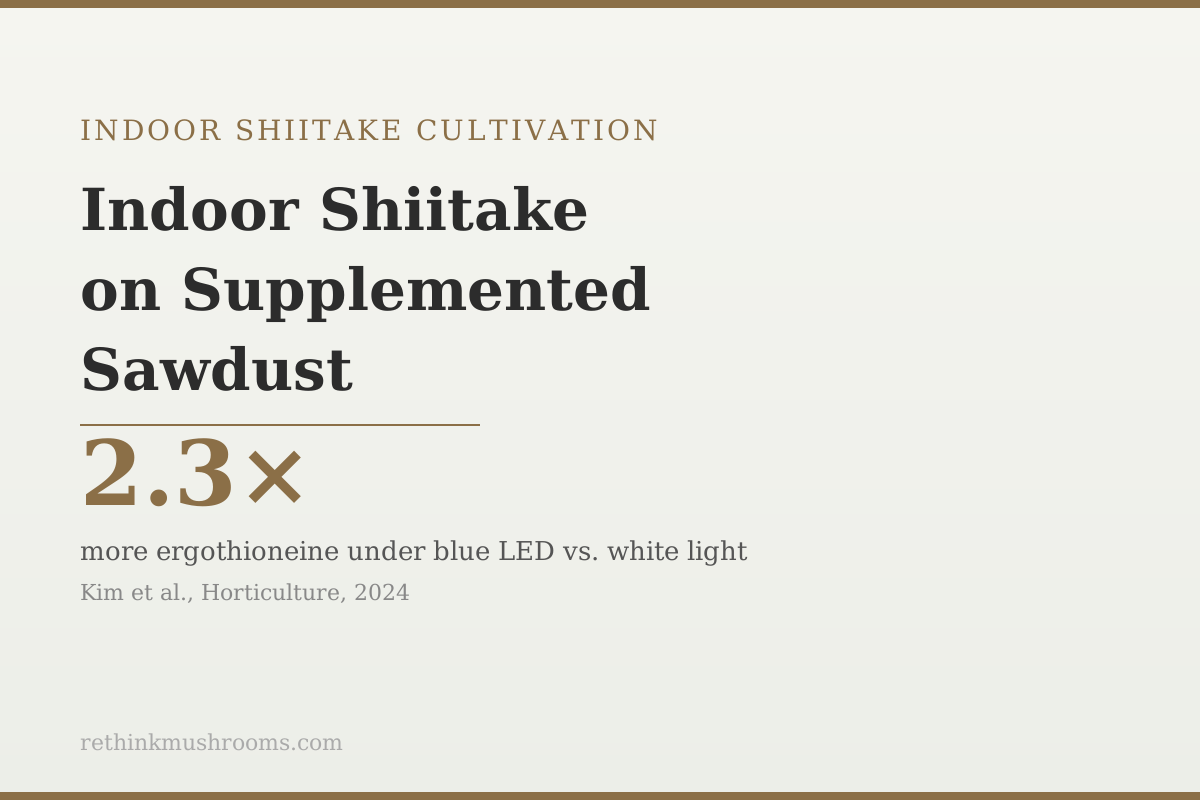
Shiitake grown on supplemented sawdust under blue LED light produced 2.8 mg/g ergothioneine versus 1.2 mg/g under white light, a 2.3-fold difference from a single cultivation decision. Indoor sawdust growing puts variables like lighting spectrum within a grower's control for the first time.
Kim et al., Horticulture, 2024
78/20/2
standard supplemented substrate ratio: hardwood sawdust / wheat bran / gypsum by weight
55%
optimal substrate moisture content for shiitake yield and mycelial development (Shen et al., 2008)
9-22%
yield improvement from amino acid nano-supplements added at first soaking in Nabhan et al. (2025)
Kim et al., Horticulture, 2024
 View as image ↗
Indoor shiitake on supplemented sawdust is faster, more predictable, and more space-efficient than log cultivation. What most guides on sawdust cultivation leave out is the quality dimension: what you gain in speed, you trade in bioactive compound concentration, and what you do with the variables uniquely available in indoor cultivation (lighting, soaking supplements, substrate species mix) determines where on the quality spectrum your mushrooms land.
Nam and colleagues compared the metabolic profiles of log-grown and sawdust-grown Lentinula edodes and found that sawdust-grown shiitake had higher amino acid concentrations but lower antioxidant capacity and bioactive compound levels than log-grown mushrooms, with log cultivation producing profiles matching wild-harvested shiitake.[1] This trade-off is worth stating upfront so growers can set realistic expectations and make informed decisions about optimization. For indoor sawdust cultivation, the goal is getting as close to log-grown quality as the medium allows. The research on substrate formulation, lighting, and supplementation gives growers specific tools to close that gap.
For a complete overview of home mushroom cultivation methods, see your complete beginner's guide to growing mushrooms at home.
Key Takeaways
- Sawdust-grown shiitake have higher amino acid content but lower bioactive compound concentrations and antioxidant capacity than log-grown shiitake; this trade-off is inherent to the substrate, not a product quality failure (Nam et al., Applied Biological Chemistry, 2021)
- Blue LED light during fruiting produced 2.8 mg/g ergothioneine versus 1.2 mg/g under white light in shiitake, a 2.3-fold increase from a single lighting variable (Kim et al., Horticulture, 2024)
- Gypsum in supplemented substrate works through three mechanisms: pH buffering of the growing environment, provision of calcium and sulfur nutrients, and stimulation of polysaccharide biosynthesis enzymes in the mycelium (Li et al., 2022)
- A 1:1 or 3:2 mix of oak and eucalyptus sawdusts outperformed pure oak in both yield and protein content, demonstrating that wood species blending can improve nutritional outcomes (El Sebaaly et al., 2024)
- Substrate moisture optimum is approximately 55% for shiitake; below this range, mycelial development slows; above it, anaerobic conditions favor contamination (Shen et al., 2008)
- Supplemented high-nitrogen substrates (wheat bran, rice bran) dramatically increase Trichoderma contamination risk; supplemented blocks require sterilization (not pasteurization) to prevent green mold disease (Wang et al., 2016)
The Quality Trade-Off: What Sawdust Gives Up
The question of which growing method produces better mushrooms for eating and health has a clear research answer. Log-grown shiitake match wild mushroom profiles; supplemented sawdust does not.
Nam et al. (2021) found this using metabolic profiling, not just measuring a few compounds: the full metabolic landscape of sawdust-grown shiitake is measurably different from log-grown or wild mushrooms.[1] Sawdust blocks produce mushrooms with higher amino acid content (the protein-building blocks available from the bran supplementation are reflected in higher free amino acids), but the complex bioactive compounds associated with health properties, including the polyphenolics and antioxidant compounds that accumulate during the extended enzymatic colonization of natural wood, are lower.
This is not a reason to avoid sawdust cultivation. It is context for optimizing it. The specific variables available in indoor sawdust cultivation (lighting, substrate mix, soaking supplementation, moisture management) can meaningfully affect the bioactive profile of the harvested mushrooms. The gap between average sawdust cultivation and optimized sawdust cultivation is substantial.
Timm and colleagues (2025) confirmed across multiple mushroom species that substrate composition directly produces different nutritional and bioactive compound profiles in the harvested mushrooms, establishing the scientific basis for substrate optimization efforts.[8] For a broader discussion of how substrate choice affects quality, see mushroom substrate guide: hardwood, straw, sawdust, and supplemented formulas.
The Standard Supplemented Substrate Recipe
The foundational recipe for indoor shiitake on supplemented sawdust, derived from the research literature:
| Ingredient | Percentage | Function |
|---|---|---|
| Hardwood sawdust | 78% | Primary carbon and nutrient source; shiitake is a wood-obligate species |
| Wheat bran | 20% | Nitrogen supplementation; accelerates mycelium development and increases yield |
| Gypsum | 1-2% | pH buffering, calcium and sulfur provision, enzyme stimulation |
| Water | To 55% moisture content | Required for mycelial metabolism; optimum documented at 55% |
Oak and hardwood sawdust are the most commonly available substrates. The wheat bran supplementation is what makes this a "supplemented" substrate versus plain sawdust; the bran provides nitrogen that accelerates mycelial growth and increases fruiting body production rates.
The moisture calculation: weigh your dry ingredients, then calculate the water needed to bring the mix to 55% moisture content by wet weight. A mix that squeaks when compressed but does not drip water freely is approximately at the right moisture level. Shen and colleagues identified 55% as the optimum through systematic moisture experiments, finding that lower moisture slowed mycelial growth while higher moisture created anaerobic conditions that reduced yield and favored contamination.[5]
Why Gypsum Works: The Li 2022 Mechanism Study
Gypsum (calcium sulfate) is standard in supplemented shiitake substrate, but few cultivation guides explain why it is there. Li and colleagues investigated the physiological mechanisms by which gypsum increases shiitake growth and yield in 2022, identifying three distinct mechanisms.[4]
pH buffering: Microbial activity during mycelial colonization tends to acidify the substrate. Shiitake mycelium functions best in a slightly acidic pH range (around 5.5-6.5). Gypsum acts as a pH buffer that resists the acidification, maintaining conditions favorable for shiitake while disadvantaging some competing organisms.
Mineral nutrition: Gypsum provides both calcium and sulfur. Both are essential nutrients for fungal cellular processes. Sulfur is a component of certain amino acids and enzyme cofactors; calcium plays roles in cellular signaling and cell wall structure.
Enzyme stimulation: This is the most mechanistically interesting finding. Li's team found that gypsum stimulates the activity of polysaccharide biosynthesis enzymes in the mycelium. Since beta-glucans are the primary polysaccharides of interest in shiitake, gypsum supplementation may directly increase the beta-glucan-related enzymatic activity in the developing mycelium, potentially contributing to higher polysaccharide content in the fruiting bodies.
Wood Species Optimization: The Oak-Eucalyptus Finding
Oak is the standard wood for shiitake substrate, but it is not necessarily the optimal choice in all contexts. El Sebaaly and colleagues (2024) tested mixtures of oak and eucalyptus sawdust at various ratios as shiitake substrate and compared them to pure oak substrate.[2]
The mixed oak-eucalyptus substrates outperformed pure oak in both yield and protein content of the resulting mushrooms. The researchers proposed that eucalyptus contributes different lignocellulosic composition that, combined with oak, provides a broader range of the nutrients and structural substrates that shiitake mycelium enzymes can efficiently degrade.
Practical implication: growers who have access to eucalyptus sawdust may benefit from using a 3:2 or 1:1 ratio with oak rather than pure oak substrate. Pure eucalyptus alone is not recommended; the benefit is in the combination.
For growers without eucalyptus access, the standard oak or mixed hardwood sawdust substrate performs well. The El Sebaaly finding provides a direction for optimization, not a requirement.
Sterilization vs. Pasteurization: Why High Supplement Levels Change the Answer
The question of whether supplemented shiitake blocks need sterilization or pasteurization has a clear answer: sterilization.
Low-nitrogen substrates (plain straw, unfertilized sawdust) can sometimes be pasteurized successfully because the limited nitrogen available does not strongly favor bacterial and fungal competitors. High-nitrogen supplemented substrates provide exactly the conditions that Trichoderma species and other competitors thrive in.
Wang and colleagues (2016) documented Trichoderma diversity on Lentinula edodes cultivation and found that Trichoderma species causing green mold disease proliferate especially under high-nitrogen substrate conditions, exploiting the same nitrogen that bran supplementation provides.[9] Pasteurization eliminates most vegetative competitors but not heat-resistant spores; sterilization (typically at 121°C under pressure in an autoclave or pressure cooker for 2-3 hours) eliminates both.
Supplemented shiitake blocks that are only pasteurized face a significantly higher Trichoderma contamination risk than sterilized blocks. This is why commercial shiitake producers universally use sterilization for supplemented substrates. For home growers, the same principle applies: supplemented blocks without sterilization are gambles. For more on sterilization vs. pasteurization principles, see how to prepare mushroom substrate: sterilization and pasteurization.
Blue LED Light: The 2.3x Ergothioneine Finding
The most practically actionable research finding for indoor sawdust growers interested in bioactive compounds is from Kim and colleagues (2024): the lighting spectrum during fruiting dramatically affects the ergothioneine content of the harvested mushrooms.[7]
Ergothioneine is an unusual amino acid that the human body cannot synthesize and must obtain from food. Mushrooms, particularly shiitake, are among the richest dietary sources. Kim's team grew shiitake on supplemented sawdust substrate under blue LED, white LED, and dark conditions and measured ergothioneine concentrations in the fruiting bodies.
Blue LED fruiting produced 2.8 mg/g ergothioneine. White LED produced 1.2 mg/g. Dark (control) produced lower still. The difference between blue LED and white LED light is not minor; it is a 2.3-fold increase in one of shiitake's most valuable bioactive compounds from a single variable change in the fruiting environment.
Blue LED grow lights (often sold for plant cultivation) in the 400-500nm range are widely available and inexpensive. For indoor sawdust growers who are already using lighting during fruiting, substituting blue LED for white LED costs nothing additional beyond the bulb itself.
Kim's team also found that blue light shortened the cultivation period, suggesting that the lighting benefit includes both quality improvement and time efficiency.
Nitrogen Supplementation Strategy
The choice of nitrogen source and amount affects both yield potential and contamination risk. The standard 20% wheat bran is a starting point, not a fixed prescription.
Desisa and colleagues (2023) studied substrate optimization for shiitake in Ethiopia and found that nitrogen source and level interacts with local wood substrate composition in determining both yield and mushroom quality.[6] The key principle: higher nitrogen increases yield potential but also increases Trichoderma contamination risk, and the balance depends on substrate composition and sterilization quality.
Nabhan and colleagues (2025) took a different approach, testing amino acid nano-supplements added at the first soaking (the force-fruiting soak) rather than mixed into the dry substrate.[3] This post-inoculation supplementation approach produced yield improvements of 9-22% and protein content increases of 2.9-8.2% depending on the amino acid formulation tested. The practical advantage: soaking supplementation adds nutrients at the fruiting trigger rather than during colonization, potentially bypassing some of the contamination risk associated with adding nitrogen to the pre-colonization substrate.
Timeline and Flush Expectations
Indoor shiitake on supplemented sawdust has a faster timeline than log cultivation:
Spawn run (colonization): 30-60 days at 20-24°C for a fully colonized block. Supplemented blocks colonize faster than plain sawdust due to additional available nitrogen. The block should turn uniformly cream-white through the sawdust when fully colonized.
Cold shock and first flush: After full colonization, submerge the block in cold water for 12-18 hours, then allow to fruit at 15-22°C with high humidity (85-95%). Pin formation typically begins within 3-7 days. First flush arrives 7-14 days after pins form.
Subsequent flushes: Rest the block for 1-2 weeks between flushes. Most blocks produce 3-5 flushes before yields decline significantly. Total lifetime yield from a 5-pound supplemented block is typically 1-2 pounds of fresh mushrooms across all flushes.
Versus log timing: A 60-day indoor sawdust cycle versus 6-18 months for log cultivation represents a fundamentally different production model. Sawdust blocks allow continuous production cycling that logs cannot match.
For how log and sawdust cultivation compare in bioactive compound profiles, and why log cultivation is still worth doing for health-focused growers, see how to grow shiitake mushrooms on logs: traditional method and shiitake bioactive compounds: lentinan, eritadenine, and beyond.
The Bottom Line
Indoor shiitake on supplemented sawdust produces mushrooms with higher amino acid content but lower bioactive compound concentrations than log-grown shiitake (Nam et al., 2021), making optimization of the indoor variables important for quality-conscious growers. The standard substrate recipe (78% hardwood sawdust, 20% wheat bran, 1-2% gypsum) benefits from specific mechanistic understanding: gypsum's three-way mechanism (pH buffering, mineral provision, enzyme stimulation) documented by Li et al. (2022). Mixing oak and eucalyptus sawdust outperforms pure oak for yield and protein (El Sebaaly et al., 2024). Blue LED light during fruiting produces 2.3x more ergothioneine than white LED (Kim et al., 2024). Supplemented blocks require sterilization rather than pasteurization to prevent the Trichoderma contamination that high-nitrogen conditions favor.
Frequently Asked Questions
Sources & References
- 1. Source details for this reference are not yet available.
- 2. Source details for this reference are not yet available.
- 3. Source details for this reference are not yet available.
- 4. Source details for this reference are not yet available.
- 5. Source details for this reference are not yet available.
- 6. Source details for this reference are not yet available.
- 7. Source details for this reference are not yet available.
- 8. Source details for this reference are not yet available.
- 9. Source details for this reference are not yet available.