Growing Mushrooms at Home
$50 basic first-grow setup
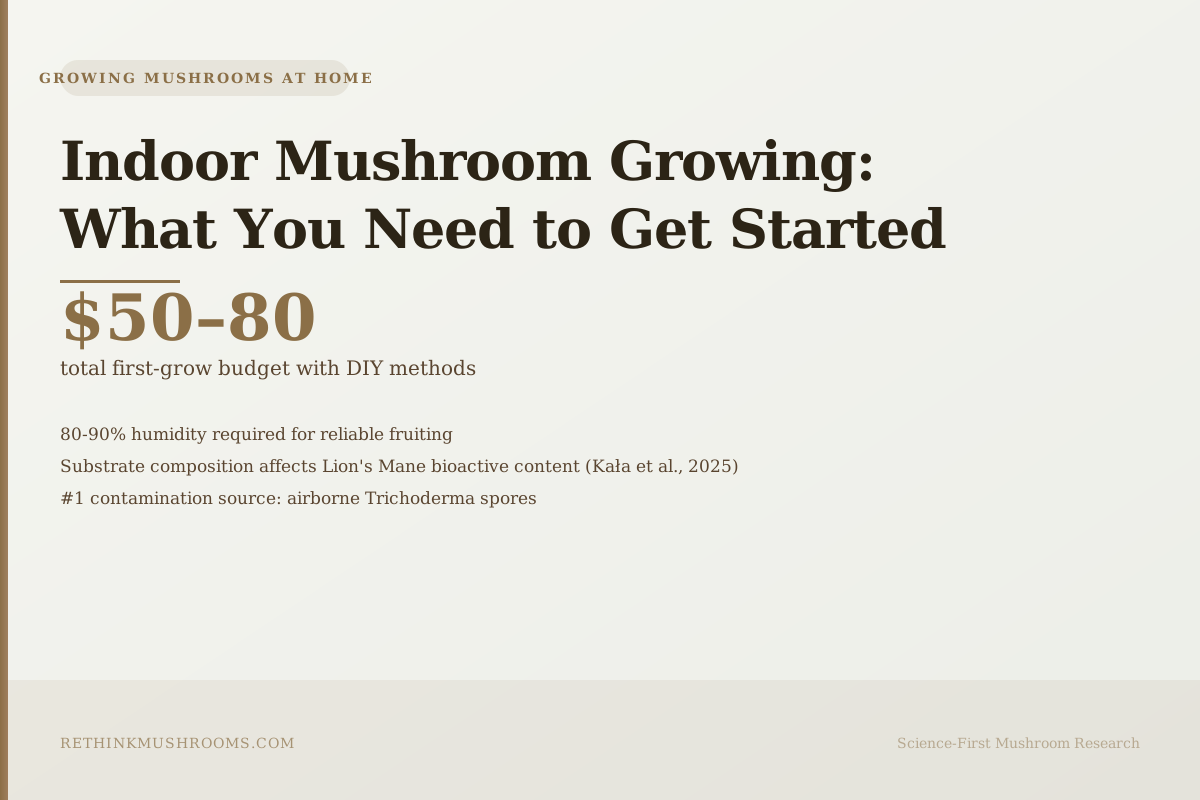
A DIY indoor mushroom setup costs $50-80 for your first grow. But substrate choice isn't just about yield; 2025 research confirmed that what you fill your growing bags with directly affects the bioactive compound content of your harvest.
Kała et al., Molecules, 2025
80-90%
humidity range required for reliable fruiting
2025
year substrate composition was linked to Lion's Mane bioactive content
#1
contamination source: airborne Trichoderma spores in indoor grows
Kała et al., Molecules, 2025
 View as image ↗
Most guides to indoor mushroom growing tell you what to buy and what numbers to aim for. They rarely explain why any of it matters biologically, or why the substrate you use for something like Lion's Mane affects what you actually harvest beyond the mushroom weight.
This article covers the equipment, environmental parameters, and contamination prevention needed to grow mushrooms indoors successfully. It also covers the research that explains why certain setup decisions matter more than equipment suppliers let on.
For the full beginner overview including species selection and health compound context, see How to Grow Mushrooms at Home: A Complete Beginner's Guide.
Key Takeaways
- A basic indoor grow setup costs $50-80: fruiting chamber ($10-20 DIY), hygrometer/thermometer ($15-20), spray bottle or humidifier ($5-20), substrate ($5-15), and spawn ($15-25)
- The primary cause of failed home grows is contamination from airborne Trichoderma mold spores; Kim et al. (Plant Pathology Journal, 2019) identified these as the dominant contaminant in indoor sawdust-based grows; this justifies still-air technique and HEPA filtration
- Substrate composition directly affects bioactive compound accumulation in Lion's Mane: Kała et al. (Molecules, 2025) showed that plant-based substrate choice is a determinant of hericenone and polysaccharide content, not just yield
- Heavy metals bioaccumulate in mushrooms from the substrate (Ab Rhaman et al., Journal of Fungi, 2021); source substrate from suppliers who can confirm heavy metal status
- Colonization and fruiting require different temperature ranges: most species colonize at 65-75°F but fruit best at 55-70°F, a difference most home setups can achieve without additional equipment
- Humidity is the most commonly mismanaged parameter: 80-90% relative humidity is required during fruiting; below 70% and pins stall; above 95% for extended periods promotes bacterial contamination
The Equipment List: What You Need, What You Can Skip, and What It Costs
Indoor mushroom growing does not require specialized equipment for a first grow. The core list:
Fruiting chamber. This is the enclosed space where your colonized substrate blocks or bags fruit. The simplest option is a DIY shotgun fruiting chamber (SGFC): a clear plastic storage tote with holes drilled every few inches across all surfaces, filled with a layer of perlite (a volcanic mineral that releases moisture slowly) on the bottom. Cost: $10-20 for tote and perlite. The alternative is a grow tent ($50-80) with better environmental control, needed if your space has low ambient humidity or temperature swings.
Hygrometer and thermometer. Indoor mushroom growing requires knowing the actual humidity and temperature inside your fruiting space, not just what the room feels like. A combined hygrometer/thermometer costs $15-20 and is non-optional. Guessing humidity does not work.
Humidity source. A simple spray bottle ($5) is sufficient for smaller setups if you mist 2-3 times per day. An ultrasonic humidifier connected to a humidity controller ($40-70 for both) automates this for larger or more demanding setups.
Substrate materials. The growing medium. For oyster mushrooms: pasteurized straw, cardboard, or supplemented hardwood sawdust. For Lion's Mane and shiitake: hardwood sawdust (usually oak or beech), sometimes with wheat bran or other supplements. Substrate bags with filter patches run $15-20 per 10 bags; bulk substrate materials run $5-15 per grow.
Spawn. This is the mushroom mycelium inoculated into a grain or sawdust carrier, the equivalent of seeds. It runs $15-25 for a small bag from a reputable supplier and is enough for several grows.
Total first-grow budget: $50-80 using fully DIY methods and a single species. Adding a grow tent brings the total to $120-160 but improves control considerably for most home environments.
What you can skip: Pressure cooker (useful for agar work or fully sterilizing hardwood substrate, not required for pasteurized straw oyster grows). Agar plates (for cloning and maintaining cultures, an advanced technique). Flow hood (needed for agar work, not for a first grow). Automated CO2 monitor (useful but not required to start).
The Environmental Parameters: Why Each Number Matters
Every species guide lists temperature and humidity requirements. Few explain the biology behind the parameters. Understanding the biology helps you troubleshoot when something goes wrong.
Temperature: two stages, different requirements.
Mushroom growth has two distinct phases with different optimal temperatures. During colonization, the mycelium (the root-like network that grows through the substrate before fruiting) prefers 65-75°F for most common species. Oyster mushrooms tolerate up to 80°F during colonization but may compete with contaminants more easily at higher temperatures.
During fruiting, most species prefer a cooler range: 55-70°F. The temperature drop from colonization to fruiting is itself a fruiting trigger for some species. In most homes, this means colonization happens at room temperature and fruiting can happen near a window or in a cooler room.
Lion's Mane and shiitake prefer the cooler end (55-65°F fruiting). Oyster mushrooms are more tolerant of temperature variation (55-75°F fruiting). Pink and yellow oyster varieties prefer warmer fruiting conditions (70-80°F).
Humidity: the most critical and most mismanaged parameter.
During fruiting, mushrooms need 80-90% relative humidity at the fruiting surface. This is not about the room humidity. It is the humidity inside the fruiting chamber that matters.
Why this specific range? Mushroom pins (the earliest visible stage of fruit body formation) are initiated partly by evaporative moisture loss from the substrate surface. The substrate surface needs to be slightly drier than 100% saturation, while the surrounding air is near-saturated. If humidity drops below 70-75%, the evaporative stress becomes too great and pins stall or abort. If humidity stays above 95% for extended periods without fresh air exchange, the condensation creates conditions favorable to bacterial contamination.
Fresh air exchange: CO2 is a fruiting inhibitor.
Mycelium produces carbon dioxide as it metabolizes substrate. In an enclosed space, CO2 concentrations build up rapidly. Most mushroom species initiate fruiting partly in response to low CO2 concentrations; the drop in CO2 signals that the mycelium has reached the surface of the substrate and is now exposed to open air.
In practical terms: colonization bags should be sealed (the mycelium produces CO2 and benefits from slightly elevated CO2 during this stage). Fruiting chambers need fresh air exchange multiple times per day. Fanning out stale air and allowing fresh air in drops CO2 and helps initiate and maintain pin formation.
Light: directional cue, not energy source.
Mushrooms do not photosynthesize. They do not use light for energy. Light functions as a directional cue; some species use it to orient growing fruit bodies toward the light source. For most indoor grows, indirect natural light or a basic LED on a 12/12 light cycle is sufficient. Direct sunlight causes heat and humidity problems. Complete darkness is suboptimal for some species but workable for oysters.
Why Contamination Happens and What the Evidence Says About Prevention
Every guide tells you to use clean technique: sterilize or pasteurize your substrate, work in a clean space, move quickly. The instructions are right but the explanations are usually vague. The research is more specific.
Kim and colleagues published a study in The Plant Pathology Journal in 2019 examining the sources of contamination in indoor mushroom grows using sawdust substrate.[2] Their finding: Trichoderma mold species were the dominant contamination threat, and the primary source was airborne spores in the cultivation space, not just from contaminated substrate or unclean tools.
Trichoderma is a fast-growing green or white mold that competes aggressively with mushroom mycelium for substrate. Once established, it typically cannot be eliminated and the grow must be abandoned.
The Kim 2019 data has practical implications:
HEPA filtration matters. If Trichoderma arrives primarily through airborne spores, filtering the air in your growing space reduces the spore load. A still-air box (a simple clear tote with arm holes, used for inoculation) creates a dead-air zone where airborne spore movement is minimized. A flow hood (for more advanced work) provides HEPA-filtered positive pressure. The instruction "work in still air" exists because it works for this specific reason.
Timing of bag openings matters. The highest contamination risk is during inoculation, when the substrate is opened and exposed to room air. Minimizing the time between opening a sterilized bag and sealing it after inoculation reduces airborne exposure.
Substrate sterilization vs. pasteurization. For hardwood-based substrates, sterilization (pressure cooking at 15 psi for 2.5 hours) eliminates all competing organisms including heat-resistant bacteria. Pasteurization (holding at 160-180°F for 1-2 hours) kills most but not all competitors. For oyster mushrooms on straw, pasteurization is sufficient because oyster mycelium colonizes aggressively and outcompetes most common contaminants.
Substrate: Why What You Fill the Bags With Affects More Than Yield
Most indoor growing guides treat substrate selection as purely a yield question: which substrate produces more mushrooms per bag? But a 2025 study by Kała and colleagues in Molecules showed substrate choice affects something more fundamental for medicinal species.[1]
Kała et al. measured hericenone and polysaccharide accumulation in Lion's Mane (Hericium erinaceus) fruiting bodies grown on different plant-based substrate compositions. The finding: substrate composition was a significant determinant of bioactive compound content in the harvested mushrooms. Different substrates produced measurably different concentrations of hericenones, the compounds associated with Lion's Mane's nerve growth factor effects, along with polysaccharides including beta-glucans.
This changes the framing for anyone growing medicinal mushrooms at home. If your goal is a higher bioactive content harvest rather than just more pounds of mushrooms, the substrate recipe is a health variable, not just an agricultural one. For Lion's Mane in particular, substrate composition affects the concentration of the compounds you are growing the mushrooms for.
There is a second dimension to substrate quality: safety. Ab Rhaman and colleagues published a study in the Journal of Fungi in 2021 examining heavy metal bioaccumulation in mushrooms grown on different substrates.[3] Mushrooms are efficient bioaccumulators; they absorb compounds from their substrate, concentrate them in fruiting bodies, and transfer them to anyone who eats those fruiting bodies. Substrates contaminated with heavy metals produce mushrooms with elevated heavy metal content.
The practical recommendation from Ab Rhaman 2021: source substrate from suppliers who can confirm the heavy metal status of their materials, or use known-clean materials (uncontaminated straw, clean hardwood sawdust from untreated wood). Agricultural byproduct substrates from unknown sources carry more uncertainty. This includes certain coffee grounds and recycled paper pulps from industrial processes.
For a deeper look at how substrate selection specifically affects compound concentration and what research says about optimizing for bioactive content, see Mushroom Substrate Guide: Choosing the Right Growing Medium.
Setting Up a Fruiting Chamber: Two Practical Approaches
Option 1: DIY Shotgun Fruiting Chamber (SGFC)
This is the standard beginner setup. A clear plastic storage tote (66-quart works well), holes drilled every 2 inches across all sides including lid and bottom, filled with 4-6 inches of perlite saturated with water on the bottom. The perlite releases moisture into the chamber air, maintaining high humidity passively.
Environmental management: mist the walls (not the substrate directly) 2-3 times daily, fan out stale air each time you open it for misting. The holes provide passive fresh air exchange between mistings.
Cost: $10-20. Limitations: less precise humidity control, requires frequent attention, difficult to maintain in very dry climates.
Option 2: Grow Tent with Active Humidity Control
A 2x2 or 3x3 grow tent ($50-80) combined with an ultrasonic humidifier and humidity controller ($40-70) allows more precise environmental management. Add a small fan on a timer for fresh air exchange. This setup suits multiple simultaneous grows, drier climates, or species with more specific requirements.
The grow tent approach makes temperature control easier (the smaller enclosed space responds faster to heating/cooling adjustments) and allows hanging multiple fruiting blocks.
Beginner Species and Their Indoor Setup Requirements
Not all species have the same requirements. The three most accessible for beginners:
Oyster mushrooms (Pleurotus species, multiple varieties) are the most beginner-friendly. They colonize rapidly and aggressively, are more tolerant of minor contamination than most species, tolerate a wider temperature range, and fruit on almost any lignocellulosic substrate including cardboard, straw, and coffee grounds. Time from inoculation to first harvest: 14-21 days. Difficulty: low.
Lion's Mane (Hericium erinaceus) requires cleaner conditions, higher humidity (90-95% during fruiting), and prefers hardwood sawdust substrate. Slower to colonize than oysters. The Kała 2025 substrate research applies specifically to this species. Time from inoculation to first harvest: 3-5 weeks. Difficulty: moderate. For a complete Lion's Mane growing guide, see How to Grow Lion's Mane at Home: Complete Guide.
Shiitake (Lentinula edodes) is more demanding and slower than oyster mushrooms but produces multiple flushes over months from a single block. It prefers supplemented hardwood substrate, cooler fruiting temperatures (55-65°F), and benefits from a cold shock (24 hours in a refrigerator) to initiate pinning. Time from inoculation to first harvest: 8-16 weeks (colonization takes longer). Difficulty: moderate.
For a step-by-step walkthrough of your first grow from start to harvest, including contamination troubleshooting, see Your First Mushroom Grow: Step-by-Step for Beginners. For an honest comparison of whether a pre-made kit or building your own setup makes more sense for your situation, see Mushroom Growing Kits: Are They Worth It? A Comparison.
The Connection Between Your Grow Decisions and What You Harvest
This is the angle most growing guides skip entirely. If you are growing mushrooms for health benefits, the following are not just technical details; they are health decisions:
Substrate sourcing. Ab Rhaman 2021 established that heavy metals from substrate accumulate in mushroom fruiting bodies. Using traceable, uncontaminated substrate is directly relevant to the safety of what you consume.
Substrate composition for medicinal species. Kała 2025 established that the substrate recipe affects hericenone and polysaccharide content in Lion's Mane. If you are growing Lion's Mane specifically for its bioactive content, substrate optimization is an evidence-based strategy, not just an agricultural one.
Species selection. Different mushroom species produce different compounds. Ergothioneine content varies significantly by species, as does beta-glucan type and concentration. Choosing which mushroom to grow is also choosing what compounds you will be harvesting. For how these compare across species, see Growing Mushrooms for Maximum Bioactive Content.
These connections are what distinguish growing mushrooms as a health practice from growing them as a hobby. The practical setup is largely the same. The reasoning behind the choices is different.
The Bottom Line
Indoor mushroom growing requires a fruiting chamber, substrate matched to your species, spawn, and active humidity management. The most important equipment investment is a hygrometer: humidity control is the variable that most frequently makes or breaks a grow. The primary contamination risk is airborne Trichoderma spores, which justifies still-air technique and HEPA filtration during inoculation. For medicinal mushroom growers, substrate choice matters beyond yield: 2025 research confirmed that substrate composition affects bioactive compound accumulation in Lion's Mane, and earlier work established that heavy metals from substrate transfer to fruiting bodies.
Frequently Asked Questions
Sources & References
- 1. Source details for this reference are not yet available.
- 2. Source details for this reference are not yet available.
- 3. Source details for this reference are not yet available.