Growing Mushrooms at Home
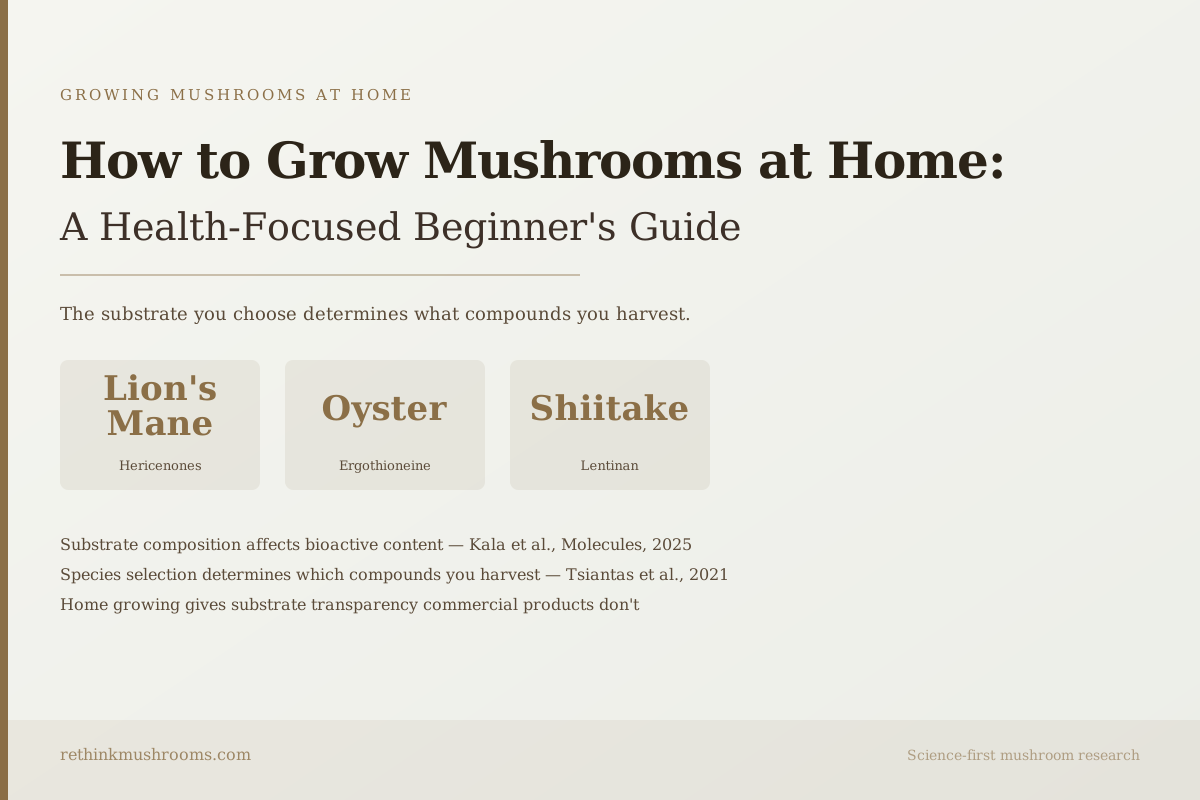
3 medicinal species beginners can grow
Lion's Mane, Oyster, and Shiitake can all be grown at home with basic equipment. Your substrate choice directly determines how many bioactive compounds end up in your harvest.
Kała et al., Molecules, 2025
Substrate-first
what you grow them in determines what you get
7-14 days
time to first oyster mushroom harvest after fruiting begins
Quality control
home growing gives you what commercial products don't
Kała et al., Molecules, 2025
 View as image ↗
Every beginner guide to growing mushrooms covers the same steps: get a kit, add water, wait for mushrooms. That information is correct and useful, and if your goal is to grow a couple of pounds of oyster mushrooms for a stir-fry, a grocery store kit will do it.
This guide is written for a different kind of beginner: someone who chose a mushroom species because of its research profile, not its flavor. Someone who wants to know whether what they grow is actually delivering the compounds they read about. The answer depends on two decisions made before the first spore goes into substrate: which species you grow, and what substrate you use.
For the full overview of home mushroom cultivation methods, see How to Grow Mushrooms at Home: A Complete Beginner's Guide, which covers the complete range of techniques from beginner to intermediate. This guide focuses specifically on growing medicinal species with quality in mind.
Key Takeaways
- Kała et al. (2025) showed substrate composition directly affects hericenone accumulation in Lion's Mane fruiting bodies, making substrate selection a medicinal quality decision, not just a yield decision
- Tsiantas et al. (2021) quantified significant variation in ergothioneine and lovastatin concentrations across mushroom species, confirming that species choice determines which compounds you harvest
- Ab Rhaman et al. (2021) found mushrooms bioaccumulate heavy metals from substrate, meaning contaminated substrate produces contaminated mushrooms regardless of species
- Grimm and Wösten (2018) validated agricultural byproducts including coffee grounds, straw, and cardboard as scientifically documented substrates for home mushroom cultivation
- Lion's Mane, Oyster, and Shiitake are the three medicinal species with the best combination of beginner-accessible cultivation requirements and research-supported compound profiles
- Home cultivation gives you substrate transparency that commercial supplement products do not provide
The Three Medicinal Species Worth Growing at Home for Their Compounds
Most beginner guides recommend oyster mushrooms because they are the most forgiving and fastest fruiting. That recommendation is sound for food growing. For compound-focused growing, species choice matters more because different species produce completely different bioactive compounds.
| Species | Difficulty | Days to first harvest | Primary researched compounds |
|---|---|---|---|
| Oyster (Pleurotus ostreatus) | Beginner | 7-14 days | Beta-glucans, ergothioneine, lovastatin |
| Lion's Mane (Hericium erinaceus) | Beginner-intermediate | 10-14 days | Hericenones, erinacines, polysaccharides |
| Shiitake (Lentinula edodes) | Intermediate | 10-16 weeks (logs) / 4-8 weeks (blocks) | Lentinan, AHCC, eritadenine, ergothioneine |
Tsiantas et al. (2021) measured ergothioneine and lovastatin concentrations across multiple mushroom species and found significant variation in these compound levels between species.[1] Ergothioneine, an unusual antioxidant amino acid found almost exclusively in fungi, is present across many species but in substantially different concentrations. Lovastatin, a natural statin compound, appears in oyster mushrooms (Pleurotus species) and not in Lion's Mane or Shiitake.
The practical implication: if your interest is in hericenones and erinacines (the compounds associated with Lion's Mane's neuroprotective research), you need to grow Lion's Mane. Oyster mushrooms are not a substitute. If you want ergothioneine from a fast-fruiting species, oyster mushrooms are the most efficient source. If you want lentinan, you grow shiitake.
This sounds obvious, but most beginner guides treat species as interchangeable. They are not.
Your Species Choice Determines Your Compound Harvest
The reason species selection matters so much for health-focused growers is that the bioactive compounds in medicinal mushrooms are not interchangeable. They are distinct molecules with distinct mechanisms, produced by specific species.
Tsiantas et al. (2021) used multiple analytical methods to quantify both ergothioneine and lovastatin across species, noting that different methods gave substantially different readings for the same compound in the same mushroom, which points to a practical problem: not all mushroom supplements report their compounds using validated analytical methods.[1] When you grow your own mushrooms, you know exactly what species you grew, eliminating one source of uncertainty.
A second layer of uncertainty in commercial products involves mycelium vs. fruiting body sourcing. Many supplements use mycelium grown on grain, not fruiting bodies. The compound profiles differ. When you grow fruiting bodies at home, you are harvesting the form whose compounds are most extensively studied. All the major mushroom biomedical research cited across this site, including the hericenone studies, polysaccharide immunology data, and ergothioneine quantification, was conducted on fruiting bodies, not mycelium-on-grain.
For depth on each species' research profile, How to Grow Lion's Mane at Home: Complete Guide covers Lion's Mane specifically, including the substrate data from the 2025 research.
Why Substrate Is the Most Important Decision You Make as a Grower
Most home growers spend most of their decision-making energy on fruiting chambers, humidity monitors, and grow tents. These matter. But they are downstream decisions. The most important decision is substrate.
Kała et al. (2025) showed that substrate composition is a direct determinant of hericenone accumulation in Lion's Mane fruiting bodies. Different plant-based substrate formulas produced measurably different concentrations of the bioactive compounds in the harvested mushrooms, not just different yields of mushroom biomass.[2]
This finding has significant implications for home growers of medicinal species. It means that using a cheap, unspecified substrate to grow Lion's Mane may produce mushrooms with lower hericenone content than mushrooms grown on a researched substrate formula. Yield (grams of mushrooms harvested) and potency (compounds per gram) are different things, and standard cultivation guides optimize for yield, not potency.
For oyster mushrooms, Grimm and Wösten (2018) reviewed the science of cultivation substrates in a circular economy context and confirmed that common agricultural byproducts including straw, coffee grounds, and cardboard are all validated growing media with documented substrate-to-mushroom conversion biology.[4] These are accessible and inexpensive options for beginners.
The substrate science for different species looks different:
- Oyster mushrooms: Straw, pasteurized cardboard, and coffee grounds all work well. The lignocellulose content and nitrogen ratio determine how fast mycelium colonizes and how many flushes you get.
- Lion's Mane: Wood-based substrates (hardwood sawdust, supplemented blocks) are the research-backed standard. Kała 2025 tested plant-based substrate formulas specifically for their effect on compound accumulation.
- Shiitake: Traditional hardwood logs produce the most research-representative mushrooms, though supplemented sawdust blocks work and fruit faster.
The substrate choice for medicinal species is a research question, not just a horticultural one. How Substrate Composition Affects Mushroom Health Compounds goes deep on the mechanism and species-specific guidance.
The Heavy Metal Problem That No Grow Guide Covers
Mushrooms are efficient bioaccumulators. They pull compounds from their substrate into the fruiting body, including compounds you want (polysaccharides, ergothioneine) and compounds you do not want (heavy metals).
Ab Rhaman et al. (2021) reviewed mushroom heavy metal bioaccumulation and translocation across substrates and found that substrate quality directly determines mushroom safety. Contaminated substrates produced mushrooms with elevated heavy metal content in the fruiting body.[3]
The practical consequence for home growers: substrate sourcing matters for safety, not just performance. Low-cost substrates from unknown sources may carry industrial contamination from the agricultural processes that produced them. Straw grown on land with prior pesticide use, wood chips from treated lumber, or coffee grounds from suppliers who use contaminated equipment can all introduce heavy metals into your grow.
This is the strongest argument for home growing over commercial supplement purchasing: you know your substrate. You chose the straw, the sawdust, or the coffee grounds. You know whether they came from an organic farm or industrial agriculture.
Questions to ask when sourcing substrate:
- Where was this grown (straw, hardwood)?
- Was pesticide use disclosed?
- Has this supplier tested their substrate for heavy metal content?
Most substrate suppliers for the home grow market operate at small scale and do not test for heavy metals as a standard practice. If you are growing for medicinal purposes rather than culinary purposes, the standard for substrate sourcing should be higher than for food production.
What You Actually Need to Start (Equipment, Costs, Timeline)
The barrier to entry is lower than most beginners expect.
Minimum setup for oyster mushrooms:
- Pasteurized straw or hardwood pellets as substrate
- Oyster mushroom spawn (grain spawn or plug spawn)
- Large plastic bags with filter patches, or a low-cost still air box
- A spray bottle for humidity
- A thermometer/hygrometer
Typical cost: $40-80 for first grow including spawn, substrate, and humidity monitoring. After the first grow, the main recurring cost is substrate and spawn.
Environmental parameters by species:
| Species | Colonization temp | Fruiting temp | Humidity (fruiting) | Light |
|---|---|---|---|---|
| Oyster | 65-75°F (18-24°C) | 55-65°F (13-18°C) | 85-95% | Indirect light |
| Lion's Mane | 65-75°F (18-24°C) | 60-70°F (15-21°C) | 85-95% | Indirect light |
| Shiitake (block) | 65-75°F (18-24°C) | 55-65°F (13-18°C) | 80-90% | Indirect light |
Note: these are the fruiting stage requirements. Colonization requires more warmth and no light. Fruiting typically requires a temperature drop and humidity spike to trigger the biological cue that it is time to produce spores (and thus mushrooms).
Mushrooms do not photosynthesize and do not need direct light. They do need indirect light as a directional cue for fruiting, and fresh air exchange to prevent carbon dioxide buildup, which triggers elongation (the same mechanism that makes cultivated enoki have long white stems).
The Four Stages of a Successful Home Grow
Stage 1: Inoculation (Day 0 to Day 1) Combine spawn with prepared substrate under clean conditions. Contamination risk is highest here because you are introducing live organism material to a nutrient-rich medium. Clean work surface, clean tools, and minimizing air movement reduce contamination risk.
Stage 2: Colonization (Weeks 1-3) Mycelium spreads through the substrate in a network visible as white, cottony growth. Temperature: 65-75°F. Keep in darkness. Do not disturb. Colonization is complete when white mycelium is visible throughout the substrate block or bag with no remaining brown substrate visible. Contamination shows as green, black, or pink patches (usually Trichoderma or Cobweb mold).
Stage 3: Fruiting initiation (Days 18-25 typically) Move colonized blocks to a fruiting environment with lower temperature, high humidity (85-95%), fresh air exchange every few hours, and indirect light. Within 3-7 days, pins (tiny mushroom primordia) appear on the surface.
Stage 4: Harvest Harvest at the point when cap edges are still slightly curled under. For oyster mushrooms, this is before the caps fully flatten and spores start releasing. For Lion's Mane, harvest when the white pom-pom is still dense and white before any yellowing begins. For Shiitake, harvest before the veil beneath the cap fully tears.
Most substrates will produce 2-4 flushes with diminishing yield in later flushes. Between flushes, let the substrate rest for 5-7 days, then rehydrate and restart the fruiting conditions.
Why Home Growing Is the Best Quality Control Available
The commercial mushroom supplement industry has a transparency problem. Products range from fruiting body extracts with disclosed compound testing to mycelium-on-grain material labeled as "mushroom" that may contain more grain starch than fungal compounds. There is no universal testing or disclosure standard.
Ab Rhaman et al. (2021) documented that substrate quality determines mushroom safety with respect to heavy metals.[3] This finding sits at the center of the quality control argument for home growing: you cannot verify what substrate a commercial grower used, but you can verify your own.
Kała et al. (2025) added the compound potency dimension: substrate formulation affects how much of the target bioactive compounds end up in the fruiting body.[2] A commercial Lion's Mane product with no substrate disclosure cannot tell you whether their growing conditions were optimized for hericenone production or simply for biomass yield.
Home growing addresses these gaps directly. You know your species (not a blend). You know your substrate and its source. You are harvesting fruiting bodies. And you know when they were grown.
None of this requires expensive equipment or professional expertise. It requires attention to the substrate quality decision before the first bag is inoculated, and a basic understanding of the environmental parameters each species needs.
For step-by-step instructions tailored to first-time growers, see Your First Mushroom Grow: Step-by-Step for Beginners and Indoor Mushroom Growing: What You Need to Get Started. For the question of whether a grow kit is the right starting point, see Mushroom Growing Kits: Are They Worth It? A Comparison.
For the full compound science behind why substrate quality matters for bioactive content, see Growing Mushrooms for Maximum Bioactive Content.
The Bottom Line
Home mushroom cultivation gives health-motivated growers two things commercial products often cannot: species certainty and substrate transparency. Research published in 2025 by Kała et al. showed substrate composition directly affects bioactive compound accumulation in Lion's Mane fruiting bodies, making substrate selection a medicinal quality decision alongside a horticultural one. Ab Rhaman et al. (2021) documented that mushrooms bioaccumulate heavy metals from contaminated substrate, making substrate sourcing a safety consideration. Lion's Mane, Oyster, and Shiitake are the three medicinal species with the best combination of beginner-accessible cultivation requirements and research-backed compound profiles. Start with species selection and substrate quality; let technique and equipment be secondary.
Frequently Asked Questions
Sources & References
- 1. Source details for this reference are not yet available.
- 2. Source details for this reference are not yet available.
- 3. Source details for this reference are not yet available.
- 4. Source details for this reference are not yet available.