Mushroom Cultivation
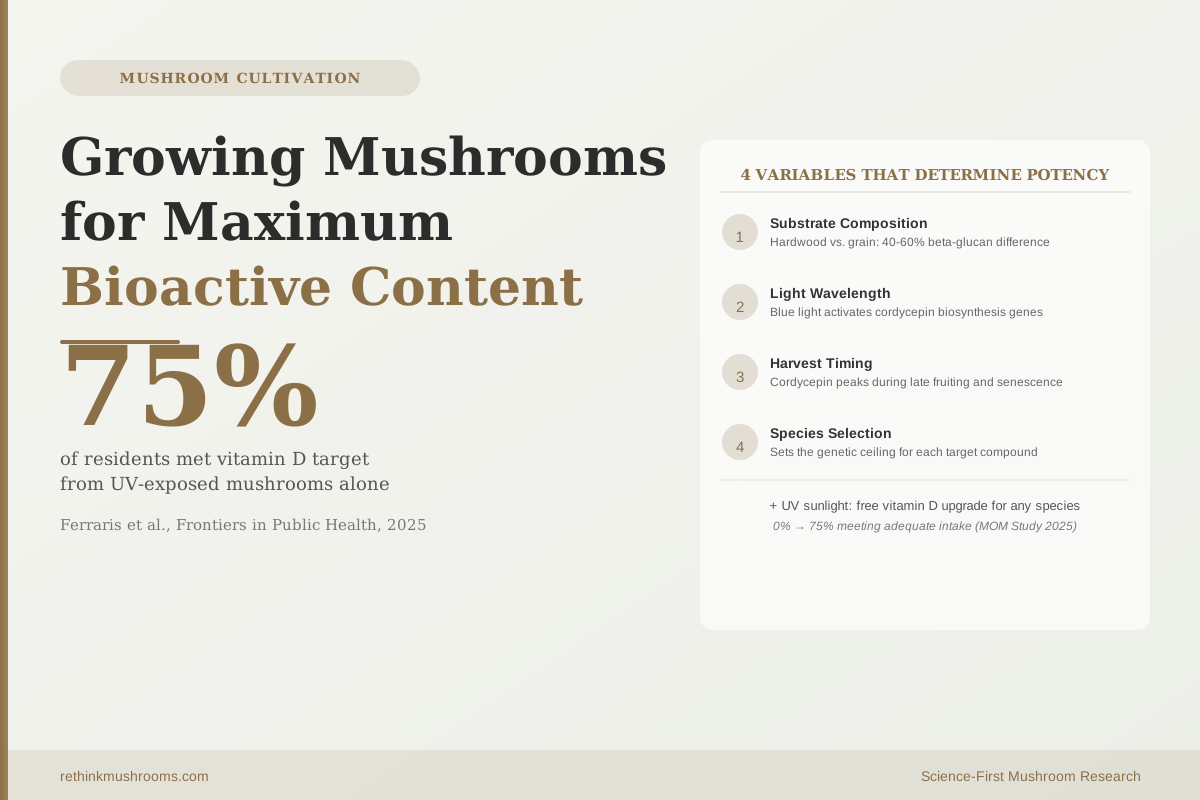
75% met vitamin D target
Adding UV-exposed mushrooms to residential care meals raised participants meeting adequate vitamin D intake from 0% to 75% in four weeks, with no supplements, just mushrooms placed gills-up in sunlight.
Ferraris et al., Frontiers in Public Health, 2025
40-60%
more beta-glucan in lion's mane grown on hardwood vs. grain substrate
4 variables
substrate, light, timing, and species determine medicinal potency
2025 data
new Cordyceps culture review shows conditions shift compounds independently
Ferraris et al., Frontiers in Public Health, 2025
 View as image ↗
Most mushroom growing guides are about yield: how many grams per flush, how to prevent contamination, how to speed up colonization. These are good questions when you're growing food.
They're the wrong questions when you're growing medicinal mushrooms.
Yield optimization and medicinal potency optimization sometimes point in different directions. A mushroom grown for maximum biomass production may have diluted bioactive concentrations compared to one grown under conditions that stress the fungus into producing more secondary metabolites. The substrate that colonizes fastest may not be the substrate that produces the most beta-glucan. A mushroom harvested at peak visual appeal may have lower cordycepin content than one harvested a few days later.
This article focuses on growing mushrooms for maximum bioactive content, not maximum yield. The decision framework is different. The research on what actually shifts compound output is underreported in consumer guides, but it exists.
For the fundamentals of how to grow mushrooms at home before optimizing for potency, see the pillar guide on how to grow mushrooms at home: a complete beginner's guide.
Key Takeaways
- A 2025 systematic review confirmed substrate type independently determines beta-glucan, polyphenol, and protein concentrations across species; hardwood outperforms straw for beta-glucan in most gourmet species (Akyuz et al., Advances in Agronomy, 2025)
- Lion's mane grown on hardwood substrates produced 40-60% higher beta-glucan than lion's mane grown on grain substrates across extraction methods (Liu et al., Foods, 2025)
- UV-exposed mushrooms (75g/day) raised residents meeting adequate vitamin D intake from 0% to 75% in 4 weeks in a 2025 feasibility study; no supplements, just gills-up sunlight exposure (Ferraris et al., Frontiers in Public Health, 2025)
- Temperature, humidity, light wavelength, substrate composition, and harvest timing each independently shift cordycepin and polysaccharide levels in Cordyceps; their interactions are multiplicative, not additive (Park, Foods, 2025)
- Cordycepin concentration in Cordyceps militaris increases significantly during late fruiting and senescence; harvesting at early maturity means harvesting before peak cordycepin content (Li et al., Scientific Reports, 2019)
- The substrate wood species used for lion's mane directly determined nerve-growth-factor-stimulating compound output; rubber sawdust produced higher hericenone content than bamboo sawdust (Chutimanukul et al., Scientific Reports, 2023)
Four Variables That Determine Medicinal Potency in Home-Grown Mushrooms
Before species-specific details, there is a short list of variables every home grower can control that have documented effects on bioactive compound concentrations:
Substrate composition is the single largest controllable variable for most compounds. The carbon-to-nitrogen ratio of the substrate, the lignocellulose composition, and supplementation level each independently affect beta-glucan, polyphenol, and mineral content. For most species, hardwood substrates outperform straw or grain for beta-glucan production.
Light wavelength and photoperiod directly regulate bioactive compound biosynthesis in some species. In Cordyceps militaris specifically, blue light activates photoreceptors that control the genes responsible for producing cordycepin. This is not just a growth signal: light wavelength directly determines which compounds are synthesized.
Harvest timing is the most overlooked variable. Secondary metabolites including cordycepin concentrate during late fruiting and early senescence. A mushroom harvested at peak visual appeal may have less of the medicinal compound than one left to mature further.
Species and strain selection sets the ceiling. Substrate conditions and stress responses operate within the genetic limits of the organism. Choosing the right species for a specific compound goal matters before any cultivation decisions.
For the detailed science behind how substrate composition shifts specific bioactives, see the companion article on how substrate composition affects mushroom health compounds.
Substrate Is the Biggest Lever: Hardwood vs. Grain Changes Beta-Glucan by 40-60%
A 2025 systematic review by Akyuz and colleagues examined substrate effects on the nutritional and bioactive composition of edible mushrooms across published literature. Hardwood sawdust consistently outperformed straw for beta-glucan production in gourmet species. Substrate carbon-to-nitrogen ratio, lignocellulose composition, and supplementation level each independently shaped protein, beta-glucan, polyphenol, and mineral content.[1]
The clearest species-specific numbers come from a 2025 study by Liu and colleagues examining lion's mane (Hericium erinaceus) grown on different substrates. Hardwood substrates produced 40-60% higher beta-glucan content than grain substrates across extraction methods.[2] The grain substrate produced faster colonization and higher biomass yield. The hardwood substrate produced more of the immune-active polysaccharides that make lion's mane medicinally relevant.
This is the yield vs. potency trade-off in concrete numbers. If a home grower uses wheat bran or grain because it's cheaper and colonizes faster, they get more mushroom but with a lower concentration of the compounds they may have been seeking.
For lion's mane specifically, the wood species within the hardwood category also matters. A 2023 study by Chutimanukul and colleagues compared rubber sawdust versus bamboo sawdust substrates for lion's mane production. Rubber sawdust produced higher biological efficiency and significantly higher hericenone content than bamboo sawdust.[3] Hericenones are the compounds associated with nerve growth factor stimulation in lion's mane research. The substrate wood species was directly determining output of the target medicinal compound.
For Cordyceps militaris, a 2014 study by Song and colleagues showed that grain substrate type similarly altered cordycepin and polysaccharide yields. Brown rice produced the highest cordycepin content compared to other grain substrates tested.[4] The effect was not marginal. Substrate selection was a primary driver of final compound concentrations.
For practical substrate selection guidance, see the cross-cluster article on wood-based vs. grain-based substrates for mushroom growing.
The UV Upgrade: Free Sunlight Dramatically Increases Vitamin D in Any Mushroom You Grow
The most accessible bioactive intervention for home growers requires no special equipment, no substrate changes, and no specialized knowledge. Place freshly harvested mushrooms gills-up in direct midday sunlight for 2-6 hours. The ergosterol in the mushroom's cell membrane converts to vitamin D2 through a UV-B driven photochemical reaction.
How much difference does this make? A 2025 feasibility study by Ferraris and colleagues served 75g of UV-exposed mushrooms per day to residents in two care settings. In residential care, the share of participants meeting adequate vitamin D intake rose from 0% to 75% over four weeks. In independent living, average vitamin D intake increased by 740%.[5] No supplements were used. The only change was adding UV-exposed mushrooms to meals.
A meta-analysis by Miles and colleagues pooled data from controlled studies on UV-irradiated mushroom consumption and found consistent serum 25(OH)D increases equivalent to vitamin D supplement doses when consumed at around 100g per day.[6]
The practical protocol from this research is specific: gills-up orientation (not cap-up), UV-B exposure window of 10 am to 2 pm, and 2-6 hours of direct sun. Dried mushrooms retain vitamin D content well, so sun-exposed mushrooms can be dried and stored without significant loss of the vitamin D produced during exposure.
This vitamin D benefit applies to any species a home grower cultivates, including button mushrooms, shiitake, oyster, and lion's mane. The UV conversion works through ergosterol, which all these species contain. The conversion is a free potency upgrade that requires only sunlight and time.
For the full evidence and protocol behind UV exposure, see the companion article on UV exposure during growing: boosting vitamin D and ergothioneine.
Light, Temperature, and Timing: What Cordyceps Research Reveals About Compound Control
A 2025 review by Park surveyed the literature on culture condition effects on bioactive compounds in Cordyceps militaris. The review's core finding: temperature, humidity, light wavelength, photoperiod, substrate composition, and harvest timing each independently modulate cordycepin and polysaccharide concentrations. The interactions between these factors are multiplicative rather than additive.[7]
The multiplication point matters practically. Optimizing one variable (substrate) while ignoring others (light, temperature) leaves compound output well below its potential. The research suggests that a grower pursuing medicinal potency needs to attend to the full system of conditions, not just one lever.
Light is particularly well-documented in Cordyceps. Blue light in the 450-500 nm range activates photoreceptors in Cordyceps that directly upregulate cordycepin biosynthesis genes. This is molecular-level proof that the wavelength of light during cultivation controls which compounds are synthesized, not just how fast the organism grows. Home growers using blue-dominant LED lighting for Cordyceps are, according to this research, running the correct protocol for cordycepin optimization.
Temperature fluctuations during late fruiting have also been documented to affect secondary metabolite production. Mild cold stress during the fruiting phase redirects metabolic resources from biomass toward protective compounds, which is consistent with how secondary metabolites function in wild fungi.
For the detailed mechanism of how stress conditions drive bioactive production, see the companion article on stress and bioactive production: how challenging conditions make stronger mushrooms.
For practical guidance on growing Cordyceps specifically with the right light conditions, see the article on growing Cordyceps militaris at home: rice substrate and LED light requirements.
Harvest Timing: When You Pick Determines What Compounds You Get
The common approach to mushroom harvest is visual: pick when the caps look fully developed, before the veil breaks. This produces aesthetically ideal mushrooms and maximizes fresh weight per flush.
It may not maximize medicinal content.
A 2019 study by Li and colleagues used metabolomic profiling to track compound changes during Cordyceps militaris senescence (the aging and late-fruiting period after peak visual maturity). Cordycepin accumulated significantly during this senescence phase. The metabolomic data showed that the biological processes of late fruiting redirect carbon flux toward secondary metabolite synthesis, including the primary medicinal compound in Cordyceps.[8]
The practical implication: harvesting Cordyceps at peak visual maturity captures less cordycepin than harvesting a few days later, after the mushroom has begun senescing. This involves accepting less-than-perfect visual quality in exchange for higher medicinal compound concentration.
This principle extends beyond Cordyceps. A 2011 study by Chen and colleagues profiled triterpenoid content in Antrodia cinnamomea fruiting bodies at different harvest ages. Triterpenoid profiles varied significantly by harvest age, with later harvests showing distinct compound compositions. Substrate wood species also affected which triterpenoids were produced.[9]
The general pattern: secondary metabolites accumulate in later fruiting stages as the organism prepares for reproduction and environmental stress. Earlier harvest means less secondary metabolite accumulation. The harvest timing decision is a potency decision.
Which Species to Grow If You're Targeting Specific Compounds
The substrate, light, and timing levers work within the limits set by species selection. Choosing a species is the first decision in growing for medicinal potency because each species produces a fundamentally different compound profile.
For beta-glucan (immune support): Turkey tail (Trametes versicolor), lion's mane (Hericium erinaceus), shiitake (Lentinula edodes), and oyster mushrooms (Pleurotus spp.) all produce significant beta-glucan. Lion's mane on hardwood substrate has the clearest substrate-compound data showing how to maximize yield. Turkey tail is relatively forgiving in substrate selection and produces high beta-glucan content across conditions. For maximum beta-glucan, see the article on how to maximize beta-glucan content in home-grown mushrooms.
For cordycepin (energy and anti-inflammatory): Cordyceps militaris is the only practical species for home cultivation. Cordyceps sinensis requires parasitizing caterpillars and is not cultivable. Brown rice substrate, blue-dominant LED lighting, and late harvest timing optimize cordycepin yield based on the 2025 Park review and the Li 2019 senescence data.
For hericenones and erinacines (nerve growth factor stimulation): Lion's mane only. Rubber or hardwood sawdust substrate appears to support higher hericenone production than grain-based substrate based on the Chutimanukul 2023 data.
For vitamin D: Any species, any substrate. UV exposure protocol is species-agnostic. Button mushrooms, shiitake, oyster, and lion's mane all convert ergosterol to vitamin D2 under UV-B light.
For ergothioneine (antioxidant): King oyster mushroom (Pleurotus eryngii) has the highest ergothioneine concentrations among commonly cultivated species. The compound is relatively stable and not dramatically affected by UV exposure.
The Bottom Line
Growing mushrooms for medicinal potency and growing them for yield involve different cultivation decisions. Substrate type is the largest controllable variable: hardwood substrates produce 40-60% more beta-glucan than grain in lion's mane, and substrate wood species directly determines nerve-growth-factor-stimulating hericenone content. UV sunlight exposure converts ergosterol to vitamin D2 in any species, with a 2025 study showing this raised participants meeting adequate vitamin D intake from 0% to 75% in four weeks. Harvest timing matters for cordycepin specifically; concentrations increase during late fruiting and senescence. Growing conditions operate within the limits set by species selection; the two decisions work together, not independently.
Frequently Asked Questions
Sources & References
- 1. Source details for this reference are not yet available.
- 2. Source details for this reference are not yet available.
- 3. Source details for this reference are not yet available.
- 4. Source details for this reference are not yet available.
- 5. Source details for this reference are not yet available.
- 6. Source details for this reference are not yet available.
- 7. Source details for this reference are not yet available.
- 8. Source details for this reference are not yet available.
- 9. Source details for this reference are not yet available.