Mushroom Cultivation for Maximum Bioactives
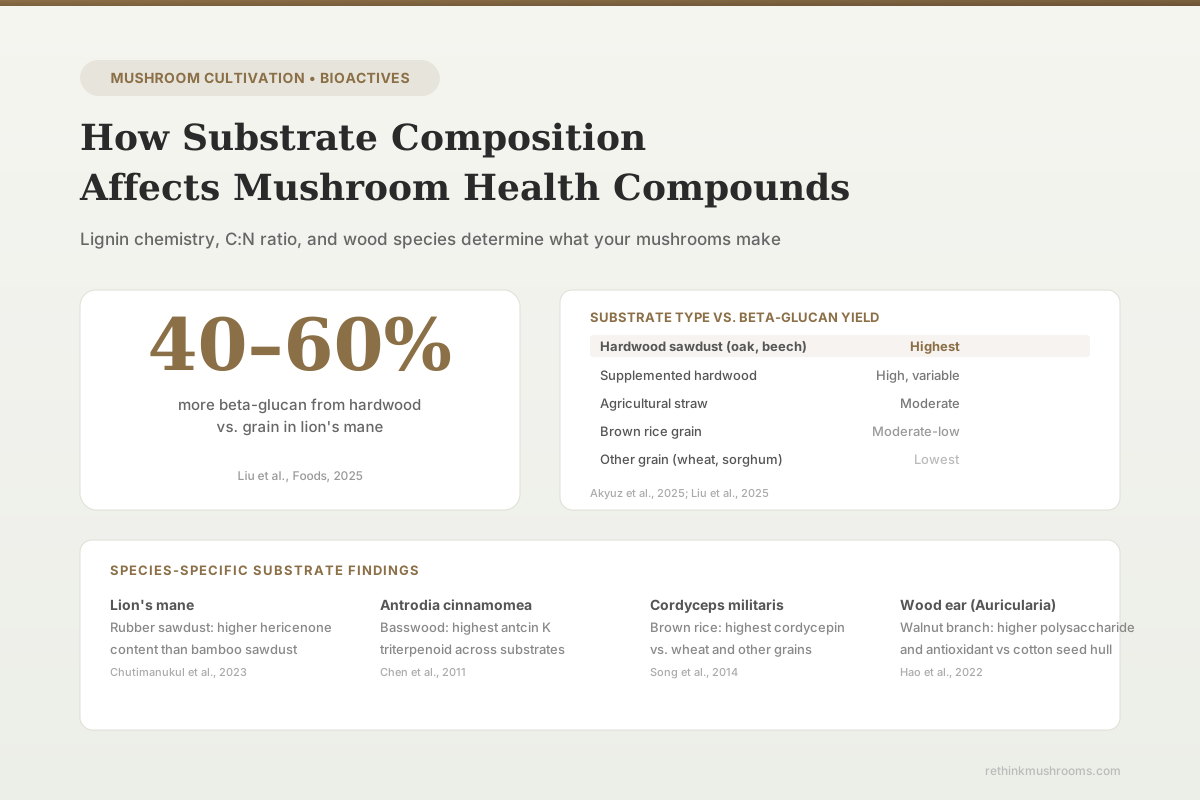
40–60% higher beta-glucan on hardwood vs. grain
Liu and colleagues found in 2025 that hardwood substrates produced 40–60% more beta-glucan in lion's mane than grain substrates, consistent across every extraction method tested. The substrate decision matters more than almost any post-harvest choice.
Liu et al., Foods, 2025
Rubber > bamboo
rubber sawdust produced higher hericenone content than bamboo sawdust in lion's mane (same species, different wood, measurably different nerve-growth-factor compound output)
Brown rice
the grain type that produced the highest cordycepin in Cordyceps militaris compared to wheat and other grains in direct substrate comparisons
Walnut branch
substrate that significantly enhanced polysaccharide and antioxidant content in Auricularia (wood ear) versus standard cotton seed hull substrate
Liu et al., Foods, 2025
 View as image ↗
Growing mushrooms on grain is fast, cheap, and widely recommended for beginners. It is not, however, the best approach for growing mushrooms with high medicinal compound content. The substrate a mushroom grows on directly feeds the biochemical pathways that produce beta-glucans, triterpenoids, hericenones, and cordycepin. Choosing the wrong substrate can cut those compound levels in half before any other cultivation factor comes into play.
A 2025 systematic review of substrate effects on edible mushrooms confirmed what smaller experimental studies had suggested: substrate type is one of the most controllable variables determining final beta-glucan, polyphenol, and protein content in harvested mushrooms, with hardwood sawdust consistently outperforming straw and grain for beta-glucan across most gourmet and medicinal species.[1] This article breaks down why, by species and substrate type, and what the research says about which substrate decisions produce the most medicinally active mushrooms.
For the broader cultivation context, see how to grow mushrooms at home: a complete beginner's guide. For a broader look at growing specifically for medicinal potency, see growing mushrooms for maximum bioactive content.
Key Takeaways
- Substrate type is the single largest controllable variable for beta-glucan content: a 2025 systematic review found hardwood sawdust consistently outperforms straw and grain for beta-glucan across gourmet and medicinal mushroom species (Akyuz et al., Advances in Agronomy, 2025)
- Lion's mane grown on hardwood substrates produced 40–60% higher beta-glucan than lion's mane grown on grain substrates, consistent across multiple extraction methods in the same study (Liu et al., Foods, 2025)
- Among wood substrates, wood species matters: rubber sawdust produced higher hericenone content than bamboo sawdust in commercial-scale lion's mane production (same species, different wood, measurably different nerve-growth-factor-stimulating compound output) (Chutimanukul et al., Scientific Reports, 2023)
- Substrate wood species determines the triterpenoid profile in Antrodia cinnamomea: basswood consistently produced the highest antcin K, a hepatoprotective triterpenoid, compared to other substrate woods tested (Chen et al., JAFC, 2011)
- In Cordyceps militaris, grain species affects cordycepin yield: brown rice produced the highest cordycepin output compared to wheat and other grains, showing that within-category substrate choice matters even when hardwood is not an option (Song et al., IJMM, 2014)
- Substrate determines the ceiling for bioactive content; extraction method determines what fraction of that ceiling survives processing; the same shiitake produced structurally different beta-glucan polysaccharides depending on extraction chemistry, with distinct immune-stimulating activity profiles (Ruthes et al., Carbohydrate Polymers, 2020)
Substrate Is Not Just Food: It Builds the Bioactive
Most cultivation guides treat substrate as a growth medium, the material that feeds the mycelium and keeps the organism alive. Biochemically, it is more than that. The chemical composition of the substrate feeds directly into the secondary metabolite pathways that produce the compounds researchers study for health effects.
Lignocellulose from hardwood is the clearest example. Hardwood contains lignin (a complex aromatic polymer), cellulose, and hemicellulose in proportions that differ substantially from grain. When mushrooms break down lignin using their peroxidase enzyme systems, the aromatic carbon fragments produced enter the biosynthetic pathways that make triterpenoids. Species like reishi (Ganoderma lucidum), turkey tail (Trametes versicolor), and Antrodia cinnamomea, which produce triterpenoids as key bioactive compounds, are naturally wood-decaying fungi. Their triterpenoid production is evolutionarily calibrated to the carbon chemistry of wood. Growing them on grain removes a key precursor source.
The carbon-to-nitrogen (C:N) ratio of the substrate has a separate effect. High C:N substrates, where carbon is plentiful relative to nitrogen, create conditions of relative nitrogen scarcity. Under nitrogen limitation, mushrooms shift metabolic flux away from protein synthesis and toward polysaccharide and secondary metabolite production. Hardwood sawdust typically runs 200:1 to 500:1 C:N. Grain typically runs 25:1 to 50:1. That gap in substrate chemistry translates into a measurable gap in compound output.
The 2025 systematic review by Akyuz and colleagues synthesized this across multiple species and substrate types: substrate C:N ratio, lignocellulose composition, and supplementation level each independently affected final protein, beta-glucan, polyphenol, and mineral concentrations in harvested mushrooms.[1] The review confirmed that hardwood sawdust consistently outperformed straw for beta-glucan in gourmet species.
Hardwood vs. Grain: Where the 40–60% Difference Comes From
The clearest evidence for the hardwood advantage in beta-glucan comes from a 2025 study by Liu and colleagues comparing hardwood and grain substrates for lion's mane (Hericium erinaceus) production across different extraction methods.[2]
The result: hardwood substrates produced 40–60% higher beta-glucan concentrations than grain substrates in lion's mane. This was not a processing artifact. The difference held across hot-water extraction, ethanol extraction, and all other methods tested. The substrate choice made before harvest determined a large fraction of the final bioactive yield after processing.
| Substrate Type | Beta-Glucan Yield | Representative Species |
|---|---|---|
| Hardwood sawdust (oak, beech) | Highest (reference standard) | Lion's mane, shiitake, reishi, turkey tail |
| Supplemented hardwood (+ wheat or rice bran) | High, variable by supplement | Oyster, lion's mane |
| Agricultural straw (wheat, rice) | Moderate | Oyster mushrooms |
| Brown rice grain | Moderate | Cordyceps militaris |
| Wheat and other grains | Lower than brown rice | Cordyceps (less preferred) |
The practical implication for anyone growing lion's mane for the beta-glucans and hericenones linked to nerve growth factor stimulation: a grower on grain is starting with a compound ceiling substantially below what hardwood would provide. Processing cannot recover what the substrate never produced.
For guidance on choosing and preparing wood versus grain substrates, see wood-based vs. grain-based substrates for mushroom growing.
Not All Hardwoods Are the Same: How Wood Species Shifts Compound Profiles
Within hardwood substrates, the species of wood matters. Different hardwoods have different lignin architectures, cellulose-to-hemicellulose ratios, and mineral content. These differences translate into measurably different compound outputs from the same mushroom species.
Chutimanukul and colleagues grew lion's mane commercially at scale on two wood substrates: rubber sawdust and bamboo sawdust.[3] Rubber sawdust produced both higher biological efficiency (more mushroom mass per substrate weight) and higher hericenone content than bamboo sawdust. Hericenones are the compounds in lion's mane studied for their ability to stimulate nerve growth factor synthesis in brain cells. The choice between two wood substrates, both technically hardwood, changed the final content of the compound most directly relevant to lion's mane's neurological interest.
The triterpenoid case is even more substrate-specific. Chen and colleagues tracked how substrate wood species affected triterpenoid profiles in Antrodia cinnamomea, a medicinal fungus from Taiwan whose liver-protecting effects are tied to specific triterpenoids, particularly a compound called antcin K.[4] Basswood substrate consistently produced the highest antcin K content across harvest ages tested. Other substrate woods produced different triterpenoid proportions. The substrate was not just influencing quantity; it was influencing which specific compounds were synthesized.
In Auricularia auricula (wood ear mushroom), Hao and colleagues compared walnut branch substrate against standard cotton seed hull substrate.[5] Walnut branch significantly enhanced polysaccharide content, phenolic content, and antioxidant activity compared to cotton seed hull. The authors attributed the difference to walnut branch's distinct lignin chemistry. The lignin structure of the substrate, not just whether it was wood or grain, was driving differences in secondary metabolite output.
Grain-Grown Species: When Wood Is Not an Option
Cordyceps militaris is a special case. It is naturally a parasitic fungus that grows on insect larvae, and it does not grow well on traditional hardwood substrates. Commercial Cordyceps is grown on grain, which immediately raises the question of which grain produces the best compound output.
Song and colleagues tested multiple grain substrates for Cordyceps militaris and measured both cordycepin and polysaccharide yields.[6] Brown rice produced the highest cordycepin content compared to wheat and other grains. Cordycepin (also called 3'-deoxyadenosine) is the key bioactive compound in Cordyceps studied for its effects on adenosine signaling, anti-inflammatory activity, and energy metabolism. Choosing the wrong grain substrate meant producing a lower-cordycepin product from otherwise identical cultivation conditions.
A 2025 comprehensive review of culture conditions for Cordyceps militaris by Park confirmed and extended this picture.[7] The review found that temperature, humidity, light wavelength, substrate composition, and harvest timing each independently affect cordycepin and polysaccharide concentrations, but the interactions between variables are multiplicative rather than additive. Getting one variable right does not compensate for getting another wrong.
For how environmental stressors beyond substrate interact with each other to influence compound production, see stress and bioactive production: how challenging conditions make stronger mushrooms.
Ergothioneine: Where Culture Medium Amino Acid Chemistry Changes the Equation
Ergothioneine is an amino acid antioxidant that mushrooms synthesize from methionine. Unlike beta-glucan, which is a structural polysaccharide built from glucose, ergothioneine requires a specific sulfur-containing amino acid as its precursor. This means the amino acid chemistry of the substrate, not just its carbohydrate or lignin content, determines ergothioneine output.
Cheung and colleagues demonstrated in 2009 that adding methionine to mushroom culture medium significantly increased ergothioneine content in mycelial cultures.[8] Among the species tested, Pleurotus eryngii (king oyster mushroom) showed the highest baseline ergothioneine content, and the response to methionine supplementation was substantial. The substrate's amino acid profile, not just its carbon structure, acts as a lever for this specific compound.
Hai and colleagues extended this in a 2013 study on liquid cultivation of king oyster mycelium.[9] Optimized liquid culture conditions for P. eryngii produced ergothioneine yields three times higher than standard solid-state cultivation. The liquid medium allowed precise control over amino acid supplementation in ways that solid substrate cannot. The implication is most relevant to commercial producers with access to liquid fermentation, but it confirms how directly the culture chemistry determines ergothioneine output.
For how UV light can boost vitamin D content in mushrooms without significantly affecting ergothioneine, see UV exposure during growing: boosting vitamin D and ergothioneine.
The Ceiling and the Recovery: Substrate Sets the Maximum, Processing Determines What You Get
Substrate determines how much of a given compound the mushroom synthesizes. Extraction and processing determine how much of that compound reaches the final product. These two variables are independent, and understanding the distinction matters for both home growers and supplement consumers.
Ruthes and colleagues compared hot-water extraction against alkaline extraction of beta-glucans from shiitake (Lentinula edodes).[10] The two extraction methods yielded structurally different polysaccharide fractions with measurably different immune-stimulating activity profiles in cell culture. A mushroom grown on hardwood substrate with high beta-glucan content would produce different recoverable fractions depending on how it was extracted. The substrate set the ceiling; the extraction method determined which portion of that ceiling was accessed.
This means neither optimizing substrate nor optimizing extraction can substitute for the other. A mushroom grown on grain with an optimized extraction protocol will still recover a smaller total beta-glucan fraction than a mushroom grown on hardwood and extracted comparably. Conversely, a hardwood-grown mushroom subjected to inadequate extraction will underperform its potential.
For guidance on the extraction side of this equation, see hot water extract vs. dual extract vs. raw powder: which delivers more beta-glucans?. For how to apply these substrate principles specifically to maximize beta-glucan in home cultivation, see how to maximize beta-glucan content in home-grown mushrooms.
Substrate is the upstream variable. No processing intervention can compensate for starting with a low-bioactive substrate. For anyone comparing home-grown fruiting bodies against commercially available grain-grown mycelium extracts, see fruiting body vs. mycelium on grain: the consumer guide, which covers how this substrate difference shows up in supplement testing.
The Bottom Line
Substrate composition is the largest controllable variable in mushroom bioactive content, operating through two primary mechanisms: lignin chemistry feeding triterpenoid biosynthesis, and C:N ratio shifting metabolic flux between growth and secondary metabolite production. Hardwood substrates consistently produce 40–60% higher beta-glucan in lion's mane than grain substrates (Liu et al., 2025), and the pattern holds broadly across gourmet and medicinal species (Akyuz et al., 2025). Within hardwood, wood species matters: rubber sawdust produced higher hericenone content than bamboo in lion's mane (Chutimanukul et al., 2023), and basswood produced the highest antcin K triterpenoid in Antrodia (Chen et al., 2011). For grain-grown species like Cordyceps, grain type matters: brown rice produced the highest cordycepin versus other grains (Song et al., 2014). Substrate sets the bioactive ceiling; extraction method determines what fraction of that ceiling is recovered.
Frequently Asked Questions
Sources & References
- 1. Source details for this reference are not yet available.
- 2. Source details for this reference are not yet available.
- 3. Source details for this reference are not yet available.
- 4. Source details for this reference are not yet available.
- 5. Source details for this reference are not yet available.
- 6. Source details for this reference are not yet available.
- 7. Source details for this reference are not yet available.
- 8. Source details for this reference are not yet available.
- 9. Source details for this reference are not yet available.
- 10. Source details for this reference are not yet available.